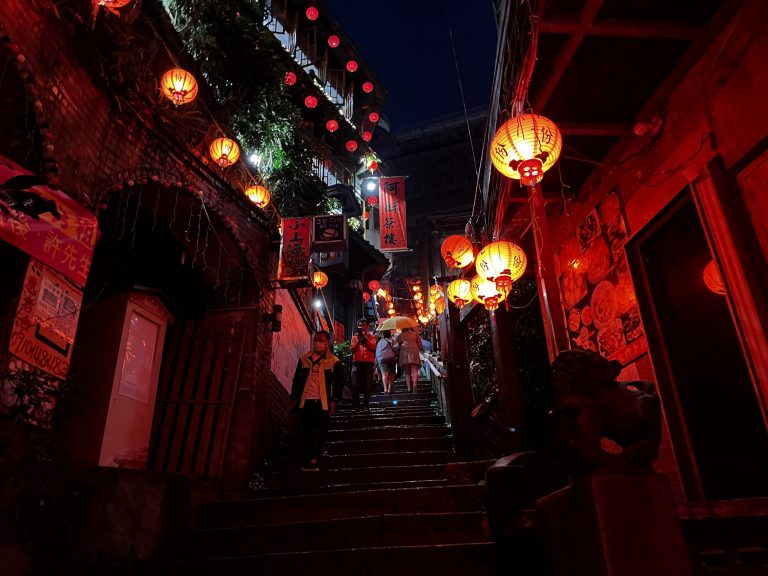
A Three-Day Weekend Model Course for Taiwan: Taipei, Jiufen and Shifen
AuthorMIRUTOBE editors
Table of Contents8 items
- Itinerary
- DAY 1 Into Taipei from the airport, and keep the first night inside the city
- DAY 2 Use Ruifang as the hub and join Shifen to Jiufen in one day
- DAY 3 Half a day: finish the shopping on Dihua Street and go back to the airport
- Alternatives
- Why we left out the National Palace Museum and Tamsui
- Where to stay
- What this trip costs
Arrive Friday evening or Saturday morning and fly home on Monday. Both nights stay in Taipei, and only the middle day goes east on the TRA to link Shifen and Jiufen. Airport to Taipei Main is 36 minutes on the Taoyuan Metro express.
Itinerary
DAY 1Into Taipei from the airport, and keep the first night inside the city
Why the day runs this way: half of it disappears into travelling, so nothing distant goes in. Taipei Main is the centre of gravity: drop the bags, then make one trip south to Xinyi and one north to Shilin.
Afternoon: the express and the commuter train cost the same on the Taoyuan Metro
Taoyuan International to the middle of Taipei is a single line. How much slack you have at either end depends on which Japanese airport you leave from, so settle that first with the comparison of Narita and Haneda. From Terminal 1 (A12) or Terminal 2 (A13), the fare to Taipei Main (A1) is the same TWD 160. Only the time differs: the express takes 36 minutes from Terminal 1 and 39 from Terminal 2, while the all-stations commuter train takes 49 and 52 — 13 minutes more.
Since the fare is identical, the right train is whichever one arrives. Standing for 15 minutes waiting for the express gets you there later than sitting down on the commuter train that is already at the platform. The express stops only at A1, A3, A8, A12 and A13, while the commuter train stops at every station from A1 to A22.
The one-day pass is TWD 320 and does not repay itself on one airport round trip: you would be paying TWD 320 per person where the two journeys cost TWD 320 between them. Day two uses the TRA and a bus, so what you actually want is not unlimited travel but a stored-value card that pays for trains, buses and the metro from the same balance.
The Taoyuan Metro gates also take contactless credit and debit cards (Visa, Mastercard, JCB and UnionPay) and Apple Pay, Google Pay and Samsung Pay, as well as the ride codes of iPASS MONEY and Alipay. A card from home is enough to get from the airport to Taipei Main, so there is no need to queue at a ticket counter on arrival. The buses accept EasyCard, iPASS and icash stored-value cards, and the ride codes of EasyWallet and iPASS MONEY.
Stored-value cards are sold at the Taoyuan Metro information counters and ticket machines (adult cards only). A card with no balance costs TWD 100, and top-ups start at TWD 100. The card cost for two, TWD 200, is not in this trip’s total. If you go through the gate with a contactless card, there is no card cost.
If you do one thing on arrival day, do the arrival card. As of 2026 Japanese tourists can file the arrival registration form (TWAC) online. Submit it on the immigration agency’s site before you land and there is no paper card to fill in on the plane. It can be done right before boarding, but on a flight where the Wi-Fi is paid you will not be able to send it in the air, so doing it before you leave is the safe version. Settling how you will get online — through the eSIM and rental Wi-Fi comparison — saves queueing at an airport counter as well.
Early evening: Taipei 101 is open until 21:00, so it can go late
The observatory can take the first evening precisely because Taipei 101 stays open until 21:00. Leaving the hotel at 18:00 still works. Go up in the middle of the day instead and there is no night view, which halves what the same TWD 600 buys.
What it is: the standard ticket covers the indoor observation floor on 89 and the tuned mass damper on 88, with a 360-degree view over the Taipei basin from 382 metres. Same-day tickets are sold at the counter on the first floor of the office tower, TWD 600 for an adult. The full-price ticket can also be bought online on the official site, but concession, senior and children’s tickets are sold only at the first-floor counter. Children of 115 cm or under go free, whatever their nationality.
In practice: the queue-skipping Fast Pass is TWD 1,200, and Skyline 460, the open deck on the roof, is TWD 3,000, by reservation and for visitors of 145 cm or taller. Going up to the 101st floor alone is an extra TWD 380 on the standard ticket. If all you want is to avoid the crowd, arriving at opening or after 20:00 costs less than the Fast Pass.
- Hours
- 10:00–21:00, open all year
- Same-day tickets
- Observatory ticket counter, first floor of the office tower
- Standard ticket
- Adult TWD 600 (89F and 88F)
Taipei 101 also has a TWD 300 concession ticket for students, people aged 65 or over, the Aixin ticket and military, police and fire personnel, but both buying and entering require valid identification issued in Taiwan. A Japanese student card or your age alone does not qualify, so budget the full TWD 1,200 for two.
Night: pick one night market and stay there
Taipei has a great many night markets, and trying to tour them over two nights turns the evenings into travelling. Keep the first night to Shilin alone and leave Raohe Street and Ningxia Road for a future trip. Shilin is directly outside Jiantan station on the metro, a straight run north from Taipei 101.
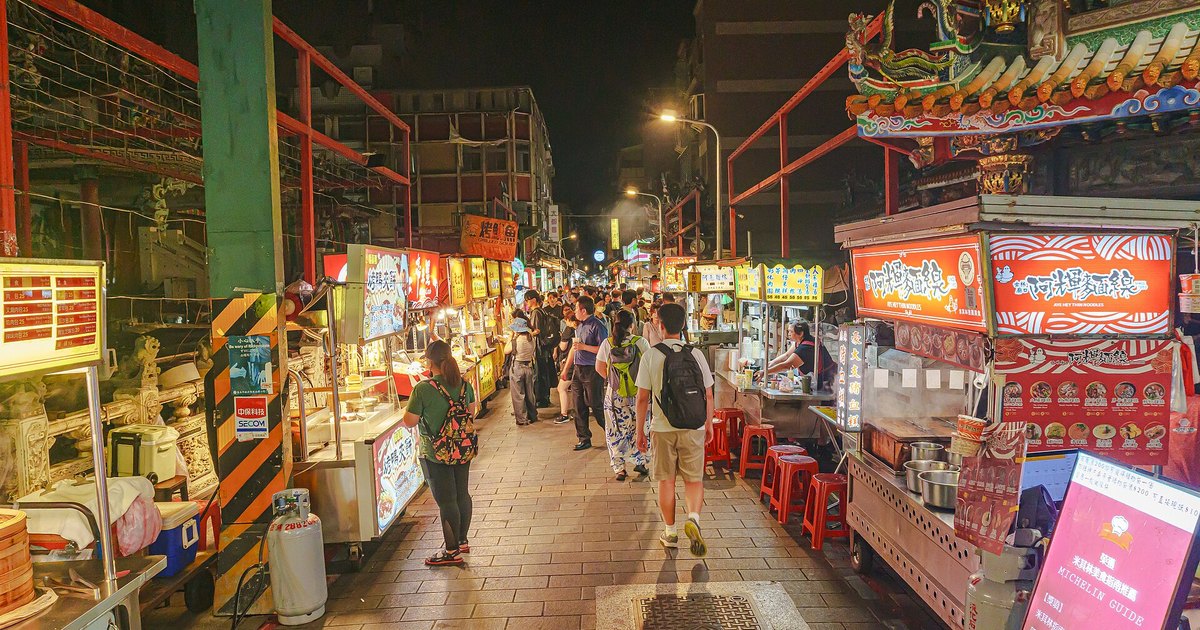
Eating and drinking are banned inside metro stations and on the trains. This is not guidance but law: Article 50, paragraph 1, item 9 of the Mass Rapid Transit Act sets a fine of TWD 1,500 to 7,500 for eating, drinking, chewing gum or chewing betel nut in the restricted area. Carrying a drink bought at the night market through the barrier is fine as long as you do not drink it inside the yellow line; one absent-minded sip is what the provision catches. Put the bottle in your bag before you go in.
DAY 2Use Ruifang as the hub and join Shifen to Jiufen in one day
Why the day runs this way: Shifen and Jiufen both branch off from Ruifang. Go to the far one by train first and call at the near one by bus on the way back, and you reach Jiufen around sunset, which is when the lanterns come on.
Morning: the local train is enough as far as Ruifang
Taipei Main to Ruifang is 33.5 km. On a TRA local it is TWD 73; on a Tze-Chiang express, TWD 114. The TWD 41 difference is the price of a canned coffee, and the journey times are about 10 minutes apart. Unless you need a reserved seat, the local does the job.
The Pingxi Line does not actually branch at Ruifang; it leaves the main line at Sandiaoling. The fare splits at the same point, Ruifang–Sandiaoling and Sandiaoling–Shifen, for TWD 29 in total. A stored-value card deducts it without your noticing, so there is no need to trace a route map at the ticket machine.
Trains are not frequent. The Pingxi Line runs roughly hourly, so missing one costs an hour on the spot. Treat any connection at Ruifang of under 10 minutes as one that leaves no time to buy a bento.
Afternoon: at Shifen the track itself is the square
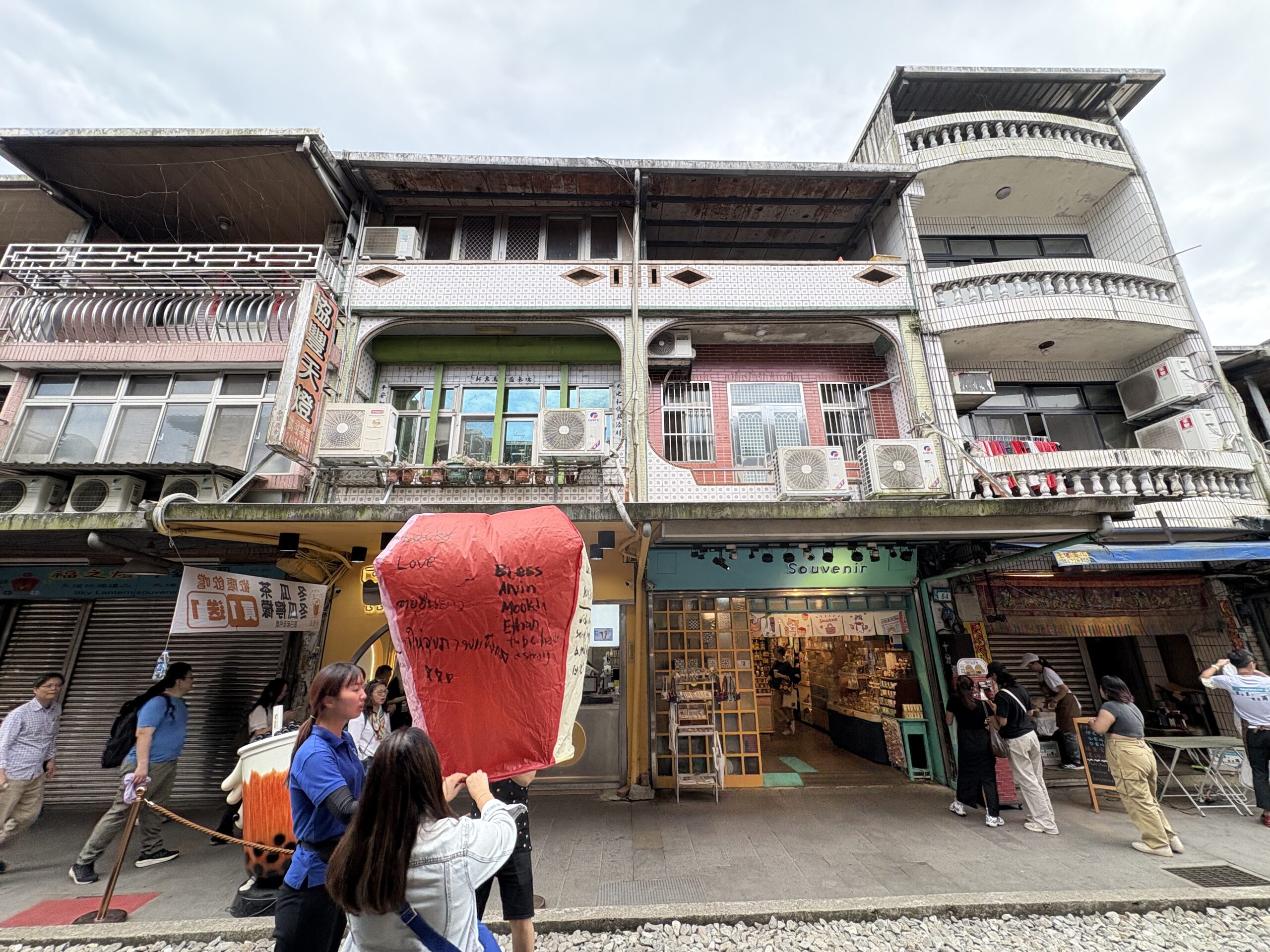
What it is: shopfronts face each other across the railway, and between trains the track is the walkway. For a sky lantern you choose the paper at a shop, write your wish on it with a brush, and the shopkeeper lights it for you to let go. The writing takes longer than the flying.
In practice: lantern prices are set by each shop and vary with the number of colours. No single official price list is published, so check what is displayed at the shopfront before ordering. As a train approaches, staff move people off, so do not linger on the track.
- Getting there
- Pingxi Line local from Ruifang to Shifen (TWD 29)
- Frequency
- About one an hour
- Back
- The same Pingxi Line to Ruifang (TWD 29)
Ride past Shifen to Jingtong at the end of the line and the fare from Ruifang becomes TWD 44, TWD 15 more each way than turning round at Shifen (TWD 29), or TWD 60 more for two on the round trip. Going to the terminus and back costs an extra hour and a half, so if Jiufen is also in the day, turn round at Shifen. To have both, drop Jiufen and make it a Pingxi Line day; there is far less rushing in that version.
Early evening: the Jiufen bus is 250 metres from Ruifang Station
Back at Ruifang, leave the station and walk left for about 250 metres. The stop is called Qumin Square, and six routes — 788, 825, 827, 856, 965 and 1062 — run from it to Jiufen Old Street. Any of them gets you there, so take whichever comes first. New Taipei City’s own guide to reaching Jiufen sets out this route exactly.
Fares are worked out differently by route. The 856, which runs as far as Fulong, is divided into two stages at Shuinandong, and Ruifang to Jiufen Old Street falls inside a single stage. The adult fare is TWD 15, whether you pay in cash or by card. TWD 12 is the student fare, and the half fare is TWD 8. One EasyCard pays for the TRA and the bus alike.
The same guide lists three ways to reach Jiufen from Taipei directly. The 1062 leaves from a stop 45 metres to the right of exit 2 at Zhongxiao Fuxing station. The 965 leaves from a stop 160 metres straight ahead of exit 2 at Ximen station and from the stop at Beimen. From Banqiao, walk 110 metres from exit 1 at Fuzhong and take the 965. Skipping the change at Ruifang is easier, but once the bus is on the mountain road the journey time stops being predictable.
What it is: a shopping street terraced into a hillside, where the lanterns coming on pick out the vertical line of the steps. Two streets carry everything — Jishan Street across the slope and the Shuqi Road stairway down it — and knowing those two is enough not to get lost. The teahouses cluster along the steps, and the window seats look out to the sea.
In practice: Jishan Street is only 1 to 2 metres wide, and in the early evening the crowd settles into one direction. Walking against it is not possible, so plan on being carried the way you entered. The queue for the bus back forms at the same stop and gets long, so find where it is when you arrive.
- Getting there
- 250 m on foot from Ruifang Station to Qumin Square, then 788 / 825 / 827 / 856 / 965 / 1062 to Jiufen Old Street
- Direct from Taipei
- 1062 from the stop 45 m right of exit 2 at Zhongxiao Fuxing
- Example fare
- The 856 within one stage: adult TWD 15 (student TWD 12, half fare TWD 8)
Going back, the choice is between returning to Ruifang for the TRA and taking the 1062 from Jiufen Old Street straight into Taipei. The 1062 runs to Zhongxiao Fuxing, so if your hotel is on the east side you get home without changing. It is a single mountain road, though, and in traffic it is slower than going via Ruifang. If you do not want unpredictable time on a Sunday evening, the train is the safer way back.
DAY 3Half a day: finish the shopping on Dihua Street and go back to the airport
Why the day runs this way: the last day does not leave Taipei Main. Dihua Street is north-west of the station, close enough to walk there and back while the bags stay behind.
Morning: more of the wholesale street is open early
Dihua Street is a wholesale district for dried goods and Chinese medicine — a workplace more than a sight. Bottarga, dried mango, pineapple cake and tea leaves are sold by the jin (600 grams). For taking things home it carries far more variety than a supermarket, and selling by weight means you can try small amounts.
The gift shops and cafes aimed at visitors open towards midday, but the wholesalers are working from early morning and some shut early in the afternoon. On a day with an afternoon flight, going first thing is what fits.
Afternoon: working out when to leave for the airport
Taipei Main to Terminal 1 is 36 minutes on the express and 39 to Terminal 2; if only a commuter train comes, 49 and 52. To be at the terminal two hours before boarding, leave Taipei Main three hours before. Add the 15-minute walk from Dihua Street and the time to collect bags from the hotel, and the morning’s shopping has to end by midday.
Taipei Main has an in-town check-in area on floor B1 (the in-town area of A1) for flights leaving Taoyuan Airport. Check-in and bag drop are done there instead of at the airport, but only for a flight departing the same day. The service closes three hours before departure, and the actual hours depend on the airline and the flight, so ask your airline beforehand. If you drop the suitcase there after Dihua Street, you skip the airline counter at the airport. On that day, though, the time to plan around is when you reach the desk, not when you leave the station: it has to be earlier than three hours before departure.
The Taoyuan Metro barriers are underground at Taipei Main and separate from the TRA and the Bannan Line. The signs take you there, but it is a long walk down the passageways with a large suitcase. Ten minutes is not enough to change.
Alternatives
Rainy-day swap
Sky lanterns do not fly in the rain. Wet paper will not lift once it is lit, and shops sometimes decline to sell. On a bad forecast, swapping day two out entirely and staying in Taipei costs you less. Taipei 101 is indoors, so the weather does not reach it, and staying open until 21:00 makes it somewhere to put spare hours.
Jiufen, on the other hand, still works wet. Jishan Street has continuous eaves and long stretches stay dry, and once you are inside a teahouse the weather is irrelevant. The Shuqi Road steps are slippery stone, though, and hard-soled shoes will find the descent difficult.
If the flight is delayed by an hour or more
An hour lost on arrival day puts the Taipei 101 observatory at risk. It closes at 21:00, so if you reach the hotel after 19:00, move the observatory to a later day. Shilin Night Market runs until late, so switching the first evening to the market alone asks less of the schedule.
Lose a Pingxi Line train on day two and the thing to cut is Jiufen, not the time at Shifen. Coming home without releasing a lantern leaves almost no reason to have gone east at all. Jiufen can be reached directly from Taipei on the 1062, so moving it to the morning of day three is an available escape route.
When you’re tired
Day two involves a lot of walking, and the track at Shifen plus the steps at Jiufen finish your legs. Travelling with cabin baggage only, so everything can be left at the hotel, changes how much of you is left by the evening. You could also stop trying to have both: go straight from Ruifang to Jiufen and sit in a teahouse for two hours. That comes to TWD 292 return on the TRA for two and TWD 60 on the buses, TWD 352 in all for two.
The other way round, if riding the trains is the point, drop Jiufen and ride the Pingxi Line through to Jingtong. TWD 44 from Ruifang buys you three stops to get off at — Shifen, Pingxi and Jingtong. Either choice leaves more behind than cramming three places into day two.
Why we left out the National Palace Museum and Tamsui
Two names come up in every three-day Taipei plan, the National Palace Museum and Tamsui, and both are left out here. The reason is arithmetic rather than taste. Day two spends more than two hours on the TRA simply going to Ruifang and back, and the run to Shifen plus the time in Jiufen takes the day to dusk. That leaves two slots: the first evening and the last morning.
Put the museum into one of them and you spend longer travelling than looking. Tamsui is a place you go for sunset, so putting it in the first evening collides head-on with Taipei 101. Trying to have both and giving each an hour is the worst use of the two slots there is.
Stretch to three nights and the calculation changes: one more day gives the museum a half day and Tamsui a whole evening. Two nights is a trip where deciding to leave Taipei for a day means narrowing the city to one or two things.
Where to stay
There is only one condition worth applying here: can you walk to Taipei Main, or reach it without changing? The Taoyuan Metro from the airport, the TRA on day two and the run back to the airport all converge on that station, so staying far from it means covering the same passageways repeatedly.
The convenience around Taipei Main comes at the price of somewhere to eat at night. The commercial buildings by the station shut before 22:00, so a late return turns into walking around looking for something open. Move one stop to Zhongshan and the density of places open late goes up.
Staying in the East District only makes sense if you intend to come back from Jiufen on the 1062. Getting home directly is pleasant, but you then pay the trip out to Taipei Main every morning. Two of the three days start from that station, so on balance being near it wins.
What this trip costs
What follows is for two people over three days, excluding accommodation, meals and metro fares inside Taipei. Flights are left out because the same dates can cost more than twice as much depending on the departure airport and when you book. Metro fares in Taipei are distance-based, small per journey and dependent on where you stay, so they are not included either. Every figure is in New Taiwan dollars; no conversion is given, because the rate moves daily.
Every price above is as published officially, checked on 2026-10-12. TRA figures come from the operator’s own fare calculator (single, full fare, shortest route); the fare actually charged is the one shown on your ticket. The bus fare is the 856’s adult fare from the official guides of the scenic area authority and Taiwan Trip.
Read the breakdown and TWD 1,200 of the TWD 2,308 is admission to Taipei 101. Transport accounts for TWD 1,108. Cutting the budget is therefore not a question of transport but of whether you go up the tower.
Split by day, day one is TWD 1,520 for the Taoyuan Metro and Taipei 101. Day two is TWD 468: TWD 292 for the TRA return, TWD 116 for the Pingxi Line return and TWD 60 for the bus return. Day three is TWD 320 for the metro back to the airport. The total is TWD 2,308. Even the day that goes out of the city costs less than the TWD 1,200 admission to Taipei 101.
Going up to the 101st floor adds TWD 380 per person, TWD 760 for two, and takes the total to TWD 3,068. What the trip costs depends less on how you combine trains and buses than on which ticket you use to go up Taipei 101.
The time budget is worth looking at too. Day two is two hours on the TRA for the Taipei–Ruifang round trip, an hour on the Pingxi Line there and back, and about 40 minutes on buses. That is close to four hours in transit before anything else, and spending three and a half hours between Shifen and Jiufen finishes the day. Assume you are back in Taipei after 21:00 and you will not be caught out.
This itinerary does not suit anyone who wants to walk Taipei itself. Day two goes out of the city entirely, which leaves about a day and a half inside it. If the city is the point, drop Jiufen and Shifen and put the time into night markets and museums instead. Rebuilt that way, the same two nights invert the ratio of moving to staying put.
Source: Taoyuan Metro fares and timetable / Taiwan Railway fare calculator / Taipei 101 Observatory ticket information / New Taipei City Government, guide to reaching Jiufen Old Street / Northeast and Yilan Coast National Scenic Area, Golden Fulong Line (856) / Laws and Regulations Database, Mass Rapid Transit Act Article 50 / National Immigration Agency, arrival registration form (TWAC) — each official site / Photos: Junyu-K (CC BY-SA 4.0), Chainwit (CC BY 4.0), Another Believer (CC BY-SA 4.0), Sunkenbean (CC BY-SA 4.0) / Wikimedia Commons / Checked on 2026-10-12
Other sales ending soon
 4 days leftuntil Oct 24Air Busan Takamatsu-Busan Coupon: Up to 9,000 Yen Off Until October 24
 5 days leftuntil Oct 25JAL Hong Kong Campaign: Tokyo–Hong Kong Round Trip from 75,800 Yen (until 25 Oct)
 11 days leftuntil Oct 31Jin Air Kobe–Seoul: 5,000 yen off a round trip with code KTOUKB1, until 31 October
 11 days leftuntil Oct 31Jin Air to Busan: 4,000 yen off a round trip with code KTOPUS, first 300 only