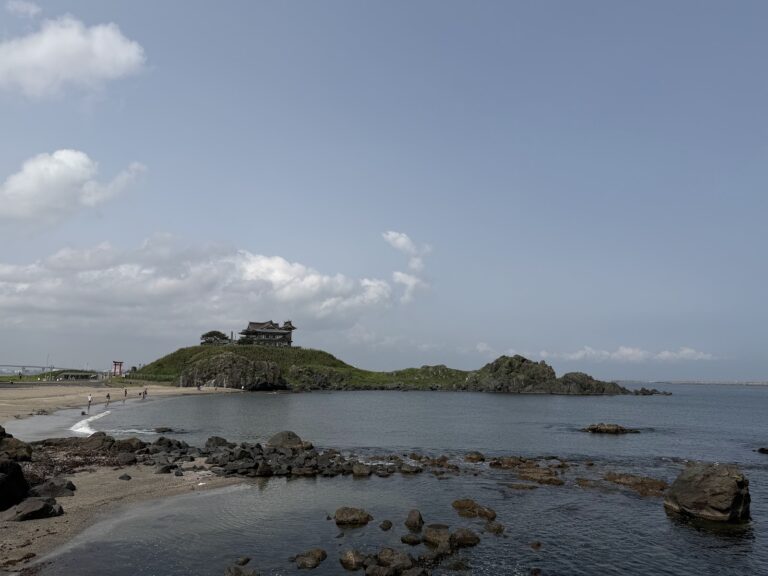
Misawa and Hachinohe in 3 Days: A Solo Dokokani Mile Trip
AuthorMIRUTOBE editors
Table of Contents7 items
- Itinerary at a glance
- DAY 1 Saturday 5 September: an afternoon flight to Misawa, an evening in central Hachinohe
- DAY 2 Sunday 6 September: from the morning market along the coast, then a castle in the afternoon
- DAY 3 Monday 7 September: the boarding point had moved, and I missed the one morning bus
- Changes to the itinerary
- Choosing where to stay
- What this trip cost
A record of a solo dash to Misawa and Hachinohe. Spending on the ground came to a little over 30,000 yen before the last-day taxi after missing the airport bus. The Dokokani Mile flight sent me to Misawa instead of the Izumo I had been aiming for, followed by an early morning market, a coastal walk from Tanesashi Coast to Kabushima, and the Japan 100 Castles stamp at Nejo.
Itinerary at a glance
DAY 1Saturday 5 September: an afternoon flight to Misawa, an evening in central Hachinohe
The idea behind the route: with an afternoon flight, the morning is left alone. At Misawa, the 1 hour 15 minutes before the next connecting bus goes to the observation deck, and dinner is narrowed to one place at Saba no Eki.
Afternoon: leaving Haneda at 14:55, reaching Misawa at 16:10
With Dokokani Mile, you apply and four candidate destinations appear; JAL picks one of them, and you fly for a standard 7,000-mile round trip (on this trip I used the once-a-year 1,500-mile benefit from a JAL Mobile contract). When I applied on Saturday 22 August the four were Izumo, Misawa, Nanki-Shirahama and Komatsu, and I was hoping for Izumo. The notice came two days later, on the morning of 24 August. I opened it and it said Misawa. I had never once thought of going. But being dropped for 7,000 miles (or 1,500 miles with the benefit) somewhere you would not choose yourself is part of the price of this scheme, so I apply with the question of how to enjoy a bad draw already built in.
One mistake: I did not specify a time of day for departure. Left unspecified, the combination was Haneda 14:55 out and a Monday 10:00 flight back. The whole of Saturday morning disappears, and on Monday you head for the airport from first thing. The time band can be narrowed on the application screen, so if you are going on a weekend it is better to set “morning departure” before the candidates are drawn. Whether the scheme pays off as a use of miles is worked out in the break-even for Dokokani Mile, and anyone torn against the Shinkansen version, Dokokani Byuun, can compare the two on the same yardstick there.
Light rain in Tokyo. The boarding gate at Haneda Terminal 1 was in the new satellite stretching north (gates 25 to 29). The ceiling is a wooden truss, the walls are wood-grain, and there are plants along the corridor, a world away from the fluorescent white of the existing terminal. At 14:40 there was hardly anyone in the corridor, just window light on the floor.

Highlights: a wooden-truss ceiling, wood-grain walls and plants along the corridor. Walking over from the existing terminal, it hardly feels like the same airport.
Practical tip: beside gate 26 is the card lounge “FOREST LOUNGE”, which opened on 1 September. It is free with a partner card, or 1,320 yen for an adult without one. It is small at 22 seats and open from 6:00 to 19:00. I did not have time to go in this time.
- Location
- Terminal 1 north satellite (gates 24 to 29)
- Lounge
- FOREST LOUNGE 6:00 to 19:00, 22 seats
- Price
- 1,320 yen without a partner card
From 1 September the checked-baggage deadline on Haneda domestic flights moved up to 30 minutes before departure. It made no difference to me with carry-on only, but anyone checking a bag has to rework when to reach the airport. Arrival times for each deadline are in the back-calculation table for Haneda domestic checked-baggage deadlines.
It was sunny at Misawa and the air was dry. On the baggage carousel in the arrivals hall sat a split apple made with the Nebuta technique, and lanterns hung from the ceiling.
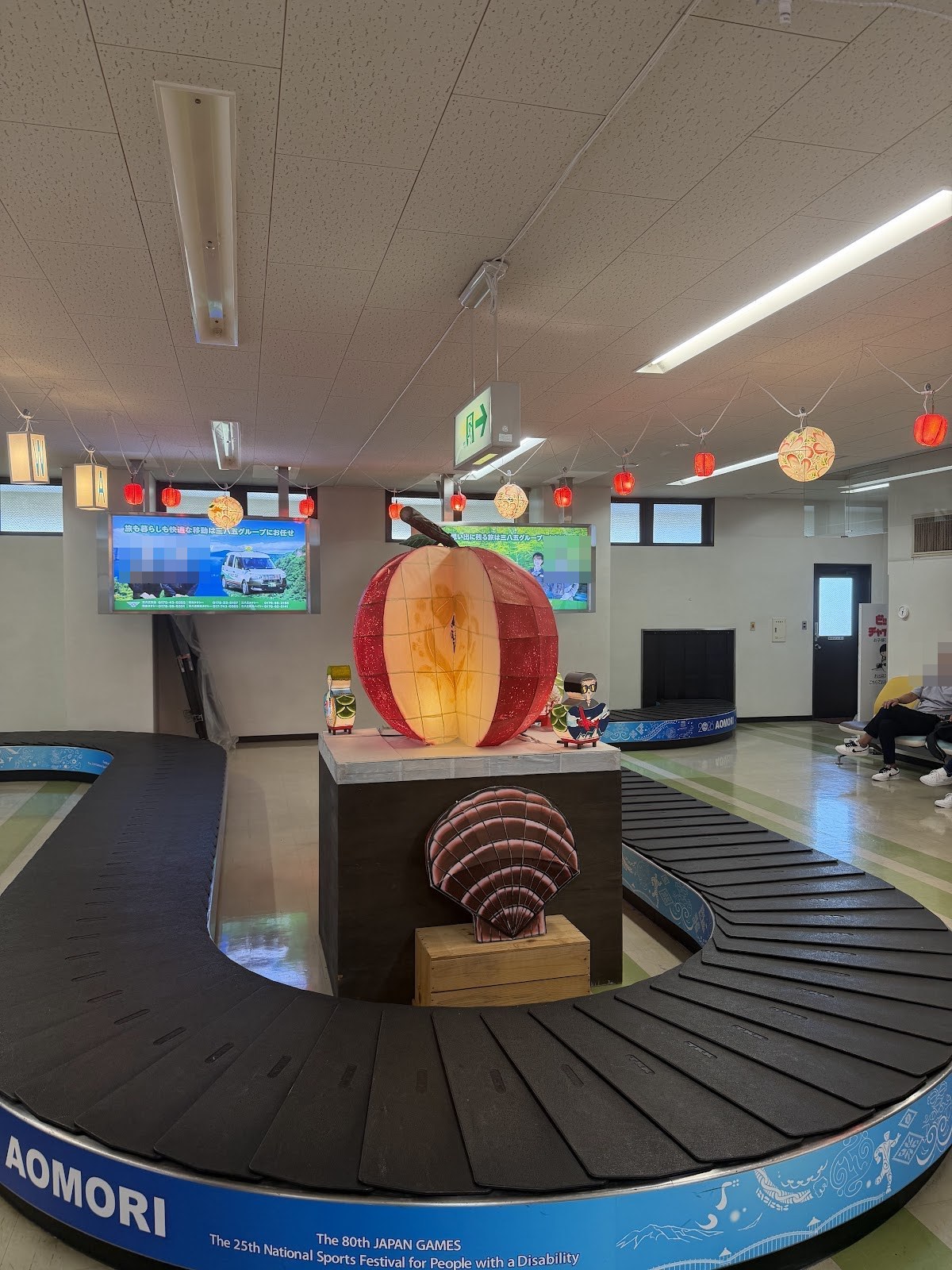
Highlights: the split apple is done in the Nebuta technique. It is small enough to take in during the few minutes before the bags come out.
Practical tip: Misawa Airport shares its runway with Misawa Air Base, used by the Japan Air Self-Defense Force and US forces in Japan. Scheduled civilian flights are four round trips to Haneda and two to Itami, with Sapporo on set days only, so the number of flights is tiny against such a wide runway. The shops and restaurants are modest too.
- Scheduled flights
- Haneda 4 round trips / Itami 2 round trips / Sapporo on set days only
- Shared use
- Runway shared with Misawa Air Base (JASDF and US forces in Japan)
The route bus to Hachinohe left at 17:25 against a 16:10 arrival, a gap of 1 hour 15 minutes. I paid 100 yen to go up to the observation deck on the third floor and watched the planes for a while. All I could see was the small JAL Group aircraft I had come on and a hangar beyond the runway; no US aircraft were moving, and the base side is hardly visible from the deck in the first place. It is not the place to go up for military aircraft.
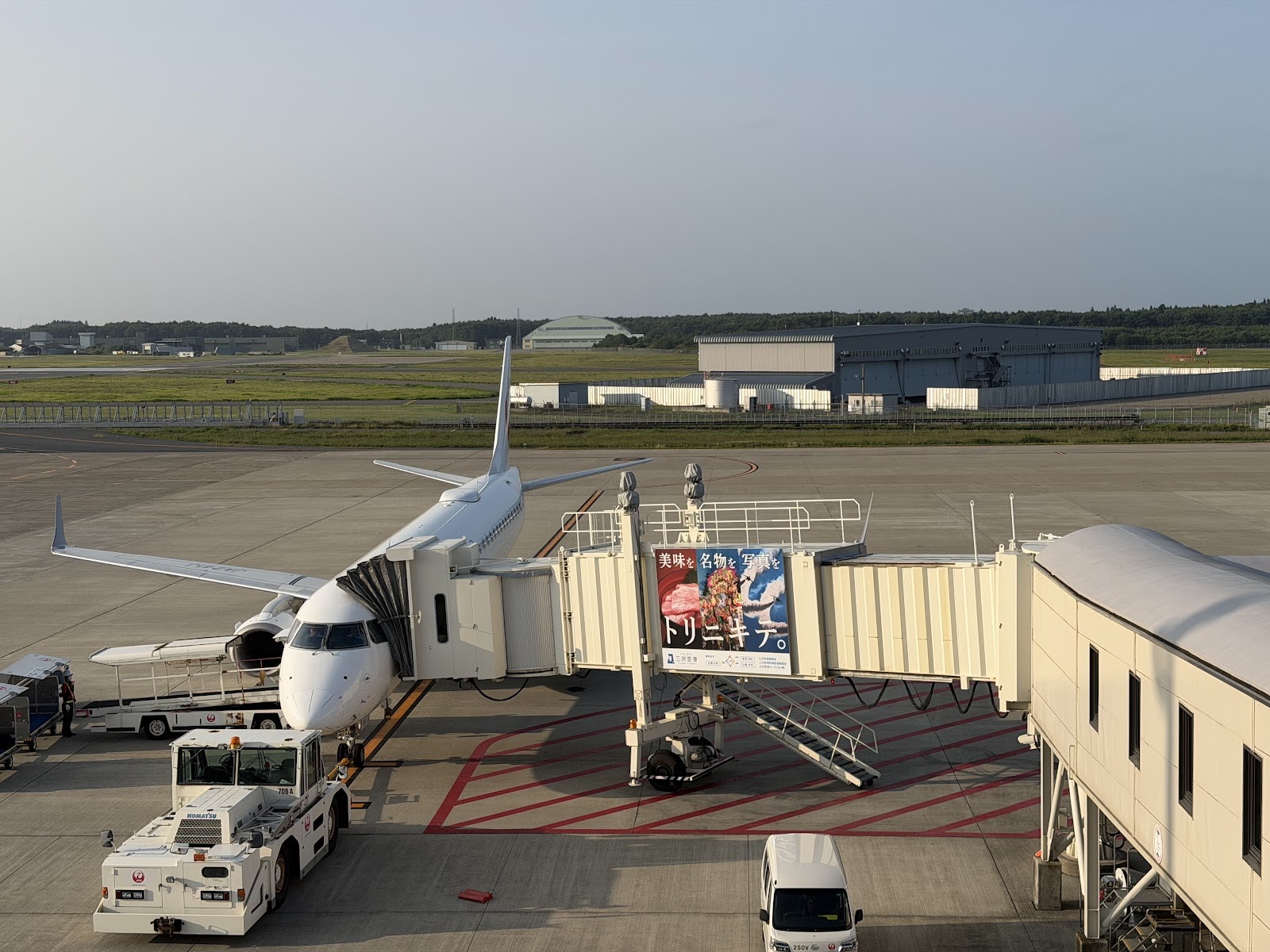
Highlights: on the third floor of the terminal. A small aircraft at the boarding bridge and a hangar fill the view.
Practical tip: leaving means paying 100 yen again to re-enter, so if you go up while waiting for the bus, do not go in and out. With 1 hour 15 minutes between the arriving flight and the bus, spending it here is the most natural use.
- Price
- 100 yen (paid again on each re-entry)
- Hours
- 8:00 to 20:00
- Location
- Terminal, floor 3
The bus is a Towada Kanko Dentetsu route bus; no reservation is needed, and you pay 1,500 yen by IC card or cash when you get off. I paid with Suica. It reached Hon-Hachinohe Station at 18:15 and Hachinohe Yokkamachi at 18:20. It does not stop at Hachinohe Station on the Shinkansen, so if you are staying in the centre, ride to Yokkamachi. On the September timetable there are five departures from the airport, at 9:35, 11:00, 12:55, 17:25 and 18:45, one set to each arriving Haneda flight; from in front of Hon-Hachinohe Station they leave at 8:05, 9:50, 11:20, 15:20 and 17:15.
Evening: Hachinohe, a town that fits in a ten-minute walk, and Saba no Eki
What getting off in Hachinohe makes clear is that the Shinkansen station and the centre of town are in entirely different places. The centre is around Hon-Hachinohe Station on the Hachinohe Line, and Sannohe Castle Park, four minutes from the station, is the site of Hachinohe Castle. It is the hill where the Edo-period Hachinohe domain had its government, and what remains now is little more than the front gate of the Kado-goten and the moat. The city hall is at the foot of the hill. From there, towards Mikkamachi and Muikamachi, come Hacchi (the portal museum), the Sakurano department store, the municipally run Hachinohe Book Center and the Miroku Yokocho food-stall alley. All of it fits within a ten-minute walk. For a regional city it is very compact, and over the three days the only time I used a taxi in town was the last ride to the airport.
Dinner on the first night was Saba no Eki. It is a mackerel specialist on the ground floor of a building on Muikamachi, built around Hachinohe Maeoki mackerel: fatty mackerel caught in waters north of 40 degrees 30 minutes north latitude and landed at Hachinohe port. I ordered grilled mackerel skewers, squid sashimi, a large (regular portion) Hachinohe silver mackerel marinated rice bowl, and a glass of Mutsu Hassen Hojun Chokara (special junmai). With the appetiser charge it came to 5,984 yen, paid by card. At the till they handed me a card made to look like a 470-yen “Saba Taste Journey Ticket”, a playful touch for a place that calls itself a station.
Hassen is a brand of Hachinohe Shuzo, in the port district of Hachinohe, and Hojun Chokara is the dry kind of sake, as the name says. In the mouth it has a solid sweetness, then cuts off extra-dry afterwards, just as the name promises.
One point to put in writing: early September falls before the certification period for Maeoki mackerel. The council decides the period each year by looking at how fatty the fish are, so it moves between autumn and winter, and in Reiwa 6 it ran from 21 November to 20 January. This is not the time of year for seasonal raw Maeoki mackerel. Even so it had little fishy smell and a rich, fatty flavour, and I did not feel short-changed.
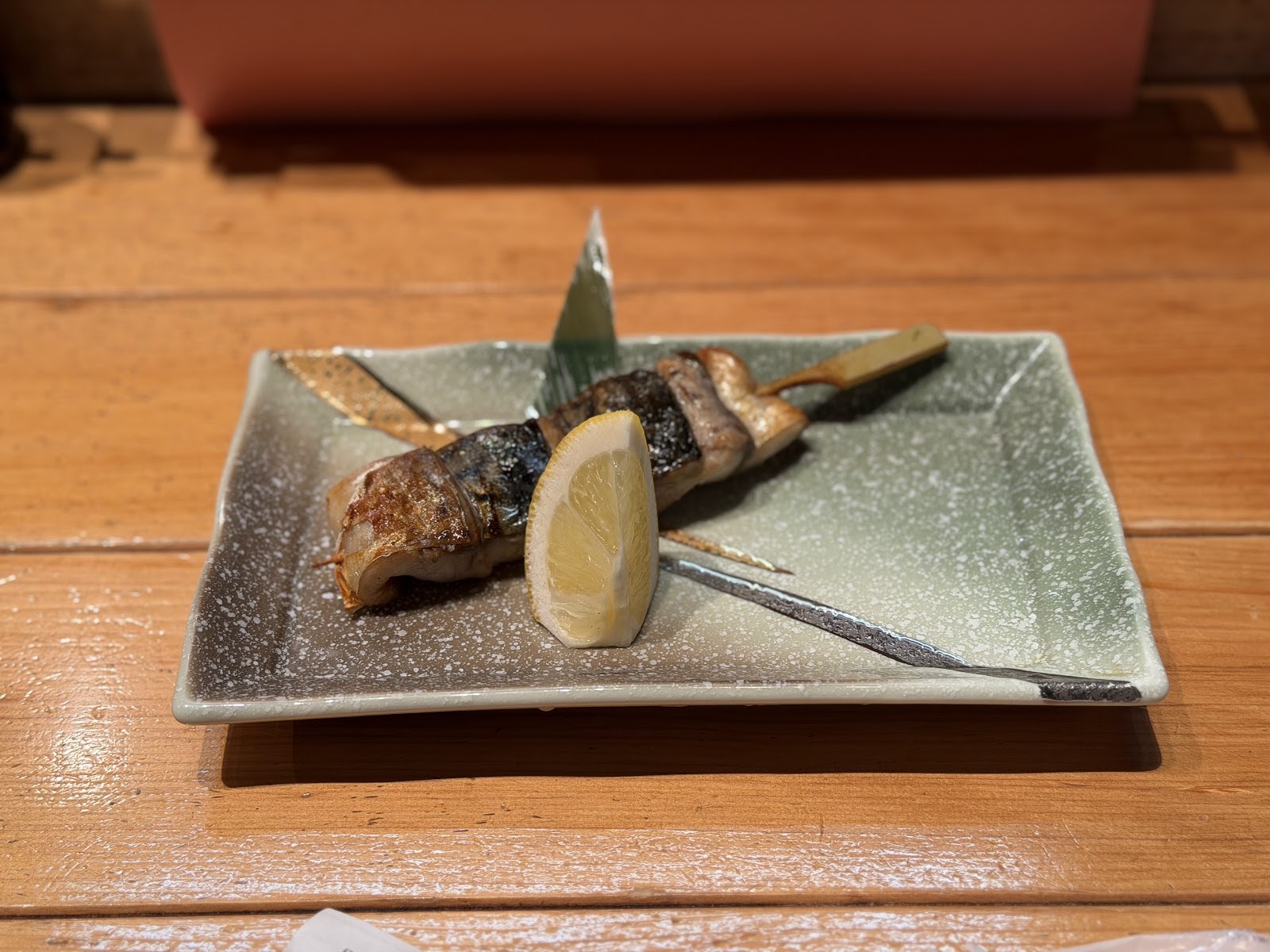
Highlights: a mackerel specialist built around Hachinohe Maeoki mackerel. A whole meal can be put together from mackerel alone.
Practical tip: the Maeoki certification period is set each year by the council according to how fatty the fish are, so to aim for the seasonal raw fish, plan for autumn to winter. Early September is before the certification period, and the raw Maeoki mackerel is not in season.
- Address
- Daimatsu Building 1F, 12 Muikamachi, Hachinohe
- Hours
- 17:00 to 22:30 (last order 22:00)
- What I paid
- 5,984 yen (one person, appetiser included, cards accepted)
DAY 2Sunday 6 September: from the morning market along the coast, then a castle in the afternoon
The idea behind the route: set out in the 5 o’clock hour to match the market train that runs only on Sundays. From Tanesashi, walk the coast rather than wait for a train, and leave the shadeless Nejo for the afternoon when the sun has moved round.
Morning: from the 5:40 market train to Kabushima, 8 km on foot
Day two began with a 5 o’clock wake-up. I watched the sunrise from the platform at Hon-Hachinohe Station and boarded the 5:40 rapid “Tatehana Quay Morning Market Train”. It is a special train that runs only on market Sundays, six minutes to Mutsu-Minato. From the station to the quay is a walk of about ten minutes. The Tatehana Quay Morning Market is held every Sunday from mid-March to December, from dawn until about 9:00, with some 300 stalls lined up for 800 m along the fishing-port quay. When I arrived at 6:00 the street was already full of people. The morning sun was reflected in the harbour.
I took it for a single street and walked to the end; when I turned back I found that the street bends into an L at a corner of the quay, and beyond it the stalls carry on at the same density. Seeing it all takes an hour.
The announcements on the grounds were good. A call for a customer who had left bought vegetables at a stall and not come back was done with humour, yet still got everything across. What I ate was grilled mackerel, grilled scallop, grilled whelk and knife-cut noodles, about 3,000 yen in cash.
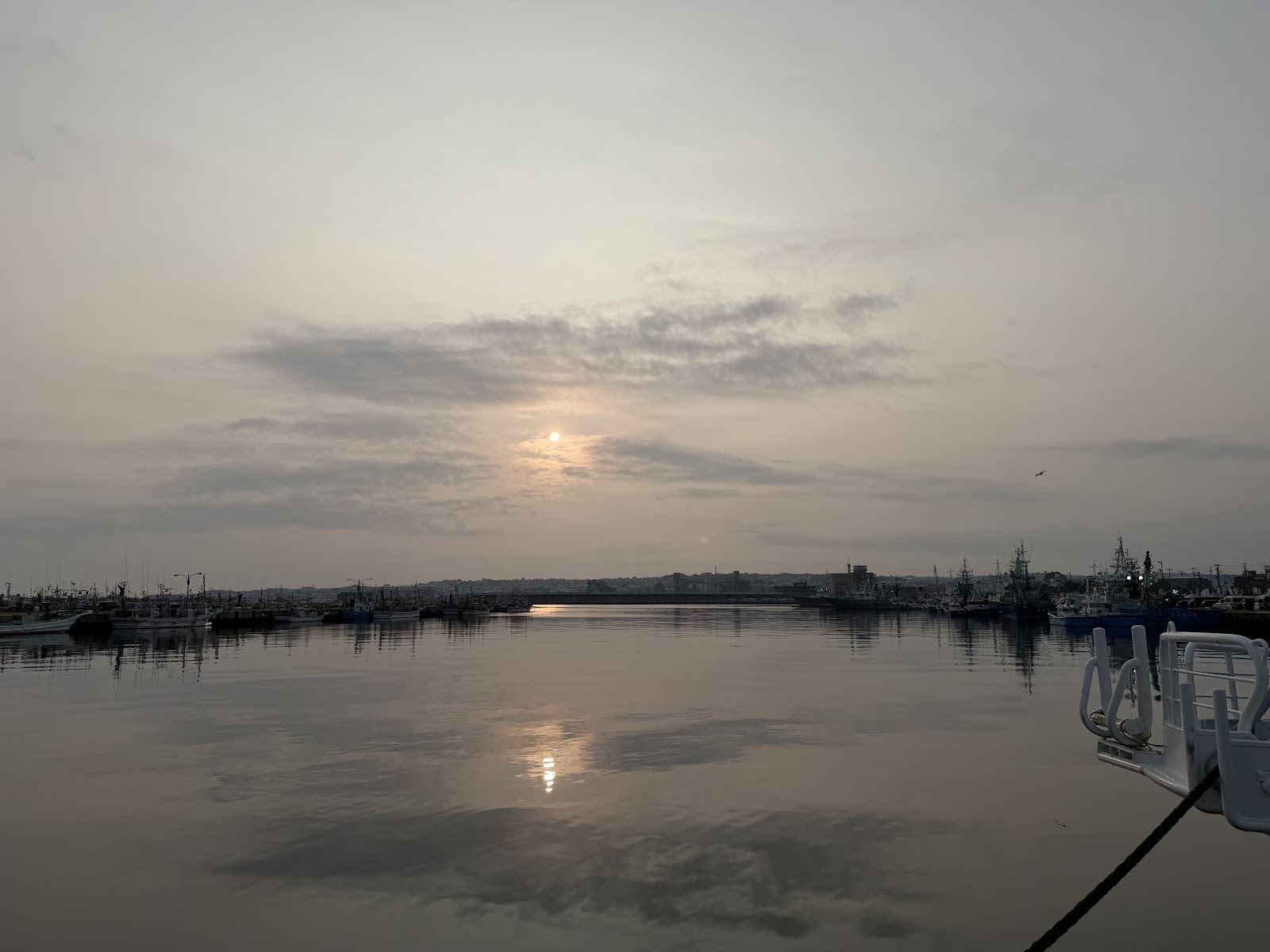
Highlights: about 300 stalls over 800 m of fishing-port quay. The street turns into an L partway, and beyond it the stalls continue at the same density.
Practical tip: it is busiest from 6:00 to 7:00, and after 8:00 some stalls begin to pack up. Payment is in cash. From the centre, take the market train (Hon-Hachinohe 5:40) or the Sunday market loop bus “Isaba-go”, 150 to 200 yen and about 16 minutes. In 2026 the market was closed on 17 May for the Umineko Marathon.
- Season
- Every Sunday from 15 March to December
- Hours
- Dawn to about 9:00
- What I ate
- About 3,000 yen (cash)
Leaving the market, I took the Hachinohe Line to Tanesashi Coast. It is at the northern end of Sanriku Fukko National Park, with natural lawn stretching right down to the water’s edge. When I arrived just before 8:00 a family was having a picnic on the grass, with a barbecue ground next door. It is a coast designated a place of scenic beauty in 1937, with a 2.3 km stretch of singing-sand beach and, they say, 650 kinds of flowers.
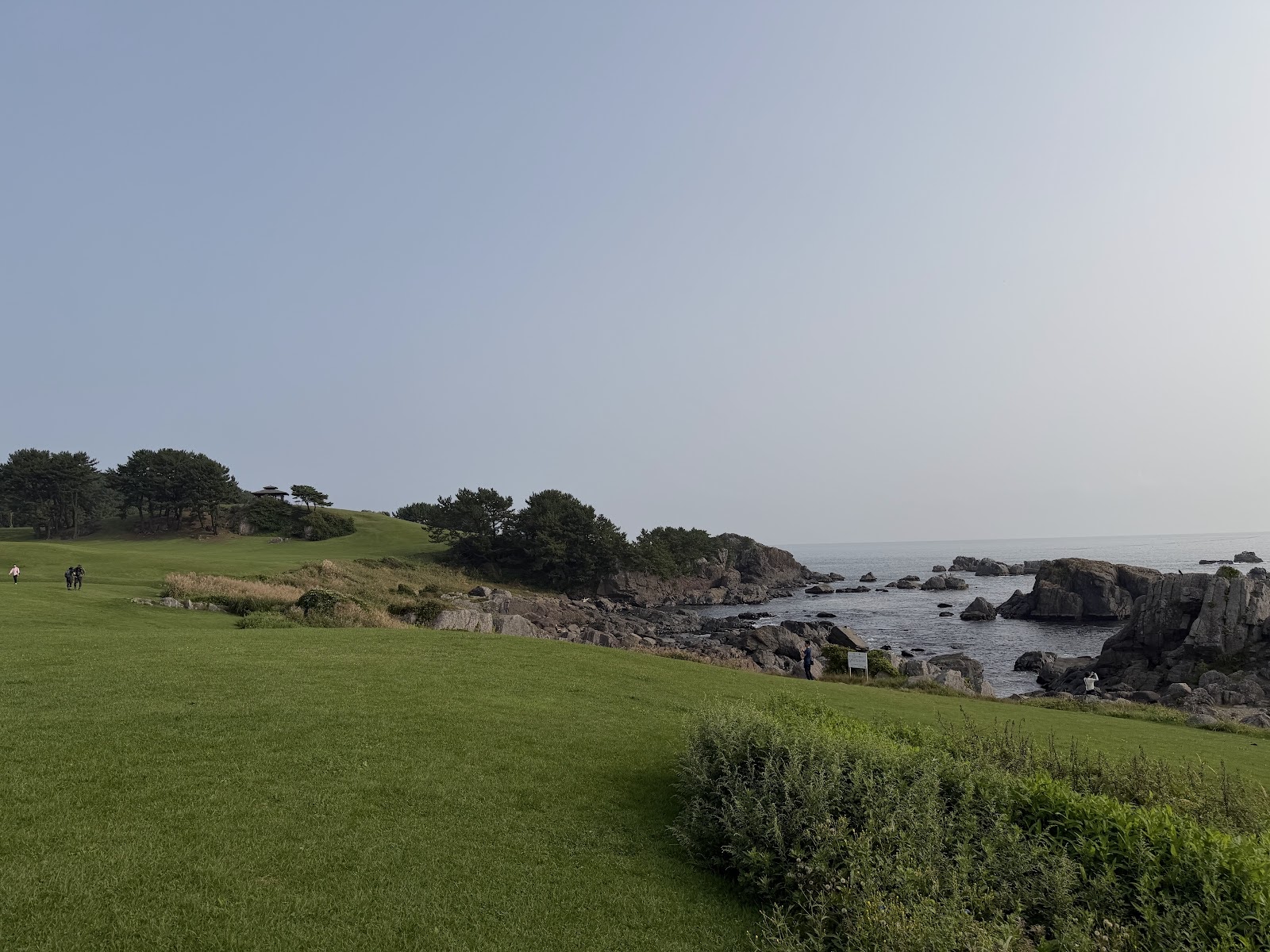
Highlights: natural lawn to the water’s edge, with a barbecue ground next door. Even before 8:00 there were families on the grass.
Practical tip: the Tanesashi Coast Information Centre is free. Decide how you are getting back before sitting down on the lawn. Inbound trains run every two hours in the daytime, and missing one leaves a two-hour gap.
- Nearest station
- JR Hachinohe Line, Tanesashi-kaigan
- Inbound departures (Sat, Sun and holidays)
- 8:20 / 10:27 / 12:19 / 14:12 / 18:08
- From Mutsu-Minato
- 260 yen
It was the timetable at Tanesashi-kaigan Station that settled it. For Hachinohe, the next train was at 8:20 and the one after at 10:27. On Saturdays, Sundays and holidays the inbound trains are at 8:20, 10:27, 12:19 and 14:12, and then nothing until 18:08, so it is every two hours in the daytime. I could not bring myself to cut the lawn short after 20 minutes, so I let the 8:20 go and decided to walk the coastal path to Kabushima. Via Shirahama, the singing sands of Osuga Coast, Nakasuga and the Ashigezaki Observatory, it is about 8 km to Kabushima, with a guide estimate of four hours. I set off around 8:10 and reached Kabushima at 10:21. Osuga Coast, where my feet sank into the sand, was the hardest stretch.
I was tired, no question.
While walking I was doing subtraction in my head. Taking the 10:27 train would have put me at Same at a little past 10:40, and from there it is a 15-minute walk to Kabushima: arrival just before 11:00. I actually reached Kabushima at 10:21. Eight kilometres in 2 hours 10 minutes, even with my feet caught in the sand of Osuga Coast, stopping for photographs at Ashigezaki and watching the black-tailed gulls on the offshore rocks, was still more than 30 minutes faster than waiting for the train. The path on this stretch has little up and down and no confusing forks. For Tanesashi Coast, “train there, walk back to Same” gains on both time and scenery over “train there, train back”. Put the other way, anyone who cannot walk and goes to this coast should settle the time of the Umineko-go first, or end up spending two hours on the lawn.
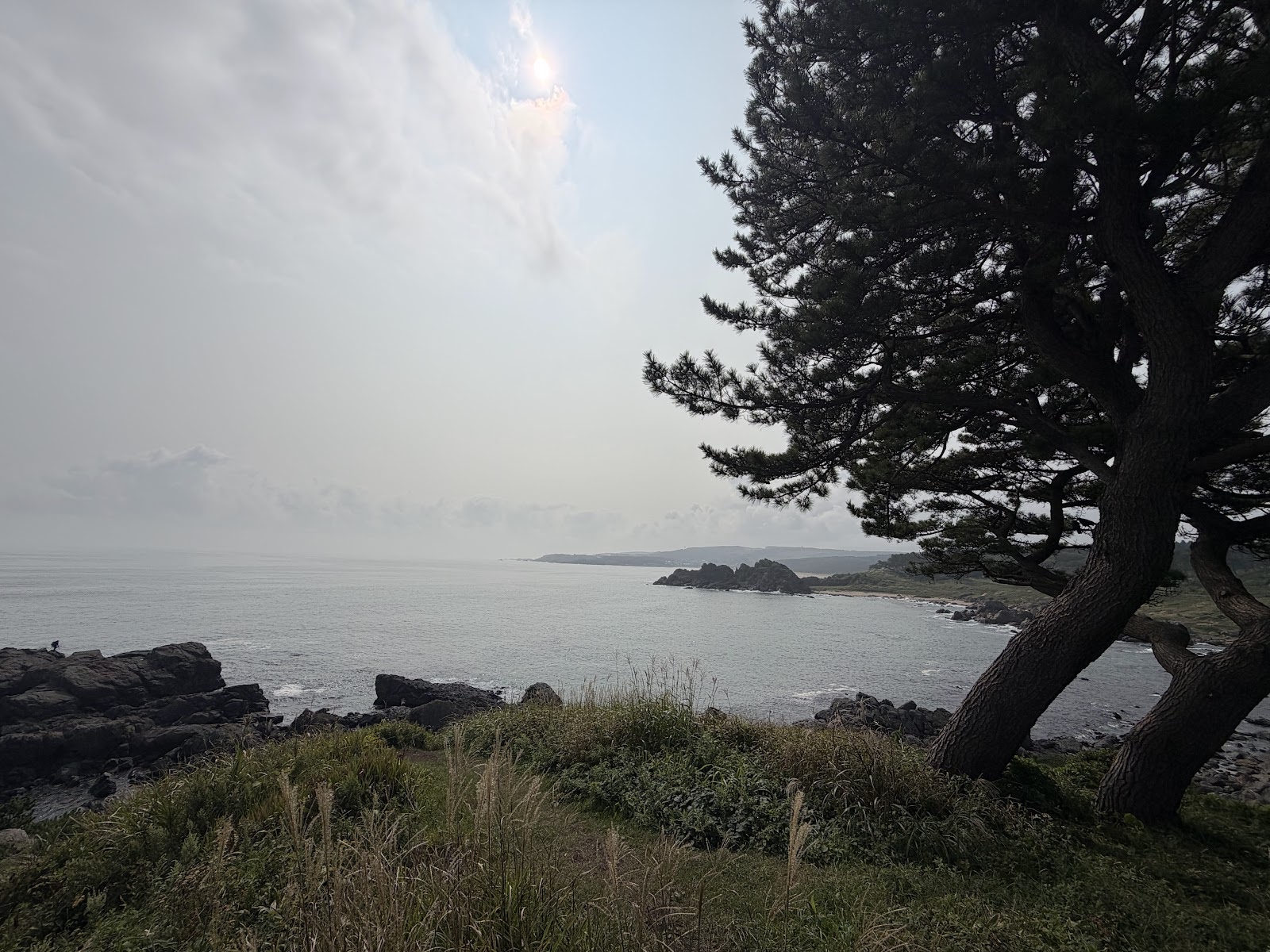
Highlights: lawn, singing sand, pines and rocky reef, and a rock of black-tailed gulls, with the scenery changing every hour.
Practical tip: the guide estimate is four hours; I set off around 8:10 and reached Kabushima at 10:21. The sand eats time, so wear sneakers at the least. If you are not walking, the city’s sightseeing bus “Umineko-go”, linking the Tanesashi Coast Information Centre and Same Station, costs 150 to 200 yen and takes 26 minutes to Same (seven round trips a day from spring to autumn).
- Distance
- About 8 km
- Estimate
- 4 hours (actually 2 hours 10 minutes)
- Cost
- 0 yen (220 yen by train to Same)
If you are not walking, the city’s sightseeing bus “Umineko-go”, linking the Tanesashi Coast Information Centre and Same Station, is available for 150 to 200 yen. It takes 26 minutes to Same Station. There are not many runs, though, so decide the return time before you get to the lawn. I did not, so I walked.
On an offshore rock just ahead, something white seemed to be swarming. Closer up it was a flock of black-tailed gulls, gathered on a rock rather than an island. Kabushima is a nationally designated natural monument and a black-tailed gull breeding ground; around 30,000 birds gather to nest at the end of February and fledge and leave the island around mid-August. On 6 September it was after the breeding season and quiet around the shrine. To see the gulls themselves, May to July is the time, but then the droppings are such that umbrellas are lent from a stand on the approach for the climb up.
Kabushima is a small island perched next to a neatly kept sandy beach, with Kabushima Shrine on top. It was once a real island, joined to the mainland by reclamation by the former Navy in 1942 and 1943. The shrine buildings burned down completely in a fire on 5 November 2015 and were rebuilt, with worship resuming on 26 March 2020, so they are still new. It enshrines Benzaiten, a deity of trade and fishing, and its well-known charm is the “kabu-agari” amulet, playing on kabu (turnip) and kabu (stock): stocks rise, reputation rises. This is something to laugh off and walk past, but I bought one. About 1,000 yen.
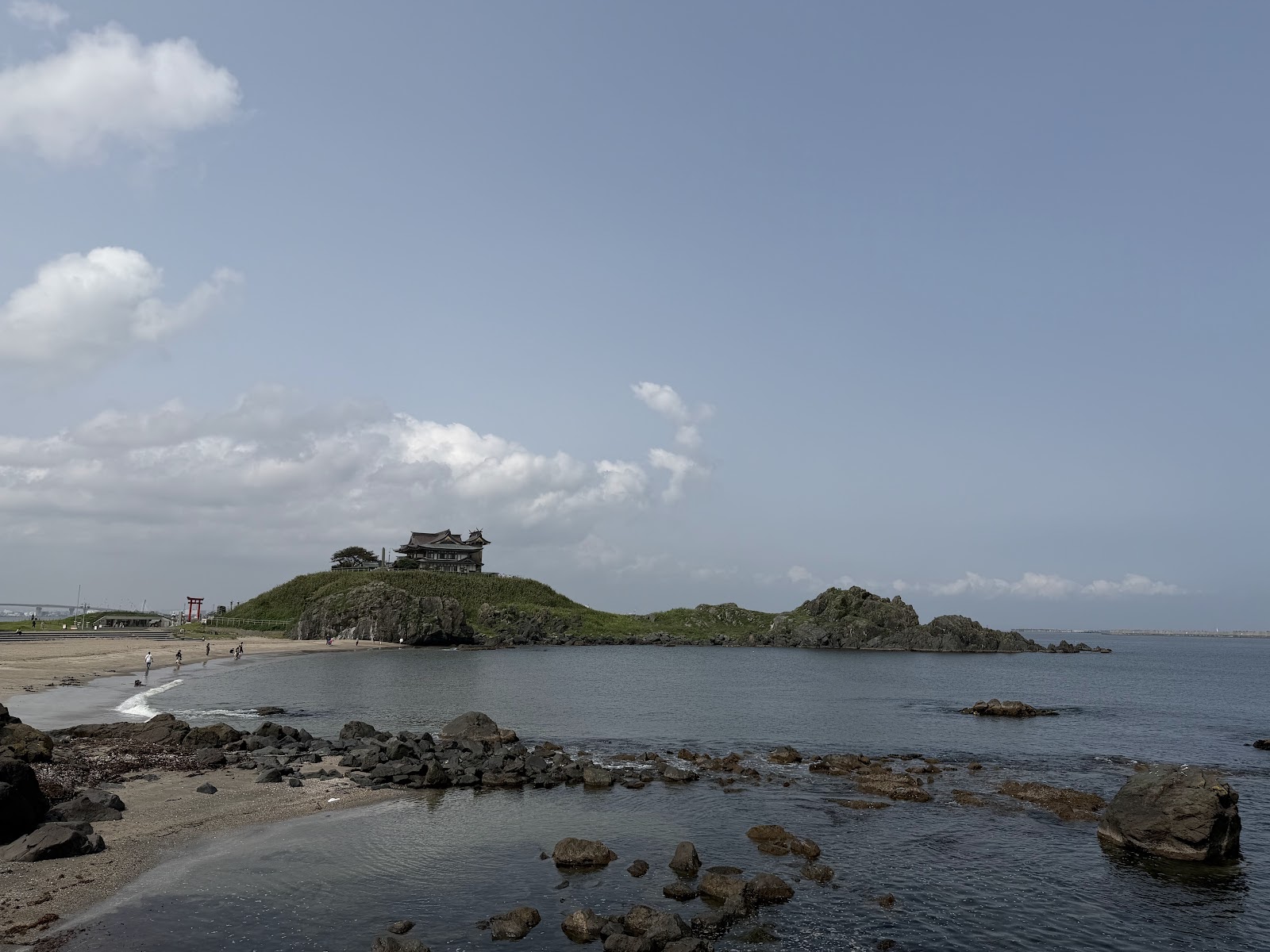
Highlights: a small island perched next to a sandy beach. The shrine on top was rebuilt in 2020 and is new.
Practical tip: it is a nationally designated natural monument and black-tailed gull breeding ground, where around 30,000 birds gather at the end of February and fledge and leave the island around mid-August. From May to July the droppings are such that umbrellas are lent from a stand on the approach for the climb. September is quiet, and for that reason there are no birds.
- Admission
- Free
- Kabu-agari amulet
- About 1,000 yen
- Nearest station
- 15 minutes on foot from Same Station on the Hachinohe Line (there is an Umineko-go stop)
Afternoon: even with the museum closed, the main compound of Nejo is open
I took the Hachinohe Line back to Hon-Hachinohe and a city bus to Nejo. This was the purpose of the trip: number 5 of Japan’s 100 Famous Castles. The Hachinohe City Museum next door is closed for a long period for renovation, from 6 October 2025 to 30 June 2027 (planned). Even so, the Nejo historic site grounds were open as usual, and the 100 Castles stamp and the 300-yen goshuin castle stamp were still available beside the museum’s front entrance and at the window of the main compound. Turn back after seeing only the word “closed” and you lose out.
Nejo was built in 1334, the first year of Kenmu, by Nanbu Moroyuki, and for roughly the next 300 years it was the centre of the Hachinohe area. It fell out of use when the Nanbu clan was moved to Tono in 1627, survived as an earthen castle with no keep and no stone walls, and became a national historic site in 1941. Eleven years of excavation from 1978 identified the building foundations, and in 1994 the main hall, workshop, plank storehouse, barn and stable were restored and the site opened as a park. It is not the stone-walled castle that comes to mind at the word “castle ruins”, but a medieval samurai residence. For 250 yen into the main compound you can go up into the main hall where the lord held ceremonies, a glimpse into the life of the Nanbu clan. At the entrance to the grounds there is a copper-plate model of the whole historic site, and it is easier to walk the grounds if you take in the layout of the moats and bailey here first.
The September sun was strong, and the wide lawn has almost no shade. Just walking to the main compound brought out a sweat. Looking around inside took about 30 minutes. In high summer I would come first thing in the morning.
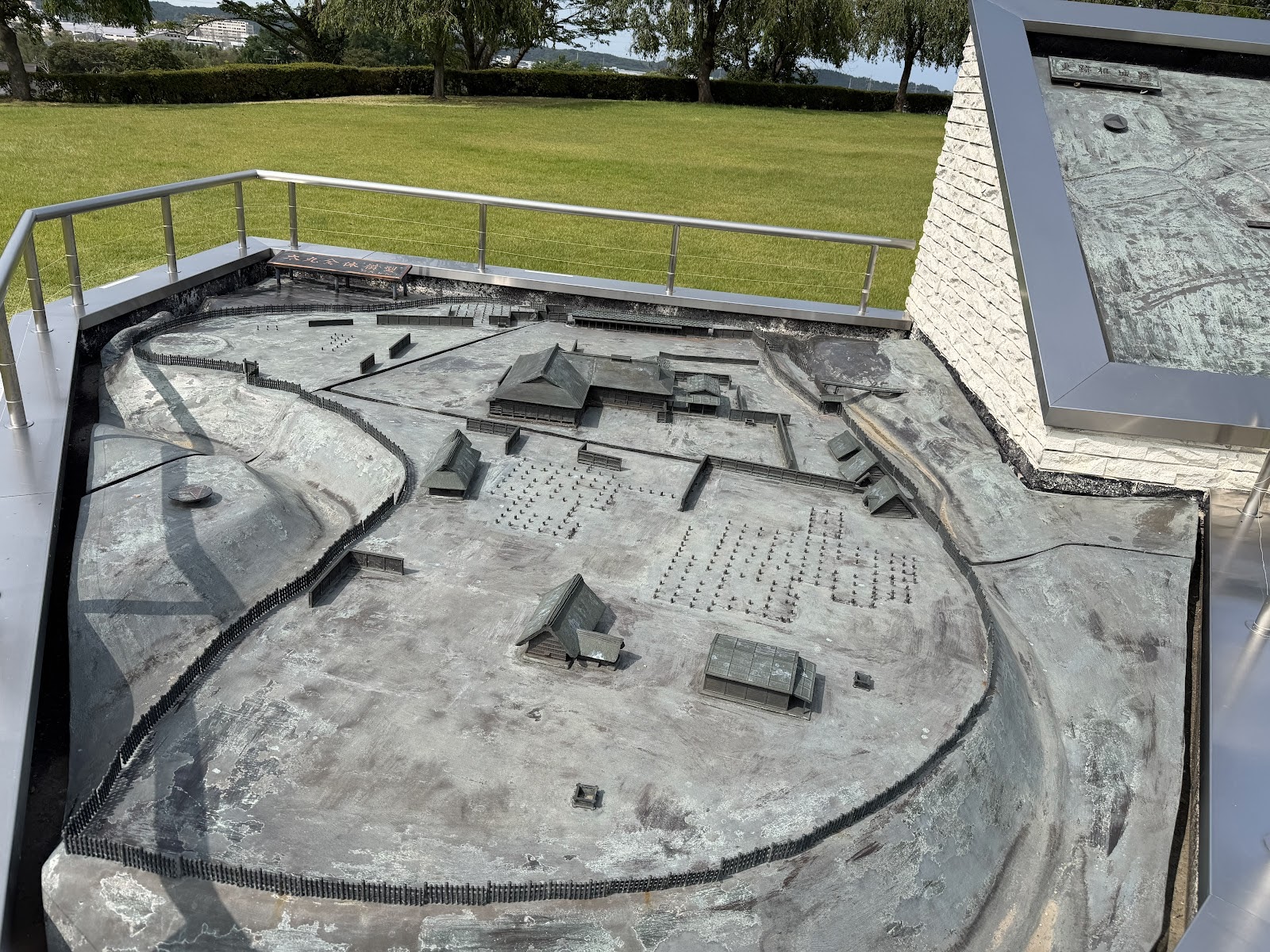
Highlights: an earthen castle with no keep and no stone walls. Inside the main compound you can go up into the main hall.
Practical tip: the Hachinohe City Museum next door is closed for a long period until 30 June 2027 (planned), but its shop and the ground-floor toilets are usable, and the 100 Castles stamp No. 5 and the 300-yen goshuin have not stopped. There is almost no shade on the grounds, so in summer go in the morning.
- Hours
- 9:00 to 17:00 (last entry 16:30)
- Closed
- Mondays (open on the first Monday and on holidays), the day after a holiday, 27 Dec to 4 Jan
- Price
- Main compound 250 yen (free if you stay on the grounds) / goshuin 300 yen, sold on site only
- Getting there
- City bus from the centre (Muikamachi) to “Nejo (Hakubutsukan-mae)”, about 10 minutes, 190 yen
Evening: the spare half-day went on Hacchi and the Book Center
Back in the centre from Nejo it was 15:00, and there was time left over. At Hacchi I bought souvenirs (Yokan au Chocolat, a bath additive scented with Aomori hiba, a Shiny petit Nebuta, Nakayoshi, Tekka Kasi cider, and small things for friends, about 8,000 yen in all), idled through the Sakurano department store, and read at the Hachinohe Book Center. The Book Center is a bookshop run by the city, closed on Tuesdays and open until 19:00 on Sundays. There are chairs and a hammock for reading before you buy, and coffee at the counter.
Around 19:00, in Machiniwa, the covered plaza opposite Hacchi, practice began for a dance that looked like Awa Odori. I did not ask what dance it was. Too worn out even to feel like a drink, and with work on Monday, I went back to the lodging early.
DAY 3Monday 7 September: the boarding point had moved, and I missed the one morning bus
The idea behind the route: the only ground transport that made the 10:00 flight was the 8:05 bus from in front of Hon-Hachinohe Station.
Morning: from Hon-Hachinohe to Misawa Airport, 43 minutes for 10,970 yen
The only route bus that made JAL 152 at 10:00 was the 8:05 from in front of Hon-Hachinohe Station, and I missed it. I had been waiting at the stop in front of the station, but, apparently because of construction, the boarding point had been moved to a road near the station, and by the time I noticed the bus had gone. At 8:13 I caught an Uber taxi at Uchimaru, near Hon-Hachinohe Station, and it took 43 minutes and 27.3 km to Misawa Airport. 10,970 yen. It came out costing more than the 7,520 yen for two nights at Kaikatsu Club.
Between Misawa Airport and Hachinohe, the design is one bus per flight. On the September timetable there are only five departures from in front of Hon-Hachinohe Station, at 8:05, 9:50, 11:20, 15:20 and 17:15, each connecting to a specific flight. Taking the next one, at 9:50, would reach the airport after 10:40 and miss the 10:00 flight. No fallback has been laid on for a missed connection.
I was at Misawa Airport at 8:56. JAL 152, leaving at 10:00, reached Haneda at 11:25, and I went straight to work.
I did not take a single photograph that day.
Changes to the itinerary
If you miss the 8:05 bus
What is left is a taxi. From Hon-Hachinohe to Misawa Airport is 27 km in 43 minutes, and what I paid was 10,970 yen, more than the 7,520 yen for two nights at the lodging. Seeing the boarding point with my own eyes the evening before would have avoided it. Stop positions can move with construction, so having the timetable is not enough. If the return flight is in the morning, stay within walking distance of Hon-Hachinohe Station. The 17 minutes from Numadate to the station eats straight into the margin before being late. If the time band can be narrowed to “morning departure” at the application stage, dropping the Monday morning flight from the candidates is the surest way; an afternoon departure paired with a morning return loses both half a Saturday and Monday morning.
If you wait for a train at Tanesashi Coast
The Hachinohe Line runs every two hours in the daytime. Towards Hachinohe from Tanesashi-kaigan on Saturdays, Sundays and holidays, the trains are at 8:20, 10:27, 12:19 and 14:12, then nothing until 18:08. To go back without walking, the city’s sightseeing bus “Umineko-go” costs 150 to 200 yen and takes 26 minutes to Same Station. Walking, it is about 8 km to Kabushima, with a guide estimate of four hours and an actual 2 hours 10 minutes. Either way, decide how you are getting back before sitting down on the lawn. Arrive without deciding and you end up like me, letting the 8:20 go and setting off on foot.
Rearranging for a rainy day
Drop the walking path and the market. The Tatehana Quay Morning Market is on an uncovered quay, not a place to hold an umbrella and walk an 800 m L-shape out and back. The coastal path is the same, and the sand of Osuga Coast gets heavier still when wet. Move towards the centre instead: Hacchi, the Hachinohe Book Center and the main compound of Nejo. Nejo is outdoors, but because you can go up inside the main hall it holds together even in rain. The same thing happens with the seasons: from late December to mid-March, when the market takes its break, this second day does not work at all. To see the black-tailed gulls, the window is late February to mid-August, but from May to July you borrow an umbrella on the approach to climb up.
Choosing where to stay
The centre of Hachinohe is clustered around Hon-Hachinohe Station, and both the market train and the airport bus leave from in front of the station. I chose Numadate for the price, but the 1.4 km to Hon-Hachinohe Station told both when I left at 5 in the morning and when I needed the return bus.
Super Hotel Hachinohe Natural Hot Spring from 3,080 yen
What this trip cost
The premise is one person, two nights, departing from Fujisawa. The flight was on Dokokani Mile (standard 7,000 miles round trip, booked this time for 1,500 miles with the JAL Mobile benefit), so it is left out of the yen total, and only what left my wallet on the ground is listed, by payee. The lodging is a lockable private room at Kaikatsu Club at 3,760 yen a night. Only three items are estimates: the morning-market snacking, the Kabushima Shrine amulet, and the Hacchi souvenirs.
Out-of-pocket costs are from payment records for 5 to 7 September 2026. Times and fares were checked on each official site on 14 October 2026.
Of the 41,058 yen, 10,970 yen, a little over a quarter, is the taxi on the last day. The lodging for two nights is 7,520 yen, so the 43 minutes that morning cost more than both nights. This is the single point that moved the total most, and the flip side is that had I made the 8:05 bus, the cheapness of the lodging would have stayed intact in this route.
The distance walked on day two, adding the round trip at the market and the 8 km from Tanesashi to Kabushima, came to around 20 km. The morning began with a 5 o’clock wake-up, and with a 10:00 flight home, Monday morning is lost to travel too. This way of putting the trip together does not suit people who do not want to walk, who do not want to be up at 5, or who want to book something for Monday morning. For those who do not mind walking and want to use the whole weekend, it comes out cheap, because the lodging stays at 7,520 yen for two nights.
The flight is not converted to yen because the price of 7,000 miles differs from person to person. Even for the same 7,000 miles, the weight of a mile changes with how it was earned and what it would otherwise be spent on. Here only what left my wallet on the ground is listed. The way of thinking that turns miles and points into yen for comparison is set out in the round-trip cost comparison of miles and JRE POINT. If you plan to buy the ticket with cash, price movements through the year are better followed in the airline sale calendar.
Next time I apply for Dokokani Mile, I will narrow the time band to “morning departure” before the candidates come up. And the return bus time goes on paper the night before, by the pillow.
Source: the official sites of JAL, Misawa Airport, Towada Kanko Dentetsu, JR East, Hachinohe City Transportation Department, the Tatehana Quay Morning Market, VISIT Hachinohe and the Nejo historic site grounds (checked 14 October 2026). Photos: all taken by me on 5 and 6 September 2026.
Other sales ending soon
 4 days leftuntil Oct 24Air Busan Takamatsu-Busan Coupon: Up to 9,000 Yen Off Until October 24
 5 days leftuntil Oct 25JAL Hong Kong Campaign: Tokyo–Hong Kong Round Trip from 75,800 Yen (until 25 Oct)
 11 days leftuntil Oct 31Jin Air Kobe–Seoul: 5,000 yen off a round trip with code KTOUKB1, until 31 October
 11 days leftuntil Oct 31Jin Air to Busan: 4,000 yen off a round trip with code KTOPUS, first 300 only