Is Dokokani Byuun Worth It? The Break-Even on a 6,000-Point Shinkansen Round Trip
AuthorMIRUTOBE editors
Table of Contents6 items
JRE POINT converts to a Suica top-up at one point per yen, so those figures are literally the multiple you got. From Tokyo, drawing Nagano is worth JPY 16,900 of reserved seats and Akita JPY 36,520 — every station beats the top-up, but the near ones by less than half as much.
Dokokani Byuun is a JR East scheme: you spend points, and the computer picks your Shinkansen destination out of four candidates. It needs Japanese-language accounts on Eki-Net and JRE POINT, and everything below is in yen.
Check first: whether you can even reach the application screen
- You have registered on Eki-Net
- You have registered on the JRE POINT website
- You have linked your JRE POINT member number on the Eki-Net side
- Your departure station is Tokyo, Ueno, Omiya, Sendai, Morioka, Niigata or Nagano
- You genuinely do not mind which of the four candidate stations comes up
Without the third item you cannot get as far as the application screen, which is the first wall: this is not something you decide to use on the morning of the trip. Once the destination is settled you sign back in to Eki-Net and register an IC card number against each traveller’s seat. On the day you tap through the gate with that card and no paper ticket is issued. Travelling companions each need a number of their own.
One station out of four candidates
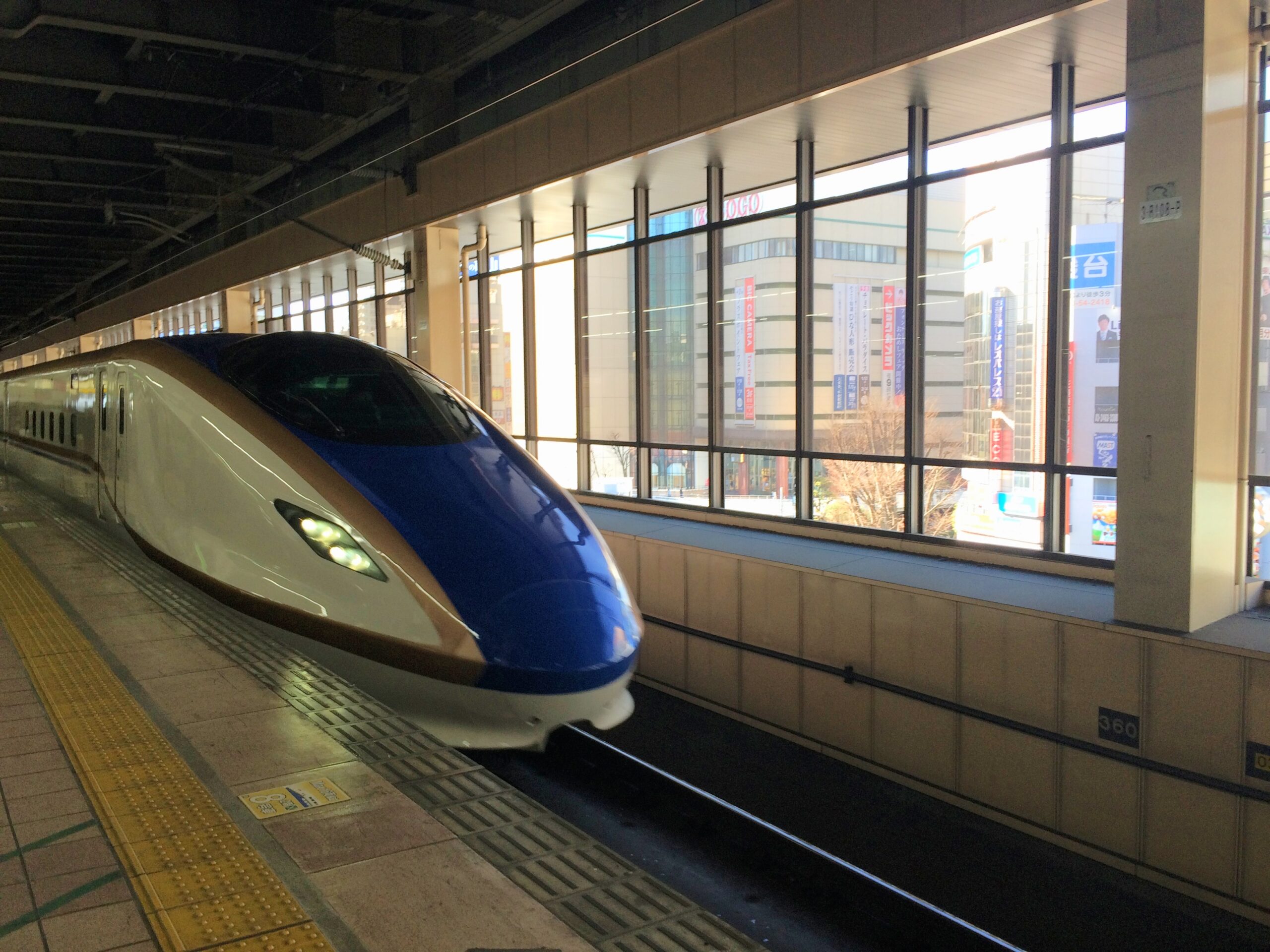
You enter the origin, the outbound and return dates, a time band and the number of travellers, and four candidate destinations appear. Accept that any of the four would do, apply, and within three days the destination and the train are fixed and sent by email. If you do not like the four, you can search again and draw a new set.
Two advantages here are specific to rail. A group application is seated together, and you can apply alongside companions who hold no points at all. Inside a single application, each traveller can spend their own points or one person can cover everybody.
Applying from Tokyo, Ueno or Omiya, the Tohoku Shinkansen candidate list on the official site runs to 18 stations: Nasushiobara, Shin-Shirakawa, Koriyama, Fukushima, Shiroishi-Zao, Sendai, Furukawa, Kurikoma-Kogen, Ichinoseki, Mizusawa-Esashi, Kitakami, Shin-Hanamaki, Morioka, Iwate-Numakunai, Ninohe, Hachinohe, Shichinohe-Towada and Shin-Aomori. The Akita, Yamagata, Joetsu and Hokuriku stops are added on top. Written out, most of them are stations whose names you know and whose platforms you have never stood on. Sendai and Shin-Aomori are a small part of the list, and the odds favour something more like Shiroishi-Zao, Furukawa, Mizusawa-Esashi or Iwate-Numakunai.
What a point is actually worth
The comparison JR East publishes is against an ordinary JRE POINT award ticket: Tokyo to Akita and back normally takes 28,000 points, against 6,000 here, a difference of 22,000. That is a comparison drawn against one of the longest possible results, though, so it overstates what you should expect. Working back from the standard fare is more useful.
All are ordinary-car reserved seats in normal season. Nagano reflects the fare revision of March 2026; Kanazawa is the figure JR East’s View Card page gives as current at 14 March 2026; Akita is the Shinkansen e-ticket price for purchases from 14 March 2026. Off-peak dates are JPY 200 less, peak dates JPY 200 more and the highest peak JPY 400 more.
Because JRE POINT tops up a Suica at one point per yen, a point is never worth less than JPY 1. Nagano, the near end, returns 2.8 times that; Akita six times. Which is where the conclusion comes from: whatever station you draw, this beats topping up the card.
Where people trip up
Valuing a short draw at the standard fare flatters it
JPY 2.82 for Nagano and JPY 6.09 for Akita are more than a factor of two apart for the same 6,000 points. “Every station is a good result” is true. “Every station is an equally good result” is not.
Look one level closer and the character of the route matters as well. Tokyo to Nagano runs in the 1 hour 20 minute range and has no competing conventional-line limited express, so short of dropping to a highway coach the Shinkansen is the only way, and the JPY 16,900 you did not pay is money you really would have spent. Tokyo to Nasushiobara is a distance you can cover on ordinary trains, so part of that “saving” is money you would never have handed over in the first place. On a short draw, the accurate way to value it is against what you personally used to pay on that stretch, not against the Shinkansen fare. If the point of the trip is time on the ground rather than distance, as in the Kanazawa two-day plan, the near stations buy you more hours there.
Leaving a JRE BANK discount coupon unused
Hold a JRE BANK account and you are issued discount coupons that bring this scheme down from 6,000 points to 4,000, up to twelve a year. The conditions are assets of JPY 500,000 or more plus Eki-Net linkage and either View Card direct debit or salary paid into the account, assessed at the close of 25 March and 25 September.
Draw Nagano on 4,000 points and the point is working at about JPY 4.23. For a JRE BANK customer, applying at 6,000 with a coupon sitting unused is simply money left on the table.
The other side is worth writing down too. JRE BANK also issues preferential vouchers taking 40% off a one-way fare within the JR East network, up to ten a year at JPY 500,000 of assets and more above JPY 3,000,000, assessed at the close of 25 June and 25 December. Tokyo to Nagano at JPY 8,450 becomes JPY 5,070, or JPY 10,140 return. Covering JPY 16,900 with points is the larger number, but the vouchers are finite and each one is worth more the further you go. The right order is to spend this scheme on the short runs and keep the 40% vouchers for the long ones — which makes a near draw here a voucher preserved rather than a disappointment.
In peak weeks the candidates do not appear at all
The number of seats released is capped, and JR East states plainly that applications covering the Obon period may not produce any candidate destinations. You do not choose the train either; what gets fixed is the destination and the service together, with your preferred time band specified at the search stage. There are also system maintenance windows, so if you are aiming at dates where applications bunch up, read the official notices first.
And 6,000 points, or 5,000, is further away than it sounds without a deliberate way of earning them. How the balance builds up by category is set out in the View Card earning rates.
What if you also hold JAL miles: which to spend first
The airline side has its own mystery-destination scheme in JAL’s Dokokani Mile. Holding both balances, the order in which you run them down changes what a year of travel costs. Side by side on the same terms:
Spend this one first, for three reasons. There is room to bring it down to 4,000 points with a JRE BANK coupon. Stations sit close to city centres, so a short draw costs you less. And Dokokani Mile has to be squeezed into ten days, which makes the timing of it less free. The order to run two balances down in is worked through in the comparison of round-trip costs by funding source.
You have at most three days between seeing the four candidates and the confirmation. Using them to look at room rates in all four places means not scrambling afterwards. Prices in Tohoku and Hokuriku differ sharply between an onsen inn and a business hotel by the station, so deciding a ceiling in advance is the practical move. Holding the transport down and putting the money on the ground is the same approach taken in the Nikko day-trip breakdown.
Common questions: the Green car version, the children’s offer, redrawing
Is there a version with Green car seats?
Yes, Dokokani Byuun! Greeen! has run since 1 December 2025. It costs more points than the standard version but keeps the same mystery-destination framework with a Green car seat. The number of points changes from offer to offer, so read the official figure at the time you apply.
Is there a discount for children?
For applications from 10:00 on 26 June 2026 JR East ran Dokokani Byuun! with Kids, a summer-only 50% reduction for children. It was capped by number of uses, and seasonal offers of this kind change their terms from year to year, so a family should read the official announcement first.
Can I keep redrawing until I like the candidates?
You can search again and get a new set of candidates. What you cannot do is pick which of them you end up with. Anyone who treats not choosing the destination as a serious risk should leave this alone. For anyone with two free days at the weekend and no appetite for deciding where to spend them, it is a tool that takes the deciding off your hands as well.
- Eki-Net — Dokokani Byuun official (points required, departure stations, candidate destinations, seating) ↗Checked on 2026-08-12
- JRE BANK official (discount coupons and preferential vouchers: counts and assessment dates) ↗Checked on 2026-08-12
- JR East View Card (Tokyo–Kanazawa fare, current at 14 March 2026) ↗Checked on 2026-08-12
Source: the reference block above / fares are those in force after the revision of 14 March 2026 / Photo: Wikimedia Commons / Checked on: the Eki-Net and JRE BANK items 2026-08-12, the standard fares 2026-09-20
Other sales ending soon




 4 days leftuntil Oct 24Air Busan Takamatsu-Busan Coupon: Up to 9,000 Yen Off Until October 24
 5 days leftuntil Oct 25JAL Hong Kong Campaign: Tokyo–Hong Kong Round Trip from 75,800 Yen (until 25 Oct)
 11 days leftuntil Oct 31Jin Air Kobe–Seoul: 5,000 yen off a round trip with code KTOUKB1, until 31 October
 11 days leftuntil Oct 31Jin Air to Busan: 4,000 yen off a round trip with code KTOPUS, first 300 only