Shikoku by Seishun 18 Ticket: Yosan and Dosan Line Scenic Routes
AuthorMIRUTOBE editors
Table of Contents8 items
- Itinerary
- DAY 1 Take the coast line and put the late afternoon at Shimonada
- DAY 2 Give the whole day to the Yodo Line, the one place you leave JR
- DAY 3 North through the gorge, a stop in Tokushima, then home to Takamatsu
- Alternatives
- Why we left out Ritsurin Garden and Katsurahama
- Where to stay
- What this trip costs
Three days from Takamatsu through Matsuyama, Kochi and Tokushima and back. No limited expresses — local and rapid trains only, in unreserved ordinary cars. Two three-day Seishun 18 Tickets, JPY 20,000, and extra distance adds nothing to that.
Itinerary
DAY 1Take the coast line and put the late afternoon at Shimonada
Why the day runs this way: past Iyoshi the Yosan Line splits into a newer inland route and an older one along the sea. The coast line takes longer, but the point of this trip is the view from the window rather than the travelling, so the slow one wins.
Morning: load up on food before leaving Takamatsu
West from Takamatsu Station on a Yosan Line local. Matsuyama is the destination for the day, which means a long time aboard. Shikoku locals have no trolley service and a great many unstaffed stations, so buy drinks and food in Takamatsu. Sanuki udon shops open near the station in the morning, and one bowl before boarding holds until the afternoon.
Decide which side to sit on as well. Past Iyoshi the coast line puts the Iyo-nada on the right in the direction of travel, so heading for Matsuyama you want a right-hand window. Moving one carriage along the platform while you wait changes the odds of getting one.
Afternoon: change at Iyoshi onto the coast line
The Yosan Line divides just beyond Iyoshi Station: a newer line cutting inland via Uchiko, and the coast line looping through Iyo-Nagahama along the water. Every limited express takes the new line, so the only way onto the coast line is a local. On a trip run with a Seishun 18 Ticket you would not be boarding an express anyway, which makes the choice an easy one.
Keeping the third row on the table from the start is the trick to this trip. A Seishun 18 Ticket does not admit you to a limited express, but buying a basic fare ticket and an express ticket separately does, and the 18 Ticket does not have to be abandoned to do it. Treat it as insurance for the day that would otherwise be lost whole. The conditions attached to the ticket are set out in the periods, prices and consecutive-day rule of the Seishun 18 Ticket.
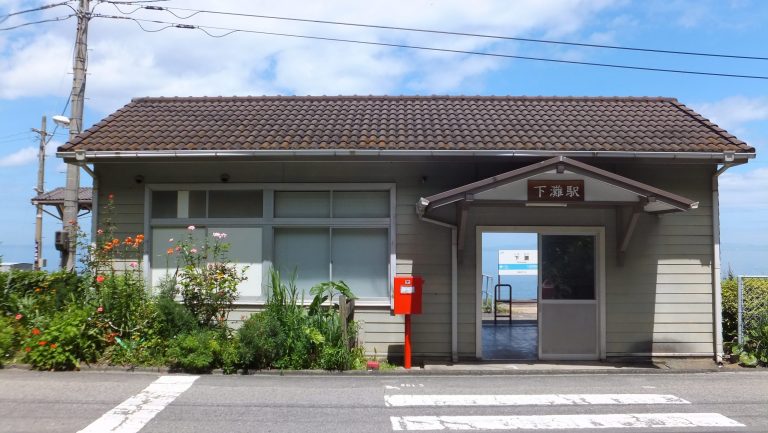
What it is: nothing stands between the platform and the Iyo-nada — no road, no buildings — so sitting on the bench puts the sea across the lower half of your field of view. Late afternoon, when the light drops onto the water, is when it works hardest. The station is unstaffed and has no barriers, so with a Seishun 18 Ticket you do nothing on arrival and show it to the driver on the next train you board.
In practice: trains are infrequent, so getting off leaves 1 to 2 hours until the next one. Plan that as time spent here rather than time waiting. A stand outside the station sells coffee, but its opening days are not fixed, so carry a drink off the train with you.
- Line
- JR Yosan Line (the coast section, Iyoshi to Iyo-Nagahama)
- Barriers
- Unstaffed, no ticket gates
- Best time
- From an hour before sunset
Evening: reach Matsuyama and get into the water first
Matsuyama Station to Dogo Onsen is a ride on the Iyotetsu city tram, which the Seishun 18 Ticket does not cover, so that fare is paid separately. One section of day one does not close out on JR alone; it is worth knowing in advance.
What it is: pricing splits five ways according to how far into the building you go. The lightest, Kami-no-yu bath only, is JPY 700 for an adult, 6:00 to 23:00 with last admission at 22:30, and 60 minutes of use. Kami-no-yu with a rest on the second floor and a loan yukata is JPY 1,300, 6:00 to 22:00. Adding the Tama-no-yu and free viewing of the Yushinden is JPY 2,000 on the second floor, or JPY 2,500 for a third-floor private room.
In practice: on a day when a late train puts you there after 22:00, only the 23:00 closing of the bath-only option is still open. If the arrival time cannot be pinned down, build the day around the JPY 700 option from the start. The guided viewing of the Yushinden is JPY 500 for an adult and runs a fixed number of times a day.
- Price
- Kami-no-yu bath only: adult JPY 700 / child JPY 350
- Hours
- 6:00–23:00 (last admission 22:30)
- Three-bathhouse ticket
- Adult JPY 1,440, valid the day of purchase and the day after
To do all three of Dogo Onsen Honkan, Tsubaki-no-yu and Asuka-no-yu Onsen, the Dogo Onsen three-bathhouse ticket is JPY 1,440 for an adult, about 20% below the separate prices. It is valid on the day of purchase and the following day, so a night in Matsuyama lets you use the second bath the next morning. This itinerary leaves for Uwajima on the morning of day two, though, and a morning bath costs you one train.
DAY 2Give the whole day to the Yodo Line, the one place you leave JR
Why the day runs this way: the Yodo Line runs very few trains, and losing one connection means not reaching Kochi at all. Nothing sightseeing-shaped goes into this day; riding the train is the plan.
Morning: down through southern Ehime to Uwajima
Matsuyama to Uwajima on the Yosan Line. This stretch runs through inland hills and the character of the view changes completely from the coast. The connection onto the Yodo Line at Uwajima is thin enough that leaving Matsuyama one train earlier can change the wait at Uwajima by more than an hour. Check the timetable for your actual date on JR Shikoku’s official schedule.
Afternoon: along the Shimanto River to Kubokawa
What it is: past Ekawasaki the track draws close to the Shimanto, and the chinkabashi — low bridges built without railings, designed to be submerged when the river rises — appear outside the window again and again. Themed trains such as the Kaiyodo Hobby Train and the Seiryu Shimanto run on some days, which changes what the inside of the carriage looks like. The slow speed is what lets you see the colour of the water and the shape of the bridges properly.
In practice: the single section between Kubokawa and Wakai belongs to the Tosa Kuroshio Railway, and the Seishun 18 Ticket is not valid on it. Yodo Line trains run through to Kubokawa, so boarding at Kubokawa means paying that fare separately, settled on board or at the station — carry coins. Assuming it is fine because the train is running on JR metals is exactly where people come unstuck.
- Frequency
- As few as a handful of trains a day in some periods
- Paid separately
- Kubokawa–Wakai (Tosa Kuroshio Railway, Nakamura Line)
- On board
- No kiosk, no vending machine. Buy drinks before boarding
At Kubokawa you change onto the Dosan Line for Kochi. That puts the thinnest stretch of the whole trip behind you. This afternoon carries the most tension of the three days, which is another way of saying that once it is done the frequencies improve.
Evening: shake the day off in Kochi
From Kochi Station to Hirome Market in the centre is a Tosaden Kotsu tram ride or a walk. The market seats several businesses around shared tables, which makes it easy to eat alone provided you secure a seat first. Katsuo no tataki is served with salt as well as with sauce, and the two are different enough to order as separate things.
What it is: a roofed block mixing food stalls and shops where you eat what you buy at communal tables. Each stall bills separately, so the pattern is katsuo no tataki from one, tempura from another, drinks from a third. After two days on trains, a structure that lets you sit down and still visit several places is worth a lot.
In practice: take a seat first, then go and buy. People hold tables with their bags, so leave a large bag at the accommodation before coming. The Dosan Line runs few trains the following morning, and drinking too much here means sleeping through Oboke on day three.
- Getting there
- Tosaden Kotsu tram from Kochi Station, or on foot
- Paying
- Separately at each stall. Keep cash in small amounts
- Next morning
- If you want the first Dosan Line train, do not drink late
That is day two finished. Set against the hours spent moving, what you have seen is a view from a window, a river and a market. This itinerary suits people for whom that is enough.
DAY 3North through the gorge, a stop in Tokushima, then home to Takamatsu
Why the day runs this way: the hour you have to be back in Takamatsu is fixed. Only one stop fits, in Tokushima, so the day is counted backwards from a performance at the Awa Odori Kaikan whose start time is published.
Morning: Oboke and Koboke from the window
North from Kochi Station on the Dosan Line, the track follows the Yoshino River into the Oboke and Koboke gorges. The train runs well above the water, so the rock and the river line up beneath you. Getting off at Oboke for a sightseeing boat is a possible variation, but the return frequency on this itinerary is not sufficient and stepping off means missing Tokushima. Deciding in advance to take this one through the window is what makes the day work.
What it is: a V-shaped valley cut by the Yoshino River, with water close to emerald green. The line alternates tunnels and bridges, so the open stretches come in fragments. It is better approached as something that reappears each time you leave a tunnel than as a continuous view.
In practice: travelling north from Kochi towards Awa-Ikeda, the river sits on the left for long stretches. If you do want the boat, it is a round trip from Oboke Station, and adding the wait for the next local erases Tokushima from the day. Taking the boat means rebuilding this as three nights rather than two.
- Section
- JR Dosan Line, Oboke to Koboke
- Change
- Awa-Ikeda, onto the Tokushima Line
- Which side
- Kochi to Awa-Ikeda: the left
For photographs, Koboke, the nearer of the two to the water, is the better of the pair. Both are gorges named for treacherous footing, though, and there is nowhere trackside to stand. It is a view you can only take from inside the carriage.
Afternoon: change at Awa-Ikeda for Tokushima
Change at Awa-Ikeda onto the Tokushima Line. Staying on the Dosan Line north takes you out into Kagawa, so this is the turning point of the circuit. The Awa Odori Kaikan is within walking distance of Tokushima Station.
What it is: the resident troupe Awa no Kaze performs four times a day at 11:00, 14:00, 15:00 and 16:00, 40 minutes each, at JPY 1,300 for an adult and JPY 700 for school-age children. In the evening the well-known troupes take turns in a single 50-minute performance from 20:00, at JPY 1,600 for an adult and JPY 800 for children. Both include a section where the audience joins in, and the hall seats 250.
In practice: working back from the last local to Takamatsu, the only one this itinerary can take is the 16:00 daytime performance. Choosing the 20:00 evening show means a night in Tokushima, and two nights become three. The hall closes on the second Wednesday of February, June, September and December (the following day if that is a public holiday) and from 28 December to 1 January. Going in September, avoid the second Wednesday.
- Daytime
- 11:00, 14:00, 15:00, 16:00 / adult JPY 1,300
- Evening
- From 20:00 / adult JPY 1,600
- Closed
- Second Wednesday of February, June, September, December; 28 Dec–1 Jan
Tokushima back to Takamatsu is the Kotoku Line. A bowl of Tokushima ramen before boarding is an option, but check what the last trains are before committing to it. Dropping one here means paying for a third night.
Alternatives
Rainy-day swap
Shimonada does not work in the rain. Only part of the platform is covered and the sea turns grey, so neither the photograph nor the memory survives. If rain is forecast, drop the coast line on day one, go into Matsuyama on the new line and spend the recovered time on a higher tier at Dogo Onsen. The JPY 2,000 Tama-no-yu second-floor option comes with a loan yukata and a rest room for 90 minutes. As a way of filling a wet late afternoon indoors, it beats standing on an exposed platform getting wet.
If you lose one connection
The Yodo Line on day two is the dangerous one. Miss the connection at Uwajima and the next train is hours away, which puts Kochi out of reach for that day. The moment you know you have missed it, abandon the Yodo Line, go back from Uwajima to Matsuyama, take a second night there and rebuild day three as a direct run to Kochi. The alternative is to buy a basic fare ticket and an express ticket for that section alone and keep going. A Seishun 18 Ticket does not admit you to a limited express, but buying the two tickets separately does. Spending on one section to rescue a whole day is the cheaper judgement.
When you’re tired
Three days on longitudinal bench seats and your lower back and shoulders stop cooperating around the second evening. At that point, drop Tokushima from day three entirely and run straight back to Takamatsu from Kochi on the Dosan Line. The circuit no longer closes, but the JPY 1,300 at the Awa Odori Kaikan and one change of train disappear and you arrive several hours earlier. The more attached you are to completing the loop, the harder the last day pushes.
Why we left out Ritsurin Garden and Katsurahama
Ritsurin Garden in Takamatsu and Katsurahama in Kochi appear in every article written about Shikoku. Both are left out here. Ritsurin is more than an hour there and back from Takamatsu Station by tram and bus, and Katsurahama is over 30 minutes each way by bus from Kochi Station; both are too long to slot between train connections. Spend the morning of day one at Ritsurin and you miss the train that gets you onto the coast line at Iyoshi.
What the omissions buy is time for the window, the baths and the performance. On a Seishun 18 Ticket trip, every destination you add eats into the slack in the connections until everything feels rushed. If seeing the famous places is the object, an itinerary built on limited expresses without the ticket suits it better.
Where to stay
Because arrival times cannot be pinned down, the accommodation only has to do two things: be walkable from the station, and have a large bath. A body that has spent a day on local trains does not recover under a shower.
Whether both nights go beside a station, or the first goes to the hot spring, is decided by what you want the mornings to do. Dogo Onsen Honkan opens at 6:00, so bathing and then returning to Matsuyama Station is physically possible. Add the tram journey and the wait for it, though, and you reach the station a good 30 minutes later. On a day when the Yodo Line connection has no slack, those 30 minutes are fatal.
Kochi goes the other way: for night two, beside the station is the only sensible choice. You arrive after two connections on the Yodo and Dosan lines, so the hour is unpredictable. Somewhere within walking distance means no hunting for transport when the train is late. The Dosan Line on day three leaves from Kochi Station too, so the morning involves no travel at all. The wish to stay somewhere with hot springs is understandable, but adding a journey to night two of this itinerary does not pay.
Choosing Dogo or the area by Matsuyama Station for night one changes what time day two starts. Dogo gives you the 6:00 opening and a morning bath, at the cost of the tram back to the station. If the plan is to catch an earlier Yodo Line connection, staying by the station and giving up the bath is the rational trade. Trying to have both leaves you 20 minutes short in the morning.
What this trip costs
The longer version is worth knowing about. The five-day ticket is JPY 12,050, or JPY 2,410 a day — about JPY 920 a day cheaper than the three-day version, so five consecutive days of movement improve the efficiency of the total. Adding two days to a Shikoku circuit means a day of sightseeing in Matsuyama and another in Kochi, which creates days on which you do not travel and wastes a day of the ticket. The five-day version earns its keep on an itinerary that crosses to Honshu afterwards and keeps moving.
The figures below are for two people over three days, excluding accommodation and meals. A Seishun 18 Ticket covers one person and cannot be transferred or lent, so two people buy two. The three-day version costs the same for adults and children and works out at about JPY 3,333 a day. If you cover more than JPY 3,333 of ordinary fares every day in Shikoku, the ticket is the cheaper route.
Every price above is as published officially, checked on 2026-09-14. Seishun 18 Ticket prices are the summer 2026 issue (three-day version JPY 10,000, five-day version JPY 12,050).
Each issue of the Seishun 18 Ticket carries its own usable period, and the summer 2026 issue ran from 18 July to 8 September. It was sold from 3 July to 6 September, with the five-day version on sale until 4 September. The winter issue is set separately, so once your dates are fixed, check the sale period and the usable period first. Outside that window not a single day of it works. How the scheme reads as a whole is covered in the periods, prices and consecutive-day rule.
Whether this itinerary repays the ticket comes down to that JPY 3,333 a day. Takamatsu to Matsuyama, Matsuyama to Kochi, Kochi to Takamatsu via Tokushima — each of those is far enough to cost over JPY 3,000 in ordinary fares, so all three days clear the line. Ride on day one and then spend day two sightseeing in Matsuyama, on the other hand, and that day’s JPY 3,333 is thrown away whole. A consecutive-day ticket cannot accommodate a day without travel. If you want a sightseeing day in the middle, buying ordinary tickets section by section comes out cheaper.
The time budget is worth looking at too. Over three days, the hours spent on trains exceed half your waking hours; that is the character of this trip. Day two treats riding the Yodo Line as the objective, so you are on trains and platforms from morning until evening. Days one and three move in the morning and fit one thing in the afternoon and one in the evening, which caps sightseeing at one or two places a day. Read it as circling Shikoku and calling at one place along the way, not as circling Shikoku and seeing the sights.
The refund conditions are worth knowing before you buy. Unused, the three-day version returns JPY 9,780 after a JPY 220 handling charge, but once it has been through a barrier and started, there is no refund. Nor is there, as a rule, if trains are cancelled after you have started using it. Typhoon season overlaps the summer usable period exactly, so look at the week ahead before fixing the first day. Before it starts, a refund and a fresh plan are still available.
How you pass a barrier has changed as well. The ticket is now a magnetic one fed into the automatic gate, not tapped like an IC card. Unstaffed stations have no gates at all, so you show it to staff at a staffed station or to the driver on a one-person-operated train. Shikoku locals run through long chains of unstaffed stations, so in practice the only automatic gates you meet are at Takamatsu, Matsuyama, Kochi and Tokushima. From the winter 2024 issue the old “five uses on any days you like” system was withdrawn, and the ticket is now consumed on consecutive days from the day you start. That is why this itinerary fits the three-day version exactly, and why using it across separate weekends is no longer possible.
This itinerary does not suit anyone who wants to see a lot of famous places, or anyone who needs arrival times to be certain. One missed connection shifts everything behind it, so it is a poor choice if you have something booked for the evening of day three. If the appeal is riding for its own sake but a single day is enough, scenic day trips from Tokyo are easier to assemble. For two nights and three days outside Shikoku, Kanazawa and Kaga Onsen is the same length with the ratio of movement to staying put reversed.
Source: JR East, Seishun 18 Ticket / Dogo Onsen Honkan, prices and opening hours / Awa Odori Kaikan, admission / Tosa Kuroshio Railway — each official site / Photo: Sunport1216, CC BY-SA 4.0 (Wikimedia Commons) / Checked on 2026-09-14
Other sales ending soon




 4 days leftuntil Oct 24Air Busan Takamatsu-Busan Coupon: Up to 9,000 Yen Off Until October 24
 5 days leftuntil Oct 25JAL Hong Kong Campaign: Tokyo–Hong Kong Round Trip from 75,800 Yen (until 25 Oct)
 11 days leftuntil Oct 31Jin Air Kobe–Seoul: 5,000 yen off a round trip with code KTOUKB1, until 31 October
 11 days leftuntil Oct 31Jin Air to Busan: 4,000 yen off a round trip with code KTOPUS, first 300 only