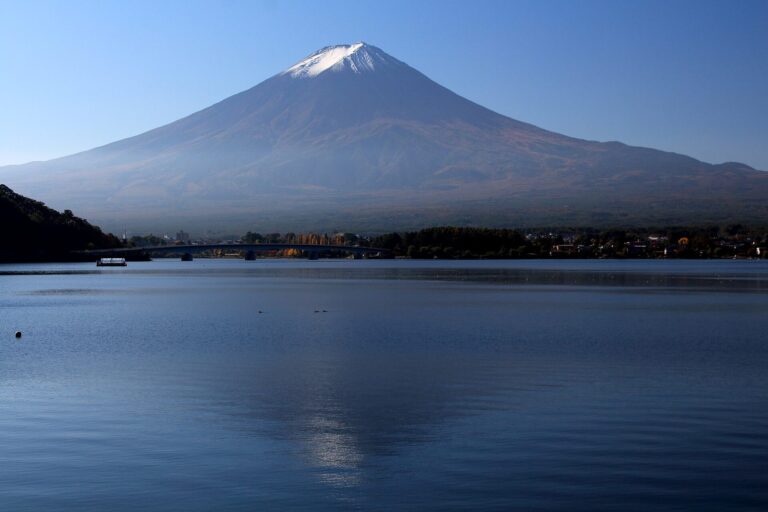
Fuji Five Lakes in Two Days Without a Car: The Total Cost and the Real Bus Connections
AuthorMIRUTOBE editors
Table of Contents7 items
Two days around the Fuji Five Lakes with no car: one highway coach from Shinjuku and three loop bus lines out of Kawaguchiko Station. Ropeway, boat, Oishi Park and both lava caves for JPY 8,000 each. Five Blue Line departures a day fix the shape of it.
Itinerary
DAY 1Make the first day a Red Line day, tied to no timetable
Why this order: the coach’s arrival time is at the mercy of traffic on day one. Build the day on the Red Line alone, which runs every 15 minutes, and a late arrival changes nothing. The line with few departures goes on the day you wake up in Kawaguchiko.
Morning — where you buy the ticket is worth JPY 400 on the round trip
The starting point is Busta Shinjuku, and the coach to Kawaguchiko Station takes about 100 minutes. The published fare table is printed in two tiers: JPY 2,200 bought at the counter against JPY 2,000 bought online. Same coach, JPY 200 a leg, JPY 800 for two people returning. Seats are reserved, so booking the way back at the same time settles day two without a last-coach problem hanging over it.
Overnight services are priced separately, at JPY 3,000 online and JPY 3,350 at the counter from Shinjuku. Half again as much as a daytime coach, and it buys a Friday evening departure after work with the morning already spent in Kawaguchiko. The fare table also states that child fares are half, rounded up to the nearest JPY 10.
First stop on arrival is the bus ticket window for the Kawaguchiko Sightseeing Pass. Adult price JPY 3,300, covering a ropeway return, the sightseeing boat and two days of unlimited loop buses. Bought separately those are JPY 1,000 plus JPY 1,000 plus JPY 2,000, or JPY 4,000, so this single purchase takes JPY 700 off.
The two-day bus element is valid for “the day you start using it and the following day”, so starting at midday still gives you through to the last bus on day two. The free coupon on its own can be bought on board, but only in the one-day version. Calling at the window as soon as you arrive is the reliable route.
There are three loop lines, and the official route map gives every stop a number so you can match it to the on-board announcements. Memorising the number you are getting off at is what stops you overshooting.
First at 9:00, every 15 minutes9 Sightseeing Boat and Ropeway Entrance / 14 Kawaguchiko Museum of Art / 15 Music Forest Museum / 16 Monkey Performance Theatre and Konohana Museum / 17 Itchiku Kubota Art Museum / 20 Kawaguchiko Natural Living CenterThe east and north shores of Lake Kawaguchi. Stop 9 is 3 to 4 minutes on foot from both the ropeway and the boat, stop 17 is a 6-minute walk, and stop 20 is Oishi Park, right at the kerb
First at 9:10, every 30 minutes24 Yagizaki Park / 27 Fuji Omuro Sengen Shrine / 45 Saiko Bat Cave / 48 Saiko Iyashi-no-Sato Nenba / 49 Saiko Wild Bird Forest ParkTowards Lake Saiko. Stop 27 is about a 3-minute walk and stop 48 the same. The Herb Festival site is stop 24
First at 9:35, 5 a day77 Michi-no-Eki Narusawa / 80 Narusawa Ice Cave / 51 Fugaku Wind Cave / 98 Motosuko Tourist InformationThe caves and Lakes Shoji and Motosu. From stop 98 it is about 9 minutes on foot to the Lake Motosu sightseeing boat and about 60 minutes to the Kohan-so viewpoint
Look at the last line of that table. The viewpoint at Kohan-so, the Fuji from the old JPY 1,000 note, is officially described as about 60 minutes on foot from the nearest stop. Being able to reach Lake Motosu by bus and being able to reach that particular composition are two different statements. Which lake gives which view is set out in the guide to where to see Mount Fuji from.
Afternoon — the ropeway and the boat share one bus stop
Eleven minutes on the Red Line from Kawaguchiko Station brings you to Sightseeing Boat and Ropeway Entrance, and from there it is 3 to 4 minutes on foot to either. Getting both out of one slot is what makes Kawaguchi efficient, and it is why the pass is sold as that particular trio.
About three minutes from the lakeside up to a viewing terrace at 1,075 metres, where Lake Kawaguchi and Mount Fuji fit into the same frame. Bought on its own it is JPY 1,000 return for adults and JPY 500 for children, or JPY 600 and JPY 300 one way. Hours are 8:30 to 17:00 with the last descent at 17:20, extended to 18:00 with a last descent at 18:20 only between 20 July and 31 August.
Practical note: the Fuji side falls into backlight as the afternoon goes on, so if photographs matter, ride up before the boat. Either order works otherwise, but the light only moves one way.
- Fare
- Return adult JPY 1,000 / child JPY 500 (included in the pass)
- Hours
- 8:30–17:00 (to 18:00 in high summer)
- Elevation
- Summit station 1,075 m
- Bus stop
- Red Line, Sightseeing Boat and Ropeway Entrance, 3–4 minutes on foot
The sightseeing boat, the Appare, is styled after a Sengoku-period atakebune warship, and from the water the view opens up on the side where Fuji reflects. Allow a little under two hours for the pair and lunch fits in the same area.
The ropeway’s hours are the one thing here that moves with the season. Normally it closes at 17:00 with the last car down at 17:20; only from 20 July to 31 August does that become 18:00 and 18:20. Come September it shuts an hour earlier, so an itinerary built around staying at Oishi Park into the late afternoon for the light will find the ropeway already closed. When the order of an afternoon is unclear, do the thing with a closing time first.
Back on the Red Line a little after two. At 15-minute intervals there is no timetable to read; you take whatever arrives. Twenty-seven minutes from the station, at the far end, Kawaguchiko Natural Living Center is Oishi Park.
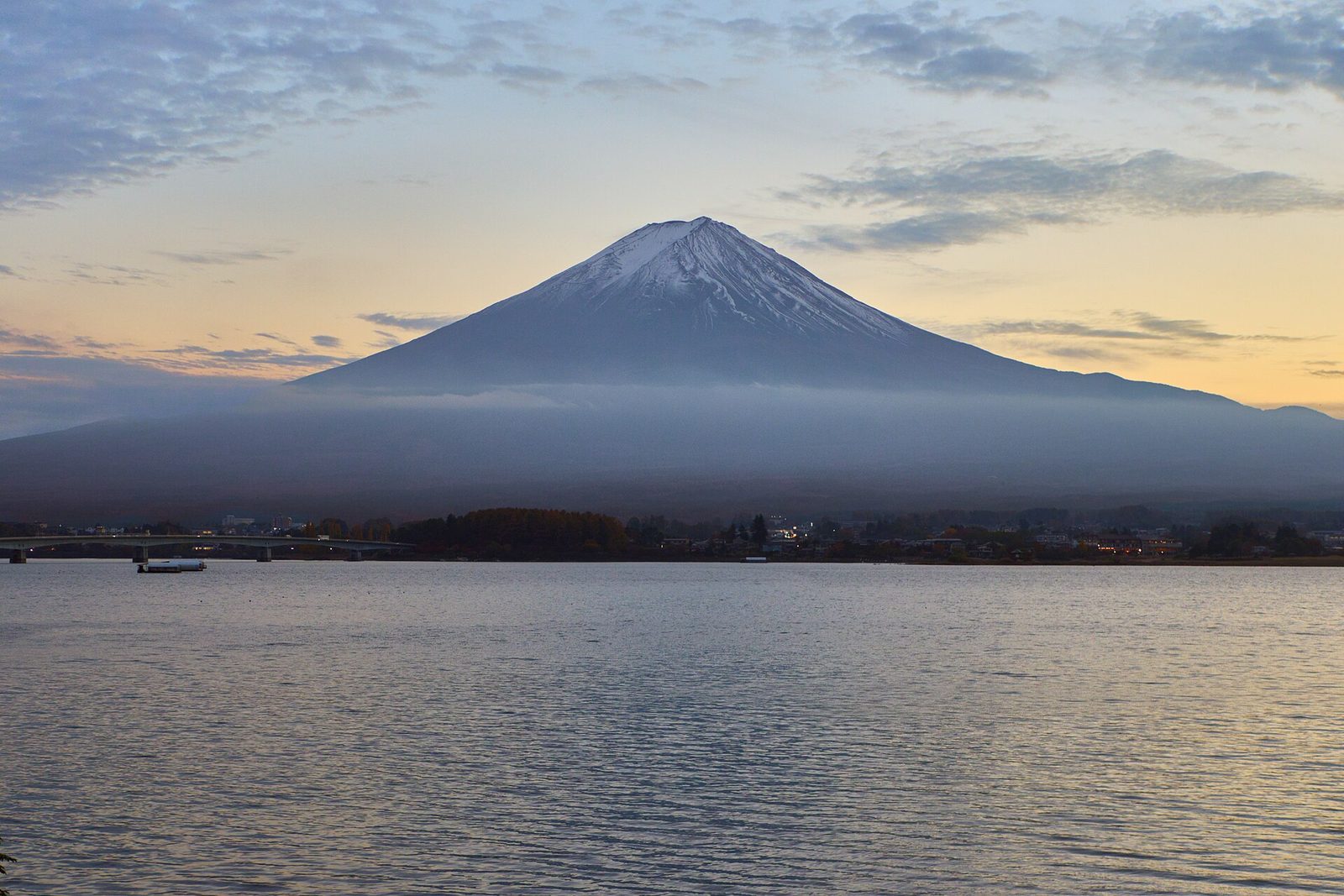
This is the standard composition, Fuji square on across the lake, and admission is free. From late June into July the Herb Festival runs here and at Yagizaki Park, which puts lavender in the foreground.
Practical note: the Natural Living Center sells its own jam, so getting the souvenirs done here frees up time at the station later. The Red Line back also runs every 15 minutes, which means you can stay until the light has finished changing.
- Admission
- Free
- Bus stop
- Red Line stop 20, Kawaguchiko Natural Living Center, at the kerb
- From the station
- 27 minutes
- Best season
- Lavender from late June into July
Evening — choose the hotel by the name of the bus stop
Without a car, judging a hotel stops being about how close it is to the station and becomes about how close it is to a loop bus stop. The Red Line timetable lists stop 8 Funatsuhama Onsen-gai, stop 11 Asakawa Onsen-gai, stop 12 in front of Kaze-no-Terrace KUKUNA and stop 13 in front of Ubuya — the onsen district and the lakeside hotels have stops named after them. Take a room along the east or north shore and even the moving around before and after check-in stays inside the two-day pass.
Do one piece of arithmetic before bed. The first Blue Line of day two is at 9:35 and the next is 10:35. The 10:35 still covers both caves, but it puts you back at the station at 13:45 with lunch pushed late. Find out at check-in how long the loop bus takes from your hotel to Kawaguchiko Station: the first Red Line is at 9:00, so a hotel 20 minutes from the station cannot make the 9:35. In that case either move to the station area the night before or rebuild the day around the 10:35.
DAY 2Pick your Blue Line departure first and build the day around it
Why this order: the Blue Line leaves at 9:35, 10:35, 11:35, 13:35 and 15:35, with nothing in the 12:00 or the 14:00 hour. Miss the 13:35 and the next is 15:35. So the times get fixed first and the time spent looking at things is fitted to the connections.
Morning — the first bus covers both caves without a minute of waiting
Leave Kawaguchiko Station on the 9:35 and you are at the Narusawa Ice Cave at 10:03. Look round, take the 11:03 onwards and you are at the Fugaku Wind Cave at 11:14. The 12:04 back gets you to Kawaguchiko Station at 12:45. The hour or so you spend at the ice cave is exactly the gap to the next bus. On paper the two halves interlock without a minute wasted.
Both caves means the 10:35 at the latest. The 11:35 strands you at the ice cave for two hours because there is no onward bus in the 13:00 hour, and from the 15:35 there is no second cave to move to. What “five a day” really means is that the later you leave, the fewer combinations survive.
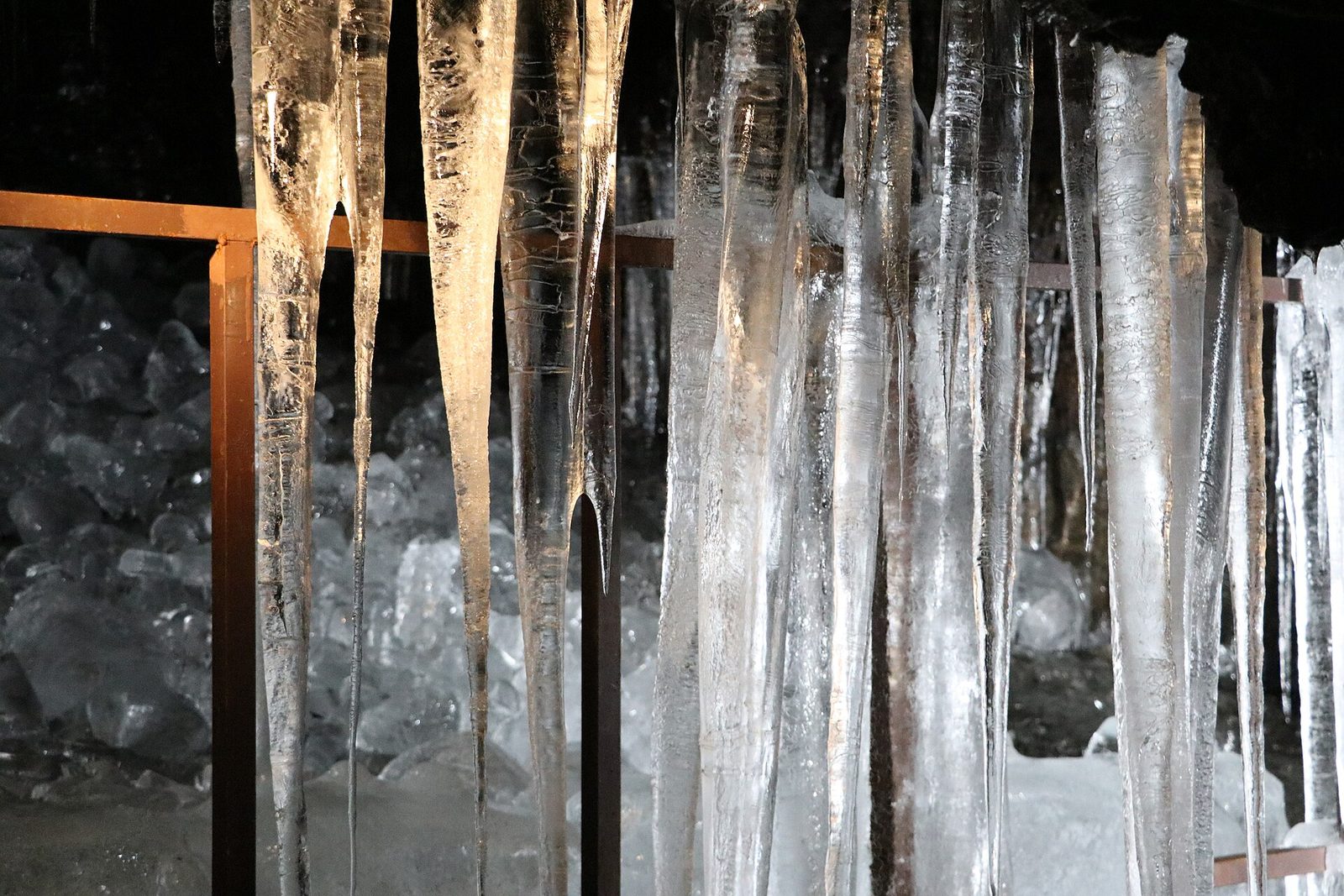
A lava cave under ice all year round, averaging 3 degrees inside. The layout is a loop, so the circuit takes 6 to 7 minutes. Admission is JPY 350 for adults and JPY 200 for primary pupils and under. From 1 August to 15 October it opens 9:00 to 17:30; the hours change with the season.
Practical note: the steps inside are steep and some sections mean ducking under a low roof. The official site carries notes on restrictions for children, so with small children the realistic call is the flat Fugaku Wind Cave on its own. The floor is wet and slippery — trainers, not sandals.
- Admission
- Adult JPY 350 / primary pupil and under JPY 200
- Inside
- Averages 3 degrees, a loop, 6–7 minutes
- Hours
- 9:00–17:30 from 1 Aug to 15 Oct (varies by season)
- Bus stop
- Blue Line stop 80, Narusawa Ice Cave, at the kerb
Afternoon — the wind cave is flat and the ice cave is steep, the opposite way round from the pictures
A gentle horizontal cave 201 metres long, once used as a natural refrigerator, and averaging the same 3 degrees as the ice cave. The official description says it is easy walking for children and older visitors, and the route takes 15 minutes. Admission is JPY 350 for adults and JPY 200 for primary pupils and under, identical to the ice cave.
Practical note: since the price is the same, choosing one comes down to the pictures or the walking. Ice pillars are the ice cave; dodgy knees are the wind cave. Doing them in this order, ice then wind, also puts the harder one first. Groups of 15 or more pay JPY 250 for adults and JPY 100 for children.
- Admission
- Adult JPY 350 / primary pupil and under JPY 200 (groups of 15+: JPY 250 / JPY 100)
- Inside
- Averages 3 degrees, 201 metres long, 15 minutes
- Hours
- 9:00–17:30 from 1 Aug to 15 Oct (varies by season)
- Bus stop
- Blue Line stop 51, Fugaku Wind Cave, at the kerb
Both caves come with a kit warning. The difference against a summer afternoon outside is close to 20 degrees, so a jacket goes in the rucksack even in August. For a day trip that mixes indoors and outdoors the same way, the scenic day trips out of Tokyo contain itineraries of a similar shape. Counting the ropeway and the walking at the park on day one, these two days assume shoes you can walk in throughout.
Back at Kawaguchiko Station by 12:45, there is time for lunch near the station before the afternoon coach, and a spare half hour to take in the Fuji view from the station forecourt once more.
Worth registering that the caves themselves are short. Narusawa is a loop of 6 to 7 minutes and Fugaku a 15-minute route. The 40 to 60 minutes allocated at each stop is the gap between buses, not the length of the cave; the balance goes on the shops and the rest areas around them. To cut the waiting, do one cave rather than two and give the spare hour back to the area around Kawaguchiko Station, where it buys more.
Alternatives
Rainy-day swap
This itinerary leans outdoors. Oishi Park, the boat and the views from the ropeway are all designed for clear weather. It is not a place that collapses in the rain, though. The Red Line threads a string of indoor attractions: stop 14 for the Kawaguchiko Museum of Art, stop 15 for the Music Forest Museum with its music boxes and gardens, stop 16 for the all-weather Monkey Performance Theatre and the Konohana Museum, stop 17 and six minutes on foot for the Itchiku Kubota Art Museum, and stop 6 for the Yamanashi Gemstone Museum.
A wet-weather skeleton is the two caves, which the sky does not touch, plus two or three of those museums. Fifteen-minute intervals are what let you shelter and then take whatever turns up, so the frequency matters more in the rain than in the sun. None of the museum admissions are covered by the pass, so add them separately.
If the coach is delayed by an hour or more
Congestion on the Chuo Expressway does not break day one, because day one only uses the Red Line. Drop Oishi Park and keep the ropeway and the boat and it still works arriving at 16:00. The dangerous version is putting the Blue Line on day one: any slippage at all and the five-departure mechanism jams, producing a two-hour wait on your first afternoon. The line with few departures belongs on the day you wake up locally, and that safety margin is the reason it sits on day two here.
A delay on day two is handled with the five-departure table above. Up to the 10:35 you can still do both. After that, switch to one cave and spend what is left near the station rather than watching a connection fail.
When you’re tired — trade the caves for the old village
If the steps in the caves are too much, day two can go to the Green Line instead. The 9:10 out of Kawaguchiko Station reaches the Saiko Bat Cave at 9:44 and Saiko Iyashi-no-Sato Nenba at 9:50. Give the thatched gassho-style village and its craft workshops about 80 minutes, take the 11:10 back and you are at the station at 11:45. The return leg is shorter than the outbound, at 35 minutes.
The Green Line runs every 30 minutes, so you can pick your way back in half-hour steps. Deciding your own length of stay is the biggest difference from a Blue Line day. As a rule of thumb, take the caves when it looks like rain, because weather does not reach them, and the village on a clear day with good air, for the thatch with Fuji behind it. Iyashi-no-Sato Nenba charges its own admission, on top of the JPY 3,300 pass.
Stop 45, the Saiko Bat Cave, is a lava cave too, and at 350 metres it is longer than the Narusawa Ice Cave. Cramming a cave and the village into the same day chops the visits up even on a 30-minute service, though. If you get off at the Bat Cave, leave Iyashi-no-Sato Nenba for another time and keep the hours where they count.
One more, for cutting the budget rather than the effort. Decide in advance that day two involves no loop bus at all and the Ropeway & Cruise Set at JPY 1,700 replaces the JPY 3,300 pass, a difference of JPY 1,600 each. It also removes the caves and Lake Saiko and leaves day two as a walk around the station and the shore. There are few reasons to choose that on a two-day trip, but it is worth knowing as a way to change your mind on the ground when the forecast is unreadable.
Why we left out Lake Motosu and Lake Shoji
The Blue Line carries on past the caves, by way of Lake Shoji, as far as Lake Motosu. They are still not in these two days, because the frequency bites hardest here.
The 9:35 puts you at the Motosuko Tourist Information at 10:35. The buses back are 10:45 and then 11:45, which is a choice between turning round in ten minutes and staying for seventy. Seventy minutes leaves nothing for the caves. And the Kohan-so viewpoint, the Fuji of the old JPY 1,000 note, is officially about 60 minutes on foot from stop 98. Reaching Lake Motosu by bus and reaching that composition are separate problems.
Lake Shoji works the same way. The 9:35 reaches Shojiko-iriguchi at 10:28, but getting off there means at least an hour until the next bus and sometimes two. On this line, adding one more place always costs you one place somewhere else. Wanting both lakes means a second night.
For two nights, the overnight coach is the neatest way in. Travel on Friday evening on the JPY 3,000 online night service and Saturday starts with two full days ahead of it. The coach costs JPY 1,000 more per person than the daytime one, and you pay for an extra night’s room. That extra night is what fits the 70 minutes at Lake Motosu and both caves into one weekend, so whether adding a night purely for Lake Motosu makes sense comes down to whether the room is worth the JPY 1,000 difference.
The other omission is Lake Yamanaka and Oshino Hakkai. Those are served by the Fujikko-go, a separate system with a separate ticket that the loop bus free coupon does not cover. The Kawaguchiko pass will not get you on it, so including them changes the transport assumptions entirely. To take in Lake Yamanaka, rebuild the trip as three days and two nights rather than adding a second kind of ticket.
Where to stay
Either along the loop bus route, or somewhere with its own shuttle. Those are the two options when there is no car. Checking the stop names against a map while you filter on a booking site is what keeps you from getting it wrong.
Parts of the southern and western shores, and hotels that assume you will use their shuttle, sit off the loop bus route. Either confirm the shuttle and its hours with the hotel before booking, or simply choose from along the bus route. For a first night without a car, the second is the better bet.
Rooms sit outside the total above because the figure moves by an order of magnitude with the season and the grade. Fares and admissions are published list prices and can be written as fixed amounts; a room is a choice about where and at what level. Aiming at a day when coupons are released, as with Rakuten Travel’s days with a 5 or a 0, can take anything from a few hundred to a few thousand yen off the same room. Those rounds start on the 5th, 10th, 15th, 20th, 25th and 30th and run for 48 hours. For rooms and tickets priced in your own currency, Klook lists the Mount Fuji area in English.
What this trip costs
Two adults, out and back from Shinjuku, one night, with rooms and meals excluded. The five places visited are the ropeway, the boat, Oishi Park, the Narusawa Ice Cave and the Fugaku Wind Cave. All are published list prices, so nothing in this table moves with the choices you make.
Every figure above is the published price as of 2026-09-20, from the official pages of Fujikyu Bus, the Mt Fuji Panoramic Ropeway, the Narusawa Ice Cave and the Fugaku Wind Cave. Rooms, meals, buses outside the loop network and museum admissions are not included.
How you buy is worth up to JPY 1,100 a head. Buying the coach at the counter costs JPY 400 per person on the round trip, and buying the pass as parts costs JPY 700 per person. For two that is JPY 2,200 in total. Both are a question of one extra step online rather than at a window, which makes this the difference least worth losing.
The family version is worth working out too. The child coach fare is half, so JPY 1,000 a leg online; the child pass is JPY 1,650; the caves are JPY 200 each for primary pupils and under. The loop bus free coupon on its own is JPY 750 for a child day ticket and JPY 1,000 for two days, half the adult price in both cases. That puts a child’s total at JPY 4,050, so two adults and one primary-school child come to JPY 20,050 excluding the room. The reason a child’s share lands so close to half is that the coach, the pass and the caves all have child rates — the opposite of petrol and parking, which cost the same however many of you there are. Adults only favours a car; children favour the bus.
The time budget is worth a look as well. On the ground, day one on the Red Line is about 50 minutes in total (11 minutes station to the ropeway entrance, 16 minutes on to Oishi Park, about 20 minutes back to the onsen district) and day two on the Blue Line about 80 minutes (28 minutes to the ice cave, 11 on to the wind cave, 41 back to the station). Just over two hours across two days, before the highway coach. With roughly eight and a half hours usable locally, that is a quarter spent moving and three quarters spent looking, and since the loop buses run along the shore, the moving comes with Fuji through the window.
Three levers move the total. One cave instead of two takes JPY 350 off each person. The overnight coach at JPY 3,000 online on a Friday, with a second night, adds JPY 1,000 each but gives you two full days from Saturday morning and puts Lake Motosu back in. Starting day one in the morning costs nothing extra and buys one or two museums on the Red Line — though since the loop buses start at 9:00 on the Red, 9:10 on the Green and 9:35 on the Blue, arriving around 9:30 is as early as is any use.
Three kinds of traveller this does not suit. Anyone whose aim is to climb Mount Fuji: the climbing buses are a separate network with their own tolls and booking rules, and the climbing restrictions and entry fee are the thing to read instead. Anyone on a family or three-generation trip with a lot of luggage: the loop buses are sightseeing routes but they are still route buses, and changing between them with a pushchair or a large case is work. And anyone who cannot confine the destinations to places a few minutes’ walk from a stop, because parts of the southern and western shores are laid out for cars and buses will not reach them.
Some things are deliberately outside the table. Admission to Saiko Iyashi-no-Sato Nenba and to the museums; Oshino Hakkai and Lake Yamanaka, which need the separate Fujikko-go coupon; and the rail route, which is a Chuo Line limited express from Shinjuku to Otsuki and then the Fujikyuko Line to Kawaguchiko. Whether IC cards are accepted on the loop buses is not assumed either, so the plan is built on buying the free coupon with cash at the window. Loop bus times change with the seasonal timetable, and the Blue Line’s five departures in particular can go up or down, so check the official timetable again shortly before you travel. For a trip built the same way at a similar scale, the Nikko day-trip breakdown is the closest comparison.
Sources: Fujikyu Bus, Kawaguchiko, Saiko and Motosuko loop buses / Mt Fuji Panoramic Ropeway fares and opening information / Narusawa Ice Cave and Fugaku Wind Cave official sites / Photos: Wikimedia Commons / Checked on 2026-09-20
Other sales ending soon
 4 days leftuntil Oct 24Air Busan Takamatsu-Busan Coupon: Up to 9,000 Yen Off Until October 24
 5 days leftuntil Oct 25JAL Hong Kong Campaign: Tokyo–Hong Kong Round Trip from 75,800 Yen (until 25 Oct)
 11 days leftuntil Oct 31Jin Air Kobe–Seoul: 5,000 yen off a round trip with code KTOUKB1, until 31 October
 11 days leftuntil Oct 31Jin Air to Busan: 4,000 yen off a round trip with code KTOPUS, first 300 only