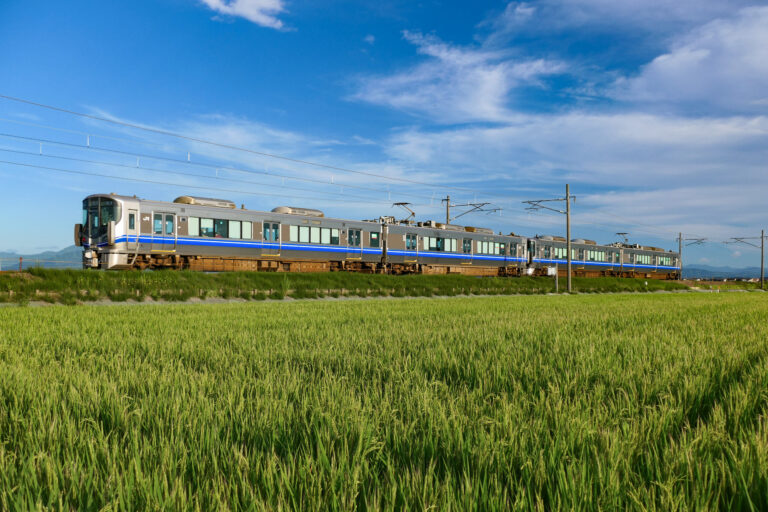
Seishun 18 Ticket Summer 2026: Periods, Prices and the Day Rule
AuthorMIRUTOBE editors
Table of Contents6 items
- Check first: does this ticket actually save you money
- Four decisions to take before you buy
- Three days or five: what is identical and what is not
- Where people trip up
- What happens if the trip falls apart after you have started
- Questions we get: does it pay, how far is a day, and is it worth it with children
In summer 2026 the Seishun 18 Ticket came in two forms: three consecutive days at JPY 10,000 and five consecutive days at JPY 12,050. Since the winter of 2024 it has been used up over consecutive days from the first day, and it now goes straight through the automatic gates.
Check first: does this ticket actually save you money
- You can free up three or five days in a row (days spread apart no longer work)
- The non-reserved ordinary cars of local and rapid trains will get you where you are going
- Anyone travelling with you can buy their own ticket (one person per ticket)
- Counting from your first day, the last day still falls inside the period of use
- Your daily fares will come to more than JPY 2,410 (the five-day version)
Five out of five and the ticket pays. Miss one and buying ordinary tickets section by section works out cheaper. The whole judgement rests on one line — JPY 2,410 a day — so settle the itinerary first, then add up the fares and compare. What the ticket buys is the non-reserved ordinary cars of JR local and rapid trains, plus the JR BRT lines and JR West’s Miyajima ferry; the summer 2026 period of use closed on 8 September.
Four decisions to take before you buy
Three days or five: what is identical and what is not
The gap in the daily rate is about JPY 920, or roughly JPY 2,770 across three days. Reasoning that “I can only take three days off, so I will take the three-day version” means paying the higher rate per day. If three days is all you have, there is nothing else to do; but if a fourth day can be prised loose, the five-day version closes most of the distance on the total as well.
The other thing the table shows, and the announcements do not, is that the last day of sale and the last day of use do not line up. In summer 2026 a five-day ticket bought on 4 September ran out exactly on 8 September. Bought any later, five consecutive days simply could not be had.
Where people trip up
Any guide that says “five uses”, “JPY 2,410 a use” or “get it date-stamped at the gate” is out of date
The five-use system ended with the tickets sold in the winter of 2024, and 2026 continued on the newer terms. Articles claiming the change happened in 2026, and articles still written around five uses, are both describing something that no longer exists. Under the old rules there were five boxes and you could spread them — one on 20 July, one on 10 August. The classic pattern of using it at weekends across several weeks does not survive that change. Before you set any dates, work out which version of the rules the page in front of you assumes.
Discount ticket shops no longer sell single days, because the product cannot exist
When the ticket ran on five uses, selling off the leftovers one at a time was a staple of the discount shops. Consecutive days killed that: a partly used ticket cannot be handed to anyone else, so there is nothing to sell. Unused tickets do still turn up slightly below list price, but the walk round the shops is worth much less than it used to be.
When the automatic gate rejects it, step aside rather than push
The barrier closes, or the ticket comes back. It is almost always one of three things: the date is outside the period of use, the line or section ahead is not covered, or the ticket has been folded or dampened and the magnetic stripe will not read. A damaged stripe can be reissued at the station. And on the days you start from an unstaffed station there is no gate to argue with in the first place, which is worth remembering before treating automatic-gate access as the headline improvement — the benefit lands in the cities.
What happens if the trip falls apart after you have started
Nothing comes back. Only an unused ticket can be refunded, at the price less a JPY 220 fee — JPY 9,780 for the three-day version and JPY 11,830 for the five-day. Put it through a gate once and the refund is gone, even if you abandon the journey on the first afternoon. A train cancelled after you have begun is not in principle grounds for a refund either.
Consecutive days made that rule bite harder. Under the five-use system a typhoon day could be skipped and the use moved to another week; now there is no date to shift it to. Summer sits squarely on the typhoon season, so look at the weekly forecast before fixing your first day. Up to that point a refund and a fresh start are still available.
On the long days your arrival time stops being predictable. One missed connection pushes everything behind it, so book a hotel attached to the station or within five minutes of the gate and the itinerary survives the delay. Two things matter in that hotel and very little else does: how far it is from the barrier, and whether there is a proper bath. Shoulders and a back that have spent six hours on a longitudinal seat do not recover in a shower. The accommodation tax is worth checking too, since it varies by municipality and adds up over five nights.
Chains with an artificial hot spring or a large communal bath make a visible difference to the following morning. Staying several nights in a hot spring town and working outwards from there is a legitimate way to build the five days as well. If the inn itself is the point of the trip, our guide to solo stays at fine hot spring inns covers that; on an Osaka-based itinerary, cheap hotels within walking distance of USJ keeps the nightly cost down near the destination.
Questions we get: does it pay, how far is a day, and is it worth it with children
Riding Tokyo to Osaka in one go — how much does that save?
The basic fare for the whole journey on the conventional lines is JPY 8,910 (checked on Ekitan on 11 August 2026, on a basic-fare-only basis). One day of the five-day version is JPY 2,410, so that single day opens a gap of about JPY 6,500. The same journey by reserved seat on the Shinkansen is JPY 15,790. To make the five-day version pay you only need the five days’ fares to exceed JPY 12,050, and one journey of that size leaves the remaining four days as very nearly free. Run it the other way — five days of short return trips, none of them worth JPY 2,410 — and ordinary tickets are cheaper.
How far can you actually get in a day?
On local trains alone, roughly 500 to 700 km is the realistic ceiling. Tokyo to Osaka is a day; from there to Kyushu is another. Tokyo to Osaka on the conventional lines runs to around nine hours (Ekitan, as of 11 August 2026): leave in the six o’clock hour and you arrive the same day, leave in the evening and you arrive the next morning. Rapid and special rapid services are covered too, and JR West’s Special Rapids change the arithmetic considerably out of the Kyoto–Osaka–Kobe area, so plan around them where they run rather than working stop by stop. Take the first train on the days you need distance and go gently on the others; five days flat out and the third one breaks you.
Is it worth buying for children?
It gets harder to justify. The ticket costs the same for adults and children, so a primary school child still pays JPY 12,050, while an ordinary child’s fare is half price — which closes the gap from both ends. A family of four is JPY 48,200. Whether a child can sit out that many hours on a train is a separate question again. Rail trips with children tend to work better with shorter daily journeys and longer stops.
Routes differ in how forgiving they are. Anything built on the Tokaido and Sanyo main lines has frequent trains and short waits, which is where to stay until you can read a timetable closely. The Nippo main line between Saiki and Nobeoka — the Sotaro crossing — has only a handful of local trains a day, and the entire itinerary either side has to be built around one of them. The Shizuoka stretch from Okitsu to Hamamatsu has trains in plenty but puts one longitudinal-seat car after another in front of you, which is its own kind of cost. Crossing to Hokkaido needs a separately sold option ticket used alongside the Seishun 18 Ticket, and both go into the automatic gate together. There are also sections with no local or rapid service where the non-reserved cars of a limited express may be used, but the sections are few and the conditions specific, so look yours up before you board rather than after.
Narrowing to one area rather than crossing the country suits the ticket just as well. The scenic stretches of the Yosan and Dosan lines are set out section by section in our guide to local-line travel in Shikoku. In the Chugoku region our Hiroshima to Miyajima day trip is costed with transport included and drops straight into one of your days. For Hokuriku there is the two-day Kanazawa plan, and on a Kansai loop the walk round Kyoto’s quieter temples cuts down the number of days spent only moving. To test the idea with a day trip first there is our guide to scenic day trips from Tokyo, and if the first day goes to the capital itself, the five-day Tokyo course. Connections thin out badly towards Hokkaido, so a stay-put trip such as our Sapporo and Otaru plan is the more realistic shape up there.
- JR East, Seishun 18 Ticket (price, sale period, period of use, conditions)↗Checked on 2026-09-14
- JR group announcement, 5 February 2026 (2026 terms and the Hokkaido Shinkansen option ticket)↗Checked on 2026-09-14
- Ekitan (Tokyo–Osaka basic fare and journey time, queried on a basic-fare-only basis)↗Checked on 2026-08-11
Source: the block above / Photos: MaedaAkihiko and LERK, CC BY-SA 4.0 (Wikimedia Commons) / Checked on 2026-09-14
Other sales ending soon




 4 days leftuntil Oct 24Air Busan Takamatsu-Busan Coupon: Up to 9,000 Yen Off Until October 24
 5 days leftuntil Oct 25JAL Hong Kong Campaign: Tokyo–Hong Kong Round Trip from 75,800 Yen (until 25 Oct)
 11 days leftuntil Oct 31Jin Air Kobe–Seoul: 5,000 yen off a round trip with code KTOUKB1, until 31 October
 11 days leftuntil Oct 31Jin Air to Busan: 4,000 yen off a round trip with code KTOPUS, first 300 only