Swiss Alps 5-Night, 7-Day Model Plan: The Matterhorn and the Jungfrau
AuthorMIRUTOBE editors
Table of Contents11 items
- Itinerary
- DAY 1 Not buying the mountain tickets on day one is the single most important rule here
- DAY 2 45 minutes to a station at 3,454 m, where the full fare is CHF 249.20 and not the CHF 129.60 on the website
- DAY 3 After 3,454 m yesterday, drop to 2,166 m today
- DAY 4 It is not only petrol cars that cannot enter Zermatt
- DAY 5 Five summits are reachable, and taking two of them costs more than CHF 500 for the pair of you
- DAY 6-7 Lucerne fits into the way home because the airport is on its side of the country
- Why we skipped the full Glacier Express
- Alternatives
- Where to stay
- What this trip costs
Five nights in the Swiss Alps, three in Grindelwald and two in Zermatt. At full fare, moving and going up costs two people CHF 1,564.80. What is expensive here is altitude, not admission: one CHF 150 Half Fare Card hands each of you CHF 226 back.
Itinerary
DAY 1Not buying the mountain tickets on day one is the single most important rule here
Why this order: day one does nothing but travel. No mountain ticket gets bought, and what goes into days two and three is decided after reading the next morning’s forecast.
Switzerland is not in the EU but is inside the Schengen area, so a Japanese passport needs no visa for tourism. The limit is 90 days within any 180-day period, and days spent in other Schengen countries count towards it. The passport must have three months of validity beyond your planned departure and must have been issued within the last ten years. Booking a trip in the final year of a ten-year passport is where that second condition catches people.
Entry procedure changed shape during the past year. The EES border system went into full operation on 10 April 2026 and passports are no longer stamped. What gets registered instead is four fingerprints and a facial image, taken in person on the first entry and only matched on later ones. Switzerland phased it in ahead of that: Basel and Geneva airports from 12 October 2025, Zurich from 17 November.
ETIAS, the other electronic travel authorisation, is still not running as of September 2026, and no start date has been announced. The European Union has said it will give several months’ notice before it begins, so a trip booked now only needs a second look before departure. The fee is EUR 20 and it lasts three years or until the passport expires, whichever comes first. Under-18s and over-70s pay nothing but still have to apply.
The currency is the Swiss franc, not the euro. Plenty of places take euros, and the change comes back in francs.
Power is 230 V at 50 Hz. Plugs are type C, two round pins, and type J, three round pins, and a type C plug goes into a type J socket. Type C carries no earth, though, and the Europlug permitted in Switzerland is rated to 2.5 A. Anything high-draw, a hairdryer for instance, is safer on a type J three-pin adapter. Switzerland Tourism’s own advice is to choose a slim adapter, because recent hotels tend to recess their sockets into the wall and a thick travel block will not seat properly. Whether you need a transformer as well is separated out in the difference between an adapter and a converter.
Zurich Airport to Interlaken Ost takes 2 h 09 m to 2 h 19 m with one or two changes, CHF 77.00. Grindelwald is another 36 minutes from there on a through train, CHF 11.80. Departures are at four and thirty-four minutes past the hour, so a long queue at immigration only costs you the next half hour.
Grindelwald is the base because it puts the Jungfraujoch 45 minutes away. Stay in Interlaken Ost and every mountain morning starts with the 36 minutes back up to Grindelwald first.
At checkout a charge appears that was not in the booking-site total. It is the Kurtaxe, the lodging tax. This is not a national scheme but a municipal one: cantonal law gives each municipality the power to levy it and the local ordinance sets the rate. Grindelwald’s ordinance is CHF 4.20 per adult per night, CHF 3.20 in a mountain hut, and nothing under 12. The tourist office quotes CHF 4.70 with the promotion levy included.
DAY 245 minutes to a station at 3,454 m, where the full fare is CHF 249.20 and not the CHF 129.60 on the website
Why this order: give this slot to whichever day the forecast says will be clear. Move as little as possible once you are up there, and let your body meet the thin air before you ask anything of it.
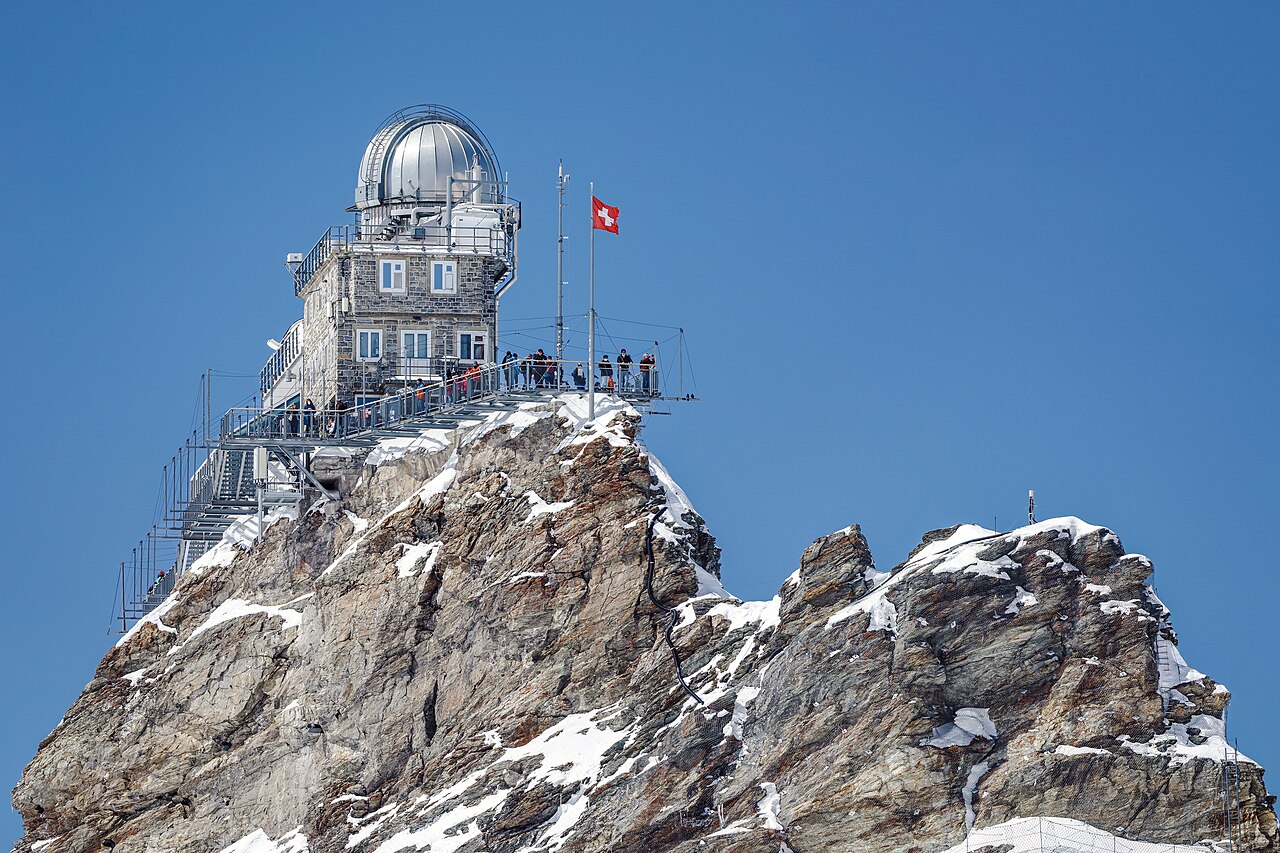
Highlights: the station itself stands at 3,454 m, cut into a tunnel inside the rock. The Sphinx observatory with the viewing deck is higher again at 3,571 m. The Aletsch Glacier below it runs 22 km, is 900 m thick and holds 12 billion tonnes of ice, and is inscribed with the Jungfrau and the Aletsch as a UNESCO World Natural Heritage site. On the way up, the Eismeer stop at 3,160 m has windows in the tunnel that look at the glacier from the side.
Practical note: 15 minutes from Grindelwald Terminal on the Eiger Express, then 26 on the Jungfrau Railway, 45 minutes in all and 47 minutes faster than the old route. The first train up leaves Eigergletscher at 08:15, the last up is 17:15 and the last down 17:47. Air pressure at 3,400 m is about two thirds of what it is at sea level, so running up a flight of stairs on arrival leaves you without breath. Spending the first 20 minutes indoors is about right.
- Return fare, full price
- From Grindelwald Terminal CHF 249.20; from Interlaken Ost CHF 271.20
- Seat reservation
- CHF 10 per person (compulsory 1 May to 31 October 2026)
- Altitude
- Station 3,454 m; Sphinx deck 3,571 m
- Journey
- 45 minutes from Grindelwald Terminal
The trap that catches most people on this trip is here. The “from CHF 129.60” on the official site is the return fare from Grindelwald Terminal for someone holding a Half Fare Card. Without a discount card the same journey is CHF 249.20, or CHF 271.20 out of Interlaken Ost. That is close to double.
Winter brings the fare itself down. From Interlaken Ost the full price is CHF 224.40 and the Half Fare version CHF 112.20, nearly CHF 47 less on the same journey. Where the dates can go either way, this leg is cheaper in the snow season.
The Jungfrau Travel Pass covers unlimited travel on the regional trains, buses, cable cars and lake boats. Three days is CHF 210 and eight days CHF 330. The Jungfraujoch is not included. It needs a separate supplementary ticket, from CHF 89 in summer and from CHF 63 in winter, and only pass holders under 16 get that supplement free.
This route goes up in the Jungfrau region twice: the Jungfraujoch and First. Added at full price that is CHF 290.20 a head, and the three-day pass plus the supplement is CHF 299.00, which is barely a difference. What the pass actually buys is three days of unlimited riding, and it starts to work on a trip that adds Schynige Platte and Harder Kulm and goes up twice a day. Stop at two summits and either route lands around CHF 300.
The afternoon is spent up there. The Ice Palace is a set of passages cut inside the glacier, floor and walls both ice. It is slippery enough that a grip sole is worth having even if you had no plan to walk on a mountain.
DAY 3After 3,454 m yesterday, drop to 2,166 m today
Why this order: take 1,300 metres off the altitude and make this the walking day. Ridge in the morning, village in the afternoon, indoors at night.
Morning: two hours there and back to Lake Bachalp, which is also the turnaround test
Highlights: a shoulder at 2,166 m, about 25 minutes from Grindelwald in a six-seat gondola. At the top a walkway juts out over the cliff, officially the First Cliff Walk by Tissot, 45 metres long and about 20 minutes to cross and come back. Parts of it have nothing under your feet, and anyone uneasy with heights does not let go of the rail. Follow the ridge from there and you reach Lake Bachalp at 2,265 m.
Practical note: the return fare is CHF 41.00 at full price, CHF 20.50 with a Half Fare Card and CHF 38.00 on a Swiss Travel Pass. Gondolas run up from 08:00 to 17:30 and down until 18:00. The lake is just under an hour each way, about two hours in total, and walking at 2,200 m takes more out of you than the same distance at sea level. Mountain carts and trottibikes are CHF 25 an adult each, counted separately from the gondola, and the carts are not sold online at all.
- Return fare
- Full CHF 41.00; Half Fare Card CHF 20.50; Swiss Travel Pass CHF 38.00
- Altitude
- First 2,166 m; Lake Bachalp 2,265 m
- Journey
- Gondola about 25 minutes; the lake about 2 hours return
- Activities
- Mountain cart and trottibike, CHF 25 an adult each (about 30 minutes)
That two-hour figure doubles as the rule for turning back. Start walking at ten and fail to be back by noon and something, cloud or wind, has been holding you up. The composition where the peaks sit reflected on the surface only appears on a windless morning, so with any wind the right move on a mountain is to change the objective and take the ridge view instead.
Afternoon into evening: the village street reads better once the light goes
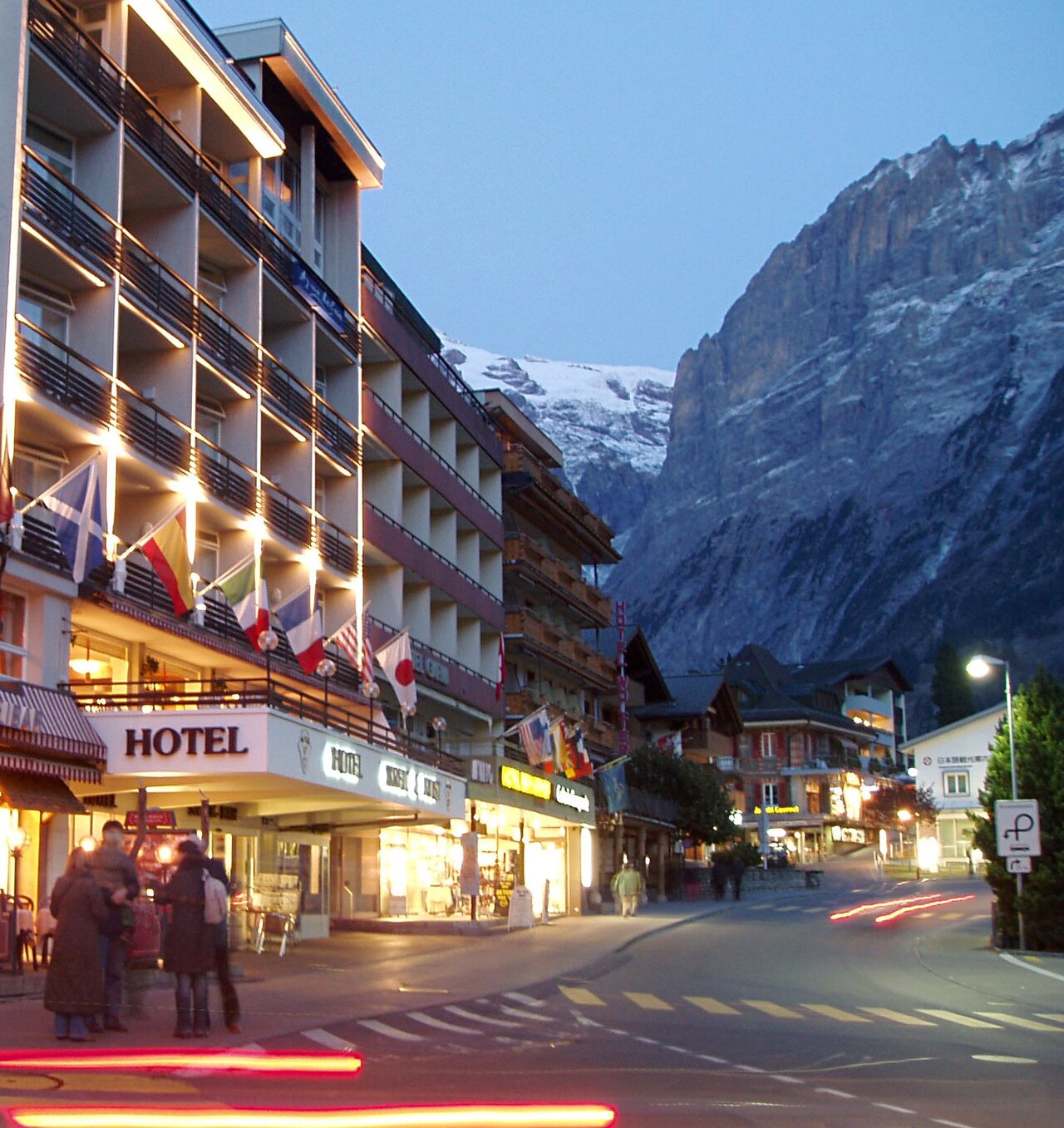
Highlights: hotels and shops along one street, and a rock wall standing straight up behind them. It is the landform rather than the architecture that gives the place its character, because the wall is visible from anywhere on that street. The sound of cowbells comes down off the grazing slopes on the wind.
Practical note: the guest card your hotel hands over makes the local buses and the ski buses free. It takes 30% off the Grindelwald to Männlichen gondola, 15% off the First railway, and the Glacier Gorge from CHF 21 to CHF 18. It comes automatically with the lodging tax, so check you were given it at check-in.
- Lodging tax
- Adult CHF 4.20 a night (ordinance rate); mountain hut CHF 3.20; under 12 exempt
- Guest card
- Buses free, gondola 30% off, First railway 15% off
- Nearest
- Grindelwald station / Grindelwald Terminal
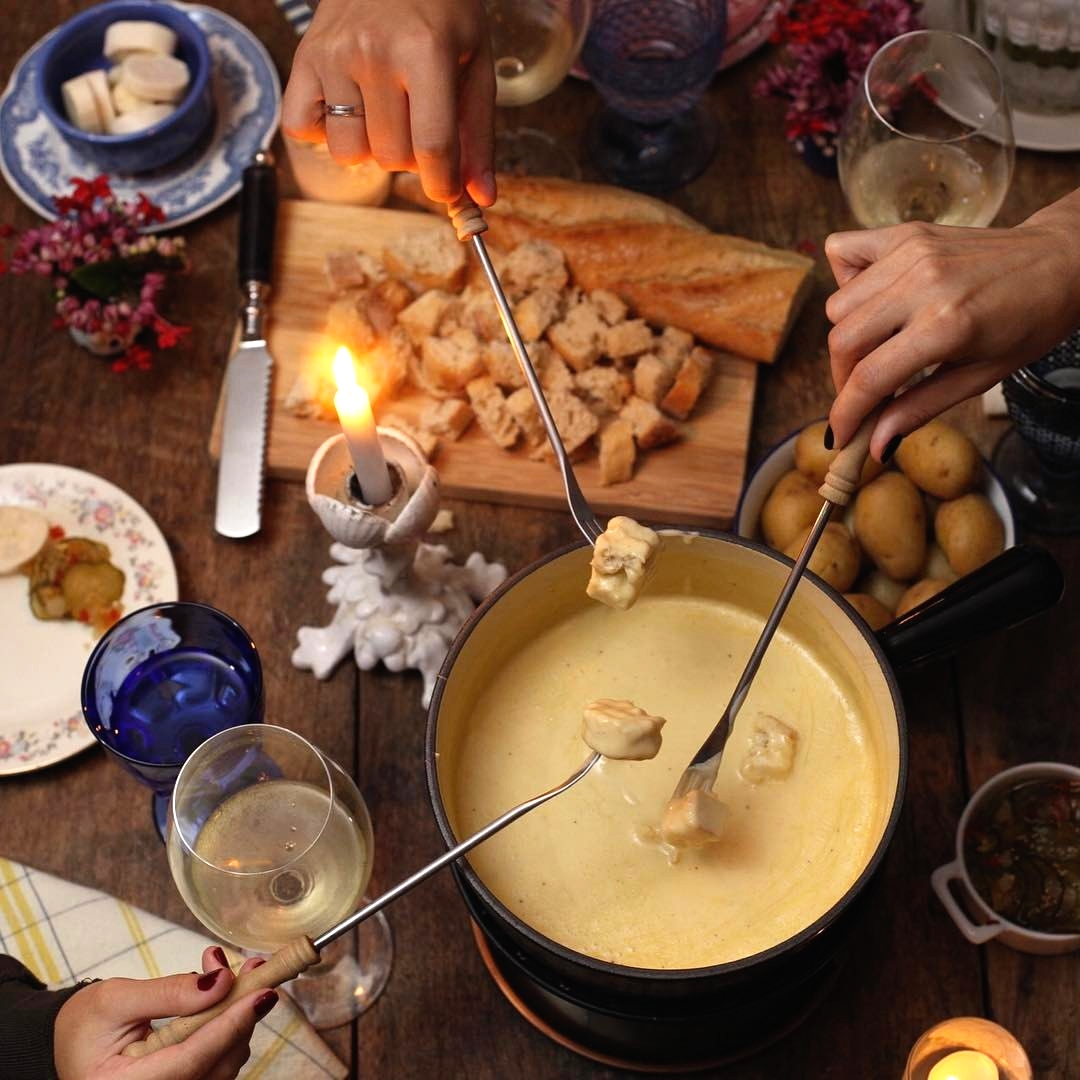
Dinner is fondue or raclette, both built around melted cheese, with rösti, the potato cake, on the side.
The bill needs no agonising over the tip. The Swiss price-indication ordinance requires any surcharge the customer cannot decline, a service charge among them, to be inside the displayed price. GastroSuisse, the trade body, states plainly that tips in hospitality have been included in prices since 1974. Anything on top is entirely voluntary, and the custom amounts to rounding up or adding about 10%. VAT is 8.1% at the standard rate, which applies when you eat in; the same food taken away carries the reduced rate of 2.6%.
DAY 4It is not only petrol cars that cannot enter Zermatt
Why this order: travel in the morning and put the village in the afternoon. The stretch you walk carrying luggage happens while the sun is still high.
Interlaken Ost to Zermatt is about 2 h 20 m with two changes, CHF 86.00, running from Spiez through the Lötschberg tunnel to Visp.
Zermatt gets described as the village of electric cars, and the municipal traffic ordinance says something stricter than that. The construction of the text is that no motor vehicle and no horse-drawn carriage may circulate without municipal permission, so what is banned is unauthorised motor traffic rather than a type of fuel. The tourist office FAQ states that electric cars are subject to the same rules as any other car and that you cannot drive to Zermatt. Combustion-engined vehicles for specialised transport, conversely, are permitted. The ordinance names hybrids that can switch to their combustion engine as prohibited too, and caps permitted vehicles at 20 km/h.
Anyone arriving by car stops at Täsch, one station short. The shuttle train from Täsch to Zermatt takes 12 minutes and runs every 20, on that interval from 05:55 to 21:55, with late-night services at weekends. A return is CHF 17.20, valid for 30 days from purchase, once in each direction. The Matterhorn Terminal at Täsch has covered parking for 2,100 cars, 131 of them with chargers.
What moves inside the village is electric taxis, horse carriages, two free e-bus lines and bicycles. The municipality describes its own village as having no cars but plenty of traffic. There are 22 km of paved road, and electric vehicles run along them at under 20 km/h. With heavy luggage, calling an electric taxi to the hotel is the fastest answer.
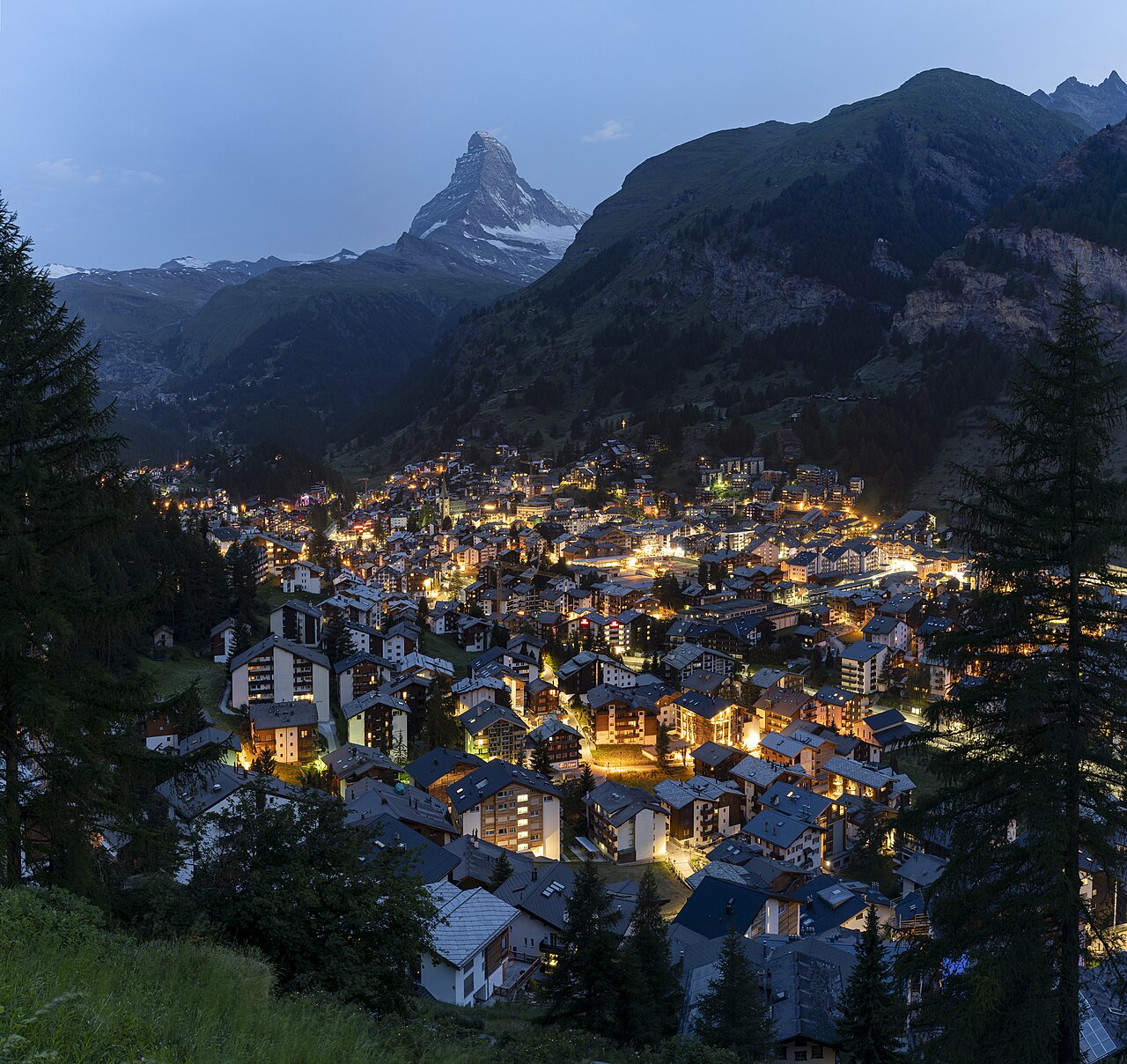
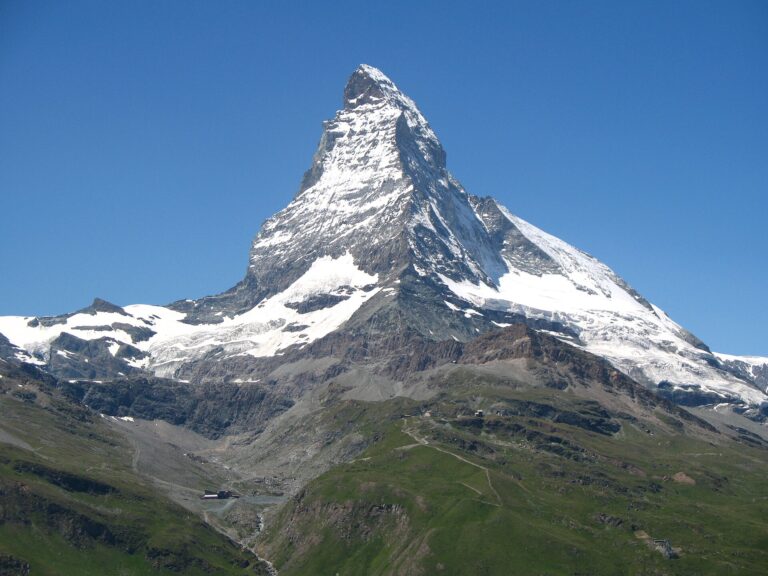
Highlights: the Matterhorn, 4,478 m, stands in front of you from almost anywhere in the village. The village centre sits at 1,620 m and the station at 1,605 m. The highest point in the municipality is the Dufourspitze on Monte Rosa at 4,634 m, and 75% of the municipal area is protected land. Of the 54 four-thousand-metre peaks in Switzerland, 38 are gathered around this village.
Practical note: the red flush on the rock at first light is Morgenrot in German. Morgen means morning, so the red of the evening is not Morgenrot but Abendrot. Neither the tourist office nor the railway uses either word on its official pages; both say “the first light”. Chasing the morning version means being outside 30 minutes before sunrise.
- Altitude
- Matterhorn 4,478 m; village centre 1,620 m
- Getting in
- Shuttle train from Täsch, 12 minutes, every 20, return CHF 17.20
- Getting around
- Electric taxi, horse carriage, two free e-bus lines, bicycle, on foot (20 km/h limit)
- Lodging tax
- CHF 4.00 a night (half for ages 9 to 16, free under 9)
DAY 5Five summits are reachable, and taking two of them costs more than CHF 500 for the pair of you
Why this order: pin the morning to Gornergrat. The afternoon gets decided on the day, out of whatever energy and budget are left, between a second summit and a rest in the village.
Highlights: a ridge at 3,089 m, reached by the first electric rack railway in Switzerland, opened in 1898. At the top the Matterhorn is straight ahead and the Gorner Glacier pours down to the right of it. Four-thousand-metre peaks stand around the whole horizon, and the view holds nothing but ice, rock and snow. Hiking paths run back down along the ridge, with stations at Riffelberg (2,582 m) and Rotenboden (2,825 m) to rejoin the train.
Practical note: the return is CHF 132.00 at full price in summer (May to October 2026) and CHF 102.00 in winter. A Half Fare Card, a GA or a Swiss Travel Pass each take 50% off, making the summer return CHF 66.00. The platform is about 50 m from Zermatt station and the journey is 33 minutes. The first train is 07:00, then every 24 minutes from 08:00. It runs all year, and the only stoppage in 2026 is engineering work from 2 to 14 November.
- Return fare, full price
- Summer CHF 132.00; winter CHF 102.00 (50% off with a discount card)
- Altitude
- Gornergrat 3,089 m; Zermatt station 1,605 m
- Journey
- 33 minutes each way (every 24 minutes from 08:00; first train 07:00)
- Closures
- 2 to 14 November 2026 only (engineering)
Whether a second summit goes into the afternoon is a conversation with your wallet. Five directions lead up out of Zermatt and the fares are a long way apart.
Put Gornergrat and Matterhorn Glacier Paradise on the same date and two people pay CHF 528 at full price. Six tenths of everything this trip spends on mountain railways goes in that one day. Choosing one, take Gornergrat if what you want is the Matterhorn face on, and Glacier Paradise at 3,883 m if what you want is the altitude itself. The latter is officially presented as the highest mountain station in Europe, and its return ticket includes the world’s highest ice palace, 15 m underground. From the deck you can see 38 four-thousand-metre peaks, 14 glaciers and three countries.
Spending the afternoon resting in the village is not a defeat on this route. The next day disappears into travel, so recovering here makes the journey home easier.
DAY 6-7Lucerne fits into the way home because the airport is on its side of the country
Why this order: count backwards from the time you need to be at the airport. Make half a day somewhere with left luggage at the station, and let the mountains settle on flat ground.
Zermatt to Lucerne takes 3 h 24 m with two changes, CHF 122.00, running from Visp through the Lötschberg and north by way of Bern. Lucerne to Zurich Airport is 1 h 12 m direct, or 1 h 02 m on a service with one change, CHF 31.00.
What makes Lucerne fit on the way home is that geometry. It sits on the straight line from the mountains to the airport, so stopping there costs no detour. St Moritz, in the south, is the exact opposite, and that is the subject of the next section.
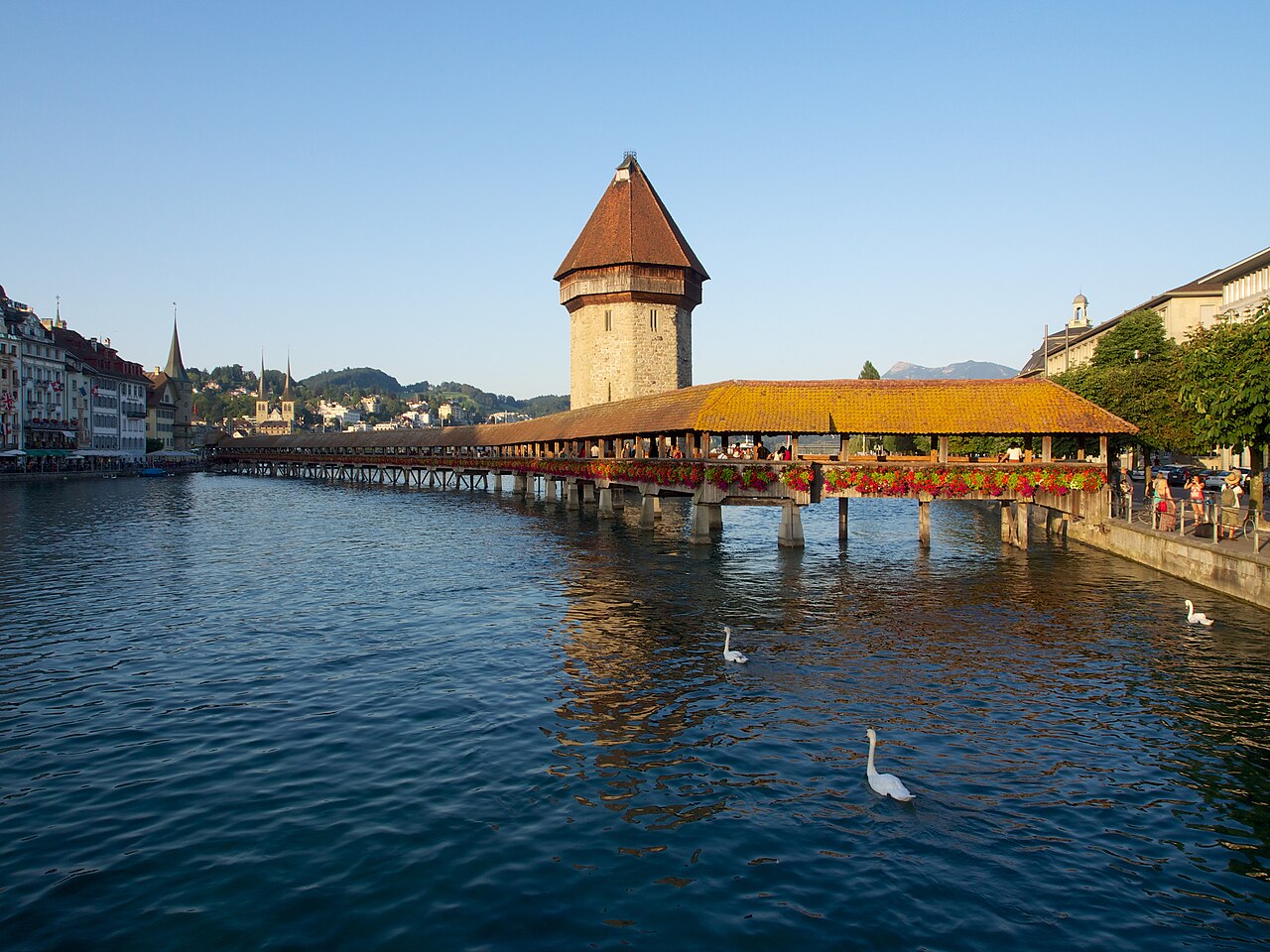
Highlights: the Chapel Bridge is a covered wooden bridge 204 m long, built in the middle of the fourteenth century, and the tourist office describes it as one of the oldest wooden bridges in Europe. Painted panels along the gables set out the history of Lucerne and of Switzerland. The octagonal Water Tower beside it is older than the bridge, built around 1290 to 1300, and stands 34.5 m high.
Practical note: fire broke out on the night of 18 August 1993 and 110 of the original 158 panels were damaged. Rebuilding took eight months and the bridge reopened on 14 April 1994, so the panels hanging there now are a mixture of survivors and repaintings. It gets called a city on a lake, but this bridge crosses the Reuss; the lake’s formal German name is the Vierwaldstättersee.
- Chapel Bridge
- Mid-fourteenth century, 204 m long; the Water Tower is 34.5 m high
- Fire and rebuilding
- 110 panels damaged on 18 August 1993; rebuilt in 8 months, reopened 14 April 1994
- Lodging tax
- CHF 2.30–2.80 a night (by hotel grade; under 12 exempt)
- To cross
- CHF 0
The other thing to walk to is the Lion Monument, a memorial to the Swiss Guards killed storming of the Tuileries on 10 August 1792. It was unveiled in 1821 and modelled by the Danish sculptor Thorvaldsen, carved into a rock face cut out 10 m by 6 m. Mark Twain called it the saddest and most moving piece of stone in the world; the lion has had its spear broken and lies dying with its head against a shield.
Staying the night in Lucerne adds a visitor card with the lodging tax. It makes buses and trains in city zone 10 free and discounts the cable cars and the museums, valid from the first to the last day of the stay, up to 14 days.
Watches and chocolate get bought here. The mountain villages have shops, but the range and the prices are both better in the city. The food belongs to a different family as well: Zürcher Geschnetzeltes, veal in a cream sauce, is city cooking. After several days of melted cheese it arrives feeling light.
Why we skipped the full Glacier Express
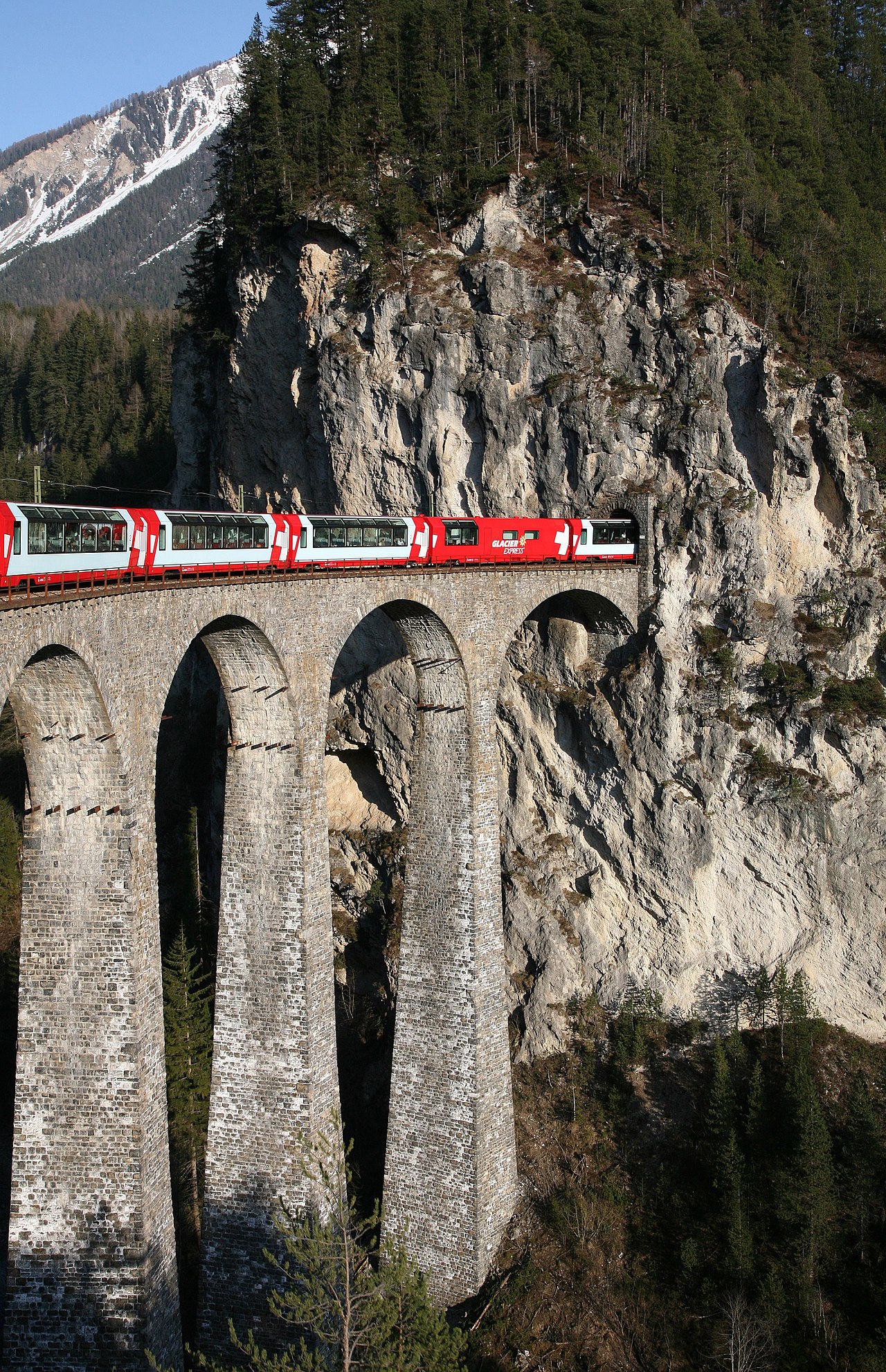
The Glacier Express links Zermatt and St Moritz. It covers 291 km, 91 tunnels and 291 bridges. The official fact sheet gives the journey as eight hours at an average of 42 km/h, while the actual timetable differs by direction: 7 h 45 m westbound and 8 h 29 m eastbound. On the summer 2026 timetable, train 902 leaves Zermatt at 08:52 and reaches St Moritz at 16:37.
Switzerland Tourism calls it the slowest express train in the world. The company that runs it does not use that phrase, and describes itself on its own site as one of the best-known narrow-gauge railways anywhere.
So the eight hours at the window are paid for with an extra day of travel.
St Moritz, where you get off, is at the south-eastern edge of the country, the furthest side from Zurich Airport. Put it into five nights and you need another day to cross back the other way. That is the decisive difference from the northern loop, which can hold Lucerne on the way.
The money is not small either. The full-route ticket is CHF 159.00 in second class and CHF 272.00 in first. On top of that, a seat reservation is compulsory for every passenger at CHF 54.00 in both classes, which makes CHF 426.00 for two in second. A Swiss Travel Pass or a Eurail pass does nothing about the reservation fee, which is paid in full regardless.
Booking has its own rules. Individual seat reservations open 93 days before travel and tickets 180 days before. The advice you hear is to book three months ahead; what the operator actually says is that demand is high and you should book early, and 93 days is simply the day the window opens. It does not run all year, either: the summer 2026 timetable runs from 2 May to 10 October, nothing runs from 11 October to 4 December, and the winter timetable starts on 5 December. Aim for autumn colour in late October and you land squarely in that gap.
Wanting the full route is a reason to lengthen the trip rather than to force it. Spend a day going from Zermatt to St Moritz, sleep there, and come back to Zurich the next day: six nights and eight days, with the window unbroken. Staying at five nights, take the western section only and head north, or take the same valleys on the ordinary express services.
Alternatives
Rainy-day swap
In the mountains cloud matters more than rain. At 3,454 m the Jungfraujoch can sit inside the cloud layer, and then the window is simply white. Paying CHF 249.20 for a day that shows you nothing is the most painful failure available on this trip.
Which is why no ticket gets bought on day one. Days two and three are both round trips out of Grindelwald, so the previous evening’s forecast can swap them. Give the clear day to the Jungfraujoch and the cloudy one to First. First is 2,166 m, low enough to come out underneath a low cloud base on some days.
With both days forecast to break, Lucerne can be brought forward and the mountains pushed back one day. Grindelwald to Lucerne is around two and a half hours each way, though, so the round trip burns more than half a day. Whether that half day is worth spending on a weather bet depends on how many days you have left.
If the flight is delayed by an hour or more
Because day one carries no mountain ticket, a late outbound costs only travelling time. Trains from Interlaken Ost to Grindelwald run twice an hour with the last at 22:05, so arriving at night leaves day two intact.
The return is where it bites. Zermatt to Zurich Airport is about four and a half hours of connections, with three hours in Lucerne inserted into it. One late train and the only thing you can cut is the time in Lucerne. Work back from the moment you need to be at the airport and decide in advance which Lucerne train you are taking, and the thing to cut is obvious when it happens.
An itinerary with the full Glacier Express in it is harsher still. A train with compulsory reservations cannot be transferred to a later one on the day.
When you’re tired
The first thing to drop is the second summit on the afternoon of day five. At full price that returns CHF 240 to CHF 264 to the two of you. Gornergrat in the morning has already given you the mountain view, so what you lose is the experience of the altitude.
Lake Bachalp on day three goes next. Two hours of walking, up and down around 2,200 m. The view from the plateau works from the cliff walk alone, so the CHF 41.00 gondola is not wasted.
What must not be cut is day two. The Jungfraujoch is the ceiling of this trip and no other day substitutes for it.
Who this route does not suit is anyone who gets a headache above 3,000 m. Day two is 3,571 m, day five 3,089 m, and a second summit takes it to 3,883 m. The Japanese foreign ministry warns specifically about Switzerland that mountain trains and cable cars make it easy to pass 2,000 m quickly, that the sudden drop in pressure makes people ill, and it cites cases of emergency admission for stroke after a short hike. Heavier still is the money: mountain rescue and emergency evacuation are at your own expense, and the ministry notes cases above ten million yen. Confirming a mountain rider on your travel insurance, or membership of Rega, the Swiss air rescue service, is cheaper than finding out. A lower-altitude rebuild stops at Kleine Scheidegg (2,061 m) instead of the Jungfraujoch and holds the Zermatt side to Sunnegga (2,288 m).
Where to stay
There is only one thing to ask of a hotel here, which is that it stands at the foot of a mountain railway. Time spent on the summit gets shortened by exactly the distance from your room to the departure point.
Grindelwald is the base that puts the Jungfraujoch 45 minutes away. The First gondola also leaves from the village, so days two and three both start within walking distance of the room. Stay at Interlaken Ost and every morning gains a 36-minute train. The lodging tax is the ordinance rate, CHF 4.20 per adult per night.
Interlaken is a proper town with more hotels and more places to eat. Its guest card reaches further, covering free public transport across 11 surrounding municipalities. The cantonal lodging tax is CHF 1.00 a night and the town’s Kurtaxe CHF 2.50 in summer, although the town ordinance dates from 2006 and may sit below what is actually billed.
Wengen (1,274 m) and Mürren (1,638 m) are car-free in the same way Zermatt is. Wengen is reached from Lauterbrunnen on the longest rack railway in the world, CHF 14.40 return. Mürren takes either a funicular and mountain railway from Lauterbrunnen, or a cable car up from Stechelberg; that newer cable car climbs at a gradient of 159.4%, the steepest anywhere. The quiet is in a class of its own, but there is one more luggage transfer in each direction, which makes them poor choices with a suitcase.
Zermatt bans cars village-wide, so decide how you get from the station to the hotel before you arrive: call an electric taxi, ask the hotel for a pickup, or pull the bag yourself. The 22 km of road include gradients, so the further the hotel is from the station the more the luggage weighs. The lodging tax is CHF 4.00 a night.
Book in this order: flights, rooms, then the mountain tickets. The mountains go last deliberately. Leaving room to swap days by weather is the design of this route, and fixing the dates early removes exactly that. The exception is the Glacier Express, where reservations open 93 days out, so a full-route itinerary has to be held at the same time as the flights. Connectivity is split by party size in the eSIM and pocket Wi-Fi break-even.
What this trip costs
Assumptions: two adults, three nights in Grindelwald and two in Zermatt, going up at three places, the Jungfraujoch, First and Gornergrat. Rail is second class and everything is added at the full fare with no discount card. Gornergrat is at the summer 2026 rate. Flights, rooms and meals are out of the total.
Every figure above is the published rate as of 2026-09-20. The yen conversion uses JPY 191.23 to the franc, derived from the European Central Bank reference rates of 2026-09-18.
Inside that CHF 1,564.80 the intercity rail is CHF 679.20, the mountain railways CHF 844.40 and the lodging tax CHF 41.20. On a trip around European cities admissions set the total; in Switzerland it is the fares that buy altitude and distance. The Jungfraujoch return alone, CHF 249.20 a head, is close to JPY 48,000.
This is where the discount card earns its keep. The Half Fare Card is CHF 150 for a month and halves every ticket bought within it. Applied to this route, intercity rail goes from CHF 339.60 to CHF 169.80, the Jungfraujoch from CHF 249.20 to CHF 129.60, First to CHF 20.50 and Gornergrat to CHF 66.00. Even with the card price added, that is CHF 535.90 a head against CHF 761.80 at full fare, CHF 225.90 cheaper. For two that is CHF 451.80, somewhere near JPY 86,000.
The Swiss Travel Pass makes intercity rail unlimited, but the eight-day version is CHF 439 and the Jungfraujoch is outside it. On this route it comes out CHF 196.70 a head more expensive than the Half Fare Card, about JPY 37,000. The pass works on a trip with far more movement in it, or one that leans on free entry to more than 500 museums. Rigi, Stanserhorn and Stoos are covered outright, so an itinerary built around those three changes the answer.
There are two places to cut. Dropping First returns CHF 82.00 to the pair of you and dropping Gornergrat CHF 264.00. Losing Gornergrat removes half the reason to sleep in Zermatt, so First is the cheaper pain. Going the other way, Matterhorn Glacier Paradise adds CHF 264.00 for two in July and August, and the full Glacier Express CHF 426.00.
Leave room in the exchange rate. The European Central Bank reference gives JPY 191.23 to the franc, but the last 90 days ran from JPY 188.83 to JPY 201.40, a swing of more than twelve yen. August 2026 averaged JPY 196.65 and September JPY 191.28. Budget both ends, JPY 190 at the bottom and JPY 202 at the top, and the number holds. The Bank of Japan publishes no franc-yen series, so this is the only route to a daily primary figure.
Who this route does not suit is anyone who wants the dates locked and left alone. How the mountains look is decided by the cloud on the day, and the design assumes tickets are not bought until the night before. A trip where everything is held early for peace of mind is simply a different trip.
Closure dates shift at short notice. In 2026 the Gornergrat Bahn stops for engineering from 2 to 14 November, and the cable car between Wengen and Männlichen was already down for inspection in September. For mountains and a castle in the same trip there is the Munich and Neuschwanstein four-night plan; for the same five nights turned towards the sea, Santorini and Athens; and for a rail extension into the city of music, the Vienna three-night plan is the closest in scale.
Sources: Jungfrau Railways; Grindelwald Tourism and the municipal ordinance; Zermatt Tourism and the municipal ordinances (traffic, lodging tax); Matterhorn Glacier Paradise; Gornergrat Bahn; Matterhorn Gotthard Bahn; Glacier Express (Sales Manual 2026); Switzerland Tourism; Swiss Federal Railways (SBB); Lucerne Tourism and the city ordinance; the Federal Inspectorate for Heavy Current Installations (ESTI); the Federal Tax Administration (VAT); GastroSuisse; the Japanese Ministry of Foreign Affairs safety data; the European Commission (EES and ETIAS); the European Central Bank and the Swiss National Bank (exchange rates) / Checked on 2026-09-20 / Photographs: Roy Egloff, Michael Ng, Juliano Mendes, Chensiyuan, Sputniktilt, Daniel Schwen (Wikimedia Commons, CC BY 2.0 / CC BY-SA 2.5 / CC BY-SA 3.0 / CC BY-SA 4.0) / Featured image: Andrew Bossi, CC BY-SA 2.5 (Wikimedia Commons)
Other sales ending soon




 4 days leftuntil Oct 24Air Busan Takamatsu-Busan Coupon: Up to 9,000 Yen Off Until October 24
 5 days leftuntil Oct 25JAL Hong Kong Campaign: Tokyo–Hong Kong Round Trip from 75,800 Yen (until 25 Oct)
 11 days leftuntil Oct 31Jin Air Kobe–Seoul: 5,000 yen off a round trip with code KTOUKB1, until 31 October
 11 days leftuntil Oct 31Jin Air to Busan: 4,000 yen off a round trip with code KTOPUS, first 300 only