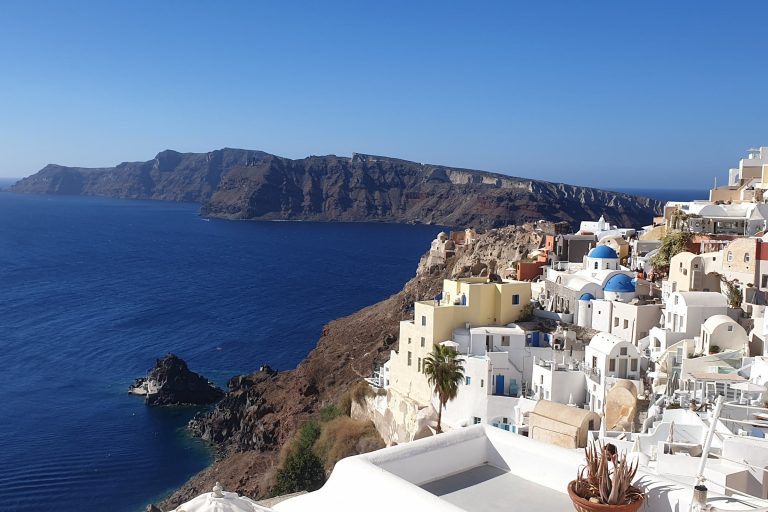
Santorini & Athens 5-Night, 7-Day Model Plan: Stunning Aegean Views and Ancient Ruins
AuthorMIRUTOBE editors
Table of Contents11 items
- Itinerary
- DAY 1 The arrival day ends with looking up at the hill, and nothing else
- DAY 2 The Acropolis has become a place where you buy an hour
- DAY 3 Crossing to the island costs you an afternoon, or a whole day
- DAY 4 The sunset at Oia is planned backwards from the time it sets
- DAY 5 The southern site, and a terrace that only opens from May to September
- DAY 6-7 On the day you fly home, do not take the boat
- Alternatives
- Why we skipped the sunset cruise
- Where to stay
- What this trip costs
Two nights in Athens and three on Santorini, built on four paid sites. On the ground the two of you spend EUR 278.80. What gets decided before the dates is the Acropolis: the ticket carries a date and a time, and it can be moved twice, up to two hours before.
Itinerary
DAY 1The arrival day ends with looking up at the hill, and nothing else
Why this order: there is no non-stop from Japan, so you land in the evening or later. Nothing with a clock goes on this day, and the point is to have your body ready for an 08:00 slot tomorrow.
Evening: how you buy the ticket in from the airport changes the price by EUR 3.50
Two things run from Athens International into the city, metro line 3 and the airport express bus. The prices are far apart, and a city day ticket does not work at the airport. Standing at the machine without knowing that generally ends in buying the expensive one.
This route costs out the return. Two singles at EUR 9.00 is EUR 18.00, so the EUR 16.00 return is EUR 2.00 cheaper, and with 30 days of validity it lasts the whole trip.
The bus is cheaper still, with one condition. Services towards the airport do not let you off along the way, and services from the airport do not let you on. That restriction holds all day regardless of the hour, so there is no getting off halfway to shop. What the bus genuinely has is that it runs when you land after midnight.
The city 24-hour ticket at EUR 4.10 and the 90-minute at EUR 1.20 do not reach the airport. Ordinary line 3 fares run as far as Koropi, and the airport section and the airport buses are priced separately. This is an exclusion the operator names explicitly, so assuming a day ticket covers the airport stops you at the gate.
Night: walk the stone lanes of Plaka and see the hill first
Put the hotel in Plaka or around Syntagma and the next morning’s journey nearly disappears. The Acropolis is 12 minutes on foot from Akropoli on metro line 2, or from Monastiraki on lines 1 and 3, and bus 230 goes there. Plaka is the district between those two stations, so a room here turns most of that 12 minutes into a walk over cobbles.
There is not much to do on the first night. Seeing the hill after dark first, though, changes how it reads when you climb it in the morning. Lit from below, the Acropolis at night looks like a different building from the white one you meet in daylight.
Highlights: the old quarter on the north-east foot of the Acropolis, where cobbled lanes climb towards the hill. The view of the hill shifts every time a lane changes angle, so walking without a destination will not get you lost. Look up and the Parthenon is always there.
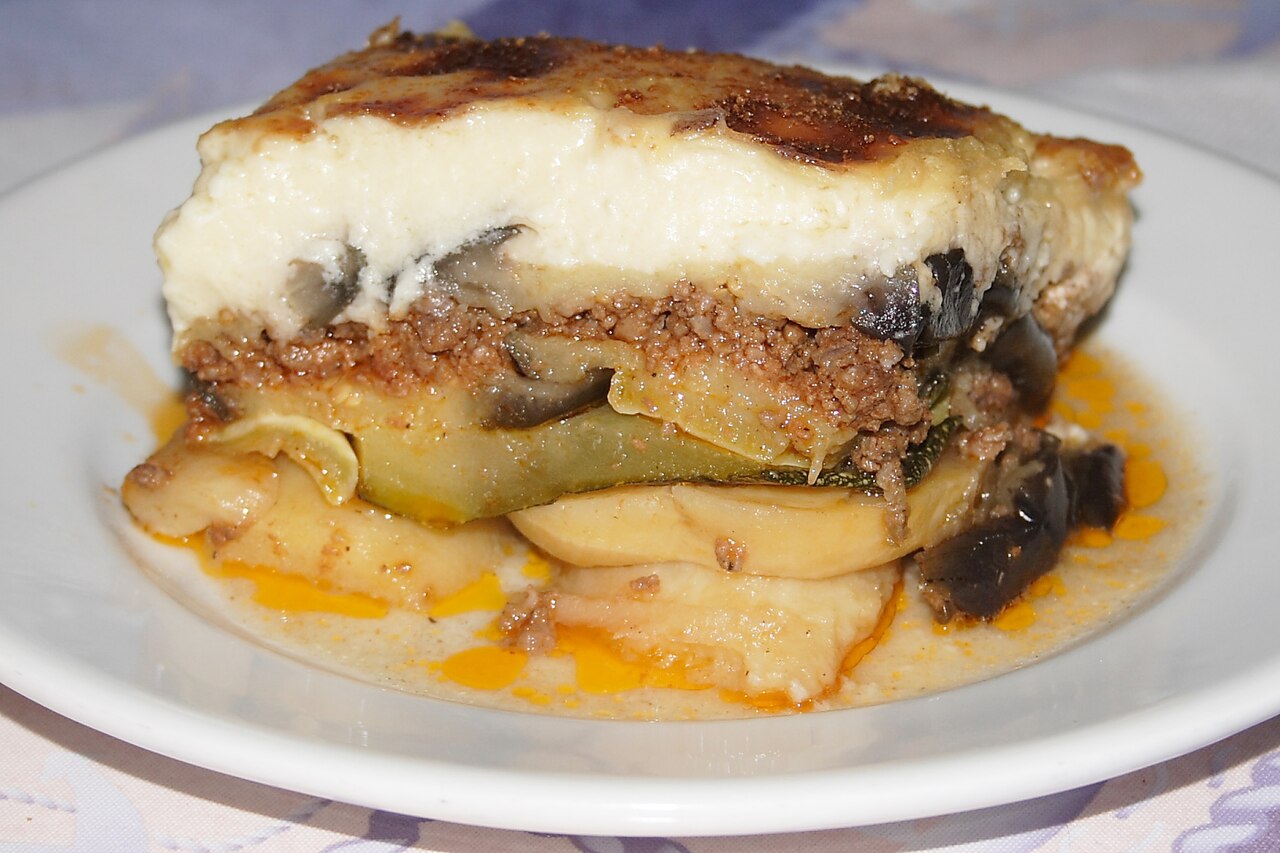
Practical note: dinner is moussaka or a gyros pita. Moussaka gets described as baked layers of aubergine and mince, and in some kitchens there are layers of courgette and potato as well. A heavy plate on the first night leaves the jet lag in place, so souvlaki and a Greek salad make the next morning easier.
- Nearest
- Akropoli on line 2; Monastiraki on lines 1 and 3
- To walk
- EUR 0
One thing done tonight makes tomorrow lighter, which is checking the ticket again. The Acropolis ticket is shown on a phone screen, and a room with a weak signal turns opening it into a struggle. How to choose a connection and where the break-even sits is in which is cheaper, an eSIM or a rental router.
DAY 2The Acropolis has become a place where you buy an hour
Why this order: there is almost no shade on the hill. Go in at the 08:00 opening, come down during the morning, and escape indoors to the museum in the afternoon. This order does not invert.
Morning: no refunds, and two changes only
The first thing to settle in this whole trip is the Acropolis ticket. You do not wander up and queue; you choose a date and a time and buy. An adult is EUR 30.00 and the reduced rate EUR 15.00.
What bites is the conditions rather than the price. The ticket is valid once, for the date and time chosen, and cannot be refunded after purchase. The time slot can be changed up to 120 minutes before the visit, twice at most. So deciding on arrival is not available, and neither is shifting it on the day because you feel rough.
There is exactly one exception. If the site closes on the day through force majeure, the terms say the ticket is extended or refunded. Which is to say nothing else brings the money back. Book one morning slot on day two once the flight arrival is fixed, and absorb anything else with the two permitted changes. That is the order least likely to break.
Closing times move in fine steps through the year. Opening is 08:00 all year, and closing is 20:00 from 1 April to 31 August, 19:30 from 1 to 15 September, 19:00 from 16 to 30 September, 18:30 from 1 to 15 October, 18:00 from 16 to 31 October, and 17:00 from 1 November to 31 March. Last admission is 20 minutes before closing in every case. Between summer and winter, the time available on the hill differs by three hours.
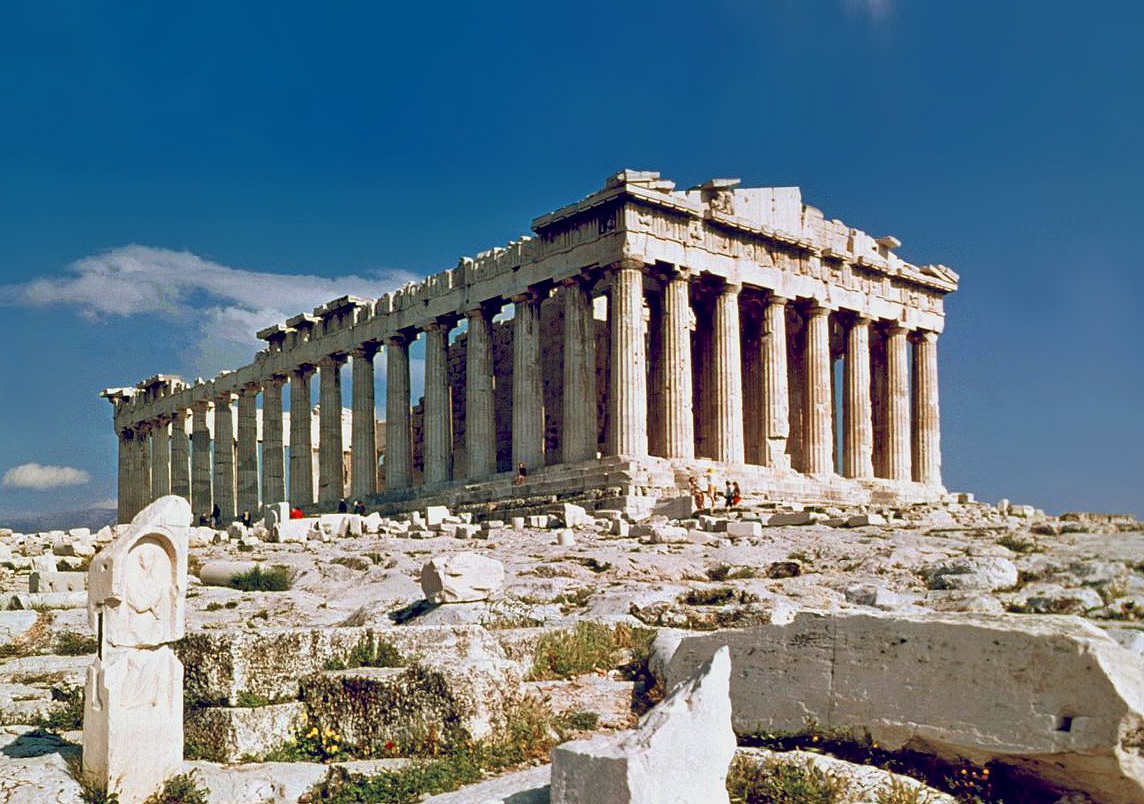
Highlights: the fifth-century BC Parthenon at the centre, with the caryatid porch of the Erechtheion, the Propylaia at the entrance and the Theatre of Dionysus on the south slope, all on one hill. The route is one way, up to the top and down the south side, which makes going back for a second photograph difficult. Walk it on the assumption that you shoot everything before you descend.
Practical note: the marble path is slippery wet or dry. It is a place where you repeatedly watch someone in leather soles lose their footing, and I would tell anyone to wear rubber. There is almost no shade at the top, and a summer afternoon slot turns sightseeing into endurance.
- Nearest
- 12 minutes on foot from Akropoli on line 2; bus 230
- Hours
- Opens 08:00 all year; closes between 17:00 and 20:00 by season (last admission 20 minutes before)
- Admission
- Adult EUR 30.00; reduced EUR 15.00
- Booking
- Date and time chosen at purchase; no refunds; two changes up to two hours before
- Closed
- 1 Jan, 25 Mar, 1 May, Orthodox Easter Sunday, 25 and 26 Dec
- Official
- Official site ↗
There are free days: 6 March, 18 April, 18 May, the last weekend of September, 28 October, and the first and third Sundays from 1 November to 31 March. They are days you save money and days it is crowded, in equal measure. Five nights gives you a day and a half in Athens, so trading the quiet of the hill for EUR 30.00 does not pay on this route.
Afternoon: the museum stays open to 22:00 on Fridays, summer and winter alike
Coming off the hill, move to the Acropolis Museum at its southern foot. The original sculpture taken off the temples is kept here, and what you saw on the surface of the buildings up on the hill is a copy. Reverse the order and you see the copies before the originals.
One thing to check in advance is that the opening hours come in three versions depending on the day. In summer, 1 April to 31 October, Monday is 09:00 to 17:00, Tuesday to Sunday 09:00 to 20:00, and Friday alone 09:00 to 22:00. In winter, 1 November to 31 March, Monday to Thursday is 09:00 to 17:00, Friday 09:00 to 22:00, and the weekend 09:00 to 20:00. Last admission is 30 minutes before closing throughout.
The long Friday is identical in both seasons, with no seasonal difference at all. The difference is on the hill. In winter it shuts at 17:00, so putting a Friday in Athens moves the hours after dark indoors. A summer Monday is the mirror image: the museum that should be open to 20:00 closes at 17:00. A departure date that puts day two on a Monday shortens the afternoon by three hours.
Highlights: the Parthenon Gallery on the top floor is built to the same orientation and the same dimensions as the temple. The hill itself is out of the windows, so the gaps in the sculpture line up with the real building along your eye. The ground floor is glazed, with the ancient street uncovered during construction visible underneath.
Practical note: admission is EUR 20.00 for an adult and EUR 10.00 reduced, the same in summer and winter. Free on 6 March, 25 March, 18 May and 28 October. On 24 and 31 December it runs 09:00 to 15:00, and Orthodox Good Friday is 12:00 to 18:00 and Holy Saturday 09:00 to 15:00, on a schedule of their own.
- Nearest
- 2 minutes on foot from Akropoli on line 2
- Hours
- Summer: Mon 09:00–17:00; Tue–Sun 09:00–20:00; Fri 09:00–22:00
- Admission
- Adult EUR 20.00; reduced EUR 10.00
- Closed
- 1 Jan, Orthodox Easter Sunday, 1 May, 25 and 26 Dec
- Official
- Official site ↗
Moving around the city today runs on the EUR 4.10 24-hour ticket. Metro, bus, trolleybus and tram all take it, for 24 hours from first validation. On a day with three or more journeys it beats repeating the EUR 1.20 90-minute ticket.
DAY 3Crossing to the island costs you an afternoon, or a whole day
Why this order: give the morning to the journey and keep the afternoon for the caldera path at Fira. That split only works if you fly.
Morning: no airline publishes the “45 minutes” that gets quoted
Aegean Airlines and Sky Express fly Athens to Santorini, Thira airport, JTR. The time varies by service. Put a date in and pull up one actual flight and either airline shows the times for that departure in the booking screen, which is where to read it.
The ferries do publish their durations. What differs is the port they leave from.
Golden Star’s timetable gives 07:20 to 12:40 outbound, 5 h 20 m, and 14:15 to 20:20 back, 6 h 05 m. The prose on the same page says five and a half hours, which does not match its own timetable. Both are official, so the per-sailing figure in the booking screen is the one to use.
And Golden Star leaves from Rafina, not Piraeus. From central Athens that is the opposite direction, further east than the airport. Book a sailing labelled as leaving Athens and turn up at Piraeus and you do not get on.
Ferries get cancelled by sea conditions. Being held up on the way out takes a day off the island. Fly out and fly back is the premise of this route, and anyone who wants the boat should not put it on the same day as the flight home.
Afternoon: Fira is a town built for looking down
Thira airport to Fira on the public KTEL bus is EUR 2.20 and takes 10 minutes. This is the one stretch where the operator states a duration. There are 17 services between 06:00 and 22:00, roughly hourly through the day.
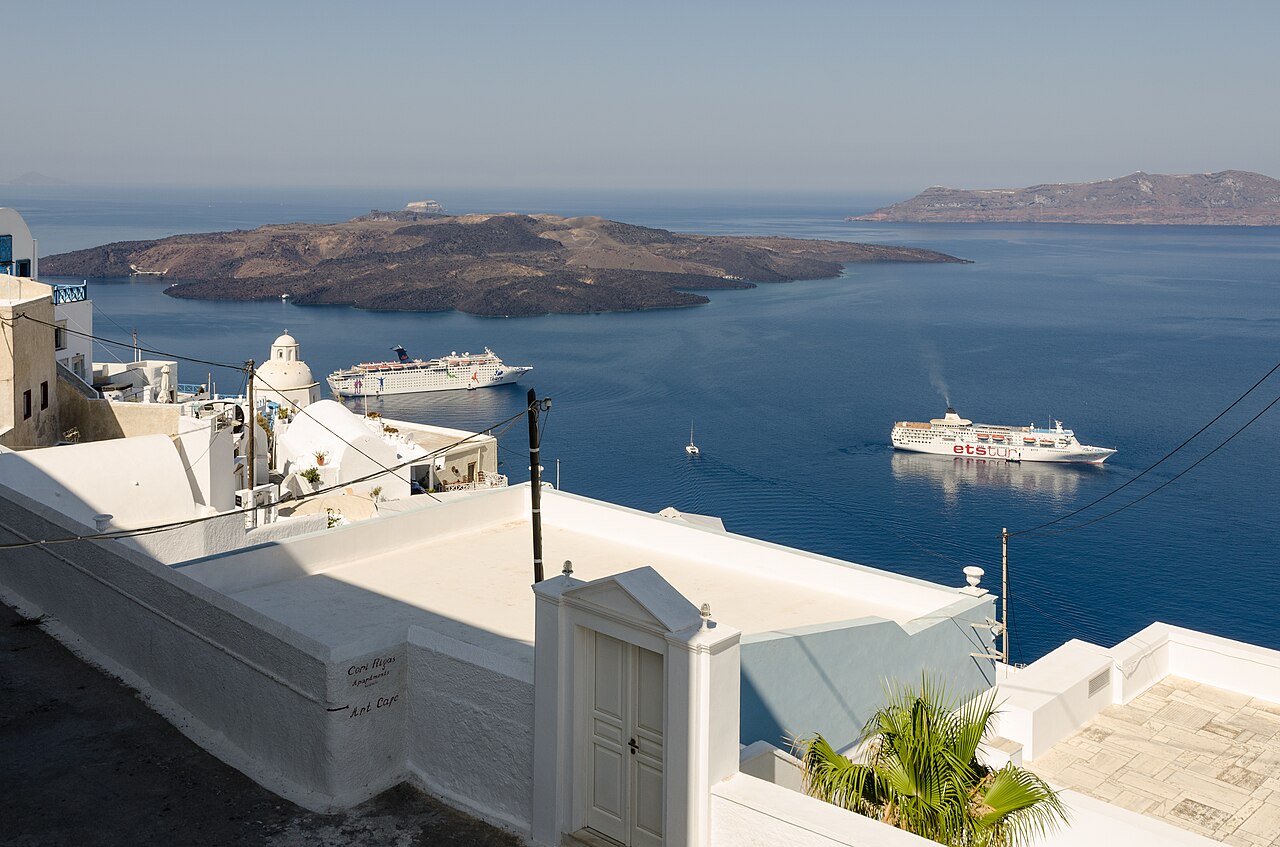
Highlights: the island’s main town, with a walkway following the rim of the caldera. The water sits close to 300 metres below the cliff, with Nea Kameni straight ahead and Thirasia behind it. The composition of white flat roofs stacked in terraces reads better looked up at from a level or two down than from the top of the cliff.
Practical note: the path continues north towards Firostefani and, if you keep going, all the way to Oia. That is a ridge walk with almost no shade and no water on it, though, and setting off on a summer afternoon in light clothing leaves you unable to turn back. This route does not assume you walk it.
- Nearest
- 10 minutes from Thira airport on the KTEL bus (EUR 2.20)
- To walk
- EUR 0
KTEL buses cover the island, radiating from Fira, and almost every section is EUR 2.20. Only Athinios port and the Perissa direction are EUR 2.70. The same shape, a cliff town worked by public transport, turns up on the slopes in the Barcelona four-night plan.
DAY 4The sunset at Oia is planned backwards from the time it sets
Why this order: move to Oia in the morning and stay put until evening. Do not put the round trip into the day twice.
Morning: Fira and Oia are different towns, about 20 minutes apart by bus
One misunderstanding to kill first. Fira and Oia are not the same place. Of the settlements strung along the caldera rim, Fira is the centre and Oia the northern end. It is 11.8 km on the KTEL bus, EUR 2.20 one way.
The frequency is good. There are 26 services from the 07:00 first bus to the 21:00 last, roughly every 30 minutes after 08:30. The operator publishes a duration only for the airport line, though, so about 20 minutes here is a reading off the gap between departures and turnarounds. Building a tight connection on that number is not advisable.
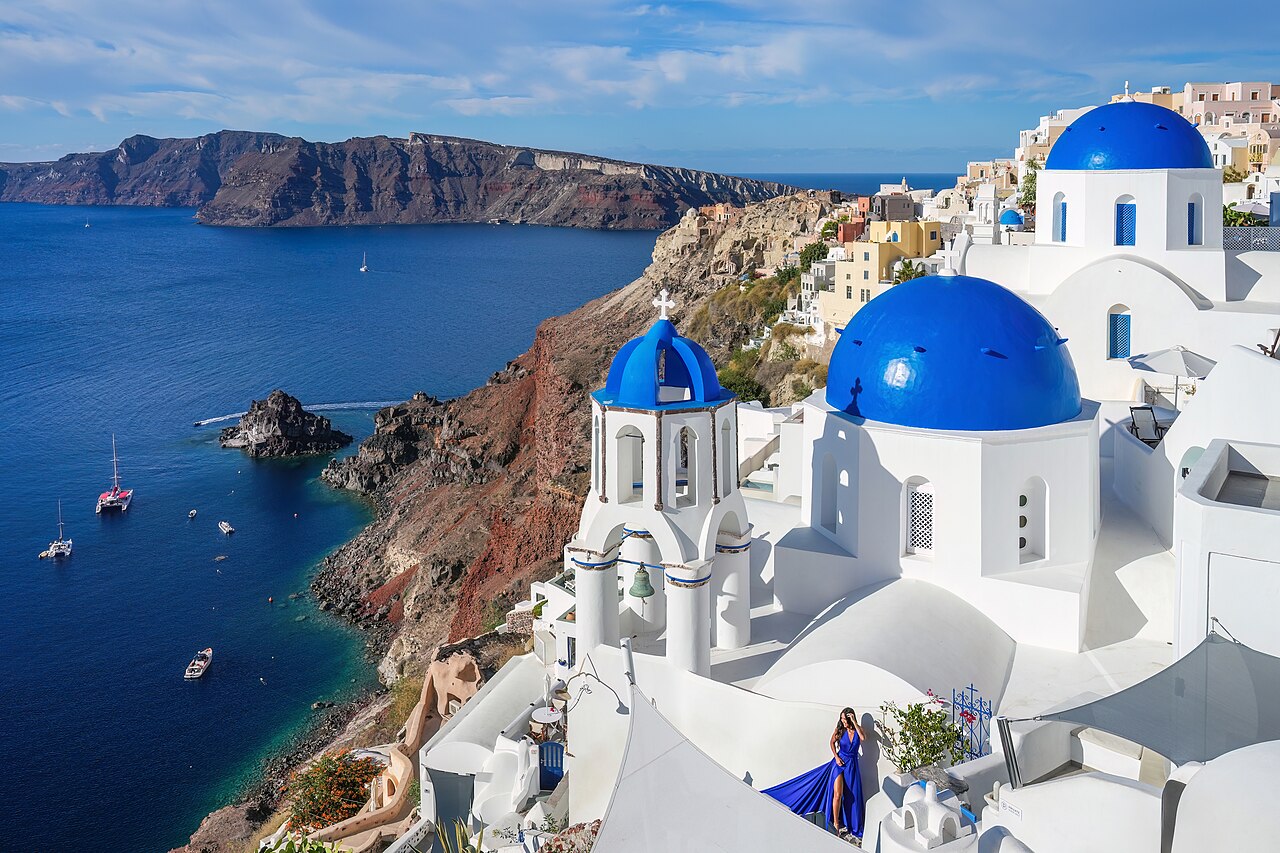
Highlights: whitewashed walls and blue-domed churches stacked in terraces, the most photographed corner on the island. The standard composition sits on a narrow path one level down from the main street towards the sea, and although the map makes it look close, the way there is up steps and down again.
Practical note: the vertical distance inflates every journey time. Reading “ten minutes on foot” at flat-ground pace will always be wrong. On a day when you are dragging a suitcase, budget 1.5 times the flat-ground figure and you will not be running at the port or the airport.
- Nearest
- About 20 minutes from Fira on the KTEL bus, EUR 2.20 one way
- Services
- 26 a day, 07:00 to 21:00 (roughly every 30 minutes after 08:30)
- To walk
- EUR 0
Evening: sunset moves by three and a half hours between June and December
The sunset at Oia enters the itinerary as the question of when you go and take your place. Computed for latitude 36.461 and longitude 25.375 on the 15th of each month, it runs like this.
Between the latest, 20:38 in June, and the earliest, 17:04 in December, there are three hours and 34 minutes. Walking the town from morning into the afternoon and finishing on sunset only works without strain while the sun sets after 19:00, which is April to early October. Outside that, the sunset pushes the afternoon forwards.
One more thing applies if your dates straddle the changeover week. Summer time in 2026 begins on 29 March and ends on 25 October. Across that line “meet at 17:00” means something an hour different, so anyone going to Oia at the end of October should check which side of it they are on before fixing the evening.
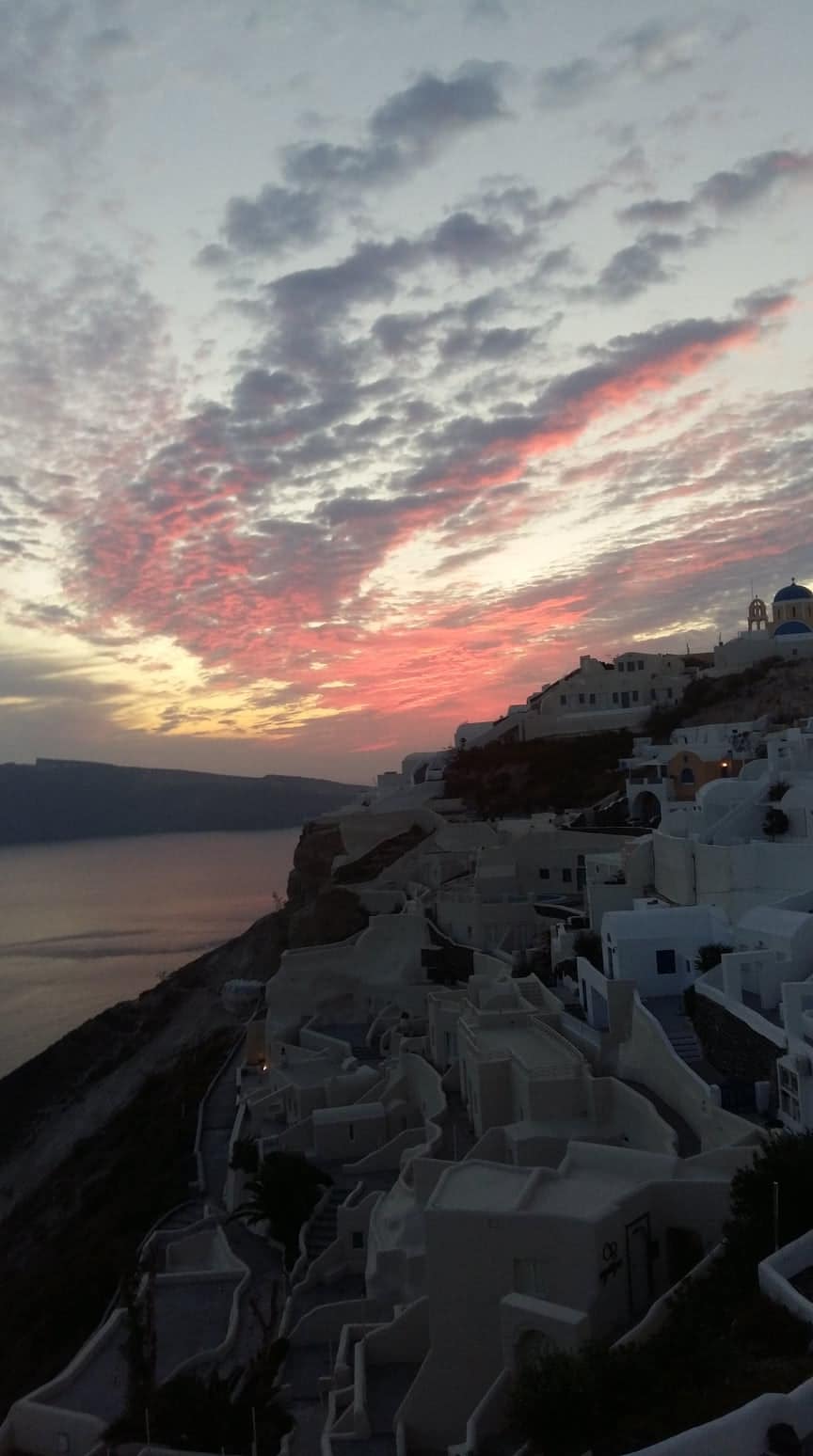
Highlights: what remains of the fortress at the western end of the settlement, facing straight west. It is where more people gather for the sunset than anywhere else on the island, and the terraces start filling more than an hour ahead.
Practical note: whether you can go in and what it costs are set by the notice on site. The crowd thins about 15 minutes after the sun has gone, which is when the sky deepens. Letting one bus go and taking the next avoids the peak of the crush.
- Nearest
- 8 minutes on foot from the Oia bus stop (the west end of the village)
- Timing
- Sunset falls between 17:04 and 20:38 depending on the month
DAY 5The southern site, and a terrace that only opens from May to September
Why this order: go down to the south end once and clear the site, the beach and the winery in the same direction. Do not mix it with Oia in the north on the same day.
Morning: Akrotiri closes at two different times depending on the day
Ancient Akrotiri at the southern end of the island is a town buried in volcanic ash by the eruption of the seventeenth century BC. Being under the ash kept the buildings standing to two and three storeys, and you walk through under a roof. It is EUR 2.20 from Fira on the KTEL bus, with a first bus at 08:30 and then hourly from 10:00 to 20:00, twelve services.
The opening hours have a quirk. In summer, 1 April to 31 October, Tuesday, Wednesday, Friday, Saturday and Sunday run 08:00 to 20:00, while Monday and Thursday alone run 08:30 to 15:30. In winter, 1 November to 31 March, Tuesday is closed and the rest run 08:30 to 15:30. A summer Monday or Thursday therefore shuts four and a half hours earlier.
Highlights: streets, drains and houses of two storeys and more, left as the ash buried them. What differs from Pompeii is that almost no human remains have been found, which suggests the inhabitants evacuated in advance. The original frescoes were moved to the National Archaeological Museum in Athens, so what is here are copies.
Practical note: no air moves under the roof, and in the middle of a summer day it feels hotter inside than out. Ancient Thera, the other site on the island, has been notified as closed until further notice from 27 June 2026, so arriving expecting to do two archaeological sites leaves you with one.
- Nearest
- KTEL bus from Fira, EUR 2.20 one way (12 services a day)
- Hours
- Summer: Tue, Wed, Fri, Sat, Sun 08:00–20:00; Mon and Thu 08:30–15:30
- Admission
- Adult EUR 20.00; reduced EUR 10.00
- Closed
- Tuesdays in winter; 1 Jan, 25 Mar, 1 May, Orthodox Easter Sunday, 25 and 26 Dec
- Official
- Official site ↗
Afternoon: the Red Beach is not something the official listings mention
Within walking distance of the site is a beach ringed by red cliffs, oxidised volcanic material above a shingle shore. It is one of the pictures the island is known by.
Put it in the plan on the understanding that the notice on site decides it. The beaches the municipality of Thira presents on its official tourism site are Vlychada, Kamari, Perissa, Perivolos and a category of hidden coves, five in all, and the red-cliff beach is not among them. Getting down means a narrow path under the cliff, and whether it is passable changes with the day.
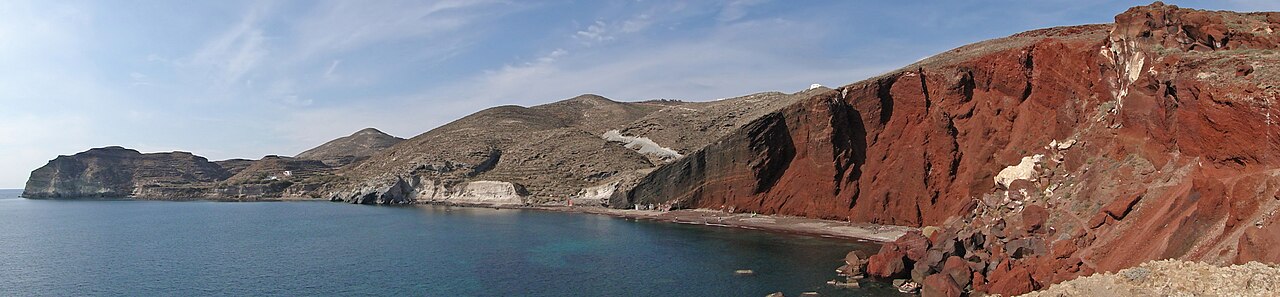
Highlights: besides the red-cliff beach, black sand runs along the east and south of the island at Perissa, Perivolos and Kamari. There is no beach actually called Black Beach; it is a collective name for the black-sand shores, and the signs on the ground carry the individual place names.
Practical note: the red-cliff beach is reached by a narrow path under the cliff, and the notice posted there is the only material for the decision on the day. If it says the path is shut, turn round. The black-sand beaches are reachable by bus from Fira, EUR 2.70 one way towards Perissa and Perivolos with 15 services a day, and EUR 2.20 to Kamari with 27.
- Nearest
- Walking distance from Akrotiri; the black-sand beaches by bus from Fira
- Entry
- EUR 0
Evening: the sunset terrace opens 1 May to 30 September
Santorini’s vines are trained low into a basket shape to keep them out of the wind. That is why the white wine of this island comes off thin volcanic soil, and the wineries are scattered halfway down the caldera side.
Venetsanos is the one publishing its prices. The winery tour is EUR 12.00 a head, tastings EUR 35.00 to 44.00 a head, and food plates EUR 10.00 to 30.00. Online booking closes 48 hours ahead, and anything later than that is by telephone only.
What matters more is the season. The sunset terrace facing the caldera opens from 1 May to 30 September, 18:30 to 22:00, and outside that the terrace itself is shut. Coming to the island from October onwards means the evening cannot be placed here.
DAY 6-7On the day you fly home, do not take the boat
Why this order: fly back to Athens from the island and keep the last morning in the city. Nothing involving a ferry goes on the same day as the flight home.
Morning: ten minutes from Fira to the airport by bus
Fira to Thira airport on the public bus is EUR 2.20 and takes 10 minutes, with 17 services from 06:00 to 22:00. In a cliff town there is always a stretch where you drag the luggage, so budget 1.5 times flat-ground pace to the stop.
The reason not to take a ferry home is that there is no substitute when it is cancelled. Rough water stops the sailings and the day’s services disappear entirely. A flight leaves you a chance of the next departure; a cancelled ferry costs you the flight home itself.
Afternoon: with half a day in Athens, go down the north side of the hill
Going up the Acropolis a second time is not an option. The ticket is valid once for the chosen date and time, and re-entering means buying again. What works instead is the Ancient Agora, spread across the north-west foot of the hill.
Highlights: the square where the citizens of ancient Athens gathered, and where Socrates walked. The Temple of Hephaestus at the western edge is better preserved than the Parthenon, with its roof and columns essentially complete. The reconstructed Stoa of Attalos houses a museum holding the devices used for voting and the ostraka from ostracism.
Practical note: admission is EUR 20.00, reduced EUR 10.00, half. You can walk in from Monastiraki, so leaving the bags at the hotel or in a locker lets you do it in two hours. The Roman Agora further east is EUR 10.00, and on a day with only half the time that one alone works.
- Nearest
- 5 minutes on foot from Monastiraki on lines 1 and 3
- Admission
- Adult EUR 20.00; reduced EUR 10.00
- Official
- Official tickets ↗
Alternatives
Rainy-day swap
What rain hurts here is the morning of day two and the whole of day four, where the outdoors is the main event. The marble path on the Acropolis is slippery, and the sunset at Oia does not happen at all under cloud.
Only the Acropolis can be moved. The time slot changes twice up to two hours before the visit, so an early-morning slot can be pushed past midday to let the rain through. The Oia sunset is neither a booking nor a ticket, so there is nothing to move. On a day forecast wet, walk the blue-domed lanes in the morning and give the evening up at the hotel.
Two places take you indoors: the Acropolis Museum, and Akrotiri on the island. The latter is walked under a roof, so rain does not stop it. It closes at 15:30 on summer Mondays and Thursdays, though, so check the hour before you move anything into it.
If the flight is delayed by an hour or more
A late day one barely hurts this route. All that sits on the first day is the journey from the airport and a walk through Plaka, neither of which runs to a clock. Land in the middle of the night and the next morning still starts the same way.
Day two is where it hurts. The Acropolis was bought for a time, and changes close 120 minutes before the visit. Moving it as soon as you know about the delay is fine; realising it in the air and trying to act after landing sometimes is not. On an itinerary with a connection on the way out, put the day-two slot in the afternoon rather than the morning and keep the room to change.
A late domestic flight on day three costs only the afternoon walk at Fira, which the next day at Oia absorbs, so this day is robust. Replace it with a ferry, on the other hand, and a cancellation takes days three and four together.
When you’re tired
The order of cuts is settled. First to go is Akrotiri on the morning of day five. The bus each way plus the visit takes half a day, and no air moves under the roof, which makes it the heaviest item on your reserves. Dropping it returns EUR 40.00 in admissions and EUR 8.80 in fares, EUR 48.80 to the two of you.
Next is the Ancient Agora on the afternoon of day six. It sits in the half day before the flight home, so if moving with the luggage is hard, going to the airport early is the safer call. That is another EUR 40.00 for two.
What is better kept is the Acropolis Museum. There are chairs, the air conditioning works, and it involves the least walking in the trip. It is the item to protect on a tired day, and cutting it means going home without knowing what the copies on the hill were copies of.
Why we skipped the sunset cruise
The standard Santorini addition is a sunset cruise round the caldera. It is not in this route.
The reason is that sunset happens once a day. Watch it at Oia on the evening of day four and again from a boat on day five and you are seeing the same event from two places on consecutive days, with both afternoons given over to waiting for it. From April to September the sun sets after 19:00 and daytime plans survive; from October it moves forward to 18:42 and the afternoon effectively disappears.
The other thing is that cruise prices and durations vary widely by operator and vessel, and it is a product chosen after the date and the hour are fixed. There is no fixed figure to put in the cost table, which is why it stays out here. Anyone who wants the sunset from land and from the water should clear the whole afternoon of day five before adding it.
Where to stay
This route splits the rooms in two: two nights in Athens and three on Santorini. The Athens side narrows to one answer; the island side changes how you move depending on where the three nights sit.
The island question is Fira or Oia. Fira is the hub of the bus network, with the airport, Akrotiri, Oia and the black-sand beaches all radiating from it. Oia is the sunset itself, but it is one end of the line, so any day heading south means changing at Fira. Put all three nights in Oia and day five gains a change in each direction.
Settling the total from the displayed rate leaves you short on the ground. Greece charges a climate crisis resilience fee separately from the room rate, collected by the property and declared monthly to the tax authority. The law behind it was replaced in 2025 and what applies now is article 44 of law 5177. It is levied per room or apartment per night rather than per person.
The amount is banded by the category of the property and by season. It sits outside the room rate, so read the actual figure in the tax line of the booking screen. Nights given free of charge are outside the scope, which the authority states explicitly.
Book in three stages: flights, the Acropolis slot, then the room. Buying the Acropolis ticket before the flight arrival is settled wastes the changes you are allowed, because it is bought for a date and time and cannot be returned. The room can come last. The same idea, separating what has to be held first from what can wait, appears with the Colosseum time slots in the Rome four-night plan.
What this trip costs
Assumptions: two adults, two nights in Athens and three on Santorini, public transport only in the city and on the island. Airfares, international and domestic alike, are out of the total because they swing too far by service and season, and rooms and meals are out because they move on the same dates. What is listed is only the published rates that barely change. At JPY 179 to the euro the total comes to about JPY 49,900.
Every figure above is the published rate as of 2026-09-14. The yen conversion uses the European Central Bank reference rate of 2026-09-11, JPY 178.56 to the euro.
Broken down, admissions are EUR 180.00 and transport EUR 74.80. The sites and the museum take two thirds of the whole. Greece has been raising admission at its major sites, so budgeting on the assumption that looking from outside is free goes wrong here.
Transport has almost no further to fall. The island buses are close to a flat EUR 2.20 a section with no multi-ride discount. The Athens 24-hour ticket beats the 90-minute one from the third journey, so on a day like day two, hill and museum and Plaka, it is worth buying. On a day where everything happens inside 90 minutes, the EUR 1.20 single is enough.
The one place there is room to cut is hitting an Acropolis free day, which returns EUR 60.00 for the two of you. Most of those days are the first and third Sundays between 1 November and 31 March, and in that period the hill shuts at 17:00. What EUR 60.00 buys back costs you the hours on top of the hill and an uncrowded morning. Over this number of days I would rather pay the full rate for a quiet slot.
Who this route does not suit is anyone travelling between November and March. The Acropolis closes at 17:00 with last admission at 16:40, and sunset at Oia falls into the five o’clock hour. Neither Athens nor Santorini leaves much afternoon, so cutting to two places a day and adding days is the version that fits. Island bus frequencies also fall below the summer timetable the operator publishes. July and August have the opposite problem: the days are too long, and with no shade on the hill there is effectively no arrangement other than the 08:00 slot and down by noon.
One thing about how you pay. The Acropolis ticket is bought online for a date and time and never refunded. With a single card, the moment that card is stopped by a limit or a fraud check, the itinerary stops with it. Carrying two cards on different networks, kept apart is the preparation for exactly this kind of “cannot buy, so the plan collapses” moment.
Entry procedure has changed over the past two years. A Japanese passport needs no visa for 90 days in any 180 under the Schengen rules, but the EES border system began phasing in on 12 October 2025 and went to full operation on 10 April 2026. Registering fingerprints and a facial image on entry is a procedure already running rather than one still to come. ETIAS, the electronic travel authorisation, is described by the European Commission as not currently in operation, with no start date announced. Notice is to come several months ahead, so check before you travel whether it has begun. The fee is published as EUR 20.00.
The same pattern, opening hours and closing days deciding the route, appears in the Paris four-night plan, but in Greece it is the closing time rather than the closing day that does the work. Durations and time on site are built from published distances and normal visit lengths.
Sources: the Greek Ministry of Culture and ODAP (hh.gr, tickets.hh.gr); the Acropolis Museum; OASA; KTEL Santorini; Blue Star Ferries; Golden Star Ferries; Venetsanos Winery; the municipality of Thira; the Independent Authority for Public Revenue (AADE); the European Commission (Schengen, EES, ETIAS); European Central Bank reference rates / Checked on 2026-09-14 / Sunset times computed with the NOAA formulae / Photographs: Omer Toledano, Steve Swayne, Norbert Nagel, Giles Laurent, Nemomagister, Bernard Gagnon, Robert Kindermann aka RobertK (Wikimedia Commons, CC BY 2.0 / CC BY-SA 2.5 / CC BY-SA 3.0 / CC BY-SA 4.0)
Other sales ending soon




 4 days leftuntil Oct 24Air Busan Takamatsu-Busan Coupon: Up to 9,000 Yen Off Until October 24
 5 days leftuntil Oct 25JAL Hong Kong Campaign: Tokyo–Hong Kong Round Trip from 75,800 Yen (until 25 Oct)
 11 days leftuntil Oct 31Jin Air Kobe–Seoul: 5,000 yen off a round trip with code KTOUKB1, until 31 October
 11 days leftuntil Oct 31Jin Air to Busan: 4,000 yen off a round trip with code KTOPUS, first 300 only