JAL Runs a Flash Sale on International Award Tickets, Including Guam
AuthorMIRUTOBE editors
Table of Contents6 items
What a flash sale on award tickets cuts is this base figure. JAL international awards start at 7,500 miles one way, and Japan–Guam runs 10,000 in economy and 23,000 in business. Once the base seats are gone, Award Ticket PLUS takes economy as far as 134,000.
Check first: is the figure on screen the base, or PLUS?
- Your JAL Mileage Bank balance already covers the requirement on the day you apply — a shortfall cannot be topped up with cash
- The travel date falls within 360 days of the day you apply
- The plan assumes you will not move the dates; no changes are accepted once the ticket is issued
- You are ready to pay the fuel surcharge, the aviation insurance surcharge and each country’s taxes separately
- You can tell whether the number an availability search returns is the base mileage or includes PLUS
That last line is the whole mechanism. JAL does not set one number per route. If the cheapest seats — the base mileage — are taken, you can still book by paying extra miles that move with the seats the airline predicts will remain. That is Award Ticket PLUS, and only First Class sits outside it. Judge a sale as cheap without knowing which of the two you are looking at and you are comparing against the wrong figure.
Five steps from request to issued ticket
The ticket is issued the moment the booking completes, and the miles leave the account then — except on a waitlist. Waitlisting exists only for First Class: apply between 360 and 90 days before the first sector departs and the request is held until 82 days before departure, and inside 7 days a waitlist request is not accepted at all.
Base mileage from Japan, one way
These are the base figures from JAL’s published chart. What stands out is Guam: business at 23,000 miles sits almost level with economy to Honolulu at 20,000. The sector is short, so the cabin above costs little more, and on a flight of under four hours you trade a fully flat bed for a seat at the front bought with very few miles. Seoul at 7,500 one way is the floor of the whole international award chart — the “from 15,000 miles return” line in JAL’s own wording points at this route.
Two conditions do not appear in the table. First Class is outside PLUS and instead moves with the seasonality of the travel date, though there is no First Class on the Guam route at all. The other is how infants are counted: children, and infants who need a seat, cost the same as an adult, while an infant not occupying a seat costs 10% of the adult requirement, and only when the accompanying adult is using the same award. Three people to Guam with one lap infant is therefore 10,000 + 10,000 + 1,000, or 21,000 miles one way in economy. The earning side — annual fees and the conditions attached to each card — is laid out in the travel credit card comparison.
Where people trip up
The same Guam flight can be 10,000 miles or 134,000
The PLUS ceiling is an order of magnitude away from the base. Japan to Guam in economy is 10,000 miles at base and up to 134,000 under PLUS; business is 23,000 against a ceiling of 140,000. Same route, same cabin, and a spread of more than thirteen times depending on the day you book and what is left.
So whether you can fly on miles is decided by how free your dates are, not by your balance. If the middle of the summer holiday cannot move by a single day, the requirement sits near the ceiling. If a week either side is negotiable, you can go looking for the days when base seats appear. Spending miles on a trip with fixed dates is a poor trade in my view. Moving smaller amounts on domestic routes keeps the swing narrow, and the break-even on a 7,000-mile Dokokani round trip works that arithmetic out.
Once it is ticketed, neither the date nor the flight can change
After the miles are deducted and the ticket is issued, changes to the booking are not accepted. Nor can you change cabin. Moving the dates means cancelling, taking the refund and rebooking the new itinerary, and a refund costs a cancellation fee of JPY 3,100 per ticket.
Rebooking also means the requirement is recalculated against whatever is left at that moment. Letting go of a seat held at base mileage and finding only PLUS-level availability on the way back in is an ordinary sequence. That gap costs far more than the JPY 3,100.
Paying in miles still leaves a cash invoice
On top of the published mileage sit the fuel surcharge, the aviation insurance surcharge and the departure, arrival and airport charges imposed by governments and airports. On some routes and some aircraft there is no fuel surcharge at all, and that varies sector by sector rather than route by route.
There is also a constraint written by US law. You cannot build an itinerary that flies from the United States to the United States — Hawaii and Guam included — via Japan without using an international sector operated by a US carrier at some point. A one-way out of Guam routed through Japan to Hawaii stops here.
If no seat is available at the base mileage
Three moves are open: shift the dates, change the destination, or wait for a campaign. The first does most of the work, since JAL states outright that the requirement is set by the date and by availability at the time of booking. Changing destination is realistic too — business to Guam at 23,000 against business to Seoul at 18,000 is a difference of 5,000 miles, and the same balance that buys economy to one place can buy the cabin above to another.
Campaigns cannot be predicted. Past rounds have combined mileage rebates with a route discount, as the More Trips Abroad campaign with its Guam discount did. If you are going to wait, the useful thing to do while waiting is to settle on one use for the balance. For long-haul, the roadmap for circling the globe on 100,000 miles sets out how the total stacks up.
Common questions: the floor, when booking opens, and children
How few miles can buy a JAL international award?
7,500 one way, or 15,000 return. That floor belongs to economy on Japan–Seoul. Guam is 10,000 one way, Honolulu 20,000, London and Paris 27,000, all as base mileage. In every case, if the base seats are taken, the Award Ticket PLUS increment goes on top.
When can I book?
From midnight Japan time, 360 days before the travel date. On a return, the inbound leg also has to sit within 360 days of the application date. The cut-offs are 48 hours before the first sector departs on the JAL website and 24 hours by phone, both in local time at the point of departure; if that moment falls outside call centre hours, the effective deadline is the previous working day.
Do children need the same number of miles?
Children, and accompanying infants who occupy a seat, need the same mileage as an adult. The only exception is an infant travelling without a seat, at 10% of the adult requirement and only when the accompanying adult is using the same award. Against 10,000 miles one way to Guam in economy, a lap infant costs 1,000.
- JAL international award tickets — mileage required (updated 16 April 2026; base mileage and PLUS) ↗Checked on 2026-09-14
- JAL international award tickets (routes, the mileage floor, the US legal restriction) ↗Checked on 2026-09-14
- JAL — making a booking (360-day opening, cut-offs, waitlist) ↗Checked on 2026-09-14
- JAL — changes and refunds (no changes after ticketing, JPY 3,100 cancellation fee) ↗Checked on 2026-09-14
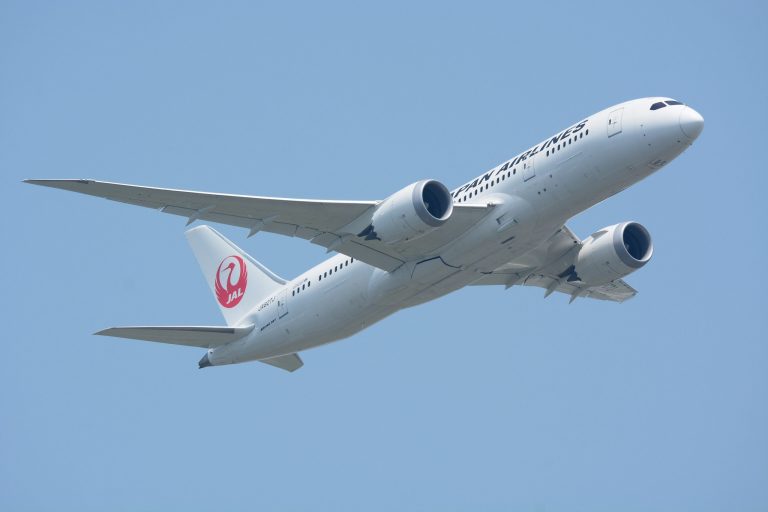
Source: the reference block above / Checked on 2026-09-14 / Photo: Masakatsu Ukon, CC BY-SA 2.0 (Wikimedia Commons)
Other sales ending soon




 4 days leftuntil Oct 24Air Busan Takamatsu-Busan Coupon: Up to 9,000 Yen Off Until October 24
 5 days leftuntil Oct 25JAL Hong Kong Campaign: Tokyo–Hong Kong Round Trip from 75,800 Yen (until 25 Oct)
 11 days leftuntil Oct 31Jin Air Kobe–Seoul: 5,000 yen off a round trip with code KTOUKB1, until 31 October
 11 days leftuntil Oct 31Jin Air to Busan: 4,000 yen off a round trip with code KTOPUS, first 300 only