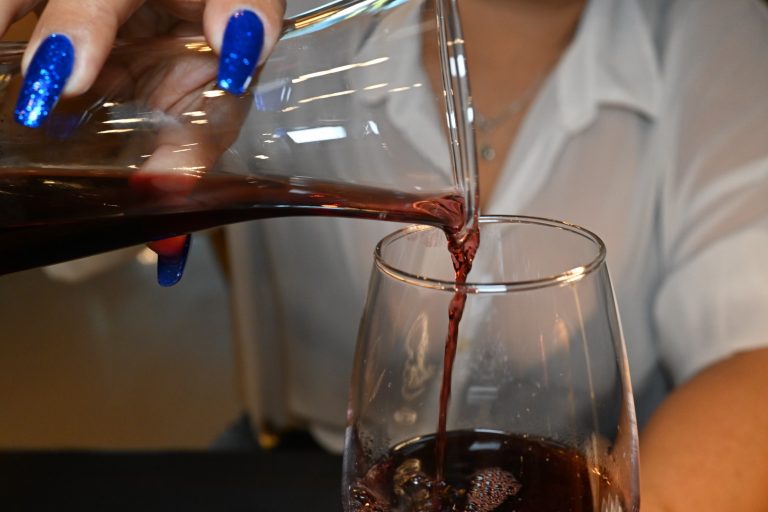
How to Make a 3,000-Yen Wine Taste Like a 10,000-Yen One
AuthorMIRUTOBE editors
Table of Contents6 items
Japan taxes fruit wine at 100,000 yen per kilolitre, which works out at 75 yen for a 750ml bottle whether the contents cost 3,000 yen or 10,000. Tariffs on EU bottled wine were removed when the Japan–EU economic partnership agreement came into force.
What creates the price gap, then, is the liquid itself and the chain that carries it. And what a drinker can move without spending anything is a different set of variables altogether: temperature, glass and food.
Check first: what is decided before the cork comes out
- You have decided how many minutes before drinking the bottle comes out of, or goes into, the fridge
- You have a clear, colourless glass with a stem (deciding to use a tumbler counts)
- You know whether the bottle is being finished tonight or kept
- You know what you are eating with it
- You are aware that you are carrying the price on the label into the glass as an expectation
That last line does the most work, because the effect of price information on how something tastes has been measured experimentally rather than merely asserted.
Five steps that take 3,000 yen apart
Taxing by volume alone is easier to see against other drinks. Beer-type drinks are taxed at 63.35 yen per 350ml equivalent and other sparkling categories such as chu-hi at 28 yen. Wine is 75 yen for a whole bottle, which divided into five glasses is 15 yen a glass.
Nor has it always been 75. The rate on fruit wine rose in two stages, in October 2020 and October 2023, moving from 80,000 to 90,000 and then 100,000 yen per kilolitre. Per bottle, that is 60 yen becoming 75.
The full picture: what temperature changes, and what the glass changes
The figures are the guidance published by Kirin’s Mercian wine academy. Three to four hours in the fridge for a white is long enough that deciding on it just before you want a glass does not work, and that is where home drinking usually comes apart. Iced water does the same job in 20 minutes.
“Room temperature” for a red does not mean a Japanese room in August, either. Chilled too far, tannin stands up; warmer, it reads as softer. Which way to push depends on how tannic the particular bottle is.
Where people trip up
“Just use a big glass” is only half right
A glass moves four things separately. The spread of the aroma comes from the shape of the rim; contact with air from the surface area of the wine poured; how fast the temperature rises from the size of the bowl overall; and how it lands in the mouth from the width and angle of the rim. Enlarge the bowl and the aroma gathers, but the wine also warms faster.
Which is why Kirin’s wine academy recommends a smaller glass for anything drunk cold. Pour a generous measure of white into a big bowl and it goes tepid before the aroma arrives. The criteria reduce to three: a tapered rim, colourless glass, and a stem. Meet those three and, the same source says, a tumbler or a rocks glass will do.
The price on the label moves the brain, not just the opinion
A research team including Caltech measured this in a paper published in the Proceedings of the National Academy of Sciences in 2008. Twenty subjects were served five samples that were really only three wines: the same wine was poured twice, described once as 90 dollars and once as 10. When the stated price was higher, both the reported pleasantness and the blood-flow response in the medial orbitofrontal cortex went up.
Useful as that is, it runs backwards just as easily. Pouring while saying “this is only a cheap one” spends part of the experience on the sentence. If the price is worth mentioning, I would mention it after the bottle is finished.
A fridge is a tool for chilling, not a place to keep wine
Six conditions are given for storage: 13 to 15 degrees, humidity around 75 per cent, darkness, no vibration, the bottle lying on its side, and nothing strongly scented nearby. Sunlight alters wine severely and can produce the off-note known as lightstruck.
A fridge is too cold and too dry, swings in temperature every time the door opens, and passes on the smell of whatever else is in it. It is not suited to keeping wine for a year or more. Leaving a 3,000-yen bottle at the back of one for six months is the single worst place to put it.
What if you want the 10,000-yen experience exactly?
You cannot have it. The quality of the liquid does not change with how you drink it. The growing season, the barrel and the years that passed inside the bottle are not things that can be added afterwards.
What makes the exercise worth doing is that a non-trivial share of the 7,000-yen gap is being thrown away at the drinker’s end. Pour a white straight from the fridge and the aroma stays shut; open a red in a Japanese summer room and the edges of the tannin blur. Temperature alone moves the impression of a single bottle. It costs nothing, and what it asks for is either 20 minutes or three hours, counted backwards from when you want to drink.
The same yardstick works on drinking out. Opening a bottle in a restaurant buys the liquid plus the temperature control, the glassware, the room and other people’s time. It is the same structure as taking apart what a night with two meals is made of, which is done in the anatomy of a 9,800-yen onsen inn.
Keeping the spending on one card also leaves a record of when and where each bottle came from. Which card to use is compared in our travel credit card round-up.
Common questions: after opening, decanters, and just buying better
How long does a bottle keep once it is open?
Anything other than sparkling will hold its character for a while if stored properly. The enemy is oxidation by the oxygen in the air, which past a certain point damages the flavour badly, so the principle is to expose it to as little air as possible. How many days depends on the condition of the wine, and Kirin’s wine academy does not put a single number on it.
Am I at a disadvantage without a decanter?
Contact with air is also governed by the surface area of the wine in the glass. Pour a small measure into a wide-bowled glass and the surface is broad. A decanter does the same thing in a larger vessel, so not owning one is not in itself a handicap.
Would it not be quicker to buy an expensive bottle?
It would. Bear in mind, though, that the 10,000-yen bottle carries the same 75 yen of tax, with the whole difference sitting in the liquid and the supply chain — and that temperature and glassware work on it exactly the same way. Skip the chilling arithmetic and the expensive bottle is the one that wastes more.
The distance between price and satisfaction is looked at from another angle in the economics of a Thai roadside coffee.
- National Tax Agency — liquor tax rate table (1 Oct 2023 to 30 Sep 2026; fruit wine 100,000 yen/kL)↗Checked on 2026-09-14
- Ministry of Finance — phased liquor tax reform (brewed categories unified in Oct 2023; 350ml comparison)↗Checked on 2026-09-14
- METI — the Japan–EU EPA (wine liberalised immediately; in force February 2019)↗Checked on 2026-09-14
- Kirin Wine Academy — serving temperatures and chilling times↗Checked on 2026-09-14
- Kirin Wine Academy — choosing a wine glass (four variables, three criteria)↗Checked on 2026-09-14
- Kirin Wine Academy — storing wine (six conditions, and after opening)↗Checked on 2026-09-14
- Plassmann et al. (2008), PNAS 105(3):1050–1054 (stated price, pleasantness and mOFC response)↗Checked on 2026-09-14
Source: the reference block above. Tax figures are the Japanese rates / Photo: Personal Creations, CC BY 2.0 (Wikimedia Commons) / Checked on 2026-09-14 / Featured image: PattayaPatrol, CC BY-SA 4.0 (Wikimedia Commons)
Other sales ending soon
 4 days leftuntil Oct 24Air Busan Takamatsu-Busan Coupon: Up to 9,000 Yen Off Until October 24
 5 days leftuntil Oct 25JAL Hong Kong Campaign: Tokyo–Hong Kong Round Trip from 75,800 Yen (until 25 Oct)
 11 days leftuntil Oct 31Jin Air Kobe–Seoul: 5,000 yen off a round trip with code KTOUKB1, until 31 October
 11 days leftuntil Oct 31Jin Air to Busan: 4,000 yen off a round trip with code KTOPUS, first 300 only