Eastern Hokkaido 4-Day Drive: Shiretoko, Akan, Mashu, Kushiro
AuthorMIRUTOBE editors
Table of Contents9 items
- Itinerary
- DAY 1 The first afternoon is two hours from the airport to Utoro, and nothing else
- DAY 2 At Shiretoko Goko, choose between the two ways of walking before you arrive
- DAY 3 Kussharo and Mashu share a parking ticket; at Lake Akan the evening is the main event
- DAY 4 Down from Lake Akan to the Kushiro Wetland, then hand the car back
- Alternatives
- Why we left out the Shiretoko sightseeing boat
- Where to stay
- What this trip costs
Four days across eastern Hokkaido in August, picking up a rental car at Memanbetsu Airport. Shiretoko Goko, Kussharo, Mashu and Lake Akan, then out to Kushiro one way. What costs money on this route is stopping, not driving.
Itinerary
DAY 1The first afternoon is two hours from the airport to Utoro, and nothing else
Why the day runs this way: Memanbetsu to Utoro is about 90 km and two hours. Slot anything sightseeing-shaped into the first day and you arrive on the Shiretoko side after dark, so treat it as a travelling day and leave it empty.
Afternoon: read 90 km as two hours
Memanbetsu Airport to Utoro is about 90 km, and two hours by car is the official estimate. The road runs almost without traffic lights, so it drives easily for the distance, and yet two hours here tires you differently from two hours on a Honshu expressway. Fuel stops and toilets are far apart, and the next convenience store can be 30 km away; filling up before leaving the airport is the safe habit. Which Japanese airport you fly out of decides how much slack the first day has, so settle that first with the comparison of Narita and Haneda.
Leave the airport at 14:00 and you reach Utoro in daylight. Land on an afternoon flight at 16:00 and you are arriving after 18:00.
Not driving is an option too. Abashiri Bus runs the Shiretoko Airport Liner direct from Memanbetsu Airport to the Utoro Onsen bus terminal, and Shari Bus operates routes as well. Joining Shiretoko Goko, Kussharo, Mashu and Lake Akan by bus from day two onwards is hard on frequency alone, though, so this itinerary assumes a car.
Evening: fix tomorrow’s departure time while you are in Utoro
Once you are at the accommodation, decide which of the two ways of walking Shiretoko Goko you are taking. The last briefing for the ground-level trail moves with the season: in August the last one for the large loop is at 16:00 and for the small loop at 17:00. To go in first thing, briefings start at 8:10 and run every 10 minutes.
If you are taking a Shiretoko sightseeing boat from Utoro, the town car park is JPY 400 for a car. Leave it there all day and it does not go above that.
DAY 2At Shiretoko Goko, choose between the two ways of walking before you arrive
Why the day runs this way: the elevated boardwalk and the ground-level trail need completely different paperwork and completely different amounts of time. Decide in advance or you lose an hour standing in the queue for the application and the briefing.
Morning: the boardwalk is free, the ground trail changes with the season
There are two ways to walk Shiretoko Goko. The elevated boardwalk runs about 800 metres and takes roughly 40 minutes there and back to the shore of the first lake. It is enclosed by a 7,000-volt electric fence, so brown bear activity does not affect it, and it has no steps, so a wheelchair can use it. It is free from opening to closing.
The ground-level trail runs through primeval forest, and the season you visit puts you into one of three regimes.
Going in August puts you on the third row. At the Field House you fill in an entry authorisation form with the lead person’s name, address and the number in the party, buy tickets for that number from the machine and hand them in at the desk. A briefing of about 10 minutes follows, and then you can walk. Parties under 15 need no reservation and can do all of it on the spot.
Between 10 May and 31 July, the brown bear activity period, that procedure will not get you in. You have to book onto a registered guide’s tour: the large loop is from JPY 6,000 booked ahead, or JPY 7,000 if you turn up on the day. Go in August, with the school holidays, and the same path costs JPY 450. One month’s difference is JPY 6,550 per person at this one spot.
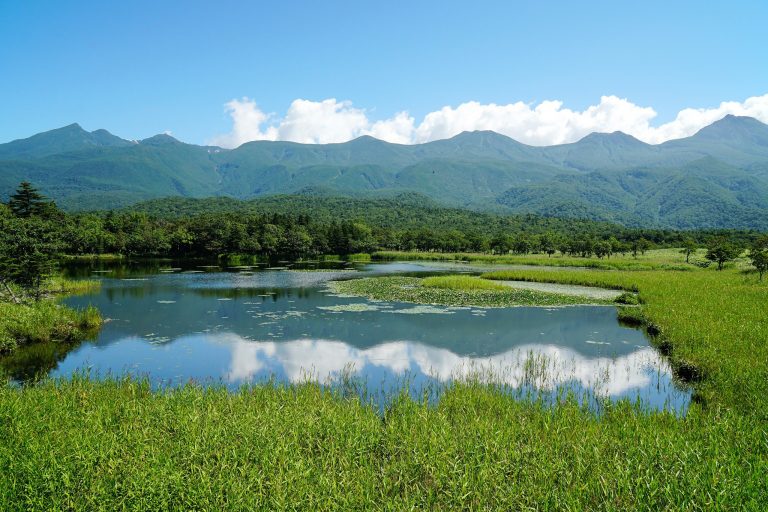
What it is: five lakes scattered through primeval forest, with the Shiretoko range reflected in the water. The ground-level trail is a 3 km circuit on the large loop and 1.6 km on the small one. Both are one-way, and you can climb from the ground trail onto the boardwalk but not the other way. Bear claw marks and black woodpecker feeding scars are visible along the path.
In practice: the Shiretoko Goko Field House, built in 2011, is missing from most car navigation systems, and searching by telephone number has been reported to send drivers somewhere else entirely. Set the Mapcode 757 730 727, or the old Shiretoko Goko Rest House (0152-24-2299), as the destination instead. There is no toilet and no shop on the trail, so use the Field House before you go in. Three hours of walking is easier with your hands free, so keeping luggage to cabin baggage only and leaving it in the car helps.
- From Utoro
- About 14 km, roughly 20 minutes by car
- Open (1–31 Aug)
- Park 8:00–18:30 / Field House 8:00–18:00
- Briefings (August)
- First at 8:10, every 10 minutes / last for the large loop 16:00, small loop 17:00
- Car park
- Paid, 100 spaces
Afternoon: count back from the last briefing
The deadline moves earlier as the season goes on. From 1 to 15 September the last large-loop briefing is 15:30, and in October it is 14:30. From 21 October the interval widens from 10 minutes to 20. If you are going for the autumn colour, decide the time you leave the accommodation on the assumption that you are going in during the morning.
If a bear appears, the ground trail closes. What is left on those days is the boardwalk, still free to walk. Going with the attitude that you will walk the ground trail if it happens to be open keeps the plan from breaking.
The rules inside the park are set down explicitly: no feeding, no litter, no cooking or eating, no smoking, no leaving the path, no pets, no drones. Carrying a packed lunch in to spread out by a lake is not one of the available uses.
DAY 3Kussharo and Mashu share a parking ticket; at Lake Akan the evening is the main event
Why the day runs this way: the parking ticket for Mount Io and for the Lake Mashu First Observatory is shared, valid once at each on the day of purchase. Call at Mount Io first and then climb to Mashu and the same JPY 500 parks you at both.
Morning: Sunayu is free and open 24 hours
Sunayu on the shore of Lake Kussharo is a stretch of beach where digging into the sand brings hot water up. There is no charge, it is open 24 hours and it never closes. The water is a sodium bicarbonate spring, and the geothermal heat means this one spot does not freeze even in the depths of winter. You can dig with your hands without a spade, but the deeper you go the hotter the water, so getting the temperature right takes a while.
Being able to call in early is what this place is for. Mount Io and Lake Mashu both mean waiting for a car park to open; Sunayu has no opening or closing time at all.
Afternoon: JPY 500 parks you at both Lake Mashu and Mount Io
The car parks at the Lake Mashu First Observatory and at Mount Io share a tariff: JPY 500 for a car, JPY 200 for a motorcycle, JPY 1,000 for a microbus and JPY 2,000 for a coach. That single payment covers one use of each car park and is valid only on the day. A car of 5 metres or more is charged at the microbus rate, which is worth knowing if you have hired a large minivan. The Third Observatory is free.
Through the winter, November to April, the car parks close and access becomes free. The notice states plainly that no responsibility is accepted for accidents or trouble while they are closed, so snow clearance and road surface are your own judgement.
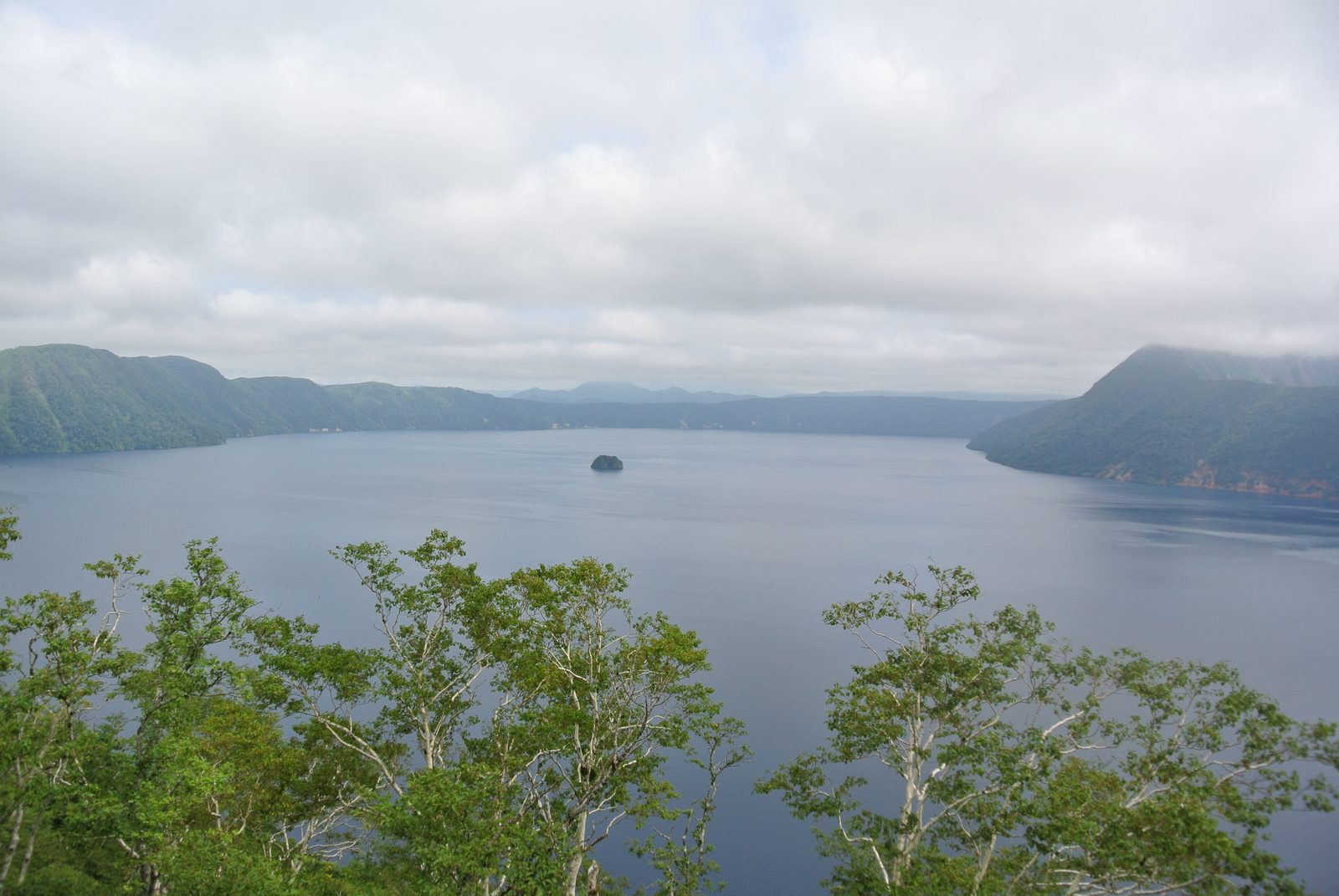
What it is: a caldera lake with its surface at 351 m, a maximum depth of 212 m, an area of 19.6 square kilometres and a circumference of 20 km. Steep caldera walls standing 500 to 700 m above sea level enclose it, 150 to 350 m above the water. Kamuishu Island in the middle is 110 m on its long axis and 40 m on its short one, with only about 30 m of it above the surface — the summit of a volcano erupted from the lake bed.
In practice: there is no path down to the shore from the observatory. It is somewhere to look at rather than enter, so the stop is short, and pairing it with Mount Io on the shared parking ticket wastes nothing. Kamuinupuri (Mount Mashu) rises to 857 m to the south-east, and on a foggy day even its outline is invisible.
- Parking
- JPY 500 per car (shared with Mount Io, once at each on the day)
- Third Observatory
- Free
- Winter
- November to April the car parks close and access is free
At the foot of Mount Io (Atosanupuri) a colony of Ezo Labrador tea spreads across roughly 100 hectares. The Tsutsujigahara nature trail from the town of Kawayu Onsen to Mount Io is about 2.5 km, an hour on foot. The flowers are out in June and July, and guided walks run for a month from early June to early July. Going in August you have missed them, so passing through to look at the fumaroles is enough.
Evening: the performances at Akanko Ainu Kotan run to fixed times
Akanko Ainu Kotan is a settlement of about 120 people. Two productions are staged at the indoor Akanko Ainu Theatre Ikor, and neither requires a booking.
What it is: “Ainu Ceremonial Dance” is traditional song and dance built around the inaw ritual implements, at JPY 1,500 for an adult and JPY 700 for primary school children. From 1 May to 31 October it runs three times a day at 11:00, 13:30 and 20:00; from 1 November to 30 April only at 20:00. “Akan Yukar: Lost Kamuy” layers contemporary dance and 3DCG over the ceremonial dance, at JPY 2,200 for an adult and JPY 700 for primary school children, daily from 21:00, using five projectors and 7.1-channel surround.
In practice: Lost Kamuy starts at 21:00, which makes a night at Akanko Onsen a precondition for this day. Unless dinner is done by around 18:00, you go straight from the table to the theatre. To see both, the 20:00 ceremonial dance runs into the 21:00 Lost Kamuy, which means nearly two hours in the same auditorium.
- Address
- 4-7-84 Akanko Onsen, Akan-cho, Kushiro, Hokkaido
- Booking
- Not required (performances may be cancelled or changed)
- Ceremonial dance
- Adult JPY 1,500, primary school JPY 700, 30 minutes
- Lost Kamuy
- Adult JPY 2,200, primary school JPY 700, about 30 minutes
DAY 4Down from Lake Akan to the Kushiro Wetland, then hand the car back
Why the day runs this way: the last day is bounded by the time the car is due back. Narrow the wetland to one observatory and reserve the time for refuelling and the handover first.
Morning: one observatory over the wetland is enough
The observatories over the Kushiro Wetland are split east and west across it. Hosooka on the east bank looks straight down onto the meanders of the Kushiro River; the Kushiro City Wetland Observatory on the west bank takes in the whole marsh from a distance. Visiting both means a long detour round the wetland, and half a day will not hold it.
This itinerary calls only at Hosooka, because it sits on the line you are already following down from Lake Akan towards Kushiro, and carries on towards the airport.
Afternoon: refuel by counting back from the handover
Rental cars are returned with a full tank as standard. Filling stations in eastern Hokkaido are far apart and there is not necessarily one just before the airport, so fill up before leaving central Kushiro. This is a one-way hire — collected at Memanbetsu on day one, returned at Kushiro on the last — so check whether a one-way fee applies when you book.
Building it as a return to Memanbetsu instead turns day four into a loop back north from Lake Akan, and the Kushiro Wetland drops out. Either you go through one way, or you go out and back and give up the wetland. This version takes the first.
Alternatives
Rainy-day swap
The ground-level trail at Shiretoko Goko can be walked in the rain, but the path turns to mud and the photographs are not worth keeping. On a wet day, take the boardwalk only and put the recovered time into crossing the Shiretoko Pass. Fog on the pass removes the visibility entirely, so getting over it in daylight is the safer order.
At Lake Mashu, fog is more trouble than rain. It is known as the foggy lake for a reason, and there are days when you reach the observatory and cannot see the water. The JPY 500 ticket is shared, so calling at Mount Io first and reading the fog before you climb saves a pointless round trip to an invisible lake.
If the flight is delayed by an hour or more
An hour lost on day one means arriving in Utoro in the dark. Roads in eastern Hokkaido have no street lighting, and that hour overlaps with when the deer come out. Once you know about the delay, moving the first night to Shari or Abashiri costs less than forcing 90 km after dark.
If day two slips, the deadline is the last briefing at Shiretoko Goko — in August 16:00 for the large loop and 17:00 for the small one. Arrive too late for the large loop and switch to the small one, or take the boardwalk alone. Make that decision before you reach the Field House and you will not be hesitating at the desk.
When you’re tired
Day three is a lot of driving. You could stop trying to join Kussharo, Mashu and Lake Akan in one day, stay two nights beside Lake Kussharo and drop Lake Akan. Sunayu is free and open around the clock, so going in morning and evening costs nothing extra.
The other way round, building the day around the performance at Lake Akan means losing Lake Mashu. Lost Kamuy starts at 21:00 and leaves no room to travel afterwards. Given that Mashu may always be invisible in fog, putting the time into something you are certain to see is a defensible call.
Why we left out the Shiretoko sightseeing boat
The boats out of Utoro are a fixture of eastern Hokkaido, and they are not in this itinerary. The reason is how day two divides. The ground-level trail at Shiretoko Goko takes three hours on the large loop and 1 hour 45 even on the small one, and adding the briefing and the paperwork fills the morning. Put the boat in as well and crossing the Shiretoko Pass to reach Kussharo the same day happens in the evening or later.
If the boat matters to you, two nights in Shiretoko with the lakes and the boat on separate days fits better — and then either Kussharo or Lake Akan comes out. Having decided to cover Shiretoko, Teshikaga and Akan in four days, each area gets one or two things and no more.
Where to stay
This is a one-way route, so all three nights are in different places. What decides the accommodation is not the view but where you are heading the next morning.
Whether night two goes to Kawayu Onsen or the lakeshore depends on what you want the morning to do. Kawayu is within walking distance of Mount Io and has the entrance to the Tsutsujigahara nature trail. Staying on the shore puts Sunayu outside the door, so you can dig into the sand as soon as you are up. Either way the distance to Lake Mashu the following day is much the same.
Akanko Onsen is the one that cannot be substituted. Driving for an hour after a performance that ends at 21:00 is exactly what you do not want to do on eastern Hokkaido’s night roads. If nothing is available at Lake Akan, switching to the 20:00 ceremonial dance and heading down towards Kushiro is the realistic version.
What this trip costs
What follows is for two people over four days, excluding the car hire, fuel, accommodation and meals. Rental cars move by nearly a factor of two according to the class and the season, and whether a one-way fee applies differs by company, so they are left out. What is included is only what you pay when you stop, and the figures assume an August trip.
Every price above is as published officially, checked on 2026-09-14. The Shiretoko Goko prices and times are for the vegetation protection period from 1 to 31 August; from September the last briefing moves earlier.
Of the JPY 5,800 total, JPY 4,400 is one performance at Lake Akan. Looking at the landscape costs almost nothing in eastern Hokkaido: JPY 450 at Shiretoko Goko and JPY 500 at Lake Mashu come to JPY 1,400 for two people. What actually decides the budget is the car and the rooms, and those move by nearly a factor of two with the season.
The month changes the total as well. Walk the Shiretoko Goko ground trail during the brown bear activity period, 10 May to 31 July, and the JPY 900 of briefings for two becomes JPY 12,000 or more of large-loop tours. The same path is JPY 450 in August. Read the other way, if those weeks are the only ones you can take off, a guided walk shows you more of what is there.
The time budget is worth looking at. Of the four days, the first is nothing but travelling and the last is tied to the handover time, which leaves days two and three as the ones that really move — and those two carry Shiretoko Goko, Sunayu, Mount Io, Lake Mashu and Lake Akan between them. Two or three places a day is the ceiling; push past it and the driving takes more of the day than the stopping.
This itinerary does not suit anyone who cannot share the driving. Four days run past 400 km one way, and roads in eastern Hokkaido are monotonous enough to make you sleepy. To build it on public transport, narrow it to Shiretoko and Utoro and shift the travelling onto buses, as the car-free Furano and Biei plan does. Within the same Hokkaido, that is a trip with a completely different weight of movement in it.
Source: Ministry of the Environment, Shiretoko Goko “two ways to walk” (ground trail, boardwalk, access) / Teshikaga Navi (Lake Mashu data, Mount Io, Sunayu) / Akanko Ainu Kotan official site (Ainu Ceremonial Dance, Akan Yukar: Lost Kamuy) / Shiretoko sightseeing boat Aurora official site (boarding point) — each official site / Photos: Suicasmo, CC BY-SA 4.0; 663highland, CC BY 2.5 (Wikimedia Commons) / Checked on 2026-09-14
Other sales ending soon
 4 days leftuntil Oct 24Air Busan Takamatsu-Busan Coupon: Up to 9,000 Yen Off Until October 24
 5 days leftuntil Oct 25JAL Hong Kong Campaign: Tokyo–Hong Kong Round Trip from 75,800 Yen (until 25 Oct)
 11 days leftuntil Oct 31Jin Air Kobe–Seoul: 5,000 yen off a round trip with code KTOUKB1, until 31 October
 11 days leftuntil Oct 31Jin Air to Busan: 4,000 yen off a round trip with code KTOPUS, first 300 only