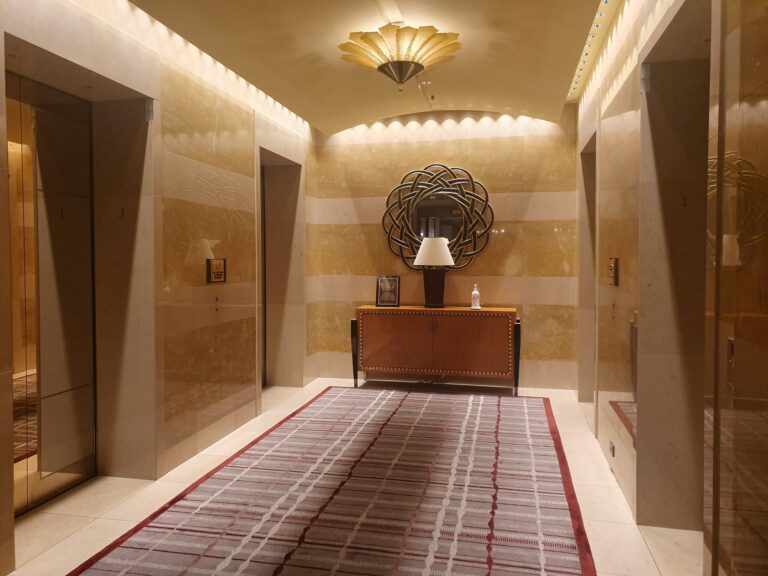
Japan Luxury Hotel Prices: What the Quoted Rate Leaves Out
AuthorMIRUTOBE editors
Table of Contents5 items
Four things have to be levelled before two upper-tier hotels can be compared: per room or per person, meals in or out, service charge and consumption tax in or out, and Japan’s local accommodation and bathing taxes.
Kyoto City charges JPY 10,000 per person per night once the room-only rate reaches JPY 100,000. Tokyo stops at JPY 200 from JPY 15,000 upwards, however expensive the room. Book the same room at the same price in two cities and the total is not the same — in Kyoto the tax is 10% of the rate, in Tokyo 0.2%.
Check first: are the two quotes on the same terms
- Both are the total for the room, or both are per person — not one of each
- Breakfast is treated the same way on both (one of them is not half board)
- You have checked whether service charge and consumption tax are inside the figure shown
- You have looked at whether accommodation tax appears in the breakdown or is settled on arrival
- For a hot-spring inn, you have allowed for the bathing tax on top
Miss the first line alone and the comparison stops meaning anything. A single page of results can hold “two people with breakfast” next to “one room, meals separate”, and sorting by price then swaps the cheap and the expensive. At the upper end the nightly figure is large, so the size of that mistake is large too.
The last two lines cover charges that often never appear on the booking screen at all. Accommodation tax is settled locally in most municipalities, which is how a guest who thought the card had paid for everything ends up asked for cash at checkout. Two people, two nights in Kyoto City on a JPY 100,000 room-only rate, and JPY 40,000 of the trip is settled at the desk. That is not loose change.
The full picture: what rides outside the displayed rate
Accommodation tax rates from the official pages of the Tokyo Metropolitan Bureau of Taxation, the City of Kyoto, Osaka Prefecture and the City of Kanazawa (checked 25 August 2026); the standard bathing tax rate from the Ministry of Internal Affairs and Communications (checked 20 September 2026). Nagoya City levies no accommodation tax.
The first two rows are what bite at the stage where you are still choosing a city. Kyoto has no exempt threshold and gets heavier fast towards the top. Tokyo does the opposite: everything below JPY 10,000 is outside the tax altogether, and above JPY 15,000 it is fixed at JPY 200. On a JPY 100,000 room that is JPY 10,000 against JPY 200, a gap of 50 times.
What the tax is calculated on is the room-only equivalent, with consumption tax and food excluded. On a half-board plan the test runs on the part left after the meals come out. A total of JPY 20,000 whose room-only equivalent is JPY 12,000 is assessed in the JPY 12,000 band. Where the booking separates the components, the itemised bill is worth reading.
Five steps to level the terms
Step 3 is the one that gets skipped. Whether a price includes consumption tax is usually written small at the edge of the screen, and the hotel’s own site and a booking site can treat it differently. On a JPY 100,000 room, consumption tax and service charge together come to around JPY 20,000. The bands and the city-by-city list are set out in the recalculation of what the accommodation tax adds per night.
Where people trip up
One yen across a band edge moves the tax by thousands
The tax is not a percentage; it steps. Move a Kyoto room-only rate from JPY 50,000 to JPY 49,999 and the charge falls from JPY 4,000 to JPY 1,000 per person per night. Three thousand yen turns on one yen. At the JPY 20,000 edge it is JPY 1,000 against JPY 400, so JPY 600 moves. What this is not good for is hunting the room one yen below a line: drop the grade or the location to get there and you lose travel time and breakfast quality long before the few hundred yen of tax comes back. A band change that follows a real drop of several thousand yen in the rate is worth having; the other kind is not.
In Tokyo, the dearer the room the smaller the tax share
Tokyo’s accommodation tax reaches JPY 200 at a room-only rate of JPY 15,000 and stays at JPY 200 however far above that the room goes. On a JPY 100,000 room that is 0.2%. The same room in Kyoto City attracts JPY 10,000, which is 10%. So “accommodation tax varies by city” is not a statement about the level of the charge but about the direction the two schemes were built in. For anyone booking an upper-tier room in Tokyo, this is a line that can safely be ignored.
Keep cash back for what is settled on site
Where a booking site’s breakdown has no accommodation tax line, the charge arrives separately at check-in or check-out. The amount cannot be reduced, but how you carry it can be. Four people for three nights in Kyoto City in the JPY 15,000 band means JPY 4,800 settled at the desk. At the upper end that becomes tens of thousands, and holding that much back keeps the checkout moving.
What if you drop a class
To move the number, look at the room category rather than the tax. Take a Kyoto room-only rate from JPY 100,000 down to JPY 49,999 and the tax falls from JPY 10,000 to JPY 1,000, so JPY 9,000 comes back — against a room rate that has fallen by JPY 50,000. Accommodation tax belongs in the arithmetic of a total; it does not belong in the choice of hotel.
How full the categories run also differs. In the Japan Tourism Agency’s Overnight Travel Statistics Survey, occupancy in 2025 was 74.1% for city hotels nationally, 56.9% for resort hotels and 38.2% for ryokan. Hunting an upper-tier room inside the cities and finding everything sold out, then finding choice the moment you step outside them, is that gap of more than 17 points at work. Redirect the same budget to a resort or an inn and the class of room can go up.
Moving to a ryokan does add a layer to the comparison, though. Most sell half board as standard, so the work starts with extracting a room-only equivalent, and the same figure drives the tax band. Where the bill does not separate the meals, the total cannot be read without asking the inn first. Whether that is worth doing depends on how many nights and how many people.
Some things do not improve when you drop a class: the location, the check-out time and the view. Location is the one you cannot buy back later, so it belongs last in the order of things to give up. When and through which route to place the booking is dealt with separately in the booking order read off occupancy.
If a hot-spring inn is on the list, the bathing tax rides on top at JPY 150 per person per day. Small in itself, but settled on site, and whether it is charged on a day visit varies with the municipal ordinance. How to use the bath is in the onsen etiquette guide built on the Ministry of the Environment’s posting standard. Which brands arrived in Japan, when, and at what they actually charged is in the record of international luxury openings.
One recent opening where the hot spring comes with the room is Onjuku Itsukiri on the Chiba coast, whose ten detached villas each have a natural hot-spring bath and a private sauna; it opened in July 2026.
The next move is to put the two candidates on the same headcount and the same meal basis and write down the room-only rate per person per night. Once that number exists, the tax and the total follow from it.
- Ministry of Internal Affairs and Communications — bathing tax (standard rate JPY 150 per person per day) ↗Checked on 2026-09-20
- Ministry of Internal Affairs and Communications — non-statutory local taxes (where accommodation tax sits) ↗Checked on 2026-09-20
- Japan Tourism Agency — Overnight Travel Statistics Survey (occupancy by facility type) ↗Checked on 2026-09-20
- Tokyo Metropolitan Bureau of Taxation — accommodation tax rates and taxable base ↗Checked on 2026-08-25
Source: the reference block above / Accommodation tax rates from the official pages of the Tokyo Metropolitan Bureau of Taxation, the City of Kyoto, Osaka Prefecture and the City of Kanazawa (checked 25 August 2026) / Photos: Syced, CC0; Wpcpey, CC BY-SA 4.0 (both Wikimedia Commons) / Checked on 2026-09-20
Other sales ending soon




 4 days leftuntil Oct 24Air Busan Takamatsu-Busan Coupon: Up to 9,000 Yen Off Until October 24
 5 days leftuntil Oct 25JAL Hong Kong Campaign: Tokyo–Hong Kong Round Trip from 75,800 Yen (until 25 Oct)
 11 days leftuntil Oct 31Jin Air Kobe–Seoul: 5,000 yen off a round trip with code KTOUKB1, until 31 October
 11 days leftuntil Oct 31Jin Air to Busan: 4,000 yen off a round trip with code KTOPUS, first 300 only