India Golden Triangle 5-Night, 7-Day Model Plan: The Definitive Route
AuthorMIRUTOBE editors
Table of Contents11 items
- Itinerary
- DAY 1 Settle the visa and the weekday before you take the night flight
- DAY 2 Walk both of Delhi’s capitals in a single day
- DAY 3 Move to Agra and take the sunset from the opposite bank
- DAY 4 The Taj at sunrise, and then five or six hours in a car
- DAY 5 The pink city from the outskirts inwards, in one day
- DAY 6 Five or six hours back to Delhi, and half a day left over
- DAY 7 The last day is decided by the margin you leave for the airport
- Alternatives
- Where to stay
- What this trip costs
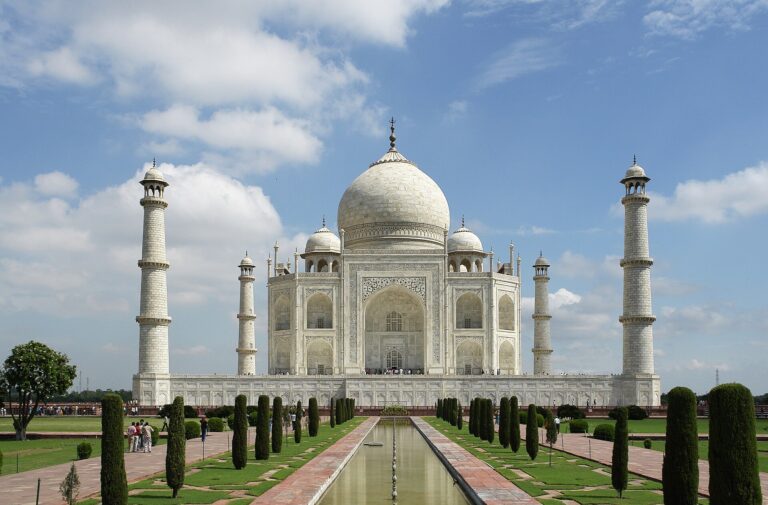
Delhi, Agra and Jaipur in a triangle over five nights and seven days. Two conditions are settled before the route is: the Taj closes on Fridays, and its gate opens against the sunrise rather than a clock. Leave Japan on a Tuesday and day four lands on the Friday, so the weekday count comes before the ticket.
Itinerary
DAY 1Settle the visa and the weekday before you take the night flight
Why this order: spend the whole of day one moving and keep five full days on the ground from the next morning. The work all sits before departure; there is almost nothing left to do on the day itself.
The way in is Indira Gandhi International in Delhi, nine to ten hours non-stop from Tokyo or Osaka. Singapore, Bangkok and the Gulf hubs all work as connecting points. Leave Japan in the evening, sleep in the air, and the next morning is already usable.
The special JAL fare between Narita and Delhi, from JPY 99,000 return, can be booked until 31 October, but its maximum stay is three days, so it cannot be used for this route out to Agra and Jaipur.
Count the day of the week before you buy the ticket
This route puts you inside the Taj Mahal on the morning of day four. Day one is the day you leave Japan, which makes day four three days later. The Taj closes every Friday, so working backwards, the weekday you depart on decides whether the plan stands up.
There is a way out if Tuesday is the only departure you can get. Mehtab Bagh, placed on the evening of day three, is a garden that looks at the Taj from the far bank of the Yamuna and stands outside its grounds. Give the Friday to Mehtab Bagh and Agra Fort, then go into the mausoleum on the Saturday morning, and almost nothing drops out of the trip.
The e-Visa deadline is four days out; the practical one is two weeks
Japanese nationals apply for the tourist e-Visa online. The Indian government’s own site, indianvisaonline.gov.in, sets the application window from 120 days before arrival to four days before at the latest. The 30-day version runs about USD 25 plus a payment fee.
Reading that four-day figure as the deadline is the dangerous part. Approval takes longer when the queue is busy, so filing two weeks before departure is the safe version.
What trips people up is not the content of the form but the file specifications. The photograph must be JPEG, between 10 KB and 1 MB, square, the whole face from the front, eyes open, glasses removed, on a plain white or light background. The passport page with the photograph and details is scanned as a PDF between 10 KB and 300 KB. Japanese photo-booth pictures come out in portrait format, so they fail as they are and have to be recropped square. Missing the instruction about glasses is the common rejection, and retaking the shot in contacts or without is quicker than arguing with it.
Entry points are specified too: 32 airports and 6 seaports. Delhi is on the list, but a plan that enters through another city on a connection needs checking first. Since 1 October 2025, India has also introduced the digital e-Arrival Card (submitted online or via the Su-Swagatam app within 72 hours before arrival) alongside paper disembarkation cards. Because e-Visa payments frequently trigger bank 3D Secure filters and private hospitals in Delhi, Agra and Jaipur require strong medical cover, checking your card setup in our comparison of travel credit cards beforehand saves trouble. The six-screen application flow and fee tiers are detailed in our screen-by-screen Indian e-Visa guide.
The dry season is November to March, and everything else changes the terms
Go between November and March. The weather holds, and daytime temperatures sit around 20 to 30 degrees. April to June is the hot season with days above 40, and July to September is the monsoon. Mornings and evenings still cool off in the dry months, so one layer goes in the bag. Temples and religious sites want skin covered and sometimes shoes off, which is what a scarf earns its place for.
For connectivity, a local SIM, an eSIM or a rental router will all do the job. Two or more people tend towards the router and a solo traveller towards the eSIM, and the break-even by party size works the numbers through. Sockets are mostly the round three-pin type and a Japanese plug will not go in. Whether a transformer is needed depends on the voltage range printed on each device, so sorting out which of your electronics need a converter rather than an adapter keeps the bag lighter.
DAY 2Walk both of Delhi’s capitals in a single day
Why this order: Old Delhi gets the morning and New Delhi the afternoon. The drop between chaos and order is what you will remember from the first day, so it does not get reversed.
Morning: from the red fort to the market without walking it
Delhi has two faces that contradict each other. Old Delhi still carries the Mughal city; New Delhi is the ordered grid the British laid out. The morning of the arrival day goes into the first of them.
Highlights: the Mughal citadel, inscribed as a World Heritage site. The red sandstone wall runs on and on, and the distance from the gate to the far side of the courtyard is itself the statement of scale. It is easy to overestimate how far you can walk on the energy you land with, so restricting yourself to the main pavilions is what leaves an afternoon behind.
Practical note: a cycle rickshaw links it to the Jama Masjid, the great mosque nearby, and on to the Chandni Chowk market. Walking that stretch puts you into market crowds where the timing stops being predictable.
- Where
- Old Delhi
- Status
- UNESCO World Heritage
Chandni Chowk sells spices, cloth and metalwork, each on its own lane. From the seat of a rickshaw you look down and the goods on the shop fronts arrive at eye level. It is faster than walking and you see more of it.
Afternoon: a garden tomb and a 72-metre minaret
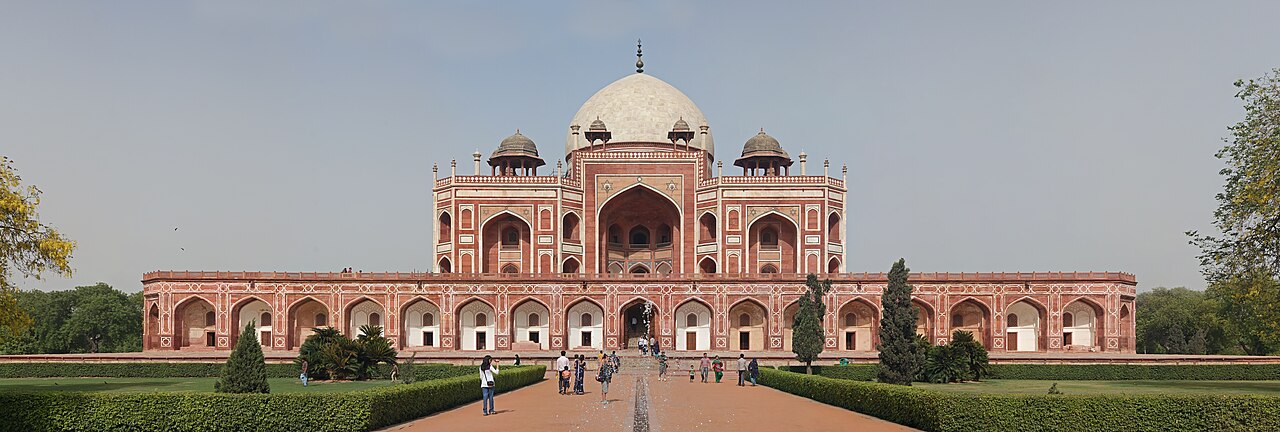
Highlights: a red sandstone mausoleum set at the centre of a quartered garden, and another World Heritage site. The symmetry and the layout of the water channels pass directly into the Taj Mahal. Seeing the red prototype two days before the finished white version on day four changes what you make of the second one.
Practical note: it is a garden, so there is little shade. Two in the afternoon still carries the day’s heat, and this is the one stop where a hat or a parasol lengthens how long you stay.
- Where
- New Delhi
- Status
- UNESCO World Heritage
Then the Qutub Minar, a minaret 72 metres high and a World Heritage site in its own right. There is only one composition available, which is standing at the foot and looking up, so the visit is short. The evening closes at India Gate, the memorial arch with the open ground around it.
Drink bottled water and nothing else. Skip tap water and ice, and brush your teeth from the bottle. Start with cooked food, and work up to street stalls through places with a reputation. Dive into a stall on the first day and the remaining five days of this route stop being predictable.
DAY 3Move to Agra and take the sunset from the opposite bank
Why this order: put the travel in the morning and give the afternoon and evening to Agra. Nobody goes inside the Taj today; it gets looked at twice, from outside.
Delhi to Agra is 1.5 to 2 hours by express train. The standard morning choice is the Gatimaan Express (#12050, departing Hazrat Nizamuddin at 08:10 and reaching Agra Cantt at 09:50 in 100 minutes; does not run on Fridays), alongside the Vande Bharat and Shatabdi services from New Delhi Station. General quota booking opens 60 days out (365 days out on the Foreign Tourist Quota), and since July 2025 next-day Tatkal tickets require Aadhaar authentication — making them unavailable to foreign visitors — so reserve CC (AC Chair Car) or EC (Executive Class) seats as soon as your dates are set. IRCTC registration, international card payment gateways, and waitlist rules are explained in our guide to booking and riding Indian Railways.
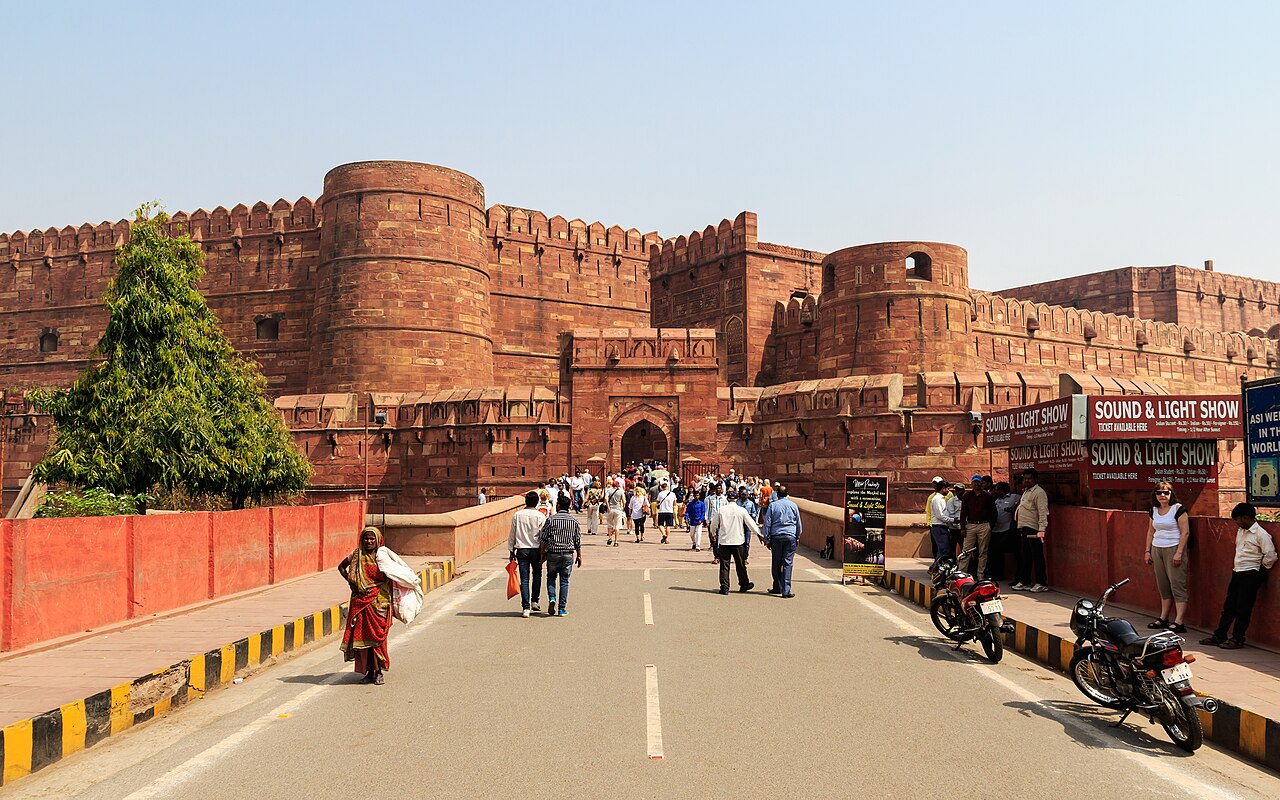
Highlights: a red sandstone citadel and a World Heritage site, and the place where Shah Jahan, who built the Taj Mahal, was confined by his own son in his last years. From one corner of the fort the white Taj appears small across the Yamuna, and knowing that relationship before you look at it is the whole difference in what the view means.
Practical note: the fort is large and you cross unshaded courtyards repeatedly. Going in early in the afternoon and coming out as the heat eases is what leaves something in your legs.
- Where
- Agra
- Status
- UNESCO World Heritage
Highlights: a garden directly opposite the Taj Mahal across the Yamuna. The composition puts you face on from the far bank, so whatever colour the low sun has goes straight onto the building. It sits outside the Taj’s own grounds, which is why it stays open on Fridays.
Practical note: it is not crowded and there is room for a tripod. Working out the direction of the light and the distance here, the evening before the real thing, is what decides how you use the thirty minutes at dawn.
- Where
- Agra, the far bank of the Yamuna
- Relation to the Taj
- Outside the grounds (open on Fridays)
DAY 4The Taj at sunrise, and then five or six hours in a car
Why this order: the densest day of the trip. A dawn entry and a long drive land on the same date, so how you sleep the night before and how you take breakfast get decided in advance.
Dawn: the gate opens against the sunrise, not a clock
The Taj Mahal differs from other sights on three points at the root. Build a route without knowing them and something in it breaks.
The admission has three tiers. The official rates are INR 1,100 for foreign nationals, INR 540 for citizens of SAARC and BIMSTEC countries, and INR 50 for Indian nationals. Japanese visitors pay the foreign rate. None of those figures includes the mausoleum chamber. Going inside the white marble dome, to the graves of Shah Jahan and Mumtaz Mahal, costs INR 200 more in every category. The INR 1,100 that looks at it from outside and the INR 1,300 that goes in are different tickets.
Opening time is not fixed either. The official wording is from 30 minutes before sunrise to 30 minutes before sunset, which shifts every day through the year. A notice reading “opens at 6:00” is a rough figure for one part of the calendar. To catch the clear early light, work backwards from the sunrise time on your own date and be at the gate then.
And Fridays it is shut. The official site states that it is closed only on Fridays, for prayers.
Night viewing is a small allocation. The official schedule is the night of the full moon plus the two nights either side, five days in all, running from 20:00 to 23:59. It operates in eight batches of up to 50 people, each batch lasting 30 minutes, so 400 people a night is the ceiling. Fridays are excluded exactly as they are in daylight. That is too narrow to build a trip around, and better treated as something to chase if your dates already land on it.
Shoes come off inside the mausoleum, and free shoe covers are handed out.
Midday: an abandoned capital on the way to Jaipur
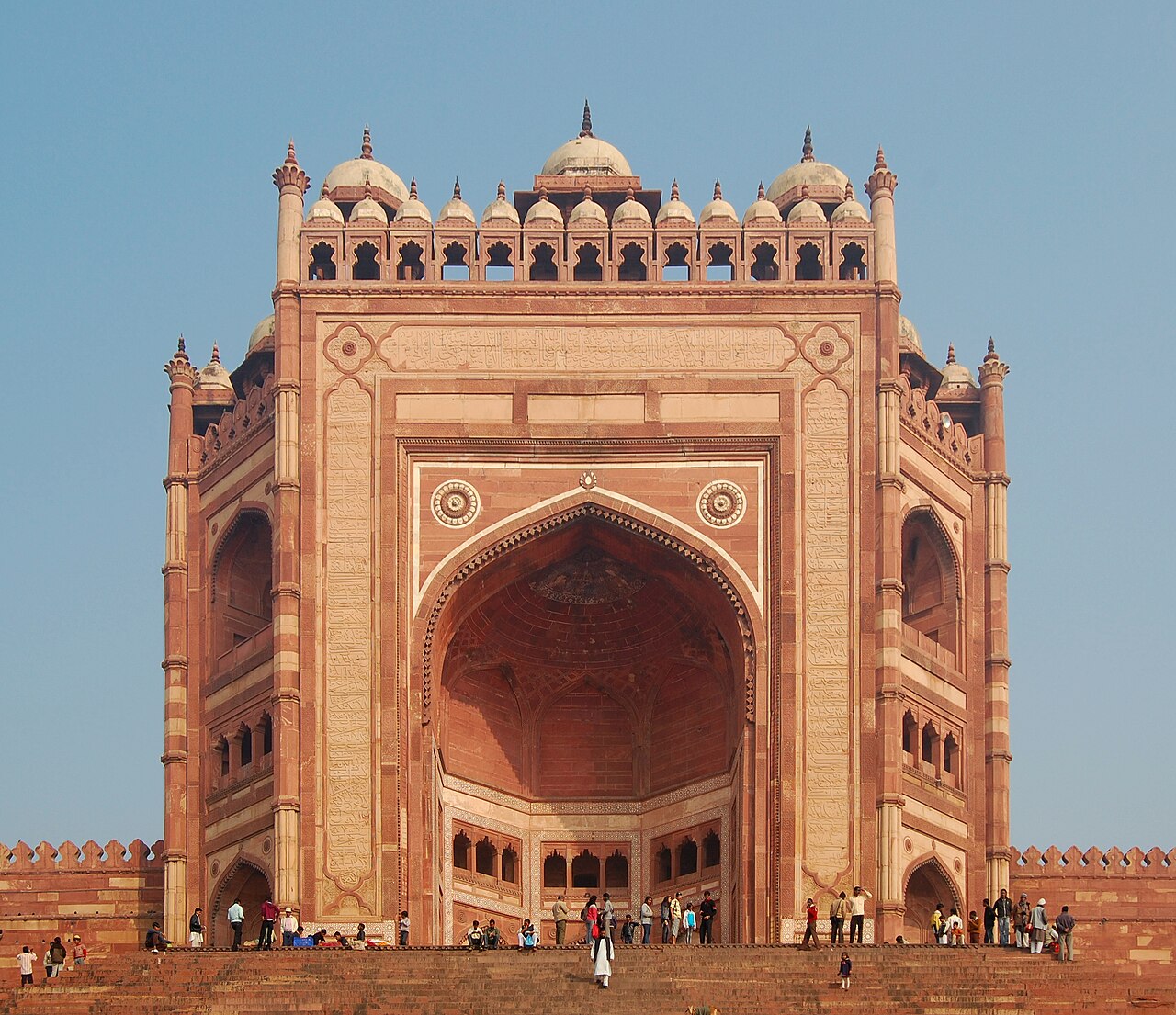
Highlights: a city the Mughals built as their capital and abandoned after little more than a decade. The red sandstone palaces stand in their original form, and the quiet of a place people stopped living in has collected between the buildings. It is a World Heritage site, and it sits on the road from Agra to Jaipur, which is what lets it go into a travelling day.
Practical note: leave it out and day four is five to six hours in a car and nothing else. The fuller you feel after the morning at the Taj, the more getting out of the car once shortens how long the drive feels.
- Where
- Between Agra and Jaipur
- Status
- UNESCO World Heritage
You reach Jaipur, the pink city, in the evening. It is a long day on the road, but what goes past the window is farmland and camel carts.
DAY 5The pink city from the outskirts inwards, in one day
Why this order: clear the hill fort in the morning and keep the afternoon inside the walking radius of the old city. One movement in the car is all it takes, and then there is energy left for the bazaars.
Morning: three ways up the hill, on an elephant, in a jeep or on foot
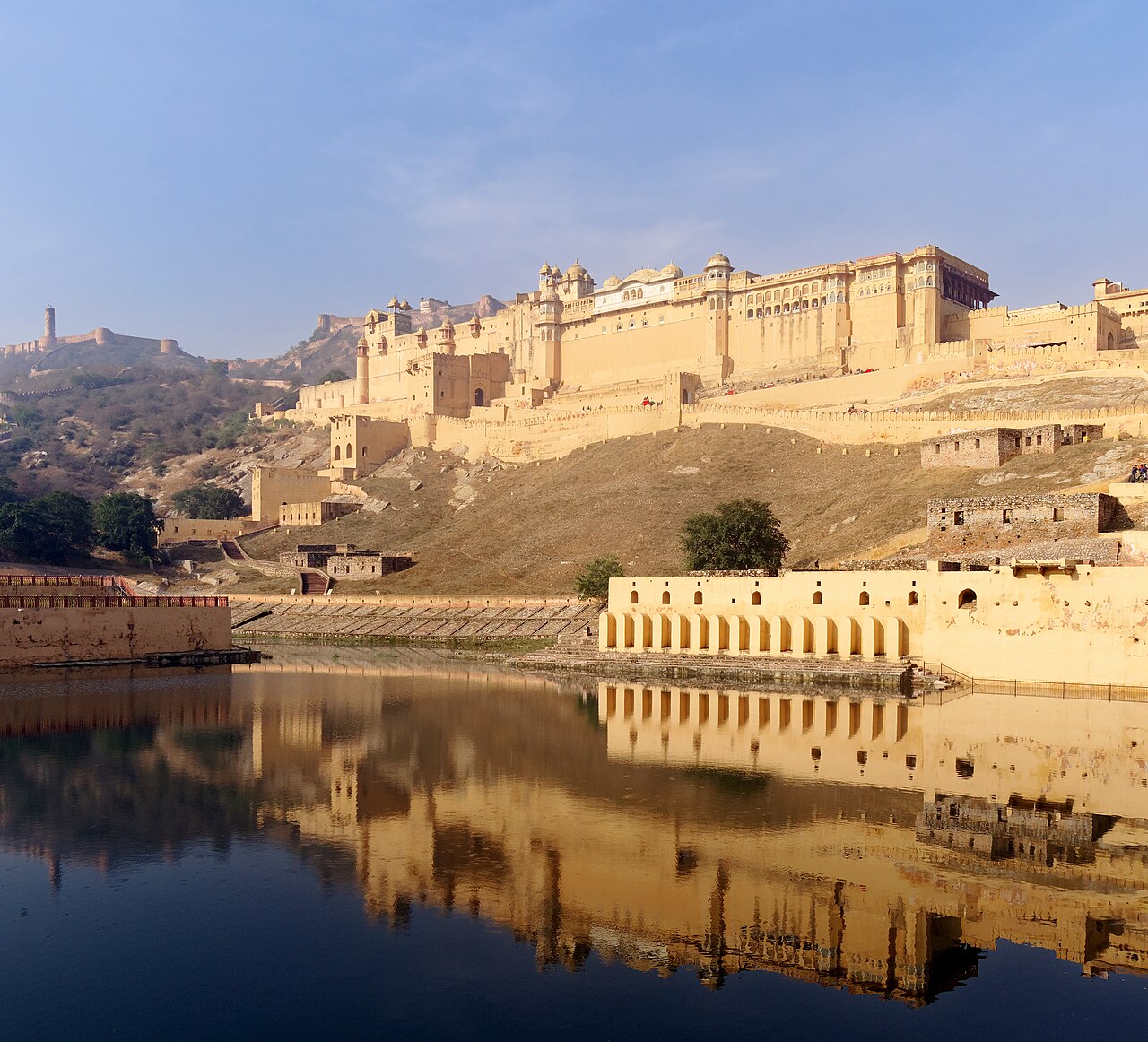
Highlights: a fortress on a hilltop, known for the Sheesh Mahal, the hall set with countless mirrors. The gap between the wall on the skyline from outside and the fineness of the decoration once you are in is wide, and both the long view and the close one need time. Elephant rides go up from the foot of the hill, and so do jeeps, and so does your own pair of legs.
Practical note: this takes half a day. Put anything else in the morning and the old city in the afternoon turns into a march.
- Where
- Outside Jaipur
- Getting up
- Elephant, jeep or on foot
Afternoon: the palace of winds and an observatory built of stone
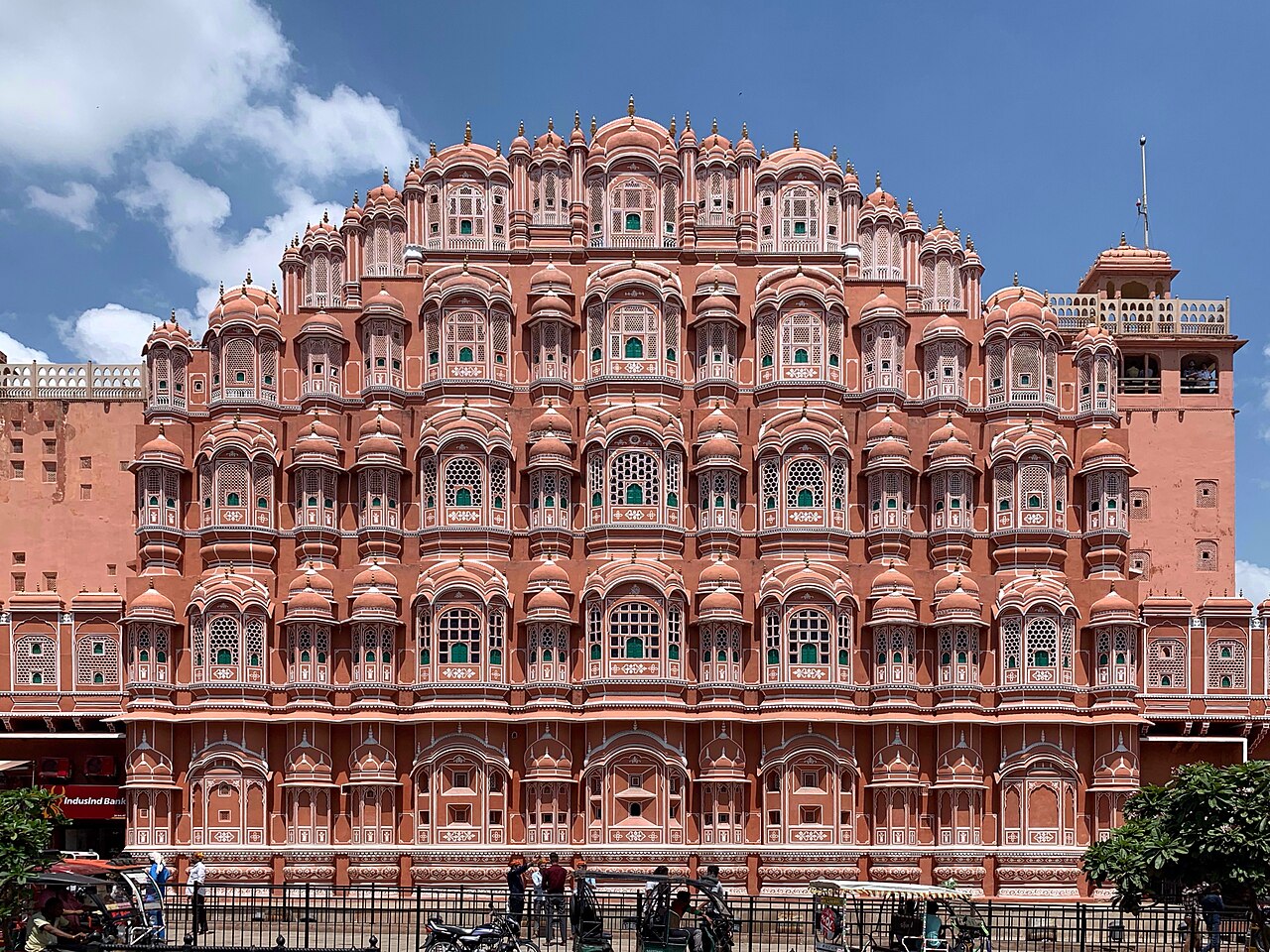
Back in the city for the Hawa Mahal. The pink facade with its endless small windows is built to be seen from the street opposite rather than from within. Because the old city is uniformly terracotta, this one building manages not to stand out, which is exactly what makes it work.
Highlights: the City Palace is still a royal residence, and you walk only the part that is open. Next to it, Jantar Mantar is a courtyard of enormous stone astronomical instruments, and another World Heritage site. Structures built to measure rather than to tell time or to be looked at, standing outdoors exactly as they were, are not something another city offers.
Practical note: the two are within walking distance of each other, and the Hawa Mahal is in the same radius. The afternoon runs with the car left behind.
- Where
- The old city, Jaipur
- Status
- Jantar Mantar is UNESCO World Heritage
The evening goes to the bazaars of the old city, where cloth, jewellery, leather and household goods each cluster on their own street. Prices are settled by asking, and few shops hold to the first number. On the way back, the floodlit Jal Mahal seen from the car shows the water palace doubled on the black surface of its lake.
DAY 6Five or six hours back to Delhi, and half a day left over
Why this order: build the day assuming the morning goes entirely to travel, and leave the half day that follows open enough to choose by how much is left in you.
Jaipur to Delhi is five to six hours by car or by train, which puts arrival in the afternoon. From there the destination gets picked on whatever energy the day has left.
For buildings, the white Lotus Temple of the Bahá’í faith, or the vast Akshardham. Both weight towards the indoors, which is kind to feet that have done five days. For shopping, the shops and cafes around Connaught Place, laid out in a circle so you choose your own walking distance.
Not overdoing this day is what carries you through the long flight the next one.
DAY 7The last day is decided by the margin you leave for the airport
Why this order: count backwards from the departure time and settle the night before whether you go out at all. Delhi traffic cannot be predicted, so the margin runs long.
The final day belongs to the flight time. Take it slowly at the hotel, or go into the city briefly, then head for the airport and home.
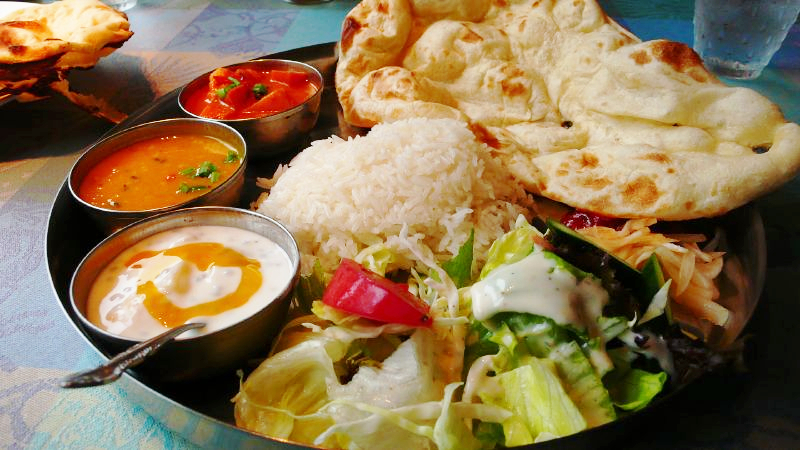
If one dish has to be eaten before you go, make it a thali, where several curries and sides arrive on one plate and can be tasted against each other. Butter chicken, said to have started in Delhi; tandoori chicken and naan from the clay oven; biryani cooked with spice and meat together; dal, the simmered lentils. Add chaat and samosas from the stalls, the thick lassi of Jaipur, spiced masala chai, and sweets like gulab jamun and jalebi that are more or less sugar in a shape, and the food of this country stops fitting inside the word curry. With a delicate stomach, begin at a well-regarded restaurant or the hotel dining room and work down to the local places once you have your bearings.
Alternatives
Rainy-day swap
Go between November and March and rain almost never breaks the route. What needs adjusting in those months is the temperature range rather than the weather. Twenty to thirty degrees in the day still means a cold morning, and the day-four queue at the Taj gate before sunrise wants a layer over whatever you had on.
In the monsoon, July to September, days two and five take the damage because they are weighted outdoors. The places to retreat into are the Lotus Temple and Akshardham in Delhi, and the indoor galleries of the City Palace in Jaipur. Amber Fort holds up in rain as long as you get as far as the Sheesh Mahal, which is under a roof. What the rain actually removes is the sunset at Mehtab Bagh and the walk through the bazaars.
April to June needs rearranging for the opposite reason. Above 40 degrees the outdoors does not work in the middle of the day. Push the outdoor parts to first thing and late afternoon and retreat indoors at noon, and the same route covers a different distance on foot.
If the flight is delayed by an hour or more
A late arrival on day two costs you the Old Delhi morning. Drop the Red Fort and Chandni Chowk, keep Humayun’s Tomb and the Qutub Minar in the afternoon, and the shape of the day survives. You come back to Delhi on day six, so what fell out can be picked up in the half day before the last one.
The frightening case is a delay that spreads into the following days. This route pins the Taj to the morning of day four and that one point cannot move. With the Friday closure in the way, shifting everything back by a day will put it on a date that cannot be entered. If the outbound slips by a full day, bringing the Taj forward to the evening of day three and sending Agra Fort and Mehtab Bagh to day four does less damage.
Missing the Delhi to Agra train on day three is recoverable with a private car. It takes longer, but neither the Agra Fort afternoon nor the Mehtab Bagh evening runs to a fixed time, so a late arrival only tightens the order.
When you’re tired
If something goes, it is Jaipur. Cutting three cities to two brings the intercity driving down to three or four hours in total and frees up eight to ten. That time goes back into Delhi’s museums and food. Amber Fort and the City Palace are half-day commitments each, though, so this is a decision to drop the city whole rather than trim it.
To shorten the trip instead, it compresses to four nights and six days by squeezing Delhi sightseeing into half a day and dropping the return to Delhi on day six. The Taj Mahal and Jaipur both stay.
Adding a day works the other way round: the day goes to Jaipur, not Delhi. Delhi shares a city with the airport and gains time naturally on the final day, while Jaipur costs 11 to 12 hours of driving for the round trip and is rushed on a single day. With more room than that, the route extends to Varanasi or to Udaipur in Rajasthan.
Experiences fit best in the early morning and the evening. Yoga at a hotel or a studio at dawn, a sari or kurta made up in local cloth, a cooking class on how the spices are actually used, the light and sound show at Amber Fort after dark, henna that fades in a few days. None of them moves the sightseeing frame.
Where to stay
Five nights across three cities. Because you keep moving, what the hotel is for changes with how many hours you spend in each place rather than with which district it stands in. Delhi takes the arrival night and the night before you fly; Agra takes one; Jaipur takes two. Three cities, three different jobs.
In Delhi the hotel is a base for movement. The Imperial New Delhi keeps its colonial-era architecture and The Leela Palace New Delhi is palatial and large; both sit where the airport and the city are each easy to reach.
Agra gets one night only, which makes the choice of hotel the same decision as how the morning goes. The Oberoi Amarvilas is built so that every room looks at the Taj Mahal, which suits a route that walks to the gate before sunrise. ITC Mughal is a Mughal-style resort in extensive gardens, and staying there is its own reason to be in Agra.
Jaipur takes two nights and therefore the most hours indoors. Rambagh Palace is a maharaja’s palace converted into one of the defining hotels in the country, and Samode Haveli is a nobleman’s townhouse run as a heritage hotel. Choosing the building you sleep in here amounts to adding another sight to the list.
Palace hotels move a long way with the season, which is why no rate for them appears in the table below. For the car and the guided pieces, Klook lists Golden Triangle transfers and day tours with all three cities handled together. Whether to arrange the car yourself or hand the whole thing over comes down to how you want to treat the long drive on day four.
What this trip costs
Assumptions: two adults, private car and express train between cities, two nights in Delhi, one in Agra, two in Jaipur. Flights and hotels are out of the total because their range is too wide, so the table holds only the rates that are officially published. One rupee is roughly JPY 1.8, and the rate moves.
The rates above are those published on the Taj Mahal official site as of 2026-10-14.
Add up the hours in the car and they come to a tenth of the trip
The Golden Triangle gets described as efficient, and that means the World Heritage sites are densely packed rather than that the travelling is short. Totalled leg by leg, this is what the route spends on movement.
You are on the ground for the five days from day two to day six, which is about 120 hours. Of that, 11.5 to 14 hours go to intercity travel alone, so roughly a tenth of the trip is spent in a vehicle looking out of it. City traffic on top makes the felt share larger.
Read a tenth as acceptable and three cities are clearly worth it. Read it as heavy and Jaipur comes out. Which way you read it depends on the number of days. Attempt the same three cities in three nights and five days and the travelling time does not change while the time on the ground falls to around 60 hours, so the share doubles from a tenth to a fifth. The question then is whether 10 to 12 hours of driving is worth half a day each at Amber Fort and the City Palace.
Five or six hours in a car is punishing if you think of it as endurance, but a private car has one advantage: it stops where you want it to. Stretches that a scheduled bus or a train would simply pass contain chai stalls, village markets and fields of mustard flower. Tell the driver in advance that you would like to stop once or twice for photographs and they will usually oblige. What stays in the memory from this trip is often the unscheduled fifteen minutes rather than the World Heritage site.
The total is decided by the hotels and the car
Setting rough figures per line for two people over five nights: the international return comes to JPY 160,000 to 300,000, five hotel nights in one room for two to JPY 100,000 to 300,000, a chartered car with a driver across three cities to JPY 50,000 to 100,000, and food, admissions and shopping to JPY 40,000 to 100,000. That makes JPY 350,000 to 800,000. The JPY 450,000 spread exists because the hotel grade moves the accommodation line by a factor of three.
Stay local and food and city transport fall a long way. Prices are far below Japan, and a local restaurant feeds you for a few hundred yen. Against that, foreign admission rates, luxury hotels and a chartered car all cost what they cost. With that much distance between cheap and expensive, deciding in advance which lines you cut and which you spend on is what makes the total readable.
Uber, Ola and auto rickshaws all work inside the cities. Tips and rickshaw fares want small notes, so breaking a large one early saves time. Cards work at hotels and larger shops.
Who this route does not suit is anyone whose dates are immovable. The Taj closes on Fridays, its gate follows the sunrise, and day four stacks a dawn entry and Fatehpur Sikri onto a day with five or six hours of driving in it. With a fixed departure weekday, or with any doubt about your health, cutting Jaipur and running two cities is the version that holds. Avoid the Tuesday departure and treat the long drive as part of the trip, though, and five nights is the length these three cities happen to fit.
Sources: Taj Mahal official site (admission, opening, closure, night viewing); Government of India e-Visa official site (application deadlines, file specifications, designated entry points) / Checked on 2026-10-14 / Photographs: Muhammad Mahdi Karim, A.Savin, Marcin Białek, Jakub Hałun, Chainwit., GracinhaMarco Abundo (Wikimedia Commons, GFDL 1.2 / FAL / CC BY 2.0 / CC BY-SA 3.0 / CC BY-SA 4.0) / Featured image: Yann; edited by Jim Carter, CC BY-SA 4.0 (Wikimedia Commons)
Other sales ending soon




 4 days leftuntil Oct 24Air Busan Takamatsu-Busan Coupon: Up to 9,000 Yen Off Until October 24
 5 days leftuntil Oct 25JAL Hong Kong Campaign: Tokyo–Hong Kong Round Trip from 75,800 Yen (until 25 Oct)
 11 days leftuntil Oct 31Jin Air Kobe–Seoul: 5,000 yen off a round trip with code KTOUKB1, until 31 October
 11 days leftuntil Oct 31Jin Air to Busan: 4,000 yen off a round trip with code KTOPUS, first 300 only