When Are Jetstar Sales? A Forecast and the Record of Past Rounds
AuthorMIRUTOBE editors
Table of Contents6 items
Between 27 June and 14 September 2026 we recorded five Jetstar sales, every one of them under the Super Star Sale name. The gaps from one opening to the next ran 11, 16, 18 and 30 days.
The lowest one-way fares stayed between 2,990 and 3,990 yen, and every round whose closing time we could confirm ended at 16:59 in the afternoon. Read off that sequence, the next round falls somewhere between the end of September and the middle of October — a calculation, not a date the airline has published.
The forecast is an estimate drawn from past rounds and is not a guarantee of the airline’s plans. For dates, fares and conditions, the airline’s own site is what counts.
Now on sale
What appears there is every round we have confirmed against an airline’s own announcement and whose deadline has not passed, so airlines other than Jetstar turn up in the list. Once a deadline goes by, an ended banner appears on the bulletin automatically; if you open one and see that banner, come back here.
When is the next one? What the record shows
The table holds only rounds we wrote up as bulletins. A round missing from it was not necessarily missing from the world; it was missing from our record. Bulletins exist in English for two of the five; the 28 August and 11 September rounds link to the Japanese bulletins.
Counting the gaps: 22 days from the 25 June opening to the 17 July opening, around 16 days from there to the August round, and 14 days from the end of August to the 11 September round. Some openings were never recorded, so the figures are approximate, but the interval moves between two and three weeks. It is not a monthly cadence, and September took two rounds.
The lowest fares were 3,820, 3,820, 3,790, 2,990 and 3,990 yen. Against an almost flat line, only the 1 September round breaks downwards. Waiting for a round cheaper than the last one wins and loses about equally across these five, which makes it a weak plan. What moves more is how much of the network is in the sale. Compare the last two: 1 September covered 18 domestic and 4 Asian sectors, 11 September covered 7 direct sectors and no international ones at all. If Taipei or Hong Kong was what you wanted, the better round was the one ten days earlier.
Month by month, what is on record (last two years)
● on record ○ nothing on record ― outside the observation window. Bulletins began on 27 June 2026, so there is no observation before May or after October. September is counted to the 14th.
Whether international routes are included moves from round to round. With one domestic-only month sitting in the middle of the run, planning on Taipei, Kaohsiung or Hong Kong appearing in the next round is not something I would recommend. Domestic has been recorded four months running, which does make it worth a look once a month.
The kinds of sale, and how each one behaves
Selling stops at 16:59, so the last evening is already too late
Of the five rounds on record, every one whose closing time could be confirmed closed at 16:59. Two closed on a Tuesday, one on a Monday and one on a Wednesday. The openings that were recorded were at 12:00 on a Thursday or a Friday: start late in the week, close in the afternoon after the weekend, repeat.
This is where rounds get missed. Treat the final day as running until midnight, open the site after getting home, and it has already closed. If the decision happens on the way back from work, it has to happen the day before the deadline rather than on it.
The headline fare belongs to one sector, and that sector has the narrowest window
In the 11 September round, the advertised 3,990 yen attached to exactly one sector, Narita to Asahikawa. Travel on it ran from 4 November to 24 December, 51 days, the shortest of the seven sectors in the sale. Take out 19 to 24 November and 45 days are actually available. Anyone wanting Asahikawa over a September or October long weekend had nothing to buy.
Travel windows vary sector by sector inside the same round. In that one, Nagoya to Naha did not begin until 1 December, and Fukuoka to New Chitose finished on 9 December. Apply the “until 28 January 2027” printed at the top of the table to every sector and you will be wrong. Most sectors also excluded roughly 24 December to 4 January, which rules the sale out as a way home for the New Year.
Connecting at Narita can cost 2,000 yen less bought as two tickets
Some rounds add sectors connecting through Narita alongside the direct ones. In the 11 September round, Naha to New Chitose through-priced at 12,580 yen. Split into Naha–Narita at 6,090 and Narita–New Chitose at 4,490, it came to 10,580: 2,000 less. Naha to Asahikawa ran 12,080 through against 10,080 split, the same 2,000 gap.
Buying two tickets moves the risk of a missed connection off the airline and onto you. Leave half a day at Narita and splitting makes sense; need to arrive the same day and it does not. The 2,000 yen is not the whole decision.
Do paid memberships and coupons pay for themselves?
Jetstar runs a paid membership, Club Jetstar, and sale fares are published with a member price beside them. In the 1 September round the difference was exactly 200 yen on all 22 sectors. Being a flat amount rather than a percentage, it is 6.7 per cent off the 2,990-yen Asahikawa fare and 1.5 per cent off the 13,390-yen Hong Kong fare.
Recovering the fee from member fares alone means 3,980 divided by 200, or 20 sectors a year — ten return trips. Adding the baggage and seat discounts does not bring that within reach of anyone who flies a few times a year.
The arithmetic is academic now in any case. Jetstar states that new enrolments in and renewals of Club Jetstar in Japan have been suspended since 1 July 2026, leaving existing members with valid memberships as the only people who can log in and claim the benefit. There is no way to join today and go after the 200 yen. Waiting for member-first access has, in this market, collapsed into free registration and app notifications.
How not to miss one
To set this against other airlines, the 50 airfare sales recorded over six weeks has the whole field, and its monthly grid shows where Jetstar’s frequency sits among them.
Before you book
- The published figure is the lowest one-way Starter economy fare. Checked baggage is not included, and taxes and the payment fee are charged separately. No fuel surcharge applied in any of the five rounds on record.
- Seat numbers are limited and the sale ends when they are gone. Some sectors run on set weekdays only: in the 11 September round, Narita to Asahikawa was Tuesday, Wednesday and Thursday.
- Travel windows and excluded dates differ by sector. Checking whether your dates fall inside that sector’s window is faster than starting from the destination.
- With checked baggage and a seat added, the total can pass a full-service airline’s ordinary fare. How an LCC fare adds up once options are included shows where the order flips; run both to the payment screen before deciding, because that is where the order changes.
Across these five rounds, the only thing worth waiting for is a round that includes international routes. Domestic lows have been flat at around 3,000 yen, so choosing a round whose travel window contains the dates you want beats waiting out a few hundred yen. On the international side, Taipei and Kaohsiung are the destinations that appear, and Klook covers the ground half of a trip there.
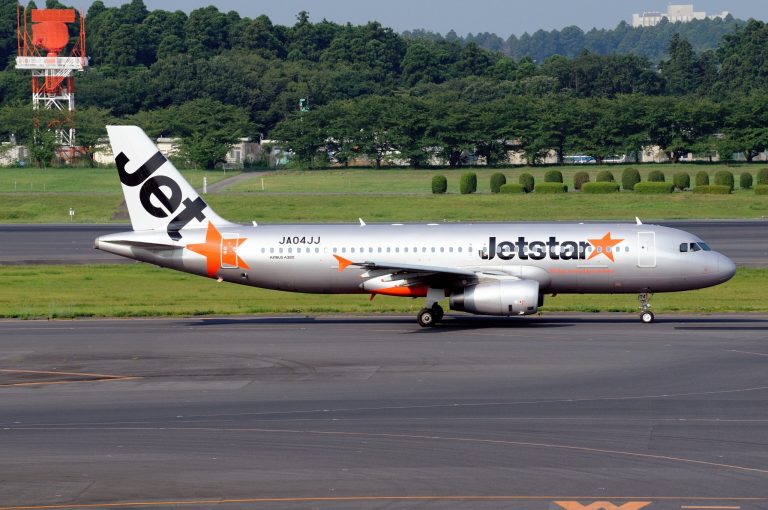
Source: Jetstar’s official site and our own bulletins (recorded 27 June to 14 September 2026) / Checked on 2026-09-14 / Featured image: contri, CC BY-SA 2.0 (Wikimedia Commons)
Other sales ending soon




 4 days leftuntil Oct 24Air Busan Takamatsu-Busan Coupon: Up to 9,000 Yen Off Until October 24
 5 days leftuntil Oct 25JAL Hong Kong Campaign: Tokyo–Hong Kong Round Trip from 75,800 Yen (until 25 Oct)
 11 days leftuntil Oct 31Jin Air Kobe–Seoul: 5,000 yen off a round trip with code KTOUKB1, until 31 October
 11 days leftuntil Oct 31Jin Air to Busan: 4,000 yen off a round trip with code KTOPUS, first 300 only