Japan on a Budget: 25 Tips That Actually Move the Needle
AuthorMIRUTOBE editors
Table of Contents6 items
Stacking 25 small economies matters less than plugging three leaks. Move the dates off the blossom peak and the long holidays and both rooms and flights shift. Price the rail legs before buying anything and the figure changes in five-digit steps. Food barely needs discipline in a country where a beef bowl is JPY 498.
Prices below are Japanese, in yen, read off the operators’ own pages. They are ordered by how much they move, not by how clever they are.
Check first: which leak is yours?
- You can move the dates outside full bloom, Golden Week, Obon and the New Year
- Your long-distance travel fits into three legs or fewer
- Your nights fall on weekdays (Saturdays and eves of holidays avoided)
- At least two days of the trip allow dinner to be bought after 19:30
- Your Shinkansen seats can be confirmed 21 days out
If only the first line is movable, that alone cuts more than the rest combined. Blossom season and the long holidays are the one variable that lifts rooms and airfares at the same time, and no amount of small savings catches up with it. Conversely, on a trip where none of the five holds — four people, at Obon, decided the day before — the only levers left are food and city transport.
The full picture: five levers, largest first
Prices as published by the JR Group, JR Central (Smart EX), Yoshinoya, the Tokyo Metropolitan Government Bureau of Finance and the Tokyo Metropolitan Foundation for History and Culture, read on 2026-09-20. No figure is attached to rooms and airfares because the spread depends on date and conditions.
The third lever is also the easiest to lose money on. The JPY 10,000 three-day Seishun 18 Ticket means three consecutive days, not three days of your choosing, and recovering JPY 3,334 a day takes three days running of four hours or more on local trains. Ride from Tokyo to Osaka and then stay put in the city the next day and two-thirds of it is wasted. It is sold only in three seasonal windows — spring, summer and winter — so check that your dates fall inside one before planning around it.
Five steps to price the rail before you buy anything
Those five steps answer most itineraries in ten minutes. The framework itself is laid out at length in our method for testing whether the JR Pass still pays, and the city-level counterpart — which IC card to carry — is in the guide to Suica, ICOCA and PASMO.
Discount tickets are easier to choose if you sort them by deadline rather than by price. On Eki-net, the Shinkansen e-ticket Tokudane 1 closes at 23:50 the day before travel and Tokudane 14 at 23:50 fourteen days before, the later one discounting more; the occasional Tokudane Special 28 closes 28 days out at 23:50 and takes 50 per cent off. On the Tokaido and Sanyo side, EX Hayatoku 21 closes 21 days out at 23:30. Which means that if your dates only firm up a fortnight before departure, your choices are the day-before products and the ordinary reserved seat. The earlier the dates settle, the more doors are open — that is the order to think in.
Some regional passes are restricted by who you are. JR West’s Kansai Wide Area Pass is JPY 12,000 for adults and JPY 6,000 for children over five consecutive days, and it is sold to holders of a passport issued by a government other than Japan whose status of residence is Temporary Visitor. Most visitors reading this qualify; anyone living in Japan does not. When you read that a regional pass is cheaper, check which side of that line you are on first. Residents are left with the Seishun 18 Ticket, the operators’ seasonal free tickets and the city day passes.
Where people trip up
Two taxes sit outside the advertised room rate
Two items are missing from the total a booking site shows you. One is the accommodation tax, levied by Tokyo, Kyoto City, Osaka Prefecture, Kanazawa and others in bands based on the room-only rate. The other is the bathing tax, which municipalities with hot-spring baths levy at a standard rate of JPY 150 per person per day. Three nights at an onsen inn is JPY 450, or JPY 1,800 for four people, added at the desk. The sums are small, but they appear at exactly the kind of small cash-only inn where a thin wallet becomes a problem. Where each city’s bands fall is worked through in our recalculation of what the accommodation tax adds per night.
A day pass is not cheap merely because it is unlimited
Sightseeing district by district, on foot, ends the day on two or three rides. In Osaka that is three fares of JPY 190, or JPY 570, against JPY 820 for the weekday pass. Kyoto’s city buses work the same way on a day that visits two temples. The day pass earns its price only when you deliberately cross the city and come back. Buying one and then inventing journeys to justify it is the wrong way round.
The advance fare is also the price of not being able to change
EX Hayatoku 21 cannot be changed after booking. Moving to a different seat in the same coach on the same train is allowed; moving to another train means a refund and a fresh booking. Missing the train, losing a day to weather, waking up ill the day before: weigh the odds of those three against the discount. Keeping the last leg home on an ordinary reserved seat, and taking the advance fare on the outbound, is the practical split.
What if you cut too far: what breaks first
Some costs cannot be cut without cutting the trip. Travel time is one: eight hours on local trains saves a few thousand yen and removes a day of sightseeing. The other is where you sleep. Moving one station out does lower the rate, but push it past the point where you can walk home at night and the last day of the trip feels different.
It is easier to treat as allocation. Business hotels every night with one night at a ryokan buys denser memory per yen than nudging every night up a little. Lunch is the same logic in reverse — the same dish at the same restaurant is frequently cheaper at midday. Fixing the walking radius first, the way the district-by-district route through Kyoto does, brings down transport and time together.
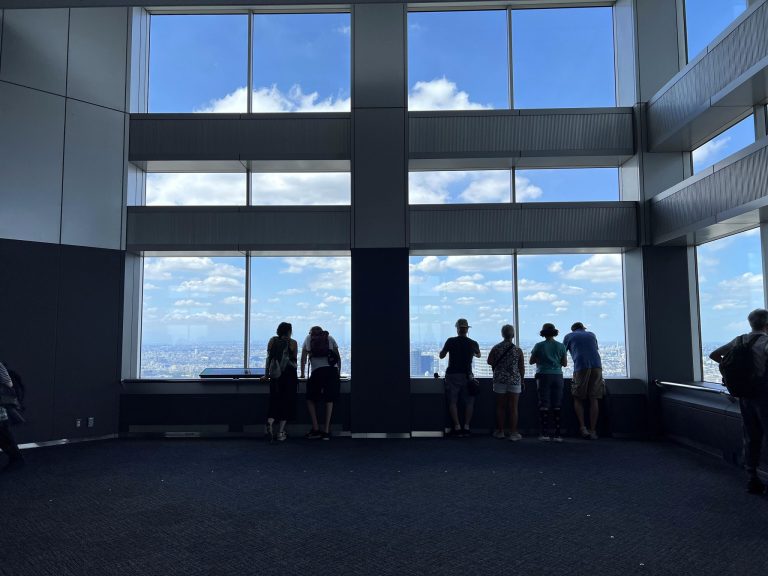
That so much is free also holds the budget down. The Tokyo Metropolitan Government observatories are on the 45th floor of Building 1, 202 metres up, and cost nothing to enter. The north deck opens 09:30–17:00 and the south 09:30–21:30, the north closing on the second and fourth Mondays and the south on the first and third Tuesdays. They look the same way as the paid towers, so for a night view alone the south deck is the whole answer.
The next thing to do is open the itinerary and write out the long legs in three lines. Book rooms before that is settled and the travel arrangements end up contradicting where you chose to sleep.
Common questions: cheap seasons, flights against trains, and cash
Which weeks are actually cheap?
The ones nobody in Japan is travelling in: the stretch after the New Year, most of February, and the weeks either side of the blossom and the autumn colour rather than during them. What you are avoiding is fixed and knowable — Golden Week at the start of May, Obon in mid-August, and the New Year period — because domestic demand concentrates there and rooms and seats rise together.
Is flying ever cheaper than the Shinkansen?
Over the long hauls, often. Tokyo to Fukuoka and Tokyo to Sapporo are the standard cases, where the total including airport access can land below the walk-up rail fare. Price the single longest leg both ways before you decide on any rail pass, because the answer changes the shape of the whole itinerary rather than just one journey.
How much cash should I carry?
Enough for the places that still refuse cards: small counters, market stalls, rural buses, shrine offices, and the accommodation and bathing taxes settled at the desk. Convenience store ATMs cover the rest, so a few thousand yen in small notes topped up as you go is the working answer rather than a large float.
- JR East, Seishun 18 Ticket (JPY 10,000 for three days, JPY 12,050 for five) ↗Checked on 2026-09-20
- Smart EX, EX Hayatoku 21 (closes 23:30 on the 21st day before, no changes) ↗Checked on 2026-09-20
- Tokyo Metropolitan Government Bureau of Finance, observatory information (free entry, 202m) ↗Checked on 2026-09-20
- Tokyo Museum Grutto Pass 2026 (JPY 2,500, 107 institutions) ↗Checked on 2026-09-20
- Eki-net, Shinkansen e-ticket Tokudane deadlines and discounts ↗Checked on 2026-09-20
- JR West, Kansai Wide Area Pass (five days, JPY 12,000, Temporary Visitor passport holders) ↗Checked on 2026-09-20
- Ministry of Internal Affairs and Communications, bathing tax (JPY 150 per person per day) ↗Checked on 2026-09-20
- Osaka Metro, Enjoy Eco Card (JPY 820 weekdays, JPY 620 weekends and holidays) ↗Checked on 2026-09-20
Source: the reference block above / Yoshinoya official menu (regular beef bowl, JPY 498 including tax) / Photos: Asanagi, CC0; DanQuinter07, CC BY-SA 4.0 (both Wikimedia Commons) / Checked on 2026-09-20
Other sales ending soon




 4 days leftuntil Oct 24Air Busan Takamatsu-Busan Coupon: Up to 9,000 Yen Off Until October 24
 5 days leftuntil Oct 25JAL Hong Kong Campaign: Tokyo–Hong Kong Round Trip from 75,800 Yen (until 25 Oct)
 11 days leftuntil Oct 31Jin Air Kobe–Seoul: 5,000 yen off a round trip with code KTOUKB1, until 31 October
 11 days leftuntil Oct 31Jin Air to Busan: 4,000 yen off a round trip with code KTOPUS, first 300 only