eSIM vs Pocket Wi-Fi for Overseas Travel: Comparing Price, Speed and Convenience
AuthorMIRUTOBE editors
Table of Contents6 items
One or two travellers, take an eSIM; three or more, a rental router. Three days in Korea is JPY 1,950 per eSIM against JPY 4,990 for one router including the handover fee. Stretch the trip and the crossover hardly shifts.
The prices below are the Japanese market’s: yen-denominated plans bought before leaving Japan, with the router collected at a Japanese airport. Because the ratio stays between 2.4 and 2.6 people whether the trip is three, five or seven days, “we are going for a long time, so rent a router” does not hold. The only thing that decides it is how many of you there are.
Check first: will an eSIM go into that phone?
- The settings menu offers “Add eSIM” or “Add mobile plan”
- The handset is not SIM-locked — worth checking carefully on a second-hand phone
- You know how many people are travelling
- You have decided whether a laptop or tablet also needs to be online at the same time
- You know whether you fly home from the airport you left from
Fail the first line and the comparison does not apply to you at all: a phone that takes only a physical SIM, or one still carrier-locked, leaves rental Wi-Fi as the only option. Check at the point of booking rather than the night before departure. The fifth line is there because rental Wi-Fi is the one where the price changes according to where you hand the device back.
Three days, per person, all in
The two sides are matched as unlimited data against unlimited data. The eSIM figures are Airalo’s unlimited plans per country; the rental figures are Imoto’s WiFi Plan A (unlimited) at the discounted online rate, with the JPY 550 airport handover fee added once.
Totalled on 14 September 2026 from the published prices of Airalo and Imoto’s WiFi. The rental figures include the JPY 550 handover fee per device and exclude the damage waiver and the charge for returning by courier.
For one traveller, the eSIM is between 2.6 and 3.3 times cheaper wherever you go. The widest gap is the US mainland, at JPY 4,340 over three days. A rental router can be shared by any number of people, so that gap divides by the size of the group — which is another way of saying there is almost no economic case for renting a router when you travel alone.
Lengthening the trip is worth checking too. In Korea the eSIM runs JPY 3,200 for five days and JPY 4,600 for seven, against JPY 7,950 and JPY 10,910 for the router, putting the crossover at 2.48 and 2.37 people. Taiwan at seven days is 2.80 and the US mainland 3.43. Against the three-day figures, only the first decimal place moved. The eSIM’s period plans and the router’s daily rate happen to rise on almost the same gradient.
Four charges that only rental Wi-Fi carries
The bottom two rows are what price-comparison tables leave out most often. Skipping JPY 1,320 means accepting a JPY 40,000 exposure, which is not the place to economise. Personal effects cover on a credit card sometimes extends to rented equipment, so reading your own policy first can save paying twice. How to read those conditions is set out in the sums insured and qualifying conditions on a card with travel insurance.
Adding the waiver moves the crossover as well. Put the cheapest JPY 440 a day onto three days in Korea and the router side becomes 4,990 + 1,320 = JPY 6,310, which pushes the crossover to 3.2 people. At three travellers the eSIM is still cheaper. The conclusion flips on a margin that thin, so always include the waiver when you work out an estimate.
Where people trip up
Capping the data still does not get one traveller below the eSIM
Rental Wi-Fi sells cheaper plans with a data cap. Lined up over three days for one person with the handover fee included, Korea is JPY 2,050 at 500 MB a day, JPY 3,310 at 1 GB a day and JPY 4,990 unlimited. Not one of them comes in under the eSIM’s JPY 1,950 unlimited. Taiwan at 500 MB a day is JPY 3,070, leaving a JPY 1,070 gap, and the US mainland is JPY 4,270, a gap of JPY 2,420. Korea narrows to about JPY 100, and what you get for it is a capped 500 MB a day rather than the same unlimited connection. Capping the data only works when the cost is being divided between people: three travellers in Korea for three days bring the 500 MB plan down to JPY 683 each, and only there does it beat the eSIM.
Renting at the counter instead of online costs 20% more
Imoto’s WiFi publishes two prices: the standard rate for walk-up applications at a shop or airport counter, and a 20% online discount for booking through the web. Unlimited in Korea is JPY 1,850 a day against JPY 1,480, Taiwan JPY 2,050 against JPY 1,640, and the US mainland JPY 2,350 against JPY 1,880 — over three days, differences of JPY 1,110, JPY 1,230 and JPY 1,410. It applies simply by booking online before departure, which makes it the single largest lever in this article. Renting at the airport on the day is best treated as a fallback for when nothing else is left, assuming there is stock.
“Unlimited” does not mean “always fast”
Both sides here are unlimited plans, so no overage charges arise, but unlimited plans can still be speed-limited. If the usage involves long stretches of high-definition video, plan on the speed dropping whichever method you choose. On a capped plan, check before buying whether exceeding the cap stops the connection or merely slows it. Actual throughput and how well each picks up a signal locally are not measured here: the same network behaves differently by handset, time of day and place, so published figures are not a basis for choosing between them, and they are left out.
Past three travellers, switch to rental Wi-Fi
Back to the head count. Three days in Korea costs two people JPY 3,900 on eSIMs against JPY 4,990 for a router. At three people the eSIMs come to JPY 5,850 and the router takes the lead. The US mainland crosses at 3.35, so the switch happens with the fourth traveller. Add the waiver and Korea stays cheaper on eSIMs even at three. Carry those three numbers and there is no need to recalculate for each destination.
Once you have decided to rent, changing provider also changes the base daily rate. Global WiFi publishes from JPY 870 a day for Korea, from JPY 870 for Taiwan and from JPY 1,170 for the United States, which sits at a different level from Imoto’s discounted JPY 1,480 a day for unlimited Korea. That “from” is the floor of a capped plan, though, so the numbers do not line up unless you compare unlimited against unlimited. Match four things before adding anything up: daily rate, handover fee, return postage and waiver.
If the way you work means three or more devices online at once, laptop and tablet included, rental Wi-Fi can win on tethering stability rather than on price. Tethering from an eSIM is restricted on some plans, and even where it is officially permitted the speed is sometimes throttled.
Common questions: setting up at home, phone numbers, travelling as a pair
Can I set up the eSIM before I leave?
Yes. The usual sequence is to buy it, install the profile, and switch the line over once you arrive. Starting the purchase after you land leaves you stuck with no connection at the moment you need one, and airport Wi-Fi is not available everywhere. Doing it the night before departure is the safe version.
Does an eSIM come with a phone number?
Data-only plans do not. If you need to make calls locally, choose a plan that includes a number, or pair rental Wi-Fi with a calling app. Where a hotel or restaurant booking form asks for a phone number, entering your home number is usually accepted.
Which is cheaper for two people?
The eSIM. Three days in Korea is JPY 3,900 for two against JPY 4,990 for a router, and adding the waiver widens it. The crossover starts at three, so up to two there is nothing to weigh up.
To work back from an itinerary to the number of days you need, counting from a day-by-day plan such as the three-day weekend course for Taiwan is quickest. Away from connectivity, the other thing that keeps coming up is whether you need a plug adapter, so check the difference between a voltage converter and a plug adapter before you go. When fares tend to fall is collected in the record of airfare sales.
- Airalo — South Korea eSIM (unlimited plans) ↗Checked on 2026-09-14
- Imoto’s WiFi — prices for South Korea ↗Checked on 2026-09-14
- Imoto’s WiFi — collection and return (handover fee, carriage forward) ↗Checked on 2026-09-14
- Imoto’s WiFi — damage waiver (amounts payable by the renter) ↗Checked on 2026-09-14
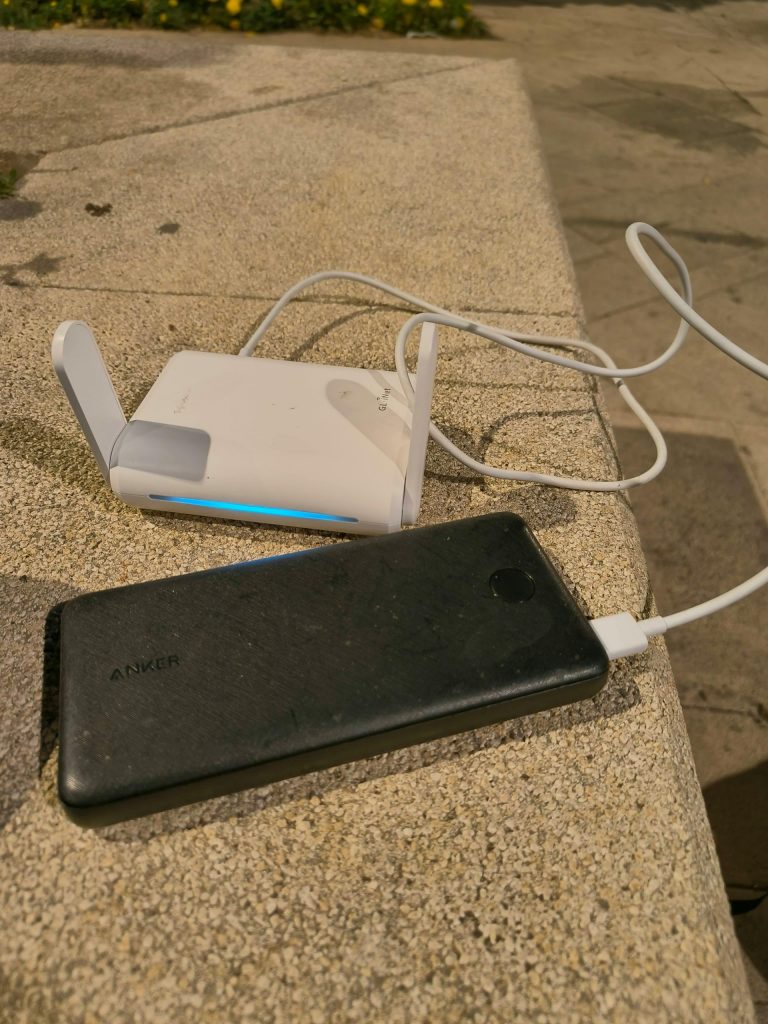
Source: the reference block above / Global WiFi official site / Photo: Wikimedia Commons / Checked on 2026-09-14 / Featured image: Danielrosehill, CC BY 4.0 (Wikimedia Commons)
Other sales ending soon
 4 days leftuntil Oct 24Air Busan Takamatsu-Busan Coupon: Up to 9,000 Yen Off Until October 24
 5 days leftuntil Oct 25JAL Hong Kong Campaign: Tokyo–Hong Kong Round Trip from 75,800 Yen (until 25 Oct)
 11 days leftuntil Oct 31Jin Air Kobe–Seoul: 5,000 yen off a round trip with code KTOUKB1, until 31 October
 11 days leftuntil Oct 31Jin Air to Busan: 4,000 yen off a round trip with code KTOPUS, first 300 only