A Roadmap to Circling the Globe on 100,000 Miles
AuthorMIRUTOBE editors
Table of Contents6 items
- Check first: can the route be drawn on your account at all
- Five steps from drawing the route to holding the ticket
- The full picture: the circuit that went, and the round trips that replaced it
- Where people trip up
- What if the miles run short before they expire
- Common questions: existing tickets, the one-way floor, rebuilding a balance
ANA stopped issuing new Star Alliance Round the World award tickets on 23 June 2025. In the 22,001 to 25,000 mile band, Economy cost exactly 100,000 miles — enough distance to get round the planet, bought in a single line on the chart.
What replaced it is a stack of one-way and round-trip Partner Airline Flight Awards. One-ways became bookable from 24 June 2025 and start at 7,500 miles. The question is no longer which band you land in, but how many separate tickets you can afford to put end to end.
Check first: can the route be drawn on your account at all
- Your balance clears the floor of 7,500 miles one way, 15,000 round trip
- The miles you plan to spend expire after your travel start date (they run to the end of the month 36 months after the month they were credited)
- Every airline you want to fly is a Star Alliance member or on the partner list
- If a domestic Japanese connection is in the plan, that sector is ANA-operated
- If you are pooling family miles, you have already joined ANA Card Family Miles or a Family Account
The third line is where plans die. The partner list moves from year to year. Asiana Airlines (OZ) leaves it after flights boarding on 16 December 2026, while ITA Airways (AZ) became eligible on 1 April 2026 and Lufthansa City Airlines (VL) on 12 November 2025. Draw a route first and discover afterwards that a carrier is not on the list, and the dates go back in the bin with it.
The fourth is newer. For flights boarding from 19 May 2026, only ANA-operated services may be used for connections within Japan. Codeshares flown by AIRDO, IBEX Airlines, Solaseed Air or StarFlyer cannot go into an award itinerary. Anyone starting from a regional city and relying on a domestic first sector may find the whole shape no longer builds.
Five steps from drawing the route to holding the ticket
The eligible-carrier list, the one-way floor and the stopover rules all sit on ANA’s conditions page for partner awards, which is the page to have open while the route is being drawn. Booking the old round-the-world award was a telephone-only affair; it could not be done on ANA’s website or at an airport. Moving to stacked one-ways took that counter away with it. More work, and in exchange the order of the cities is yours to set, which is a gain for anyone with three or more places to be.
The full picture: the circuit that went, and the round trips that replaced it
From ANA’s own charts for the Star Alliance Round the World award and for Partner Airline Flight Awards, checked 20 September 2026.
What 100,000 miles meant is in the second row. A circuit of the earth is roughly 24,900 miles, so the 22,001 to 25,000 band was precisely the one a near-shortest circumnavigation dropped into. The figure was the entry price for going round the world, and one mile past it moved you into the 120,000 band. The number stuck not because it was round but because that was where the step in the chart sat.
Rebuild the same three continents on today’s chart and it reads differently. Tokyo to Europe and back is 62,000 miles, Tokyo to North America and back 55,000. That is 117,000 miles, some 17,000 more than the old circuit, and you return to Japan twice, so none of the one-way distance works in your favour. Crossing the Pacific once and the Atlantic once on miles alone now means three one-way tickets or more.
In Business the step is blunter. The old chart asked 145,000 miles for that distance band. A Tokyo–Europe Business round trip on ANA-operated flights in high season now needs 180,000. One out-and-back costs more than a lap of the planet used to. For anyone who had been saving towards Business class round the world, I think the June 2025 change hurt less through the mileage than through the fact that the product itself stopped existing. What the same sectors cost when bought with something other than miles is in the round-trip comparison by funding source.
Where people trip up
Switch to one-ways and you lose the stopover
One-way itineraries allow no stopovers at all. Transfers are capped at one inside Japan and two overseas, three in total, and any stay over 24 hours stops counting as a transfer and becomes a stopover. “A night in the connecting city while I am there” cannot be built on a one-way. A round trip permits exactly one stopover somewhere other than the destination, so Tokyo to Singapore via Bangkok lets you stay in Bangkok on either the outbound or the return.
Four cities on four one-ways sidesteps the restriction entirely. What it does not sidestep is paying for four sectors. The old design principle of using stopovers to see more for less stopped working the day one-ways arrived.
One extra sector drops the whole trip into Zone 1-B
Zones are decided by the shape of the itinerary rather than by geography. Two international sectors as a round trip, with or without connections inside Japan, is Zone 1-A. Add a single further international sector and the whole thing moves to Zone 1-B. ANA’s own worked example is Tokyo–Paris–Frankfurt–Paris–Tokyo, where the Paris–Frankfurt pair pushes the entire itinerary into 1-B.
The difference for Europe in Economy is 55,000 against 62,000 miles, so 7,000. In Business it is 115,000 against 121,000. Whether you put one intra-European hop inside the award or buy it separately on the day is what moves those 7,000 miles. Adding a stray one-way like Phuket to Bangkok on the way home does the same thing.
A surface segment can be rejected on distance
Sectors travelled other than by air can sit inside an award itinerary, but not if the surface distance exceeds the total flown distance from the start of the trip to the point where the surface segment begins. ANA’s example of one that fails is flying Tokyo to Beijing, 1,313 miles, and then covering Beijing to Manila, 1,788 miles, overland. Because 1,788 is greater than 1,313, the itinerary will not build.
Fly the long sector first and a short surface hop afterwards passes. It is a question of order.
What if the miles run short before they expire
There is no way to make up a shortfall with cash or ANA SKY Coins. That leaves three moves: pool family miles, shift the season, or shorten the destination.
Pooling only works between family members enrolled in ANA Card Family Miles or a Family Account. Shifting the season does more. On ANA-operated flights, Europe in Economy is 45,000 miles in low season, 55,000 in regular and 78,000 in high. For 2026, low season on Japan–North America and Japan–Europe routes runs 6 January to 28 February and 1 April to 28 April. Move the trip into one of those two windows and the same seat is 33,000 miles cheaper.
Where the expiry arrives first, spending the balance on something short beats hoarding it. A partner award between Japan and Korea or Russia 1 is 15,000 miles return in Economy. Miles run to the end of the month 36 months after the month they were credited, and the oldest are deducted first, so even one small issue eats into the batch nearest its date. What it looks like to burn roughly 7,000 miles inside Japan is worked through in the break-even on JAL’s Dokokani Mile.
Building the balance in the first place is a separate problem. Where you concentrate a year of card spending decides how fast it grows, and the options are laid out in the travel credit card comparison. Whether the dates can exist at all is answered more directly by what five days of paid leave can be made to do.
Common questions: existing tickets, the one-way floor, rebuilding a balance
Can a round-the-world award issued before 23 June 2025 still be used?
Yes. ANA states that Star Alliance Round the World award tickets issued up to 23 June 2025 remain usable as before, changes included, until the ticket expires. What ended was new issuance.
How few miles can a one-way award be booked with?
Partner Airline Flight Awards start at 7,500 miles one way and 15,000 round trip. One-ways apply to bookings and issues from 24 June 2025; there is no one-way setting on anything booked before that. The mileage is fixed by zone and class of service, with no seasonal movement.
Starting from zero, which sector should be decided first?
The longest one. The steps in the chart are steepest over distance — Japan to Latin America and back is 115,000 miles even in Economy, against 55,000 for North America. Short sectors barely move the total when added later. Since miles run to the end of the month 36 months after they are credited, work out when one long sector’s worth will have accumulated and set the year of the trip from that.
- ANA — Star Alliance Round the World (end of issuance, mileage chart, itinerary rules) ↗Checked on 2026-09-20
- ANA — Partner Airline Flight Awards, conditions of use (carriers, one-way floor, stopovers) ↗Checked on 2026-09-20
- ANA — Partner Airline Flight Awards, zones and required mileage ↗Checked on 2026-09-20
- ANA — international award tickets, seasons and required mileage ↗Checked on 2026-09-20
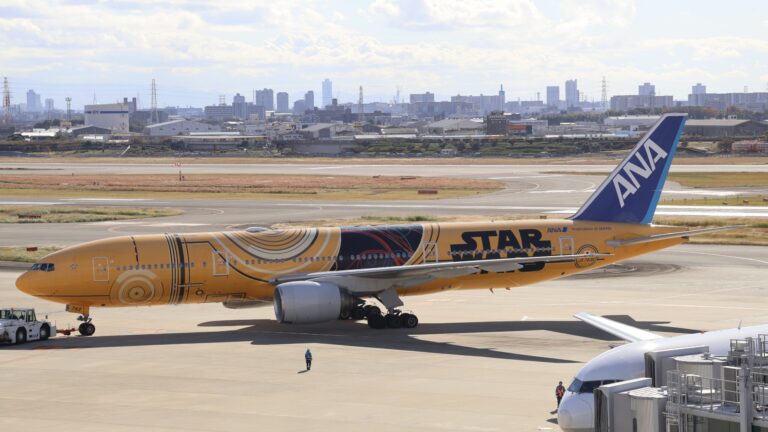
Source: the reference block above / Checked on 2026-09-20 / Photo: S5A-0043, CC BY 4.0 (Wikimedia Commons)
Other sales ending soon




 4 days leftuntil Oct 24Air Busan Takamatsu-Busan Coupon: Up to 9,000 Yen Off Until October 24
 5 days leftuntil Oct 25JAL Hong Kong Campaign: Tokyo–Hong Kong Round Trip from 75,800 Yen (until 25 Oct)
 11 days leftuntil Oct 31Jin Air Kobe–Seoul: 5,000 yen off a round trip with code KTOUKB1, until 31 October
 11 days leftuntil Oct 31Jin Air to Busan: 4,000 yen off a round trip with code KTOPUS, first 300 only