Furano and Biei 3-Day, 2-Night Model Plan: Touring the Views Without a Car by Bus and Train
AuthorMIRUTOBE editors
Table of Contents8 items
Two nights in Furano and Biei with Asahikawa as the way in and out, and no driving. The Shirogane sights go to the tourism association’s bus tour, the hills to an electric bike, the rest to scheduled buses. Outside the lavender peak the plan is unchanged.
Itinerary
DAY 1Hand the Shirogane area to the bus and do the hills on your own legs
Why this order: the bus tour has fixed times, so it takes the morning, and the bike, which stretches and shrinks freely, takes the afternoon. Finish Biei on day one and work south from there.
Furano and Biei are usually described as country you cannot see without a car. In practice the Biei tourism association runs a bus tour every day through the summer, and it clears in one go the three places in the Shirogane area that are otherwise out of reach. The rest of the hills can be done on an electric bike. This itinerary uses Asahikawa as its gateway because the desk for both of those sits directly outside Biei Station, and Asahikawa reaches Biei by a single train or a single bus.
Morning: be at the Shiki-no-Johokan by 09:25
Asahikawa to Biei is JPY 680 one way on the JR Furano Line. The time that actually governs this day is not the train’s but the tour desk’s.
The Biyu Bus leaves from and returns to the Shiki-no-Johokan, a building inside the station forecourt, one minute on foot from Biei Station. You check in at the bus tour counter on the ground floor, and it closes 15 minutes before departure. Route A leaves at 09:40, which makes 09:25 the real meeting time. Work back from that to choose the train out of Asahikawa.
A and B run the same three places in opposite order and divide the time differently. A gives about 35 minutes at the Blue Pond, about 20 at Shirahige Falls and about 45 at Shikisai-no-oka. B gives about 40 at Shikisai-no-oka, about 30 at the Blue Pond and about 15 at the falls. If photographs are the point, A is the one with room in it, because the two places worth the time both get the longer slot.
Pricing is from JPY 5,000 an adult from July to September and from JPY 4,500 in June and October. The word “from” is there because the operator states plainly that the fare varies with the booking date, the date of travel and fuel costs. Bookings open 90 days ahead and close at 17:00 four days before. Most people stop there, but the association also writes that even when a date shows as sold out, tickets are sometimes released the day before or on the day at the Shiki-no-Johokan when the coach is not actually full. It is first come first served and guarantees nothing, but walking to the station the previous day and asking is worth doing.
Cancellation runs at 20 per cent from 10 to 8 days out, 30 per cent from 7 to 2 days, 40 per cent the day before, 50 per cent on the day and 100 per cent for a no-show. That makes it a poor fit for anyone who wants to decide by the forecast. On this itinerary the thing to move for weather is not the bus but the afternoon’s bike.
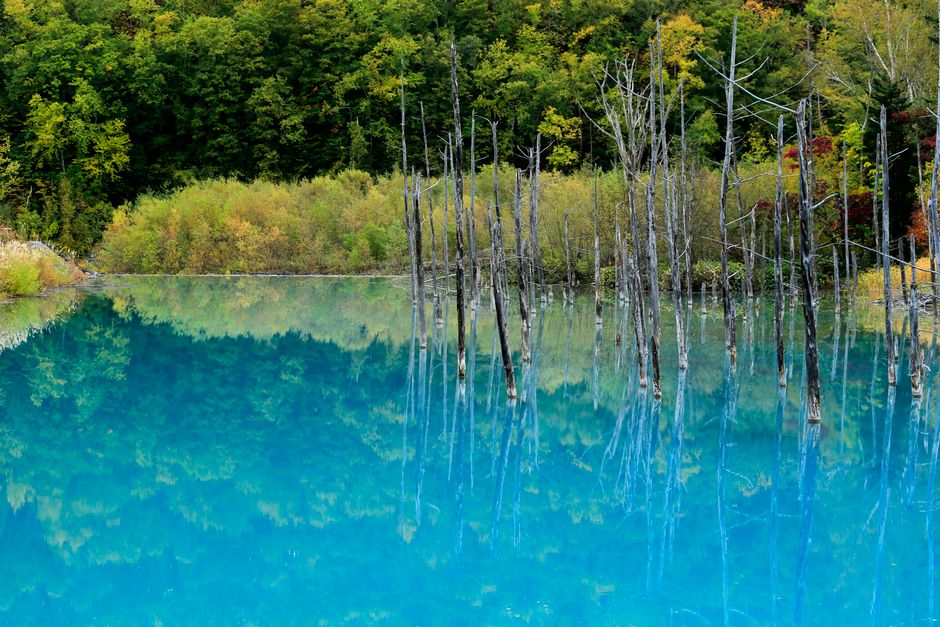
Highlights: the pond itself is free. The colour of the water changes with the angle of the light, so morning and afternoon look like different ponds on the same day. The path is close to one way and 35 minutes is enough to walk out and back.
Practical note: anyone arriving by car should know that parking charges changed on 1 July 2026 — JPY 1,000 a visit for standard, compact and kei cars, up from JPY 500, with JPY 300 for motorcycles and JPY 6,000 for coaches. On the bus tour none of that applies. In winter the tourism association states plainly that snow cover means the blue surface cannot be seen at all.
- Entry
- JPY 0
- Open
- May to 22 October 7:00–19:00; 23 October to April 8:00–21:30
- Illumination
- 22 October to 21 April (17:00–21:00 in October and November)
- Parking
- Standard car JPY 1,000 (revised July 2026)
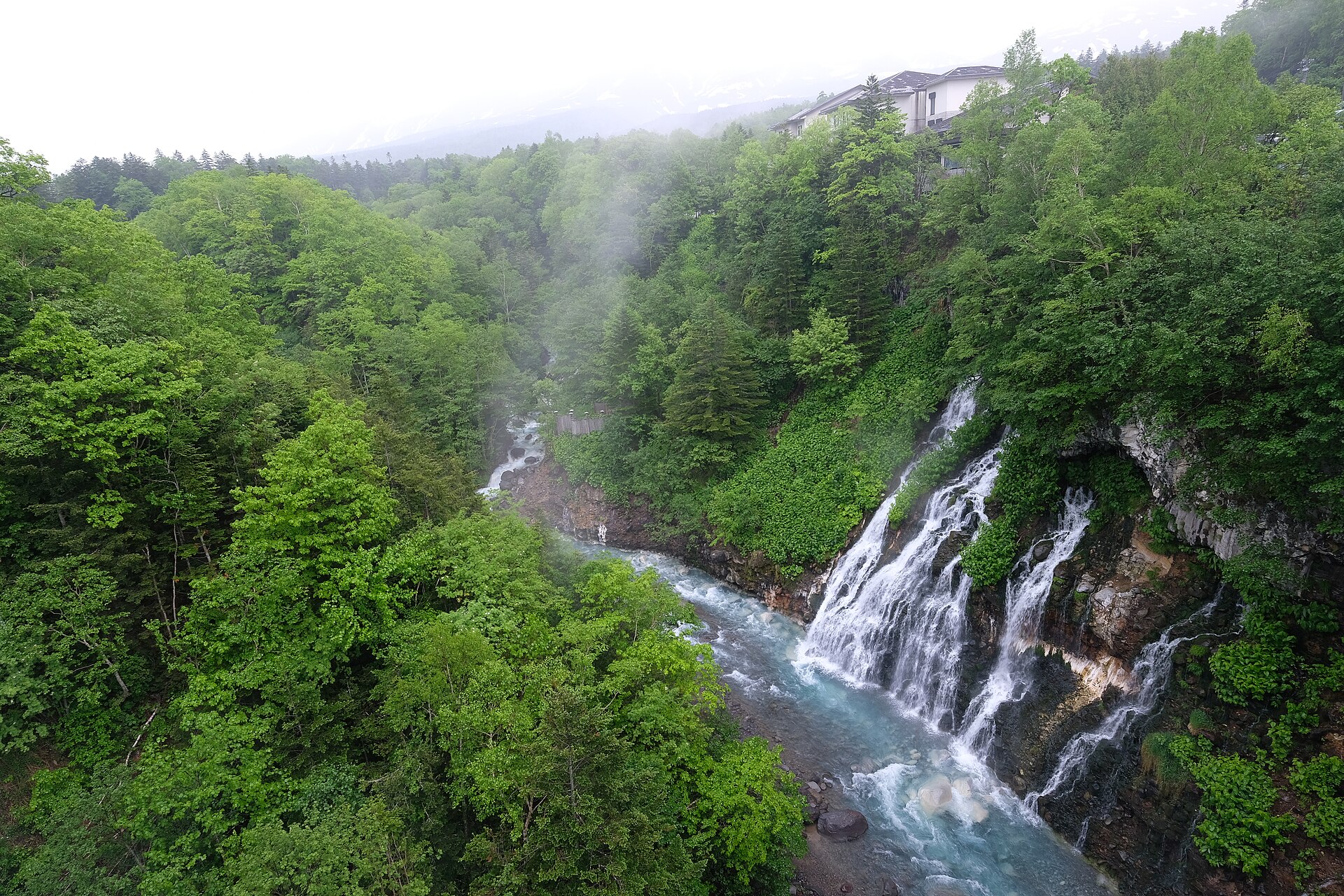
Highlights: a drop of about 30 metres. Nothing flows into it from upstream; groundwater seeps directly out of the gaps in the cliff face and falls from there, which the tourism association calls a subterranean-flow fall, rare in Japan. The most interesting part of the place is the seam where the falling water is swallowed by the blue of the Biei river.
Practical note: you look down on it from what people call the Blue River Bridge, and half of the twenty minutes will be spent standing on it. Unlike the Blue Pond, the floodlighting here runs all year, from sunset to 21:00, which makes it the more reliable of the two in winter.
- Viewing
- JPY 0
- Drop
- About 30 metres
- Illumination
- All year, sunset to 21:00
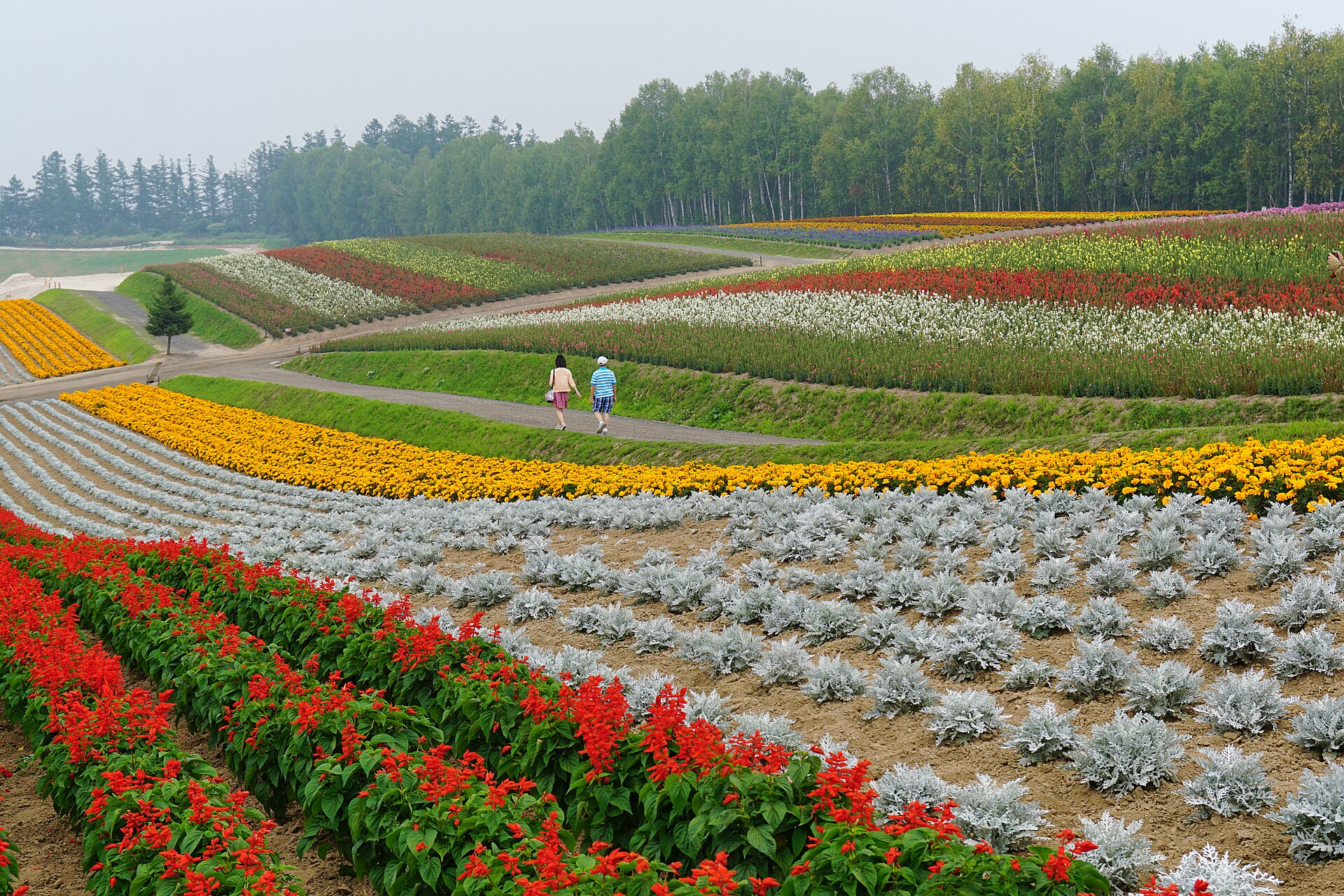
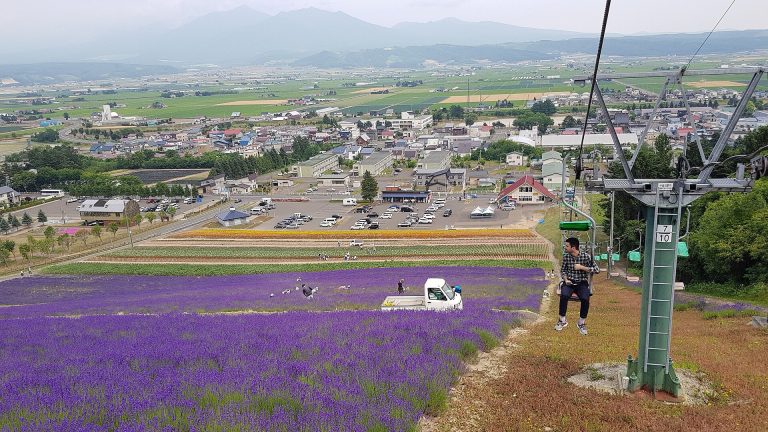
Highlights: about 15 hectares of hillside planted in bands of flowers. Admission is charged only from July to September, at JPY 800 from high school age and JPY 500 for primary and junior high pupils when bought from the machine. The Biyu Bus fare already includes that admission for the charged months, so nobody on the tour pays it twice. From October to June entry is free.
Practical note: 45 minutes is not enough to walk to the far end of the hill and back, so the tractor bus inside the grounds (JPY 500 from high school age, a 15-minute circuit) is what gets you to the upper slopes. It takes cash only. Photography from inside the flower beds is prohibited, and drones only by arrangement outside opening hours. What is in bloom in late September is cosmos, kochia, salvia and marigold; lavender is not on the flower calendar at all.
- Admission
- July–September only: JPY 800 from high school age, JPY 500 primary and junior high (machine)
- Hours
- June–September 8:40–17:30 (last entry 17:15 July–September); May and October 8:40–17:00
- Closed
- Open all year except 31 December and 1 January
- Official
- Official site ↗
Mt Tokachi needs one check before you travel. At 09:30 on 12 September 2026 the Sapporo Regional Headquarters of the Japan Meteorological Agency raised the eruption warning level for Mt Tokachi from 2 to 3, meaning restricted entry. The town of Biei states that the restriction applies only around the crater and not to the Shirogane district or the residential areas, and the tourism association’s notice of 15 September says the Biyu Bus is running normally. The Blue Pond, Shirahige Falls and Shikisai-no-oka all sit short of the restricted zone. The association also writes, though, that if any of them fell inside a restricted area it would suspend the tour rather than shorten or reroute it. A cancellation is refunded in full, and it leaves that afternoon completely empty.
Afternoon: without the motor you will not get up these hills
Back at the Shiki-no-Johokan at 12:45, change straight onto a bicycle. Three hire shops sit around Biei Station and all of them rent electrically assisted bikes at JPY 600 an hour.
Highlights: the farmland spreading north-west of Biei Station. Each crop is a different colour, so the whole set of hills reads as a quilt. The gradients are genuinely steep, and on an ordinary bicycle you will end up pushing part way up. Choosing the electric version roughly doubles the ground the same two hours covers.
Practical note: Matsuura Shoten is one minute from Biei Station, open from late April to early November, 09:00 to 18:00, every day — and it does not hire out in the rain. It has no car park, so anyone who drove here cannot use it anyway. Terashima Shokai (five minutes from the station, 08:00–17:00) and Rental Cycle Station Biei Hills (two minutes, open all year, entirely electric) start at the same JPY 600 an hour.
- Nearest
- 1 minute on foot from JR Biei (Matsuura Shoten)
- Rate
- Electrically assisted bicycle, JPY 600 an hour
- Season
- Late April to early November, 09:00–18:00, daily (no hire in rain)
Something here is worth reading before you set off. The Biei tourism association writes that the beautiful hills are, every one of them, working farmers’ fields, and asks visitors not to step onto farmland, not to enter gravel tracks or farm roads, and to stay on the surfaced roads. The town’s photography rules are more specific still: do not enter farmland even where there is no sign; doing so is trespass, and the bacteria and pests on the soles of your shoes cause crop infections; when parking, keep away from field entrances and do not obstruct the farmers. Flying and filming with drones inside the town is prohibited in principle, requiring not only the transport ministry’s permission but the landowner’s consent.
On 28 August 2026 the association published an appeal titled BIEI Rules, whose text says that the beautiful scenery of Biei is also somebody’s everyday surroundings, and that this is a place where people live and should be looked at quietly from a distance. If you are going to hire a bicycle here, it is worth reading once before you ride.
One more thing: building the day around the Mild Seven Hill is no longer a good idea. The record of Biei’s landscape council contains the remark that immediately after the felling of the Philosophy Tree a thorough review with additional budget and a proper agreement with the landowner should have been pursued, and that the Mild Seven trees were another such case; the council also recorded agreement that the felling of another row of trees was unavoidable. A tree famous enough to have a name, gone by the time you arrive, is an ordinary occurrence in these hills.
Evening: staying in Biei makes the next morning easier
This plan assumes a night in Biei. Going back to Asahikawa and coming out again the next morning spends the whole of day two’s morning on travel. There are not many rooms around Biei Station, so booking as soon as the dates are settled is the realistic approach.
DAY 2Pay JPY 150 more and get off the bus at Nakafurano
Why this order: rather than running straight down from Biei to Furano, break the journey at Nakafurano for Farm Tomita. It splits one bus ride into two and nothing else changes.
Morning: JPY 650 through, JPY 800 in two pieces
Biei to Furano is served by Furano Bus on its Asahikawa line, the Lavender-go. It runs from in front of Furano Station and the Shin Furano Prince Hotel up to Asahikawa Station via Nakafurano, Kamifurano, Biei Station and Asahikawa Airport, seven services a day. There are no reservations; you take a numbered ticket on boarding and pay on the way out.
The nearest stop to Farm Tomita is Nakafurano on that route. What the farm’s own site gives is about 25 minutes on foot from Nakafurano, or a taxi. From JR Nakafurano station it is also about 25 minutes, so the distance is much the same either way.
Stopping for Farm Tomita costs JPY 150 a head. If the 50 minutes of walking there and back feels heavier than that, replacing it with a taxi leaves the bus fares unchanged either way. The real constraint is not the money but the timetable: seven services a day in each direction. Whatever gap falls between your arrival at Nakafurano and the next departure is the ceiling on how long you can stay.
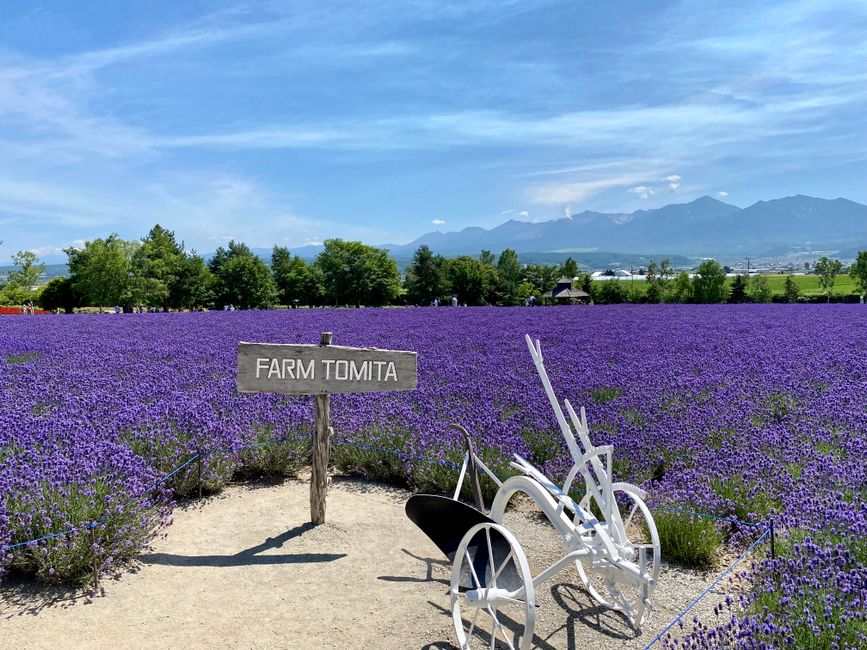
Highlights: there is no admission charge and no parking charge; the farm’s own FAQ says so in a single line. On the flowering season the official wording is that early varieties begin to colour from around late June and the peak comes in early to mid-July. Cutting follows, and all of it finishes around early to mid-August. You will often see it written that the second half of July is still in time; the peak the farm itself names is earlier than that.
Practical note: the fields do not go empty once the cutting is over. The farm diary for 19 September records that the cut lavender was putting out a second flowering, that past the lavender field an autumn planting of salvia and others takes over, and that the marigolds and angelonia were still going strong. The lavender soft-serve is sold all year, JPY 450 in a cone and JPY 400 in a cup.
- Nearest
- About 25 minutes on foot from the Furano Bus stop at Nakafurano, or from JR Nakafurano
- Entry
- JPY 0 (parking free as well)
- Hours
- Late August–September 9:00–17:00; October–November 9:30–16:30; December–early April 10:00–16:00
- Official
- Official site ↗
The rules inside are detailed, and breaking them damages the crop. Never step into the beds; no drone flying or filming; no food or drink brought in; no pets; no tripods; no smoking anywhere in the grounds. The farm also takes the trouble to state that the adjacent Tomita Melon House is a separate business with no connection to it, which is worth knowing before you look at a map and assume the two are one site.
Afternoon: down into Furano, and decide where you are eating first
Nakafurano to Furano Station is JPY 260 and about fifteen minutes on the bus. The town of Furano is compact enough to walk from the station, so the afternoon starts once the bags are at the hotel.
Highlights: the restaurant Furano’s omelette curry is associated with. The tourism association describes it as a curry of slowly fried vegetables with 29 spices added. The building is log-built and it is busy at lunch and at dinner.
Practical note: it closes on Mondays, or the following day when a Monday is a public holiday, so on an itinerary whose second day falls on a Monday this disappears entirely. Tuesday to Friday it runs two sittings, 11:00–15:30 and 17:00–21:00; at weekends and on holidays, and through Golden Week, July and August, it runs straight through 11:00–21:00. Confirm prices with the restaurant by telephone rather than relying on a listing.
- Address
- 11-8 Hinode-machi, Furano, Hokkaido
- Hours
- Tuesday–Friday 11:00–15:30 and 17:00–21:00; weekends, holidays, Golden Week, July and August 11:00–21:00
- Closed
- Mondays (the following day if a public holiday)
- Prices
- Confirm with the restaurant by telephone
If the evening in Furano is going to run late, fix tomorrow’s departure first. The first service on day three leaves Furano Station in the morning, and missing it comes straight out of the time you have at the zoo.
DAY 3Back to Asahikawa, and half a day at the zoo
Why this order: come back from Furano to Asahikawa Station without changing, and pick up the zoo bus from the same forecourt. Put the luggage in a coin locker and travel light.
Morning: bay 6 at Asahikawa Station, route 41 or 47
Furano Station to JR Asahikawa Station is JPY 900 on the Furano Bus Asahikawa line, via Biei Station and Asahikawa Airport. At Asahikawa, change in the same forecourt at bay 6 for the Asahikawa Denki Kidosha bus to Asahiyama Zoo.
The fare here has moved. Asahikawa Station to Asahiyama Zoo was revised on 1 September 2026 and is now JPY 670 for an adult and JPY 340 for a child one way, so JPY 1,340 each return. The services are route 41, via 4-jo-dori, and route 47, via 10-jo-dori, taking 39 to 47 minutes. Outbound there are 23 departures between 07:40 and 15:10, and taken together the two routes leave every 15 to 30 minutes.
Payment is what catches people out. Asahikawa Denki Kidosha states that the only IC travel cards accepted are Asaca and DoCARD. Suica and Kitaca do not work. Either carry cash, or buy the bus ticket and the zoo admission together from the machine at the central bus information office, where some machines take credit cards.
Highlights: admission is JPY 1,000 for adults and free for junior high age and under, with a JPY 700 resident rate for people living in Asahikawa. Opening hours come in three seasonal settings: 09:30–17:15 from 1 May to 15 October with last entry at 16:00, 09:30–16:30 from 16 October to 3 November, and 10:30–15:30 from 11 November to 29 December and from 2 January to 7 April.
Practical note: the shortened hours from 16 October to 3 November, and the closure immediately after from 4 to 10 November, are the holes an autumn itinerary falls into. If you are travelling in autumn, check that one week first. The zoo has also given notice that the adult rate rises to JPY 1,400 from the start of the summer season on 29 April 2027.
- Admission
- Adult JPY 1,000; free for junior high age and under
- Hours
- 1 May–15 October 9:30–17:15 (last entry 16:00); 16 October–3 November 9:30–16:30
- Closed
- 4–10 November; 30 December–1 January; 8–30 April
- Official
- Official site ↗
Afternoon: the ramen shop is not where it was last year
Back at Asahikawa Station, take a late lunch. Set off without checking the address and you will arrive at an empty building.
Highlights: founded in 1947 and one of the shops that shaped what Asahikawa ramen is. The stock is pork and chicken bones with Rishiri kelp, dried bonito, dried sardine and vegetables, drawn out over a low flame without ever being brought to the boil. Soy-sauce ramen is from JPY 950.
Practical note: it moved to new premises on 6 August 2026. The present address is 1705-6, 8-chome, 4-jo-dori, Asahikawa — not the 2-jo 8-chome of before. The shop’s own website still carries a 2001 copyright line with the old address and a JPY 750 price, so navigating from that page will not get you there. Hours are 09:30–14:00 and 15:00–17:00, ending earlier when the noodles and stock run out. Twenty seats, cash only, no car park.
- Address
- 1705-6, 8-chome, 4-jo-dori, Asahikawa (moved 6 August 2026)
- Price
- Soy-sauce ramen from JPY 950
- Hours
- 9:30–14:00 and 15:00–17:00 (may end early); closed Wednesdays
- Payment
- Cash only
Flying out of Asahikawa Airport, there is a scheduled bus from the station forecourt: JPY 750 from JR Asahikawa Station on the Furano Bus Asahikawa line. At weekends and on public holidays route 78 also runs directly from Asahiyama Zoo to Asahikawa Airport, about 35 minutes for JPY 840 an adult, which means you can leave for the airport without returning to the station. That service was also re-priced on 1 September 2026.
Alternatives
Rainy-day swap
The only part of this plan that rain defeats is the bicycle on the first afternoon. The hire shops do not hire out in the wet; Matsuura Shoten says so outright in its own information. Going to ask on a wet day means being turned away, so it is quicker to have decided in advance what the afternoon becomes instead.
The substitutes are either moving the Biyu Bus from A to B and giving the morning to the town of Biei and the displays inside the Shiki-no-Johokan, or pulling the whole afternoon forward into Furano so that day two’s morning is lighter. Neither changes what you pay. Since the itinerary contains only two charged attractions, the zoo and Shikisai-no-oka, losing the outdoors to weather does not cost anything extra.
The Blue Pond and Shirahige Falls are not cancelled for rain. The pond’s water clouds and loses its brightness; the falls gain from the extra volume. The bus tour is not a service that suspends itself for weather, so cancelling because it is raining costs you 40 per cent the day before or 50 per cent on the day.
If the flight is delayed by an hour or more
Only day one breaks. The desk for Biyu Bus route A closes at 09:25 and there is no allowance for arriving late. As soon as you know Asahikawa will be an hour behind, the first move is to ask whether you can be switched to route B at 14:10 the same day.
If no switch is available, the alternative way into the Shirogane area is the Dohoku Bus. There are ten services a day from Biei Station to Shirogane Onsen, and the Biei and Shirogane one-day pass introduced in 2026 is JPY 2,000 for an adult and JPY 1,000 for a child. That reaches the Blue Pond and Shirahige Falls, but Shikisai-no-oka is on a different route and will not fit into the same day. It becomes a choice of which of the three to give up.
Delay on the way home matters less here. On day three, the zoo to Asahikawa Station is about 40 minutes by bus and the airport is JPY 750 from the forecourt, so leaving the zoo at 16:00 still makes an evening departure. Furano Bus states plainly that its services are not timed to connect with flights or JR, so nothing is guaranteed and the arithmetic is yours to do.
When you’re tired
The order is settled. First out is the bicycle on the first afternoon, then the walk to and from Farm Tomita. Dropping the bicycle frees JPY 2,400 and leaves the afternoon free to rest in the town of Biei. Dropping Farm Tomita turns day two into simply sitting on the bus from Biei Station to Furano, removing JPY 150 a head and 50 minutes on foot.
With children the centre of gravity shifts. Asahiyama Zoo is free for junior high age and under, Shikisai-no-oka is JPY 500 for primary and junior high pupils and free below school age, so almost everything charged is adult. Against that, the Biyu Bus charges from JPY 2,500 for children aged 6 to 11 and from JPY 2,250 for those aged 4 to 5, free under 3, and those stack up per head. For a family of four it becomes the largest single line in the budget.
To shorten day three, two hours at the zoo rather than three is perfectly workable; where to draw the line is your call. The polar bear house, the seal house and the penguin house alone are about what two hours covers.
Why we skipped the Norokko train and Lavender Farm station
A car-free trip to Furano and Biei used to mean the Furano-Biei Norokko, a sightseeing train of open-window carriages pulled by a diesel locomotive, which stopped at Lavender Farm, a temporary station opened only for the summer. From that platform Farm Tomita is about seven minutes on foot — far easier than the 25-minute walk from the bus.
It is not in this plan because it ends on 23 September 2026. JR Hokkaido’s announcement states that the train, which has run since 1998, makes its final journey on Wednesday 23 September 2026, a public holiday. Lavender Farm station operates from 6 June to 23 September and disappears with it. For anyone travelling from 24 September onwards, the seven-minute walk from Lavender Farm station no longer exists.
The same reasoning leaves out the seasonal limited express from Sapporo, the Furano Lavender Express. Its 2026 operating dates were 1 to 31 July, parts of August, 5, 6, 12 and 13 September, and 19 to 23 September. No October dates are set. It too is a summer train.
The area passes have changed as well. The standard Furano-Biei Free Ticket stopped being sold in spring 2026, and the same release ended the Asahiyama Zoo Ticket, the S Ticket, the R Ticket and the Furano-Sapporo Return Ticket among others. What replaced them is the Hokkaido Mannaka Nonbiri Train Pass, at JPY 3,300 for one day, JPY 5,600 for two and JPY 6,900 for three, sold only as an electronic ticket on a smartphone.
Before the price, though, check what it actually covers. It is valid only in non-reserved ordinary-class seats on local trains inside the free area, which excludes limited expresses and expresses altogether. The free area is northern Hokkaido, taking in the Furano Line and the Nemuro Line between Takikawa and Furano — and it does not include Sapporo. Travelling out of Sapporo by limited express, using the pass locally and returning by limited express is not something it allows. It is also only valid from 18 April to 8 November.
Starting from Sapporo therefore means buying individually rather than with a pass. JR Hokkaido’s published undiscounted figures are JPY 5,440 one way from Sapporo to Furano with a ticket and reserved limited-express supplement, and JPY 5,440 from Sapporo to Asahikawa as well. Through Ekinet, the Tokudane 1 fares run from JPY 2,720 to JPY 4,890 for Sapporo to Furano and from JPY 2,440 to JPY 4,340 for Sapporo to Asahikawa. Note also that the timetable revision of 14 March 2026 made every limited express in Hokkaido fully reserved, so there are no non-reserved seats and the idea of buying a reserved-seat supplement on top has lost its basis. Combining this with the three days in Sapporo and Otaru means adding that return journey separately.
Where to stay
There is only one condition a room has to meet on this trip: you must be able to walk to it from the station. With no car, whether the place runs a pick-up decides what time you can leave the next morning.
The first night goes to Biei and the second to Furano because on both of those mornings the first commitment is in that town. Day one begins with a 09:25 check-in at the Shiki-no-Johokan outside Biei Station; day three begins with a bus from outside Furano Station. Skip Biei and take both nights in Furano and you spend the first morning travelling from Furano to Biei, which removes all the slack against that check-in deadline.
Rates move even for identical dates, which is why no room figure appears in the table below. If you want to fix timed activities around the stay as well, Klook lists Furano and Biei slots by date.
Biei and Furano have few rooms in absolute terms and fill early for the July lavender season. Asahikawa Station has far more business hotels and is easier to book, so if Biei is gone you can stay in Asahikawa and come in on the first train instead. That adds one more JPY 680 single fare to the day. The tax on a room differs by municipality, so when you total everything up, look at the municipalities that levy a lodging tax and what they charge and there will be nothing unexpected at the desk.
Book in this order: the Biyu Bus, then the rooms, then the transport. The bus closes four days out at 17:00 and sells out on some dates before that. Secure it, choose the rooms around it, and fit the train and bus times last. Do it the other way and you can end up with rooms booked and no seat on the tour, which removes the core of the trip.
What this trip costs
Assumptions: two adults, no car, out and back from Asahikawa over three days. Flights, rooms and meals vary too much by circumstance to belong in the total, so what is listed is what you spend on the ground. The Biyu Bus uses variable pricing, and the table is built on the published floor for July to September, JPY 5,000 an adult.
Every figure above is the published rate as of 2026-09-20.
Of that JPY 21,840, JPY 10,000 is the Biyu Bus. One tour accounts for close to half the total, and dropping it takes the figure to JPY 11,840. The replacement is the Dohoku Bus one-day pass at JPY 2,000 an adult, JPY 4,000 for two, plus JPY 1,600 of admission at Shikisai-no-oka that is no longer bundled, which nets out about JPY 4,400 cheaper. What you lose is the ability to take Shikisai-no-oka and the Blue Pond on the same day, so day one contains one place fewer.
It is worth looking at the same trade in hours. Biyu Bus A runs 09:40 to 12:45, three hours and five minutes, and covers the Blue Pond, Shirahige Falls and Shikisai-no-oka. Doing the same three by Dohoku Bus and scheduled connections means working with ten services a day between Biei Station and Shirogane Onsen, and on some legs the wait exceeds the time spent at the place. The JPY 5,000 difference per head is less a guiding fee than the price of not waiting.
One item is easy to pay for twice. Admission to Shikisai-no-oka is inside the tour price for travel between July and September on the Biyu Bus. Putting JPY 800 into the budget separately inflates the total by exactly that much. From October onwards, on the other hand, entry is free, so the month you travel changes how the line is counted.
This plan does not suit two kinds of traveller: anyone whose dates overlap 4 to 10 November, and anyone coming for a carpet of lavender. For the first, the zoo is closed and day three empties out. For the second, the farm’s own wording is that the peak comes in early to mid-July and that all cutting finishes around early to mid-August, so the timing has to be matched or it does not happen. What a visitor sees in September or October is the second flowering and the autumn beds.
Clothing can be decided off the meteorological normals. Furano in September has a normal daily maximum of 21.9 degrees and a minimum of 11.1; by October those fall to 14.9 and 4.1. Biei’s October minimum is 3.0. If the plan involves riding the hills, an October morning is in glove territory. For trimming what you carry, the way to size a battery is set out in the note on power bank capacity. The same car-free approach in a different city is Fukuoka on one subway line over two days, and when to buy the flights can be followed through the record of past airfare sales.
Furano Bus has a timetable revision planned for 1 October 2026. If you are building around departure times on or after that date, work from the revised timetable rather than this one. The fare table was last revised on 1 October 2025 and is not expected to move for now.
Sources: JR Hokkaido; the town of Biei and the Biei Tourism Association; Shikisai-no-oka; Farm Tomita; Asahikawa City Asahiyama Zoo; Asahikawa Denki Kidosha; Furano Bus; Dohoku Bus; Japan Meteorological Agency / Checked on 2026-09-20 / Photographs: Blondinrikard Fröberg (CC BY 2.0), 663highland (CC BY 2.5), OKJaguar (CC BY-SA 4.0) and as credited in each caption
Other sales ending soon




 4 days leftuntil Oct 24Air Busan Takamatsu-Busan Coupon: Up to 9,000 Yen Off Until October 24
 5 days leftuntil Oct 25JAL Hong Kong Campaign: Tokyo–Hong Kong Round Trip from 75,800 Yen (until 25 Oct)
 11 days leftuntil Oct 31Jin Air Kobe–Seoul: 5,000 yen off a round trip with code KTOUKB1, until 31 October
 11 days leftuntil Oct 31Jin Air to Busan: 4,000 yen off a round trip with code KTOPUS, first 300 only