Da Nang & Hoi An 4-Night, 6-Day Model Plan: Beach, World Heritage and a Town of Lanterns
AuthorMIRUTOBE editors
Table of Contents9 items
- Itinerary
- DAY 1 The only job on arrival day is checking your entry stamp
- DAY 2 Mountain in the morning, beach in the afternoon, bridge at exactly 21:00
- DAY 3 The Ba Na Hills ticket lasts three days, so one day need not finish it
- DAY 4 Hoi An is inside the same city now. The lantern night is the 14th of the lunar month
- DAY 5 Count back from the flight and keep only the morning free
- Alternatives
- Where to stay
- What this trip costs
A basic Ba Na Hills ticket is VND 1,000,000 a head and takes three quarters of the fixed cost. The Marble Mountains are VND 40,000 and the Hoi An old town pass VND 120,000. After the 2025 reorganisation, Hoi An is part of Da Nang city and route 02 links them for VND 30,000.
Itinerary
DAY 1The only job on arrival day is checking your entry stamp
Why this order: day one is a single leg from the airport to the hotel. Tomorrow morning gives three to four hours to the Marble Mountains, so nothing goes into this evening.
Before you go: the visa waiver is 45 days and its decree expires on 14 March 2028
A Japanese passport needs no visa for a stay of 45 days or less. The basis is Resolution 44/NQ-CP of 7 March 2025, covering twelve countries including Japan, with no condition on the type of passport or the purpose of entry. It runs from 15 March 2025 to 14 March 2028, and what happens afterwards will be decided again under law. It is usually written as “until 2028”; precisely, it is until 14 March 2028.
Three conditions attach: a stay of 45 days or less, at least six months of passport validity on entry, and not falling under a ground for refusal. The old requirement of at least 30 days since your last departure was abolished by Law 51/2019/QH14. Older articles still carry it, so if you are going twice in quick succession, that is one thing you no longer have to worry about.
Arriving at an international airport, there is no arrival or departure card to fill in, though provincial immigration posts such as land borders may ask for one. More important is looking at your passport for the entry stamp. The limit of your permitted stay is calculated from the date on that stamp. Trying to leave without one is treated as illegal entry, so open the passport before you walk away from the counter.
During 2026 a pre-arrival declaration system entered trial operation. It began at Tan Son Nhat on 15 April 2026 and extended to Noi Bai in June. The registration site belongs to the immigration authority, accepts declarations from three days before arrival in several languages including Japanese, is free, and has no field for card details. Showing the resulting QR code at the counter speeds up processing. Da Nang International is listed among the airports it will extend to, but no start date has been published. It is not compulsory, so being unable to register does not affect entry itself.
There are limits on cash too. Bringing in foreign currency worth more than USD 5,000, or more than VND 15 million, requires a declaration at the airport. Registering your stay with the authorities is handled for you by the hotel or apartment operator.
Night: VND 10,000 is about JPY 61, and the airport journey time is not published
One number is worth carrying so that market stalls stop being confusing. Vietcombank’s published rate puts the telegraphic buying rate for the yen at VND 164.13 to JPY 1, which makes VND 10,000 about JPY 61. The Japanese embassy in Vietnam also writes it as roughly JPY 60, and for a sense of scale that is enough. The currency carries a lot of zeros, so rounding to the nearest ten thousand and converting is faster than reading every digit.
Neither the distance nor the journey time from the airport into town appears in official material. The figure of twenty minutes by car circulates widely, but it has no traceable source, so it is not a number to choose a hotel on. What is documented is that Hoi An to Da Nang International is about 30 km.
Voltage and plug shape fall into the same category. They are usually given as 220 V and type A, but nothing to that effect appears in the Japanese embassy’s entry and living information, on the Vietnam National Authority of Tourism’s site, or on the English pages of Vietnam Electricity. What your equipment accepts is printed on the equipment. Whether an adapter is enough or a transformer is needed is set out in the difference between a plug adapter and a transformer.
DAY 2Mountain in the morning, beach in the afternoon, bridge at exactly 21:00
Why this order: the official recommendation for the Marble Mountains is three to four hours in the morning. The Dragon Bridge fires at 21:00. Fix both ends first and leave the hottest part of the day for the sea.
Today’s three places line up due south of the city centre. The Marble Mountains are about 8 km out, My Khe Beach is on the way back along the coast, and the evening goes up to the Han River for the Dragon Bridge. The total distance is small, so the day can be rearranged even if the heat wears you down.
Morning: there are six peaks, and you climb one
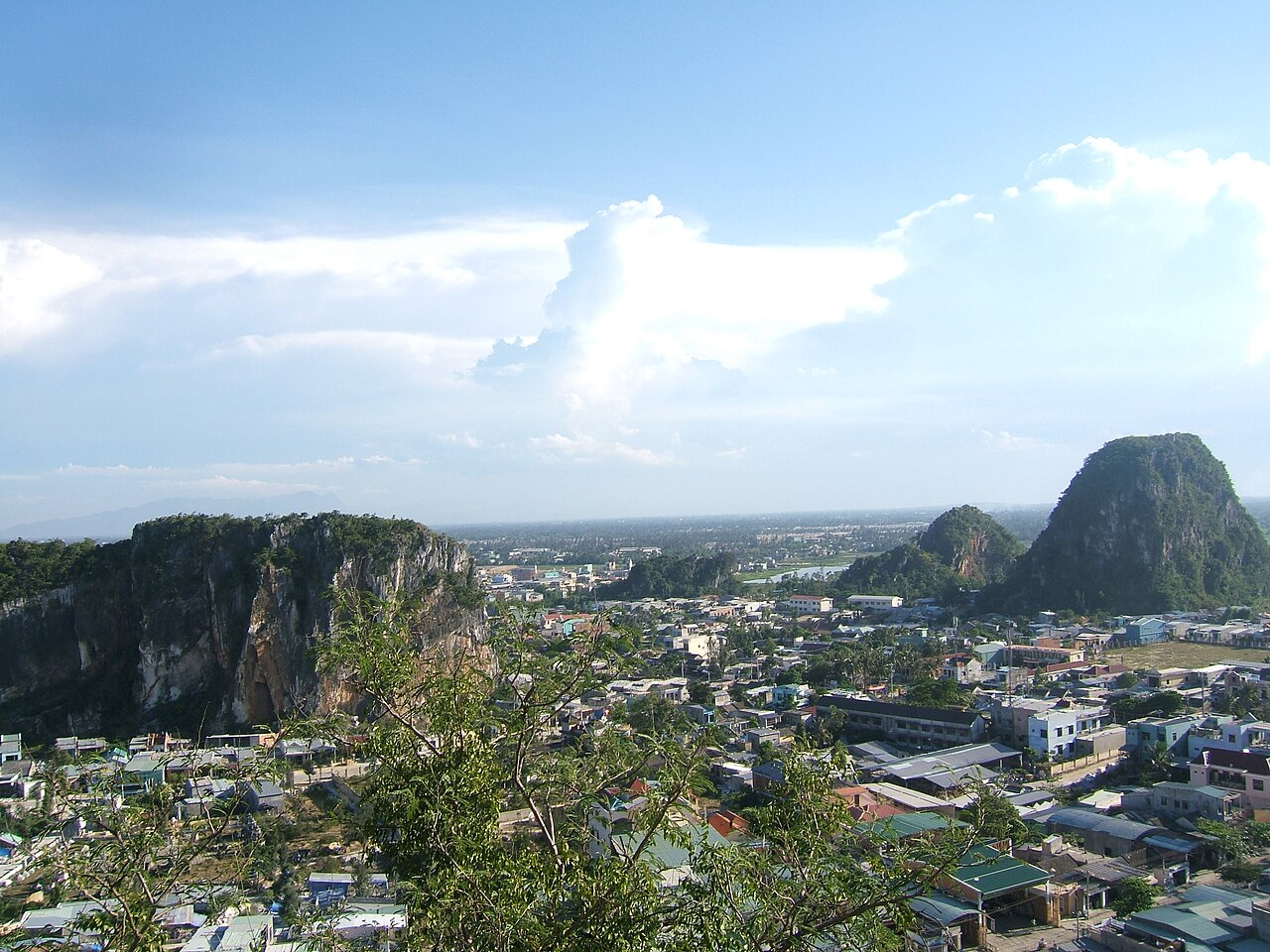
The name Ngu Hanh Son, five-element mountains, suggests five hills, but the official description is a massif of six peaks. Of the five names, Thuy Son, Kim Son, Hoa Son, Tho Son and Moc Son, only Hoa Son splits into two, Duong Hoa Son and Am Hoa Son. Visitors climb just one of them, Thuy Son. It spreads 15 hectares east to west, holds nine caves, and contains Tam Thai and Linh Ung pagodas, both over 400 years old.
Highlights: classified a special national heritage site by Prime Ministerial Decision 1820/QD-TTg of 24 December 2018, with the award ceremony held in January 2019. Buddha images sit in caves cut into the limestone, and from the summit you see the coastline at My Khe and the city at once. The neighbouring Non Nuoc stone carving village was recognised as national intangible heritage in 2014, and the masons’ workshops stand exactly where you come down off the hill.
Practical note: walking up means more than 150 stone steps. A glass lift costs VND 15,000 one way and VND 30,000 return, so taking the stairs only on the way down is an option. The Am Phu cave, the hell cave, is not covered by admission and costs VND 20,000 extra. A guide is VND 50,000 per group. There are two entrances, gate 1 and gate 2, and tickets are sold at both. The official advice is to leave the city centre between 07:30 and 08:00 and start walking around 08:30, and in summer to go before 09:00 or after 16:00.
- Admission
- Adult VND 40,000 per person per visit (under 6 free)
- Lift
- VND 15,000 one way; VND 30,000 return
- Extra
- Am Phu cave, adult VND 20,000 (students VND 7,000); guide VND 50,000 per group
- Location
- About 8 km south-east of central Da Nang, roughly 15 minutes by car
- Hours
- No opening times found on the official site (the recommended visit is 3 to 4 morning hours)
- Official
- Da Nang Department of Tourism ↗
This hill has long been described as an hour and a half to two hours. What the tourism department recommends is three to four hours in the morning. Look into all nine caves and walk down to the stone carving village and the gap is not walking speed but how much you look at. If the afternoon belongs to the beach, narrowing the caves to the three main ones on Thuy Son is enough.
Afternoon: My Khe is a beach with high-rise hotels along its back
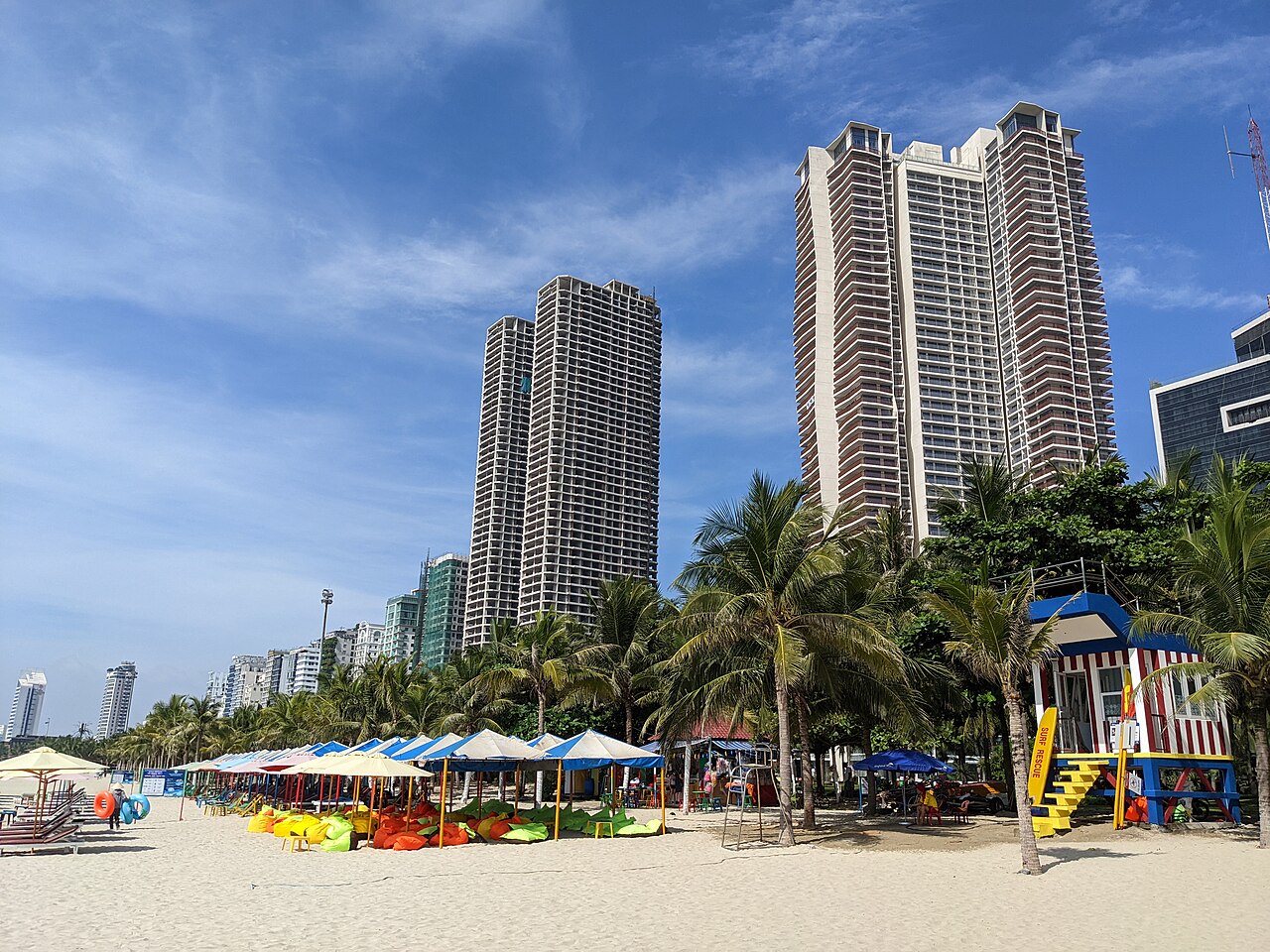
From the Marble Mountains back to My Khe is a single coastal road running north. The white sand and shallow water are as the photographs show, but what stands behind it is a wall of high-rise hotels rather than palms, which is not the tropical resort the pictures suggest. Arriving expecting an empty beach is where that goes wrong.
Many articles say an American magazine named it one of the world’s most attractive beaches, but neither the magazine nor the year could be pinned down. Rather than judging by an accolade that cannot be traced, treat it as somewhere to spend a few afternoon hours in sight of the sea and the plan stays steadier. If you are not swimming, order a fruit juice at a beachfront cafe and wait for the light to drop.
Evening: two minutes of fire, three of water, on Fridays to Sundays only
Highlights: a 666.5-metre bridge over the Han River, opened on 29 March 2013, with the body of a dragon running along the deck. Fire and water come from the head on the east bank. It fires every Friday, Saturday and Sunday and on major public holidays at 21:00: two minutes of fire, then three minutes of water. The order and the length are fixed, so there is no moving position once it starts.
Practical note: nothing happens on a weekday evening. It has long been written up as “weekend evenings, check the time locally”, but the start is fixed at 21:00. If your days do not line up, switch this evening to the riverside lighting alone. Holidays are the exception: for National Day on 2 September 2026 it ran on six consecutive evenings at 21:00, from 28 August to 2 September.
- When
- Fridays, Saturdays, Sundays and major holidays at 21:00
- Sequence
- Fire 2 minutes, then water 3 minutes
- Length
- 666.5 m (opened 29 March 2013)
- Cost
- Free, watched from around the bridge
- Official
- Da Nang Department of Tourism ↗
This is the point in the plan most tied to the day of the week. Land DAY 2 on a Monday to Thursday and waiting at the bridge for nine o’clock gets you nothing. If the departure date can move by a day, build it so DAY 2 falls on a Friday, Saturday or Sunday. If it cannot, going back to the bridge alone on the DAY 3 or DAY 4 evening works. Four nights in Da Nang means a weekend evening turns up somewhere.
DAY 3The Ba Na Hills ticket lasts three days, so one day need not finish it
Why this order: the summit is 1,487 m up and the weather is unpredictable. Because the ticket runs for three days from first use, treat today as the day you go up once, and if the cloud closes in, keep the rest for tomorrow.
Ba Na Hills is more than 20 km from central Da Nang. Going under your own steam, route 03 links Da Nang International Airport with the Ba Na Hills car park. It runs 32 services a day, takes 60 minutes each way, and averages 25 km. The fare is VND 15,000 for less than half the route and VND 30,000 from half up to the full length, with students paying VND 8,000. The vehicles are 30-seat electric buses built in 2026.
Because it starts at the airport, a hotel in town means travelling out to the airport first. If that is not worth the trouble, a ride-hailing app or a tour with transfers goes straight to the car park. Ride-hailing prices are not officially published, so you read the figure off the screen on the day.
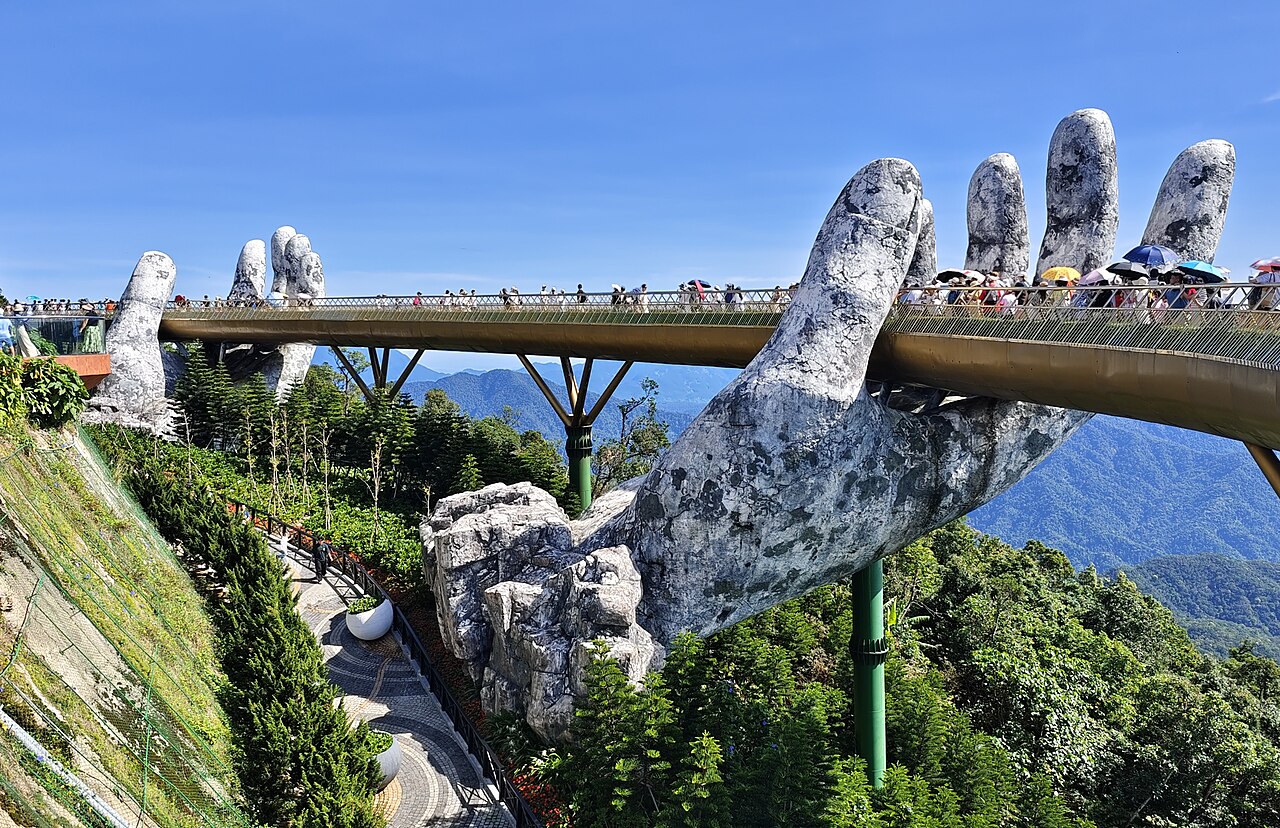
Highlights: a cable car takes you straight up to 1,487 m. The basic ticket for visitors from outside the city, foreign travellers included, is VND 1,000,000 for an adult and covers the return cable car plus entry to the Golden Bridge, the French Village, Fantasy Park and Le Jardin D’Amour. The cable car holds several Guinness World Records, and at the 2022 World Travel Awards it took World’s Best Cable Car System and World’s Best Iconic Tourist Attraction, with the Golden Bridge taking World’s Best Iconic Tourist Bridge.
Practical note: the ticket is valid for three consecutive days from first use, with no limit on cable car rides during that period. That is what lets you abandon the idea of covering it in a day. From 1 September 2026 the benefits included in the ticket were consolidated into a single QR code on the cable car ticket and the paper coupons withdrawn. Paid extras: the climb VND 100,000, the museum of light VND 150,000, the wine cellar VND 100,000, the bobsleigh VND 70,000 to 250,000, and the Wow Pass priority lane VND 300,000. At 1,487 m the summit is chilly even on a day the city is above 30 degrees, so pack a layer.
- Hours
- Daily 08:00–22:00
- Basic ticket (visitors from outside the city)
- Adult VND 1,000,000; over 70 and 1 m to 1.4 m tall VND 800,000
- Basic ticket (Da Nang residents)
- Adult VND 650,000; over 70 and 1 m to 1.4 m tall VND 550,000
- Validity
- 3 consecutive days from first use (unlimited cable car rides)
- Altitude
- 1,487 m; more than 20 km from central Da Nang
- Official
- Sun World Ba Na Hills ↗
The cable car often gets described as among the longest in the world, but no length appears on the official pages. What appears is the statement that it holds several Guinness records. The same goes for the Golden Bridge’s span and height, which are not published either. How the bridge reads depends on the weather rather than the distance, so not knowing the numbers is unlikely to cost you anything.
Giving one place an entire day is also a way of concentrating the trip’s slack into that day. The same idea is worked through in the Munich and Neuschwanstein four-night plan, where one castle takes a day. In both cases, deciding in advance what is left if that one place collapses is what keeps the rest standing.
To have the transport and the entry handled together, Klook lists Da Nang tours and Ba Na Hills tickets with transfers and the cable car bundled. Under your own steam the return on route 03 is VND 120,000 for two, so the difference is the price of the trip out to the airport and of reading the timetable yourself.
DAY 4Hoi An is inside the same city now. The lantern night is the 14th of the lunar month
Why this order: the old town goes pedestrian-only from 09:00, and the ticket window stays open until 21:30. Use the pass during the day and go down to the river once the light drops.
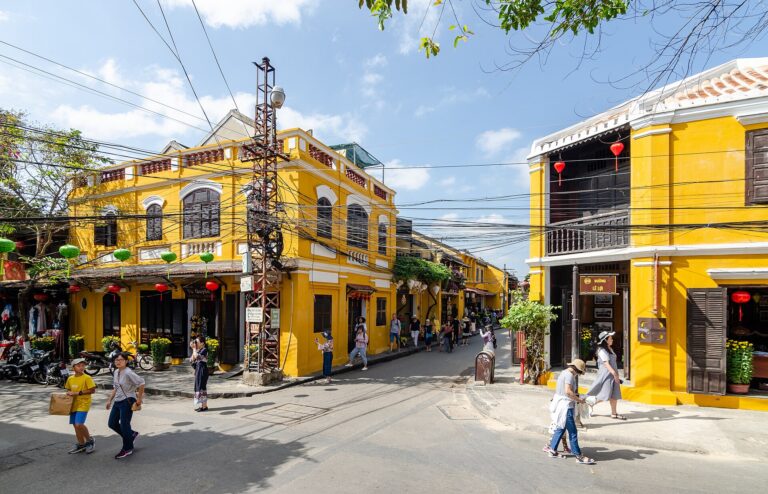
In the 2025 administrative reorganisation, Quang Nam province was merged into Da Nang. The new city covers 11,859.59 square kilometres with a population of 3,065,628 across 94 communes and wards, the largest of the six centrally governed cities. The Hoi An World Cultural Heritage Preservation Centre’s own address now reads Phuong Hoi An, TP. Da Nang. Any guide treating Da Nang and Hoi An as separate provinces was written before that.
Morning: route 02 is VND 30,000 end to end, and the last bus is 18:30
The public bus between Da Nang and Hoi An is route 02. The old route 01 Da Nang to Hoi An no longer runs. It goes from Ben Xe Trung Tam, the central bus station, via the Da Nang administrative centre to Cua Dai. Fares are by distance: VND 8,000 up to 10 km, VND 20,000 from 10 to 25 km, and VND 30,000 beyond 25 km to the full route. Students pay VND 8,000 regardless.
The familiar “thirty minutes from Da Nang to Hoi An” is measured from the Non Nuoc district by the Marble Mountains. Travelling from the city centre on the public bus, it is 70 minutes from the administrative centre to Cua Dai, or 90 for the full route. That is more than double, so planning without checking which starting point a journey time refers to pushes the afternoon back.
And the thing most likely to trip this plan up is the journey home. Route 02 runs 05:15 to 18:30, while the lantern night runs 18:30 to 21:00. You cannot watch it and then catch the bus back. Staying into the evening means securing a ride-hailing car or a chartered vehicle for the return leg in advance.
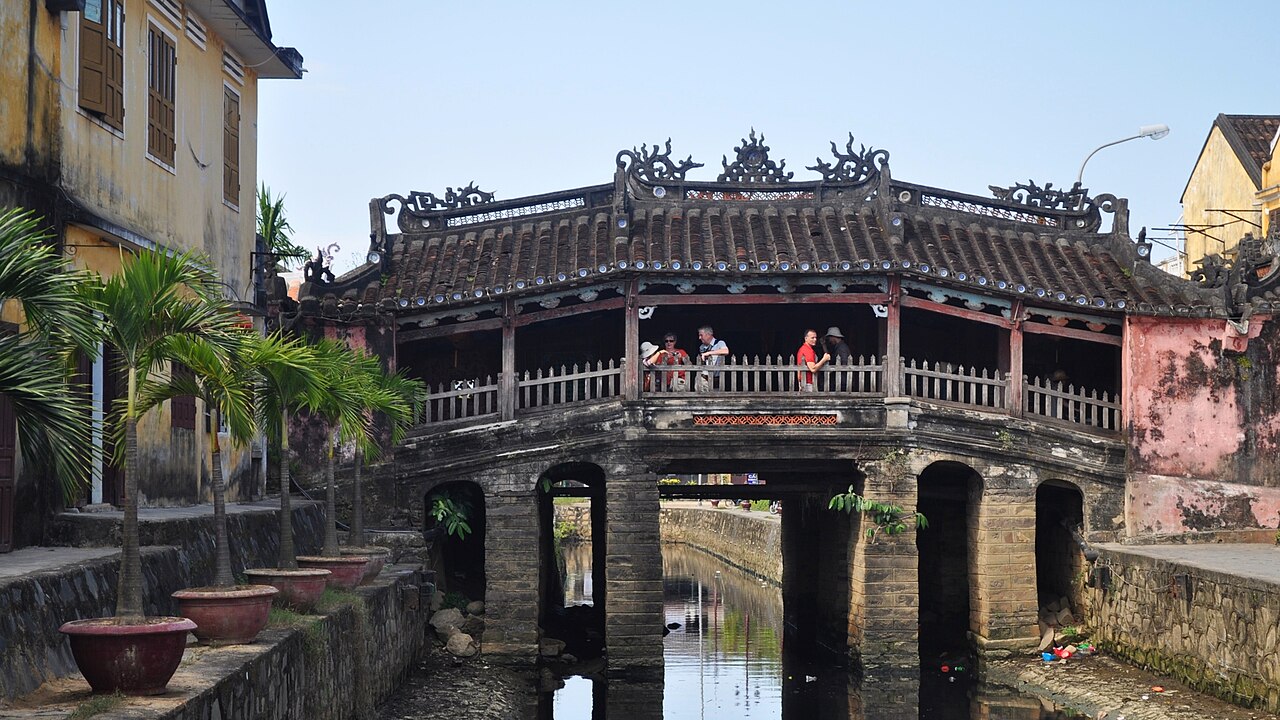
Highlights: the pass is VND 120,000 for foreign visitors and VND 80,000 for Vietnamese, one per person. VND 120,000 buys the old town itself plus one of either the Japanese Covered Bridge or the Quan Cong Temple, a share from the museums, and three more from the remaining cultural sites. More than 23 places qualify: four assembly halls, Fujian, Cantonese, Chaozhou and Hainan; the old houses Tan Ky, Phung Hung, Quan Thang and Duc An; the Tran and Nguyen Tuong family chapels; the Cam Pho communal house, Quan Cong Temple, Minh Huong Tuy Tien Duong and the Hoi An communal house; and five museums covering Hoi An, trade ceramics, folk culture, Sa Huynh culture and traditional medicine. The handicraft workshop, the traditional performance hall and the Japanese culture exhibition room are all included.
Practical note: buying the pass once during your stay is enough. After the allocation is used, keeping the stub lets you continue entering the old town. Under-16s are free, and students, people with distinguished service and over-60s pay half, so two people share one ticket. Buy eight or more and a free guide comes with them; fifteen gets one free. Some events are inside the pass: the Japanese culture exhibition room at 06 Nguyen Thi Minh Khai holds a Japanese tea ceremony demonstration daily at 09:30 and 16:30. The old town is limited to pedestrians and non-motorised vehicles from 09:00 to 21:30 in summer and 09:00 to 21:00 in winter, with Phan Chau Trinh Street from 17:30 to 21:30 and 17:30 to 21:00 respectively.
- Pass
- Foreign visitors VND 120,000; Vietnamese VND 80,000 (one per person)
- Ticket window
- Daily 7:30–21:30
- What it covers
- The old town, one of the Bridge or Quan Cong Temple, the museums, plus three others (more than 23 qualify)
- Pedestrian hours
- Old town, summer 09:00–21:30; winter 09:00–21:00
- Nearby villages
- Thanh Ha pottery village and Tra Que vegetable village, VND 35,000 each (valid 24 hours; e-tickets since 1 July 2022)
- Official
- Hoi An World Cultural Heritage Preservation Centre ↗
Restoration of the Japanese Covered Bridge, carried out with Japanese support, is complete. Hoi An is framed as evidence of more than 400 years of trade between Japan and Vietnam, and the annual Hoi An Japan Cultural Exchange Festival comes from that. It began in 1998 to mark 25 years of diplomatic relations and has run yearly since 2003. The 22nd was held from 22 to 24 May 2026. Land your dates on that week and the whole town becomes the venue, separate from anything the pass covers.
Do not try to use up the whole allocation; the walking gets better if you do not. See one assembly hall, one old house and one museum, then spend the time on the yellow-walled lanes. With more than 23 qualifying sites, trying to see them all turns the afternoon into entering and leaving buildings.
Evening: the lantern night is the 14th of each lunar month, 18:30 to 21:00
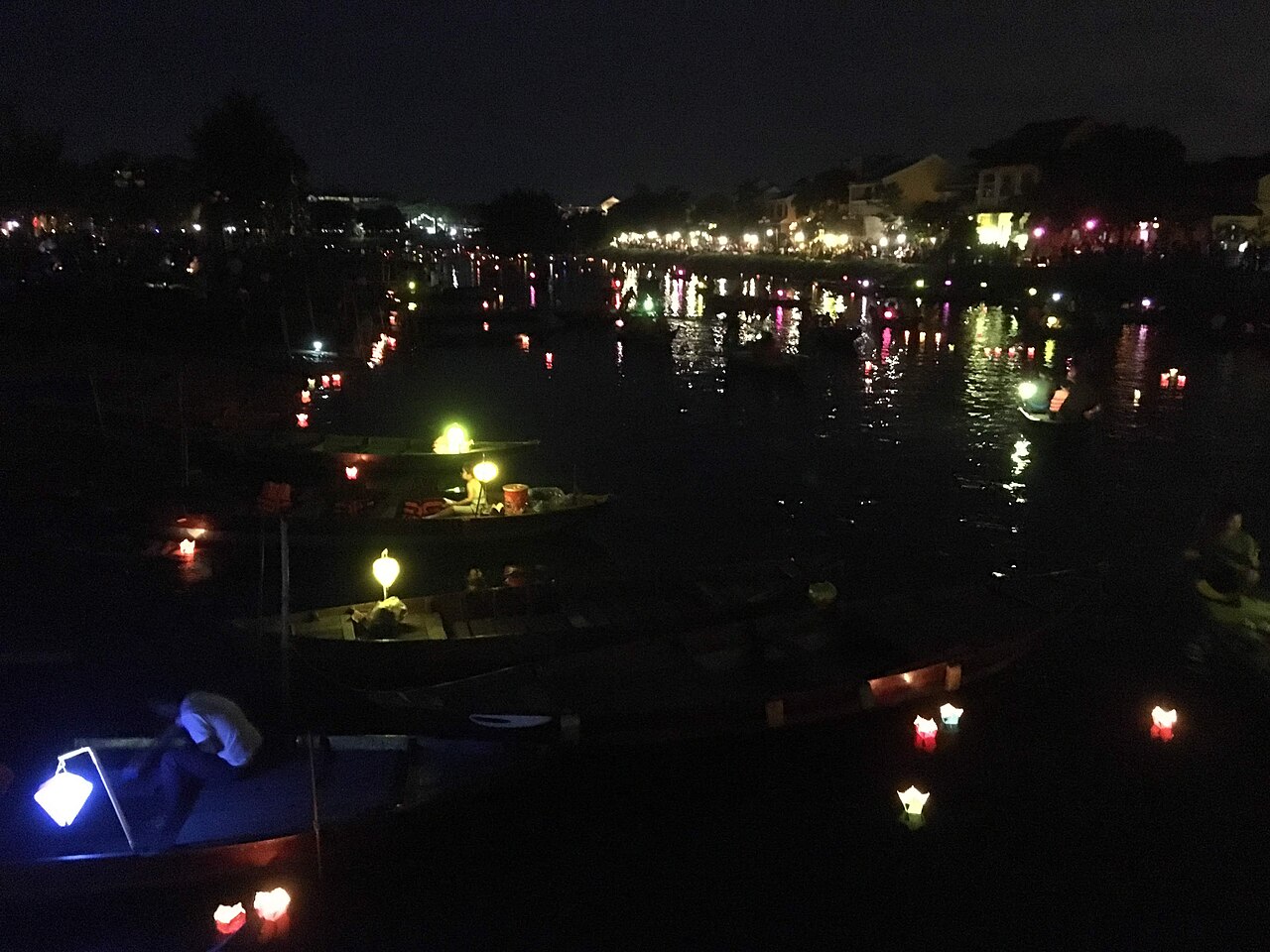
What gets called the lantern night has an official name and an official date. It is Dem pho co, the old town night, a recreation of Hoi An at the start of the twentieth century, held on the 14th of each lunar month from 18:30 to 21:00. It is usually written as though lanterns sway there on any evening, but the official programme runs once a month. Once your dates are set, work out which lunar day they fall on before deciding when to put Hoi An in.
There are 18 items in the programme. The floating lanterns, Hoi hoa dang tren song, happen on the Hoai River, not the Thu Bon. Elsewhere there is bai choi at the An Hoi roundabout, Tang poetry recitation at the Phung Hung old house, traditional martial arts at 33 Nguyen Thai Hoc, hat boi at 106 Bach Dang, calligraphy at 46 Tran Phu and 97 Nguyen Thai Hoc, and a food market from Bach Dang Street to the front of the Japanese Bridge. Every location is published, so what you see in two and a half hours, and in what order, can be decided before you arrive.
Rowing boat fares are not published. Watching the lanterns from the water is part of the programme, but with no published tariff the price is negotiated at the landing. It is the one item that cannot be fixed in advance, which is why it is also left out of the cost table.
Central Vietnam serves a different noodle in every town

Cao lau is Hoi An’s own noodle, thick and chewy and tossed with very little broth. Da Nang’s equivalent is mi quang, also nearly dry. Hoi An’s dumpling is the white rose, a steamed prawn parcel; breakfast is pho; and the coffee comes with condensed milk under it. Banh mi is the French-roll sandwich, and Hoi An has shops with queues. Eat noodles three times a day and they start to look like the same dish, so putting banh mi at lunch and noodles at dinner makes the differences between the towns legible.
DAY 5Count back from the flight and keep only the morning free
Why this order: the journey time to the airport is not published, so leave more slack than feels necessary. Keep shopping and the spa in town and add no excursion.
Adding an excursion on the last day hands the whole schedule to a journey time nobody has measured. Neither the distance nor the duration between the airport and the city appears officially, so set your departure from the hotel with room to spare. The one figure that exists is 30 km from Hoi An to the airport, which is why Hoi An does not belong in a last-day plan.
Taking cash out carries the same threshold as bringing it in. Foreign currency worth more than USD 5,000 or more than VND 15 million requires a declaration. Buying the souvenirs in cash and spending the rest down in small notes removes one procedure at the airport.
Alternatives
Rainy-day swap
What rain hurts most here is DAY 3. At 1,487 m you can be inside the cloud with clear sky below. Spending a VND 1,000,000 ticket on a day you cannot see the end of the Golden Bridge is a waste, and the three consecutive days of validity is exactly the insurance against it. Go up in the morning, and if the visibility is poor, keep that day to the French Village and the indoor Fantasy Park and ride the cable car again tomorrow. With no limit on rides, there is nothing more to pay.
DAY 2 holds its shape in the rain. The Marble Mountains are mostly caves and pagodas, so you spend a lot of it under cover. Wet stone steps get slippery, which is when you switch to the lift both ways. The only casualty is the beach in the afternoon, and that converts easily into a rest at the hotel.
Hoi An’s old town is walkable in rain, but the lantern night is an outdoor programme built around floating lanterns and a food market on the riverbank, so a wet evening thins it out. The 14th of the lunar month will not come round twice inside one trip, so there is no alternative date to hold.
If the flight is delayed by an hour or more
A late arrival changes nothing, because this plan puts nothing on DAY 1 and the same itinerary starts the next morning. All that breaks is the check-in time, so if your flight could land in the small hours, choose a hotel with a 24-hour front desk.
Where it bites is the return leg on DAY 4. Route 02’s last service is 18:30, so being held up in Hoi An in the late afternoon removes public transport as a way home. On that day alone, decide in the morning whether to secure a car for the evening or to leave by 18:00.
A delay on the way home barely matters. DAY 5 holds a market and a spa, so there is nothing to cut.
When you’re tired
Ba Na Hills goes first. VND 2,000,000 for two, about JPY 12,200. Three quarters of the fixed cost sits there, so dropping it takes the remainder to VND 620,000. Losing the mountain also frees a 60-minute journey each way and six or seven hours on site, which then goes to My Khe Beach and eating around the city.
The Marble Mountains can be lightened instead. Take the lift both ways and the 150-plus steps disappear; narrow the caves to the main three and the time halves from the recommended three to four hours. The Am Phu cave is VND 20,000 extra, so on a day for conserving energy that is the natural thing to leave out.
With an extra night available, insert it between DAY 3 and DAY 4. Because the Ba Na Hills ticket lasts three days, the day after the mountain becomes a rest day and you gain the freedom to land Hoi An on the 14th of the lunar month. DAY 1 and DAY 5 are pinned to flight times, so stretching them adds awkward fragments.
Where to stay
What this plan asks of a hotel is whether it is nearer the sea or the river. DAY 2 runs north and south along the coast, DAY 3 starts at the airport, and DAY 4 is a return trip to Hoi An. Three days pointing three ways, so leaning too hard on one puts the other two further off.
Along My Khe Beach, the Marble Mountains are a single coastal road away and the afternoon returns straight to the sand. The strip is lined with high-rise hotels, so there is plenty of choice. It is away from the restaurants in the city across the Han River, though, which adds a journey to any evening out.
The city centre along the Han River puts the Dragon Bridge within walking distance. You can leave for the 21:00 firing and walk home afterwards. The Da Nang administrative centre, where route 02 stops, is also close, which makes the Hoi An return the shortest it can be. Getting to the sea means crossing a bridge.
Staying near Hoi An’s old town means watching the lantern night without a clock on it. It is the only choice that removes the bus timetable from the evening. Both Ba Na Hills and the Marble Mountains get further away, though, so giving one of the four nights to Hoi An is more realistic than all of them.
Prices move on identical dates, which is why none appear in the table above. Book flights, then the room, then the cars on the ground. Ba Na Hills tickets are sold at the window on the day, so they can wait until last.
What this trip costs
Assumptions: two adults, four nights, moving on public transport rather than a tour. Air fares are outside the total because they swing too far by route and season, and rooms and meals move on identical dates. Ride-hailing and the rowing boats have no published tariff, so they cannot go in the table. What is listed is only the admissions and bus fares with an official price.
Every figure above is the published rate as of 2026-09-14. The yen conversion uses Vietcombank’s telegraphic buying rate published the same day, JPY 1 = VND 164.13.
Of the VND 2,620,000, two million is Ba Na Hills. The remaining 620,000 covers the Marble Mountains, the World Heritage town of Hoi An and both bus returns. In yen that is about JPY 12,200 for the mountain and about JPY 3,800 for everything else. Vietnam is described as cheap, and in this plan that applies to the food and the rooms; the mountaintop park costs what a comparable Japanese attraction costs. Estimate the total while assuming prices are half of Japan’s and this is where it goes wrong.
Of the items outside the table, the unreadable ones are ride-hailing, the rowing boats and data. This is an itinerary run on a map and a ride-hailing app, so being connected from the moment you land is quicker. The break-even by party size is worked out in the eSIM against pocket Wi-Fi comparison.
Where this plan does not work is for anyone who cannot move a single day. The Dragon Bridge fires on Fridays to Sundays at 21:00, and the lantern night falls on the 14th of the lunar month. Both are pinned to a calendar, so fixing the dates first means missing both. Shift the departure by a day either way and the odds improve that a Da Nang evening lands on a Friday to Sunday and that Hoi An lands on the 14th. Whether you go hunting for those two changes how the dates are built in the first place. Assume you will miss both and the mountain, the old town and the sea still fill four nights.
For the same four nights given to temples and ruins, the Bangkok four-night plan; for everything handed to the sea, the Cebu four-night plan; and for the World Heritage streets and a beach stretched over one more night, the Penang five-night plan. Decide by how many days you have and how many calendar-bound events you want to chase.
Sources: official sites of the Da Nang Department of Tourism (danangfantasticity.com); Sun World Ba Na Hills (sunworld.vn); the Hoi An World Cultural Heritage Preservation Centre (hoianworldheritage.org.vn); Da Nang city buses (danangbus.vn); the Vietnam National Authority of Tourism (vietnam.travel); the Embassy of Japan in Vietnam; the Embassy of Vietnam in Japan; and Vietcombank / Checked on 2026-09-14 / Featured image: Steffen Schmitz, CC BY-SA 4.0 (Wikimedia Commons)
Other sales ending soon



 4 days leftuntil Oct 24Air Busan Takamatsu-Busan Coupon: Up to 9,000 Yen Off Until October 24
 5 days leftuntil Oct 25JAL Hong Kong Campaign: Tokyo–Hong Kong Round Trip from 75,800 Yen (until 25 Oct)
 11 days leftuntil Oct 31Jin Air Kobe–Seoul: 5,000 yen off a round trip with code KTOUKB1, until 31 October
 11 days leftuntil Oct 31Jin Air to Busan: 4,000 yen off a round trip with code KTOPUS, first 300 only