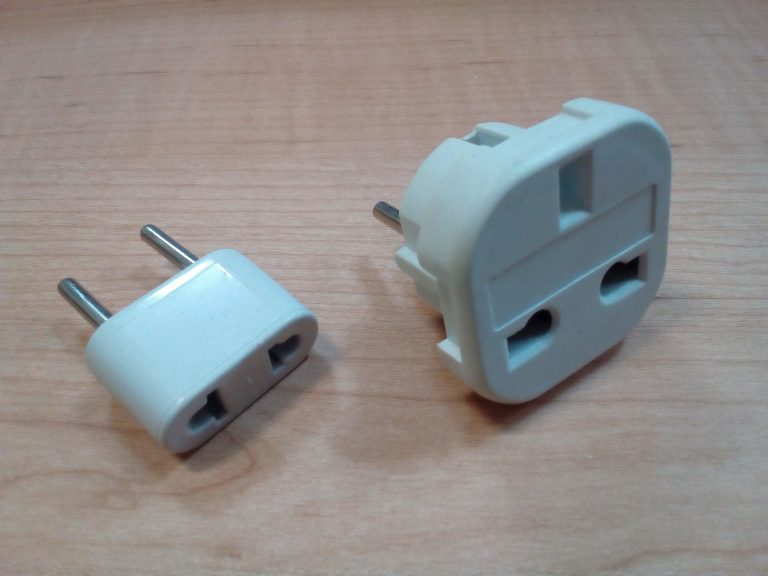
Do You Need a Voltage Converter Abroad? Plug Adapters, the Difference and How to Choose
AuthorMIRUTOBE editors
Table of Contents6 items
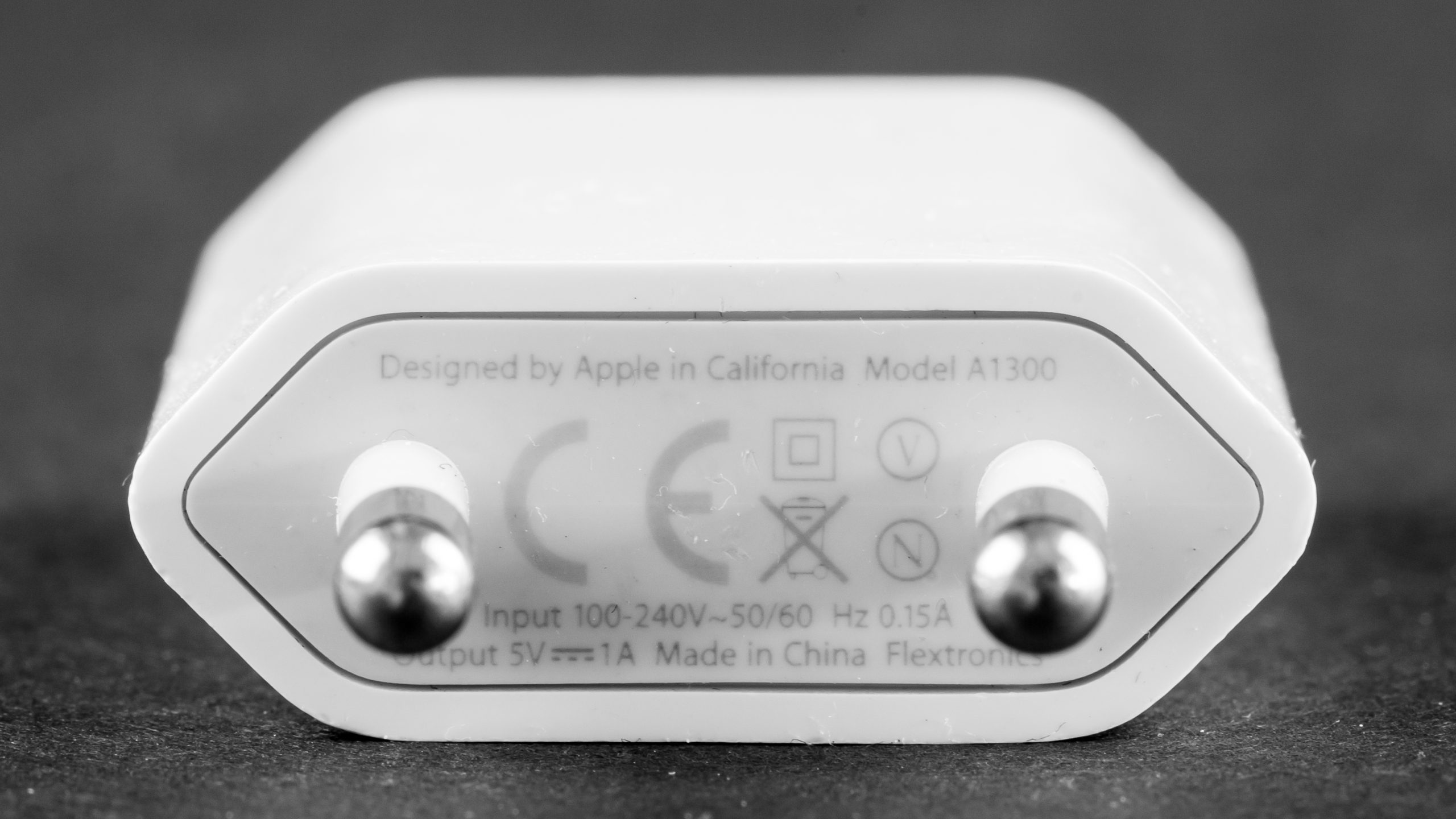
The power adapter for a phone or a laptop has its input voltage range printed on it. Apple’s A1300 reads “Input 100-240V—50/60 Hz 0.15A”. Anywhere inside that range, the voltage side needs nothing from you at all.
Trouble starts with anything that makes heat. Most Japanese hair dryers draw 1,200W, and Kashimura specifies a rated capacity of at least three times the load for heat-producing appliances — which puts a 1,200W dryer on a 3,600W-class transformer.
Check first: the label on the charger decides it
- Every device you are taking is marked 100-240V or AC100-240V on its input
- You are not carrying a hair dryer, a hair iron or a kettle bought in Japan
- You have looked up the voltage and the socket shapes for the country by name
- Where one country uses several shapes, you have chosen a multi-shape adapter
- You will not draw more than the adapter’s rating, typically 6A at 250V
If the first line holds, the voltage question is finished. The adapter accepts anything from 100V to 240V by itself, and the only job left is making the pins fit the hole. Only the people caught by the second line need the rest of the transformer discussion.
Five steps from reading the label to buying something
Step 3 is where people stall. A guidebook may say Europe is type C, but Kashimura’s country list puts France at A, C and O, and Germany, Italy and Spain at A, C and SE. Since the hole in the wall depends on the age of the building, arriving with a single type C and nothing else can leave you stuck in the room.
Settling step 5 first is quicker, in my view. Whether you are carrying something to dry your hair with is what decides whether this is a 48g problem or a problem measured in kilograms.
The full picture: which devices need which
The dividing line is heat or motor. Kashimura’s sizing guidance asks for three times the load on motor-driven and heating appliances and about 1.25 times for everything else. Dryers, vacuum cleaners, sewing machines and juicers sit on the motor side; rice cookers, irons, hotplates, electric pots, hair irons and electric blankets on the heating side.
Panasonic’s dual-voltage nanoe dryer, the EH-NA9F, switches between AC100/120V and AC200/240V, drawing 1,000W on AC100/200V and 1,400W on AC120/240V. It ships with a single C-2 plug adapter, so in a BF or O country you are still buying a separate adapter.
Where people trip up
A travel plug adapter is sold on terms that exclude use inside Japan
The specification for the Kashimura WP-81M states that it is an exempted-approval product, made for use abroad and not usable in Japan. Article 27(1) of Japan’s Electrical Appliance and Material Safety Act prohibits selling or displaying electrical products without the required marking, and article 27(2)(i) carves out products for a specified use where the Minister of Economy, Trade and Industry has granted approval. “Overseas use only” is that specified use, and the approval is why the thing is on the shelf.
Repurposing one after you get home, to run an appliance bought abroad from a Japanese socket, falls outside that approval. It would not work in any case: a plug adapter changes the shape of the pins, and no arrangement of pins makes 220V come out of a 100V wall.
Add a USB port and the legal category changes
A plug adapter with USB ports contains a circuit that turns alternating current into direct current. The Ministry of Economy, Trade and Industry’s list of 116 specified electrical appliances puts “DC power supply (including combined AC/DC units, limited to a rated capacity of 1kVA or less)” at number 115. Specified appliances are the ones that need the diamond-shaped PSE mark. That is the boundary between a part that changes a shape and a device that makes electricity.
Even shape-changers can cross it. A ministry interpretation dated 17 June 2002 examined a universal plug whose two flat blades rotate through 360 degrees with the spacing adjustable from 12.7mm to 19mm, and concluded that it is treated as a “plug” within the specified category. A plug attachment designed for one particular product went the other way on 29 May 2002, held to be outside the category because on its own it cannot serve as an adapter.
A transformer’s rating is not the same number as the load
Kashimura’s travel transformer WT-74M handles up to 300W in countries running AC110–130V and up to 200W at AC220–240V. The body is 80×120×68mm, weighs 1,250g, and the cord is 145cm. The specification carries two lines side by side: for continuous use of 30 minutes or more, stay under 80 per cent of the rated capacity; and it cannot be used inside Japan.
That 1,250g matters on any route with a cabin weight limit. Spending 1.25kg of a 7kg budget-airline allowance on power is a decision worth making after reading how the 7kg carry-on limit works, not before. Running several devices off one transformer through a power strip is not a way round it either: Kashimura states plainly that it does not recommend use with power strips.
What if you plug a 100V-only device into a 220V socket
Panasonic writes that using an appliance in a country with a different voltage risks a short circuit, an explosion or a failure. At more than double the rated voltage, the failure is not gradual. Smoke in a hotel room brings the compensation conversation and the fire alarm at the same time.
Taking the voltage through a transformer is possible in principle, but the capacity wall arrives first. Pairing a 1,200W dryer with a 3,600W-class transformer produces something that does not fit in a suitcase. Panasonic itself warns that depending on the transformer’s performance the appliance may not work properly or may be damaged. That leaves three options: use what the hotel provides, replace the appliance with a dual-voltage model, or change how you dry your hair for the length of the trip.
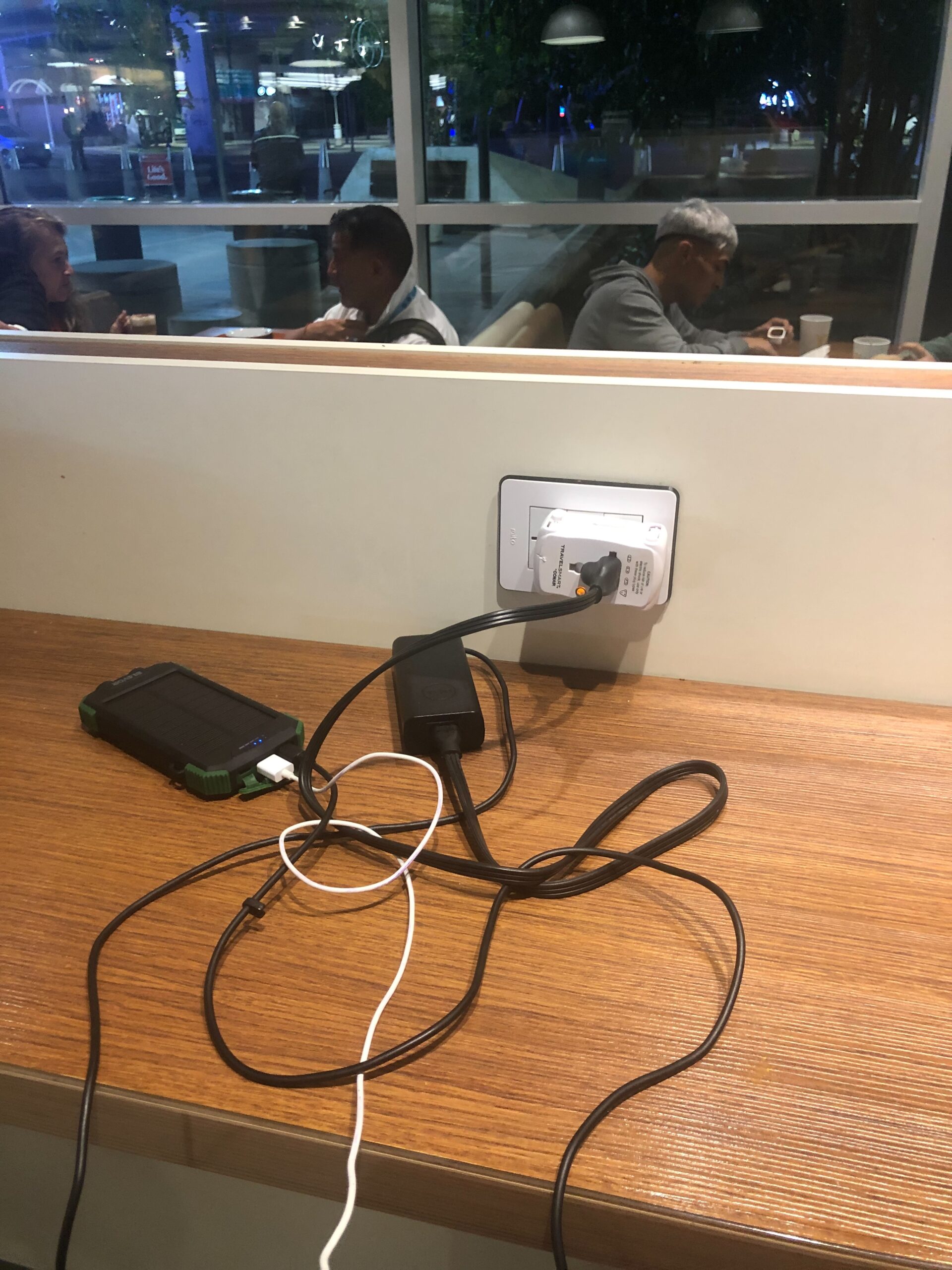
With power settled, the remaining worry moves to connectivity. Renting a pocket router adds one more device to charge; an eSIM that lives inside the phone adds none. On the night you find one socket in the room, that difference is the whole difference.
How to choose between the connectivity options is set out in our comparison of eSIM, pocket Wi-Fi and roaming, and what you may carry onto the aircraft is in the power bank rules. Power, data and batteries run on three separate sets of rules, so they are easier to settle separately before you leave.
Common questions: frequency, USB ports, buying on arrival
Can I ignore the difference between 50Hz and 60Hz?
Power adapters are built for both. Apple’s A1300 says “50/60 Hz”, and even Panasonic’s domestic hair dryers are marked “AC100 V 50-60 Hz”. Frequency matters for appliances where it drives motor speed directly, not for chargers. Taiwan, Korea and the United States run at 60Hz; Thailand, the United Kingdom and Singapore at 50Hz.
Can one adapter with USB ports charge the whole family?
The adapter’s rating is the ceiling. The WP-81M is 6A at 250V. USB output varies by product, and Kashimura’s own table includes models limited to 0.5A. If you want fast charging, plug in your own charger instead. What decides this is how many watts flow at once, not how many holes there are.
Why not just buy one at the airport on arrival?
You can. What is sold locally, though, converts to the local shape, and it will not necessarily have a hole that accepts Japan’s type A. Airport shops also close overnight in some terminals. Packing 48g is lighter than searching for a shop on the evening you land.
- e-Gov — Electrical Appliance and Material Safety Act, article 27 (sales restriction and exempted approval)↗Checked on 2026-09-14
- METI — list of 116 specified electrical appliances (no. 115, DC power supply)↗Checked on 2026-09-14
- METI interpretation, “plug” (17 June 2002: universal plugs are within the category)↗Checked on 2026-09-14
- METI interpretation, “plug attachment” (29 May 2002: outside the category on its own)↗Checked on 2026-09-14
- Kashimura — choosing a transformer or plug adapter (capacity guidance, voltages and shapes by country, FAQ)↗Checked on 2026-09-14
- Kashimura WP-81M specification (8 shapes, 6A/250V, 48g, exempted-approval product)↗Checked on 2026-09-14
- Kashimura WT-74M specification (300W/200W, 1,250g, 80 per cent for continuous use)↗Checked on 2026-09-14
- Panasonic — hair dryer comparison table (EH-NA9F power supply, consumption, accessories)↗Checked on 2026-09-14
- Panasonic — travelling abroad with a hair dryer (voltages and socket shapes by country)↗Checked on 2026-09-14
Source: the reference block above / Photos: Fructibus, CC0; Raimond Spekking, CC BY-SA 4.0; Grandmaster Huon, CC0 (all Wikimedia Commons) / Checked on 2026-09-14
Other sales ending soon




 4 days leftuntil Oct 24Air Busan Takamatsu-Busan Coupon: Up to 9,000 Yen Off Until October 24
 5 days leftuntil Oct 25JAL Hong Kong Campaign: Tokyo–Hong Kong Round Trip from 75,800 Yen (until 25 Oct)
 11 days leftuntil Oct 31Jin Air Kobe–Seoul: 5,000 yen off a round trip with code KTOUKB1, until 31 October
 11 days leftuntil Oct 31Jin Air to Busan: 4,000 yen off a round trip with code KTOPUS, first 300 only