Kanazawa and Kaga Onsen 3-Day Itinerary: Sights and Hot Springs
AuthorMIRUTOBE editors
Table of Contents8 items
Two nights, the first in Kanazawa and the second out in the Kaga hot springs, with no car. Kanazawa to Kaga-Onsen is 16 minutes at best by Shinkansen, and the Canbus loops the spa towns. Every admission and every public bath still fits inside JPY 11,200.
Itinerary
DAY 1In Kanazawa, everything you need is within walking distance of the station
Why this order: the first day uses only the north-east side of the station. Omicho Market, Higashi Chaya and Kazuemachi join up on foot, so the buses are needed twice and no more.
Kanazawa’s sights scatter east and south of the station. Trying to take all of them on the first day means riding the same bus route back and forth. The three on the east side connect on foot, so putting those together on day one and leaving Kenrokuen and the museum, which are south, to the second morning cuts the number of boardings roughly in half.
Morning: buy the day pass at the station, not on the bus
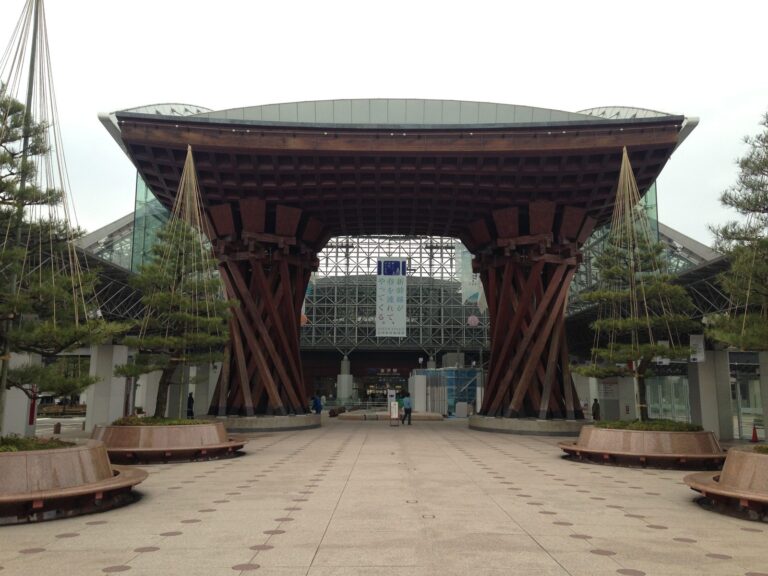
Come out of Kanazawa Station on the east side, the Kenrokuen exit. The structure in front of you is the Tsuzumi Gate, 13.7 metres tall. It is shaped after a Noh hand drum and built of laminated timber without a single steel member. The glass canopy behind it, the Motenashi Dome, uses 3,019 panes, not one of them square.
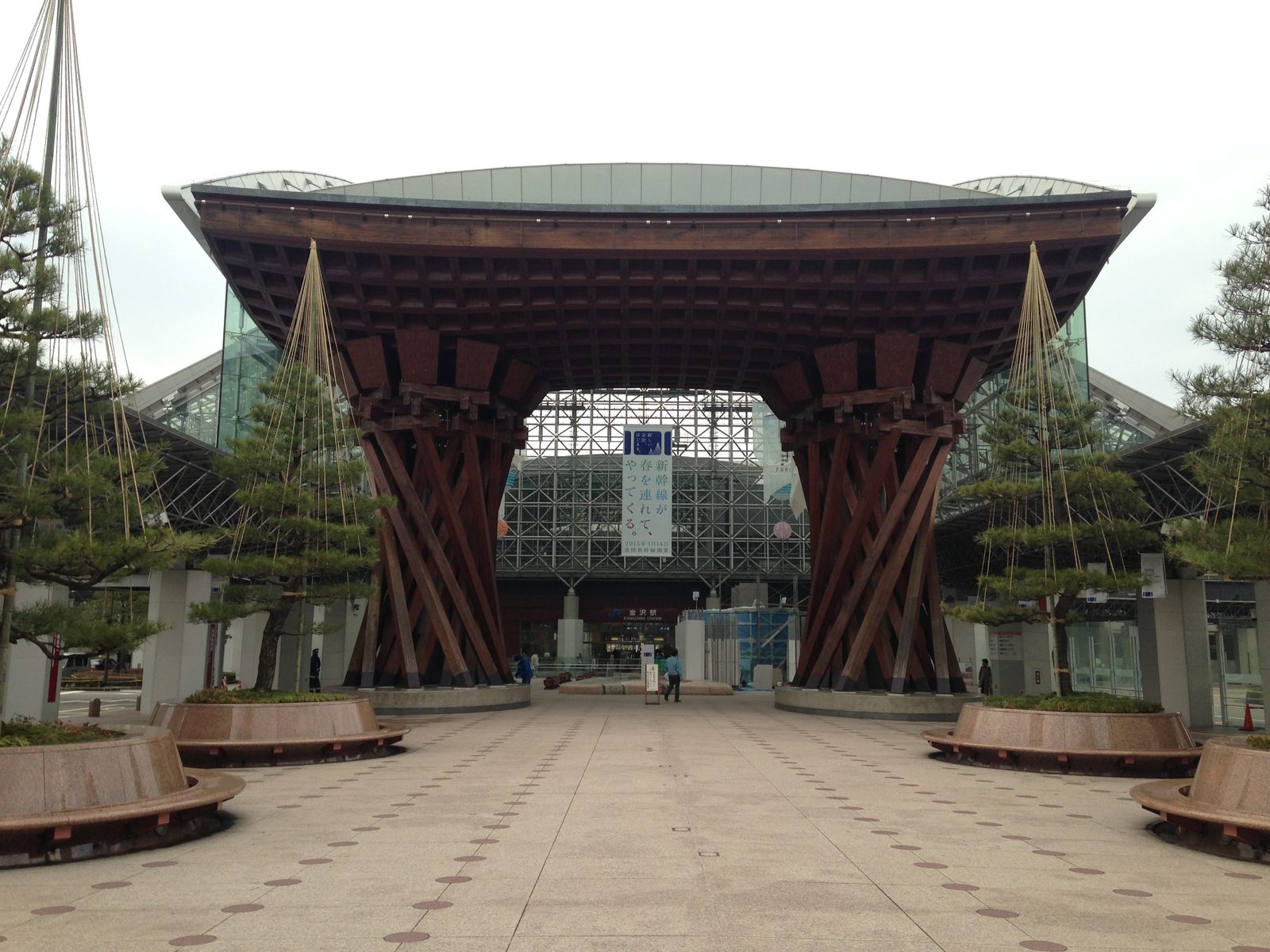
Highlights: the dome exists because this is a place of a great deal of rain and snow, and the idea was to hold an umbrella over anyone arriving. Taken separately the gate and the canopy are ordinary structures; stand under the dome looking up at the gate and the two overlap into one thing.
Practical note: before photographing the gate, go and buy a Kanazawa City One-Day Pass at the Hokuriku Railroad ticket centre by the west exit or at the information desk on the east side. It is JPY 800 for an adult and JPY 400 for a child, and gives unlimited travel on the Kanazawa Loop Bus, on local buses within a defined city zone and on the Kanazawa Flat Bus. It is not sold on board.
- Height
- 13.7 metres (the Tsuzumi Gate)
- Day pass
- Adult JPY 800, child JPY 400 (not sold on the bus)
- Official
- Hokuriku Railroad ↗
Showing that pass also cuts the price at several venues. Shima in the Higashi Chaya district takes JPY 50 off, Kaikaro JPY 100, and the Yasue Gold Leaf Museum comes down from JPY 310 to JPY 260. On paper three rides pay for it; on this itinerary the first day alone goes past three.
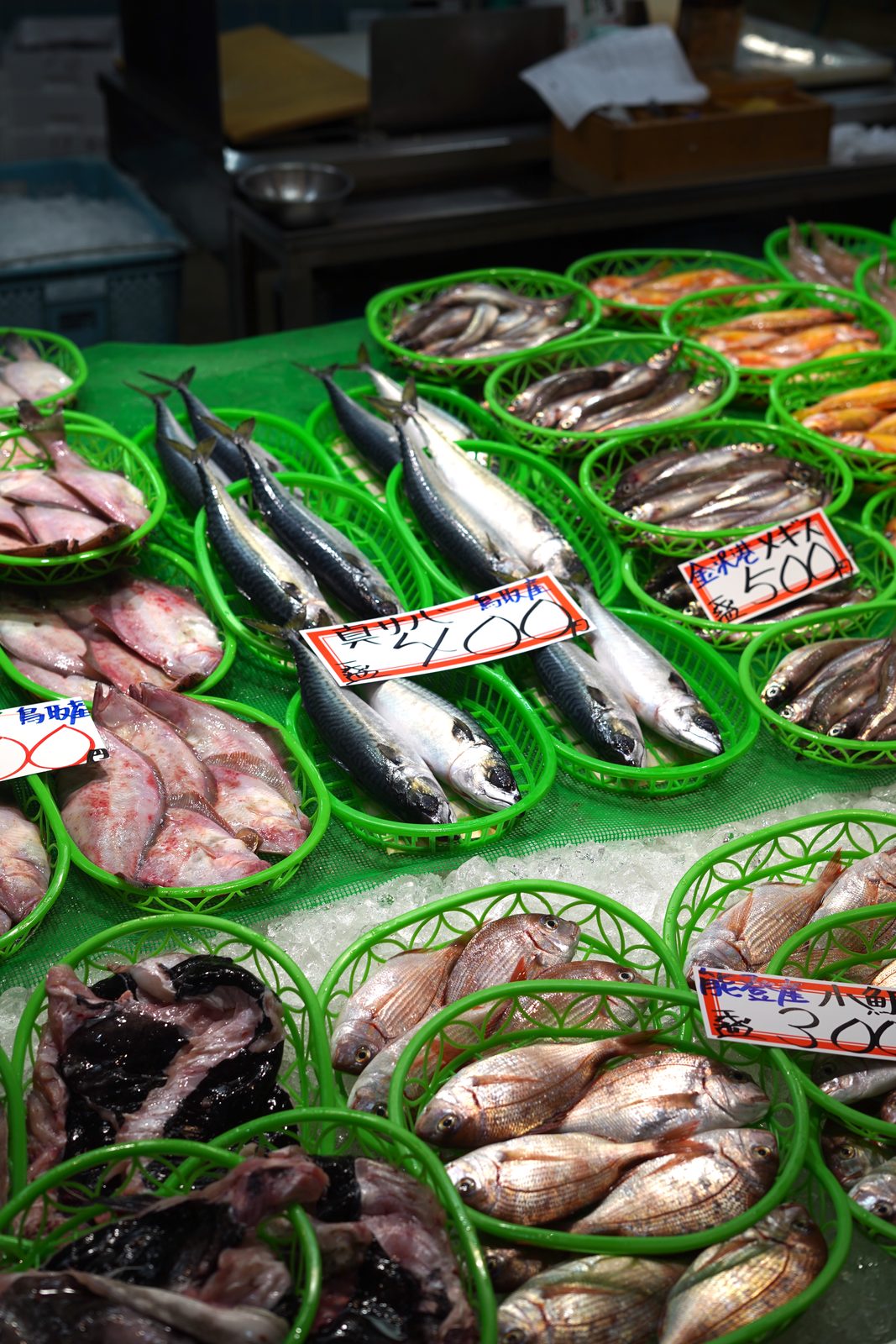
Highlights: about 170 shops packed along narrow lanes, trading here for some three hundred years since the domain period. It is fifteen minutes on foot from Kanazawa Station. Reading the price tags is interesting in itself: cards saying Kanazawa Port and Noto sit on the same counter as fish brought in from Tottori and Hokkaido. This is not a market that sells only what was landed locally.
Practical note: the aisles are narrow enough that arriving with a wheeled case immobilises you and everyone around you. Leave it at the hotel or in a locker at the station. The Hokutetsu bus service centre in the Musashi Emza store beside the market (10:00–19:00) also sells the one-day pass, which is the fallback if you missed it at the station.
- Nearest
- 15 minutes on foot from Kanazawa Station
- Entry
- JPY 0 (you pay each shop)
- Shops
- About 170
- Official
- Omicho Market ↗
Afternoon: see both teahouse districts, because they are not the same
Cross the Asano river from Omicho Market and you are in Higashi Chaya. On the loop bus the stop is Hashiba-cho; on foot it is about fifteen minutes from the market.
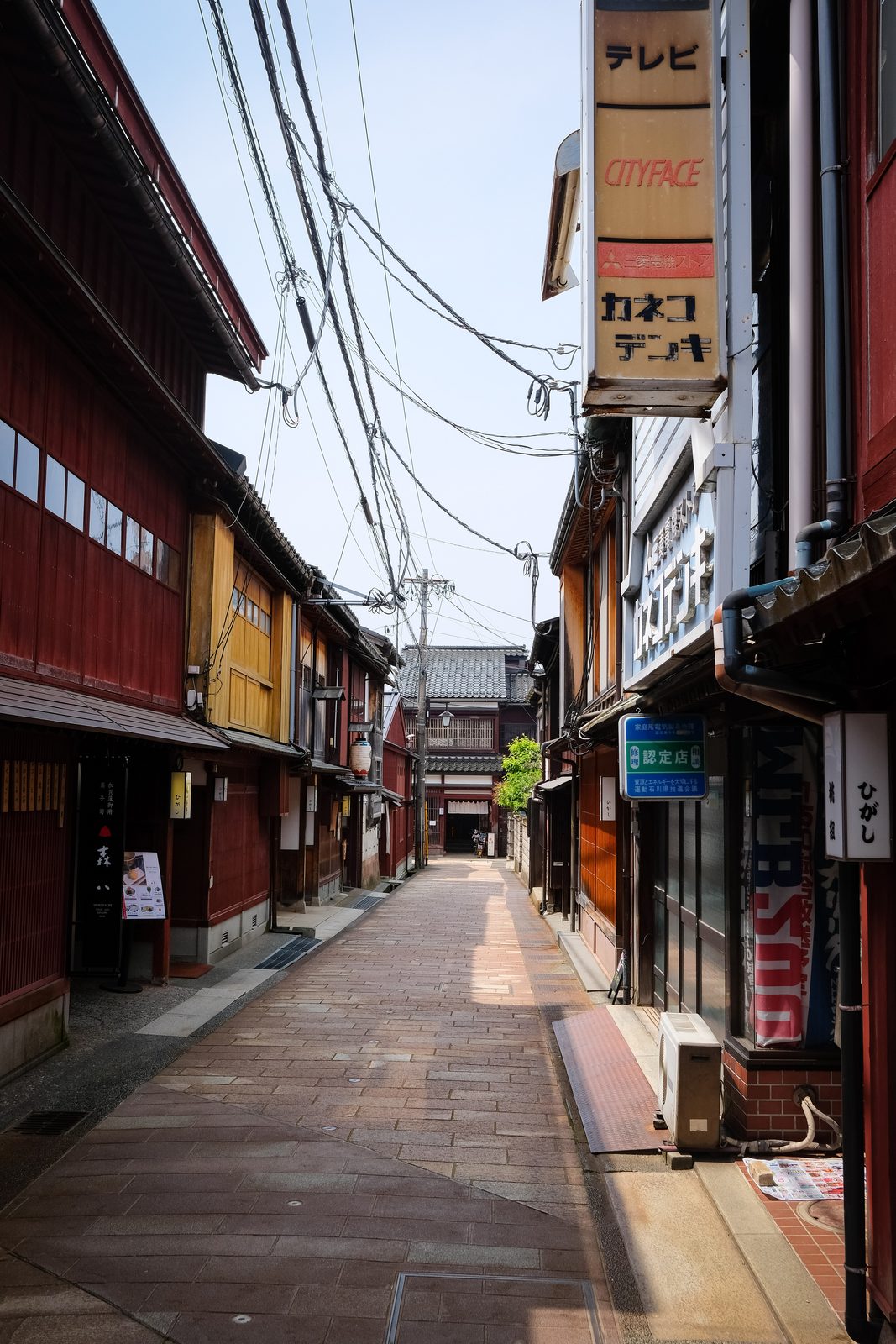
Highlights: an Important Preservation District for Groups of Traditional Buildings, and the largest of Kanazawa’s three teahouse quarters. Walking it costs nothing. The main street fills with visitors, but step one lane back and there are electrical shops and parked bicycles across from the townhouses, which is the evidence that people still live and work here.
Practical note: to see inside the buildings, the teahouses Shima, a nationally designated Important Cultural Property, and Kaikaro are open to the public for a charge. The one-day pass takes JPY 50 off Shima and JPY 100 off Kaikaro. Kaikaro opens 10:00 to 17:00 with irregular closing days, so if your date is fixed, check it is open before you go.
- Nearest
- Loop bus to Hashiba-cho; 15 minutes on foot from Omicho Market
- Walking
- JPY 0 (going inside the teahouses is charged)
- Discount
- With the one-day pass, JPY 50 off Shima and JPY 100 off Kaikaro
Highlights: the other teahouse district, on the opposite bank of the Asano river from Higashi Chaya. It carries the same preservation designation, and the width of the streets and the number of people in them are both different. Walk out to the riverside and you are looking at the backs of the buildings, which is another face of the same place.
Practical note: two narrow named slopes, Akari-zaka and Kuragari-zaka, run from the river up into the lanes behind. At the hour when Higashi Chaya fills with people, this side still has the riverbank to retreat to. It is one bridge away, so if Higashi Chaya is heaving you can simply come here first.
- Nearest
- 5 minutes from Higashi Chaya across the Asano river
- Walking
- JPY 0
Evening: Kanazawa oden is a counter with very few seats
Dinner means going back to Korinbo and Katamachi, about fifteen minutes on the loop bus. Kanazawa oden is served mostly across a counter, seats are few, and many places take no bookings, so the choice is to be there when they open or to eat at an odd hour. On a day that started with seafood at the market, shifting to jibuni, the duck and wheat-gluten stew, or to Kanazawa curry keeps the evening from repeating the afternoon.
The tax on a room differs by municipality. Kanazawa charges nothing below JPY 5,000 per person per night, JPY 200 from JPY 5,000 to under JPY 20,000, and JPY 500 at JPY 20,000 and above. A ryokan on the second night can easily fall in a higher band than the hotel on the first, so when you total everything up, check the rates against the municipalities that levy a lodging tax and what they charge and there will be no surprise at checkout.
DAY 2Kenrokuen in the morning, then 16 minutes down to the hot springs
Why this order: Kenrokuen, the castle park and the 21st Century Museum stand next to one another on foot. Clear them between the morning and early afternoon and move down to Kaga-Onsen while it is still light.
Morning: one JPY 500 ticket instead of two JPY 320 ones
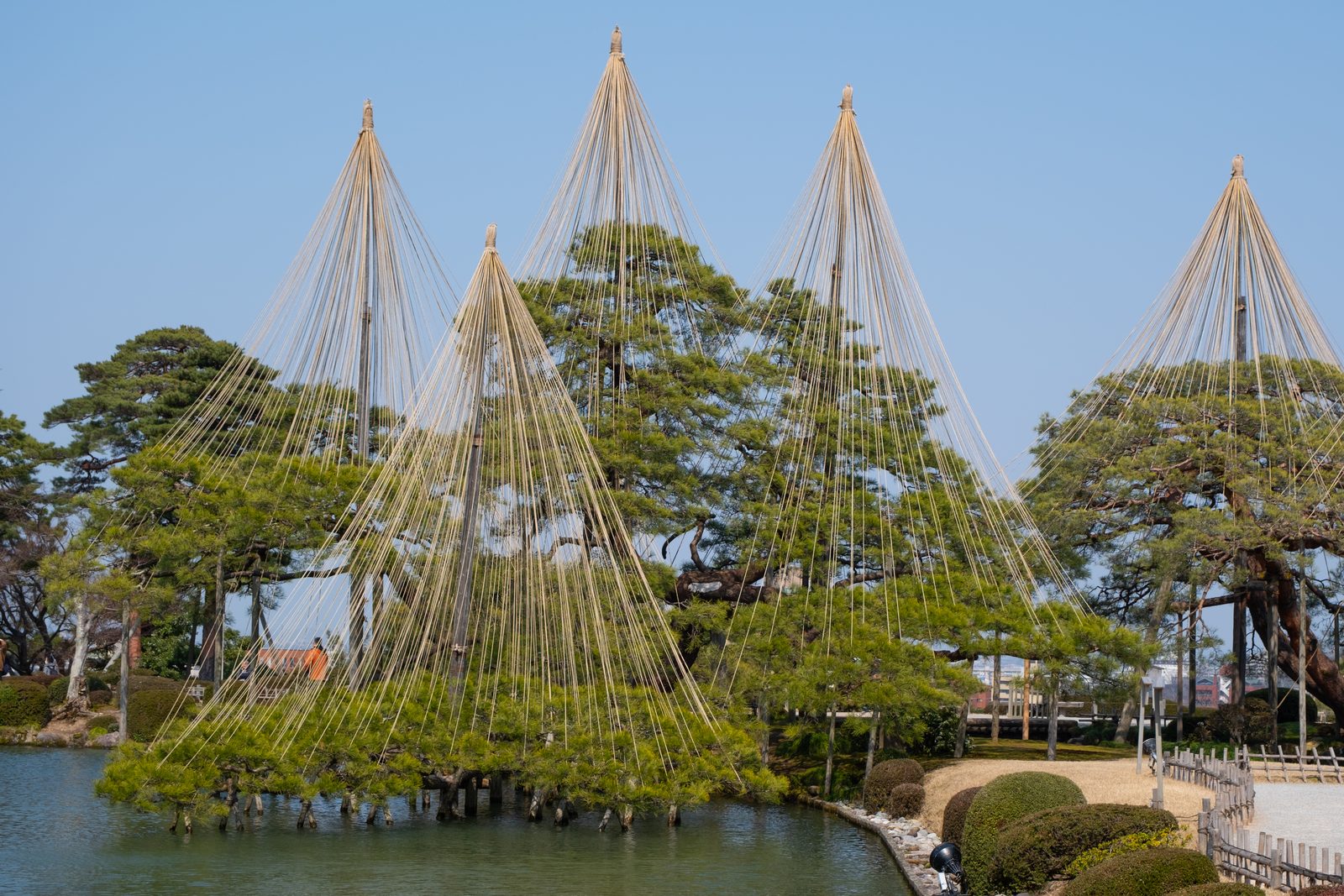
Highlights: admission is JPY 320 for adults from 18 and JPY 100 for children aged 6 to under 18. Hours are 07:00–18:00 from 1 March to 15 October and 08:00–17:00 from 16 October to the end of February, with last entry 30 minutes before closing in both cases. The Karasaki pine and the Kotoji stone lantern beside Kasumigaike pond sit together on the east side, and that corner alone takes about thirty minutes.
Practical note: before the paid hours there is a free early opening — 04:00–06:45 from 1 April to 31 August, 05:00–06:45 from 1 September to 15 October, and 06:00–07:45 from 1 November to the end of February. Only two gates are used, Renchimon and Zuishinzaka, and you must be out 15 minutes before the paid opening. Visitors of 65 and over are admitted free on showing official identification.
- Admission
- Adult JPY 320; child JPY 100
- Hours
- 1 March–15 October 07:00–18:00 (last entry 17:30); 16 October–end February 08:00–17:00 (last entry 16:30)
- Early opening
- Free; Renchimon and Zuishinzaka gates only
- Official
- Official site ↗
Kanazawa Castle Park is straight across the Ishikawa bridge from Kenrokuen. Walking the grounds is free, and the Kahokumon gate, the Nezumitamon gate and the Tsuru-no-maru rest house all admit you at no charge. The only paid part is the inside of the Hishi Turret, the Fifty-Ken Storehouse and the Hashizumemon Continuing Turret: JPY 320 for an adult, 09:00 to 16:30 with last entry at 16:00, open every day.
If you are going inside the castle buildings, the combined ticket always wins. Ask for the Kenrokuen combined ticket at the window and it is JPY 500; groups of 30 or more paying visitors get it at JPY 400. If time is short the free areas are enough on their own, and both the Kahokumon and the Nezumitamon can be entered.
Afternoon: the public zone is free, and the exhibitions close on Mondays
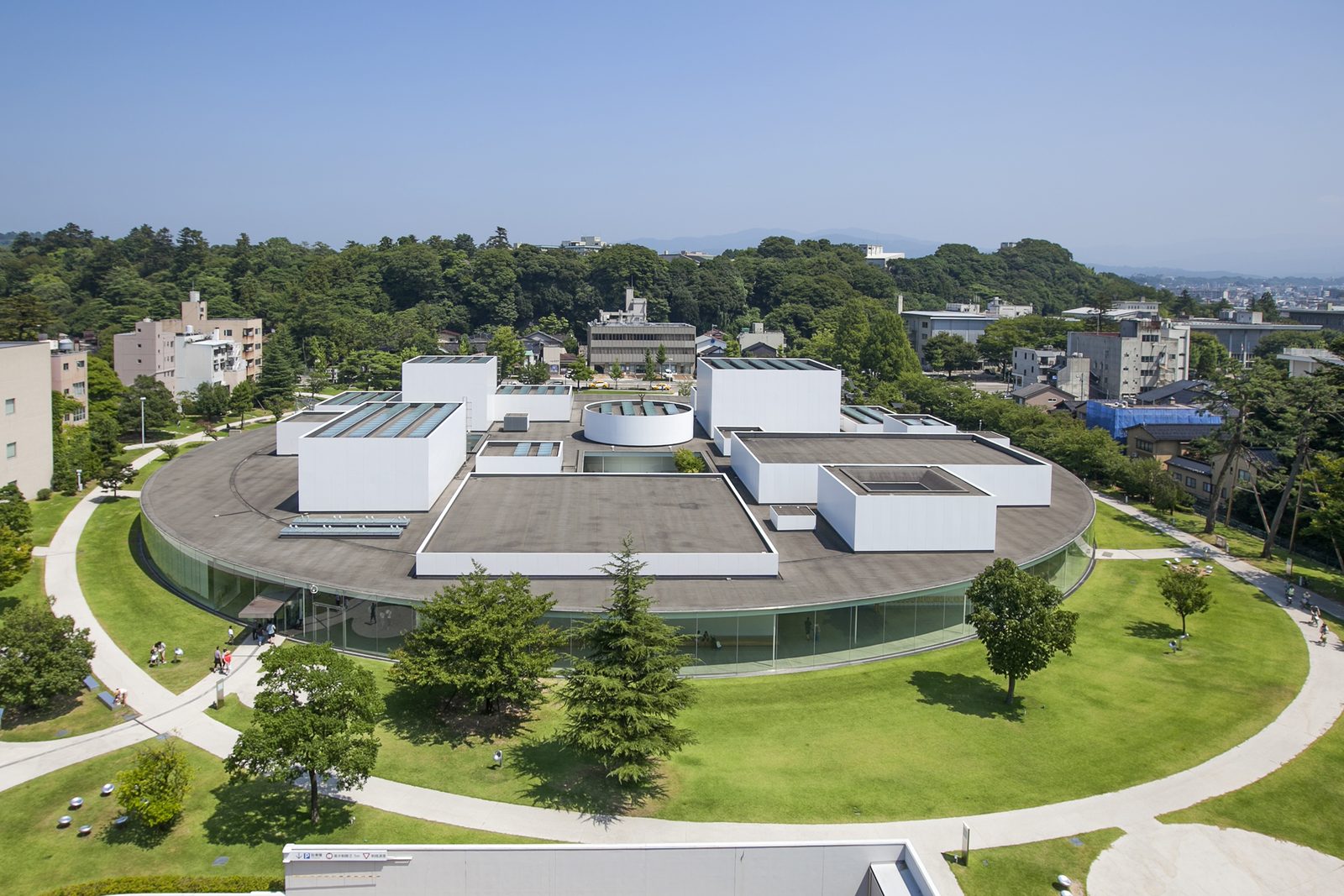
Highlights: a circular glass building with entrances on every side, so you can walk through it from any direction. Inside it splits into a public zone and an exhibition zone. The public zone is free and open 09:00 to 22:00; the exhibition zone runs 10:00 to 18:00, or to 20:00 on Fridays and Saturdays, and the price depends on what is showing.
Practical note: it closes on Mondays, or the next weekday when a Monday is a public holiday. If your second day lands on a Monday, the whole exhibition zone is shut. The public zone still opens at 09:00 on Mondays, so half of the visit survives without moving anything else. Because the price varies by exhibition, check the dates and the fee on the official site before you put a figure in your budget.
- Public zone
- JPY 0; 09:00–22:00
- Exhibition zone
- 10:00–18:00 (to 20:00 Friday and Saturday); price varies by exhibition
- Closed
- Mondays (the next weekday if a public holiday); the new year period
- Official
- Official site ↗
From here you move to the Kaga hot springs. Kanazawa to Kaga-Onsen is 16 minutes at best on the Hokuriku Shinkansen, which is the route the Yamashiro Onsen tourism association gives for reaching it. When the parallel conventional line was transferred in March 2024, Kanazawa to Daishoji became part of the IR Ishikawa Railway, and no limited express runs on that stretch. If you come across an old note saying 25 minutes by limited express, it describes the railway before the transfer.
The Canbus is one-man operated: you board at the front and put JPY 500 in the farebox. The one-day digital ticket is bought on a phone and is not sold on board. Three rides pay for it, which is why the third day — Yamashiro, Natadera, Yamanaka — takes the day ticket while the second day, which needs one ride to the inn, is cheaper paid singly.
Evening: the two public baths differ in price and in what they are for
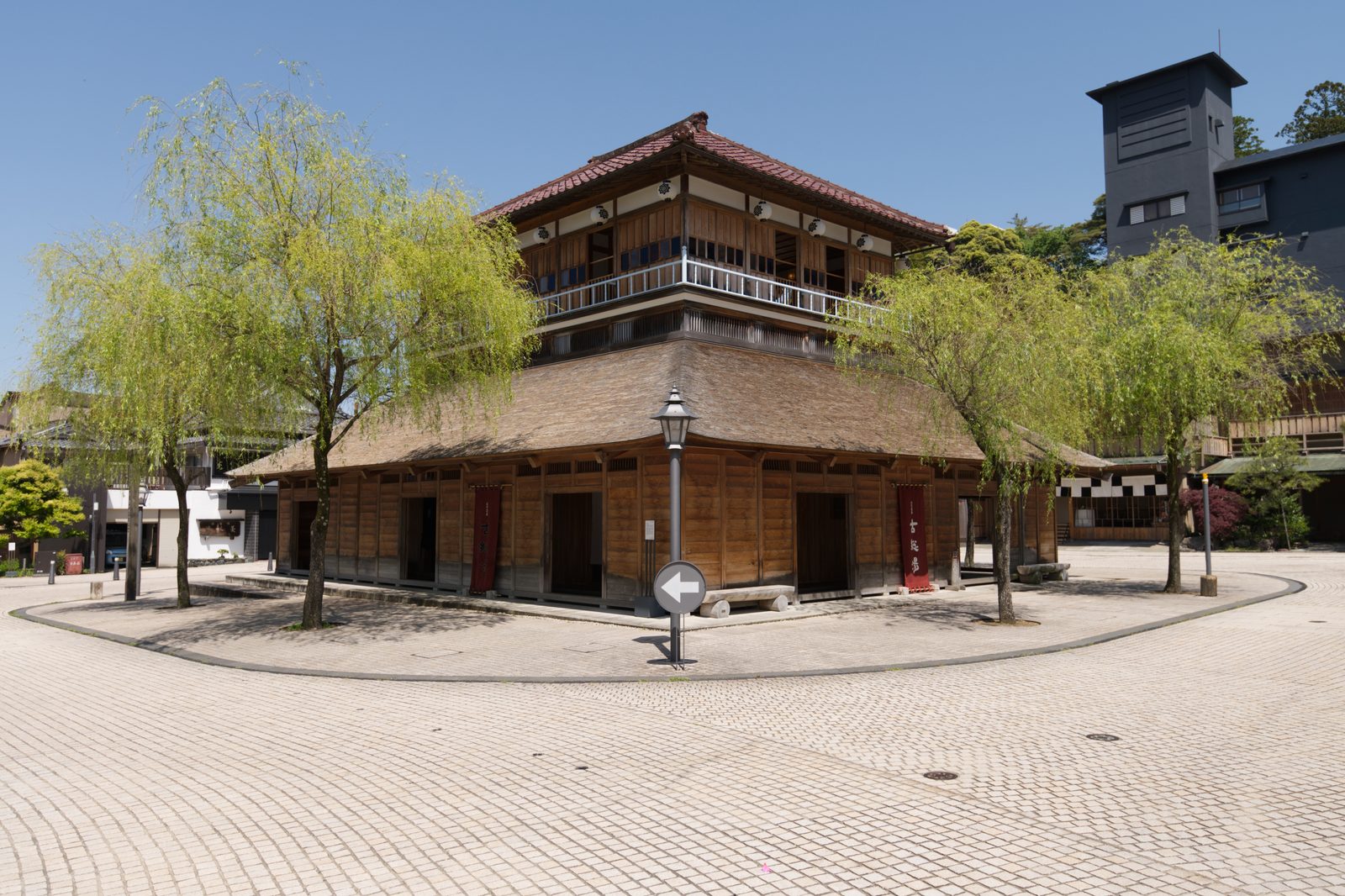
Highlights: two public baths stand side by side at the centre of the spa town. Soyu is a modern bathhouse with washing places, JPY 500 for an adult. Ko-Soyu is a reconstruction of the Meiji-period bathhouse, JPY 700 for an adult, with no shower and no washing area at all — it is built for soaking and nothing else. The floors and walls are Kutani tile and the ceiling is stained glass. For both, the combined ticket at JPY 1,000 saves JPY 200.
Practical note: both close from 06:00 to 12:00 on the fourth Wednesday of each month and return to normal hours at midday. Putting a bath into that morning is a wasted walk. Otherwise they run from 06:00 with the doors closing at 22:00, and Ko-Soyu alone shortens to 07:00–21:00 from December to February.
- Bathing
- Soyu adult JPY 500; Ko-Soyu adult JPY 700; combined JPY 1,000
- Hours
- From 06:00, doors close 22:00 (Ko-Soyu 07:00–21:00, December to February)
- Closed
- Fourth Wednesday of each month, 06:00–12:00
- Official
- Yamashiro Onsen Tourism Association ↗
Fitting one public bath in before dinner at the inn gives the day two different baths. The water is the same as the inn’s; the buildings are not, and Ko-Soyu in particular keeps visits short because there is nowhere to wash. Plan to be out in thirty minutes and it fits.
DAY 3Natadera shuts at 16:00, so it goes first
Why this order: Natadera has the earliest cut-off of anything here, so it takes the morning, and Yamanaka Onsen, which can be walked until dusk, takes the afternoon. Switch the Canbus to the day ticket.
Morning: admission runs 09:15 to 16:00
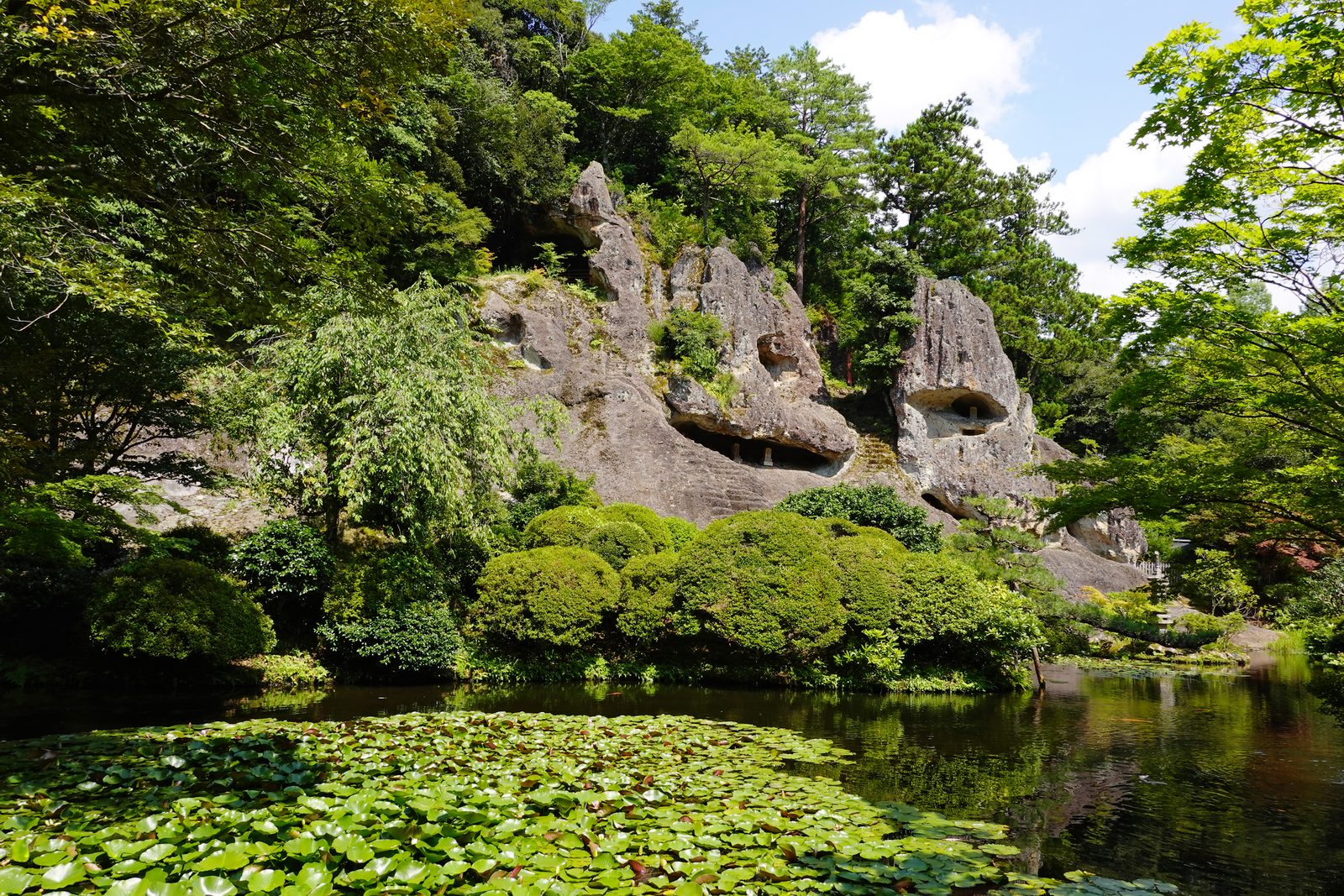
Highlights: admission is JPY 1,000 for adults from junior high age, JPY 300 for primary pupils and free for pre-school children, reduced to JPY 500 on showing a disability certificate. Hours are 09:15 to 16:00 in both summer and winter, open every day of the year. The temple marked 1,300 years since its founding in 2017, and at the centre of the grounds is a weathered rock wall known as Kigan Yusenkyo. The main hall, the Daihikaku, is built against that wall.
Practical note: the gate closes at 16:00, so moving this to the afternoon leaves no room for the ninety minutes it takes. Travelling on the Canbus, go in on a morning service and be out again before midday. Parking is free, with space for 40 coaches and 200 cars. Group rates are JPY 900 from 30 people and JPY 800 from 100.
- Admission
- Adult, junior high and above, JPY 1,000; primary JPY 300; pre-school free
- Hours
- 09:15–16:00 (summer and winter alike)
- Closed
- Open every day
- Official
- Official site ↗
Afternoon: the riverside platforms are only out from April to November
From Natadera the Canbus goes on to Yamanaka Onsen. Eat on Yuge-kaido, the street running through the spa town, then drop down into the gorge of the Daishoji river.
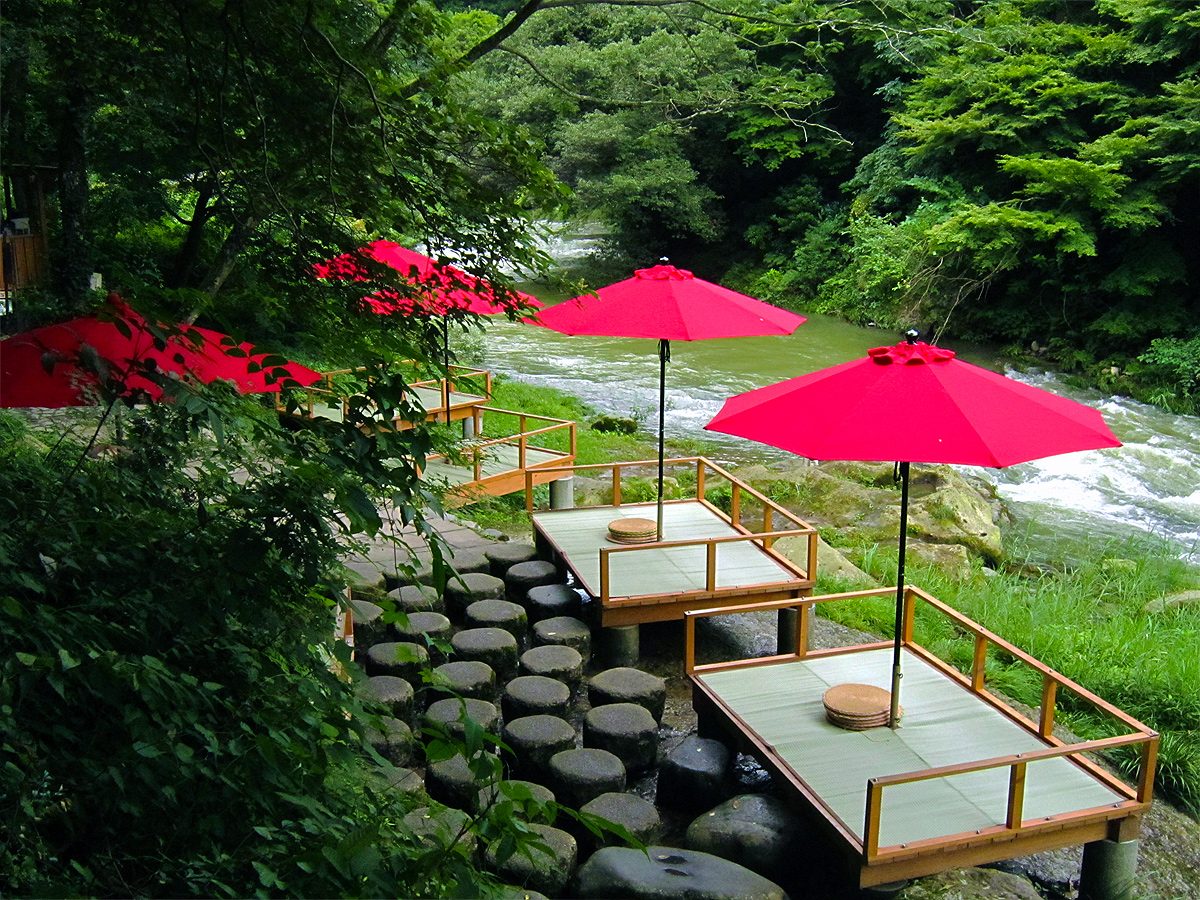
Highlights: a 1.3 km walkway runs from Korogi bridge to Kurotani bridge. Ayatorihashi, the bridge on the way, is a 94.7-metre pedestrian-only S-curve designed by Hiroshi Teshigahara, head of the Sogetsu school of flower arrangement, on the idea of arranging the gorge itself. Korogi bridge is built entirely of cypress, and the one standing now is the fourth, completed on 12 October 2019.
Practical note: the riverside platforms at the foot of Ayatorihashi are out from April to November, and from December to March the seating is not there at all. Coming in winter, plan on walking the path instead. The riverside track is earth and stone and gets slippery after rain.
- Walkway
- Korogi bridge to Kurotani bridge, 1.3 km
- Ayatorihashi
- 94.7 metres, pedestrians only
- Riverside platforms
- April to November (not set up December to March)
- Official
- Yamanaka Onsen Tourism Association ↗
Highlights: JPY 500 for adults, JPY 150 for middle rate and JPY 70 for children, open 07:00 to 22:00. The men’s and women’s baths are in separate buildings on opposite sides of the road. It sits where you come out of the gorge, so you can walk straight in.
Practical note: it closes on the second and fourth Tuesday. The Yamashiro baths close on the fourth Wednesday morning, so the two towns do not share a closing day even though they belong to the same group of spas. Planning public baths in both places means putting the two calendars side by side.
- Bathing
- Adult JPY 500; middle JPY 150; child JPY 70
- Hours
- 07:00–22:00
- Closed
- Second and fourth Tuesday
The Canbus takes you back to Kaga-Onsen Station at the end, a ride already covered if you bought the day ticket. From there it is 16 minutes back to Kanazawa by Shinkansen, and if you are heading on towards Tokyo you do not need to change at Kaga-Onsen at all.
Alternatives
Rainy-day swap
Kanazawa gets a great many wet days. On the Japan Meteorological Agency normals for 1991–2020, the local observatory records 177.3 days a year with 1 mm or more of rain. That is better than one day in three, so over two nights the realistic assumption is that you will meet one. January is the wettest at 23.4 days and August the driest at 9.3.
What rain exposes here is the paving in the teahouse districts on day one and the gorge path on day three. Both are walkable under an umbrella, and both are slippery. To move indoors, stretch the time in the covered part of Omicho Market on day one and lengthen the stay in the museum’s public zone on day two. Natadera is outdoors but the rock face and the moss come out better wet.
The public baths are unaffected by weather. If anything, a day where the outdoor hours get cut is the day you have room to take both Soyu and Ko-Soyu at Yamashiro, and the JPY 1,000 combined ticket earns its keep.
If your train is delayed by an hour or more
A late first day does not break anything. Omicho Market, Higashi Chaya and Kazuemachi are all free, and their closing times belong to individual shops. Arriving in the evening, make day one dinner in Katamachi and start earlier the next morning instead.
Day three is the one that breaks. Natadera shuts at 16:00, so missing the morning service removes the visit altogether. In that case drop Natadera, put everything into Yamanaka Onsen and walk the full 1.3 km of the gorge path. The JPY 2,000 of admission comes straight back.
If it is the second day’s connection that slips, check the Canbus departures from Kaga-Onsen Station. It is a circular tourist service with limited frequency, and missing the last one leaves only a taxi. Whether the inn runs a pick-up is a question to ask when you book.
When you’re tired
The order things come out in is Kazuemachi, then Natadera, then the paid part of the castle. Losing Kazuemachi takes forty minutes of walking off day one and changes nothing financially. Losing Natadera frees JPY 2,000 and opens up the third morning. Giving up the castle interiors drops the JPY 500 combined ticket back to the JPY 320 for Kenrokuen alone.
To cut the walking without cutting the content, change how you use the buses on day one instead. Replacing the walk from Omicho Market to Higashi Chaya with the loop bus turns fifteen minutes on foot into about five. Since the one-day pass is already bought, that costs nothing extra.
With children the shape of the cost changes. Kenrokuen is JPY 100 for a child, Natadera JPY 300 for a primary pupil and Kiku-no-yu JPY 70. Against that the Canbus charges JPY 250 a child per ride with no family allowance, so the heavy-travelling third day is where it tells.
Why we skipped the rental car
A trip from Kanazawa down to the Kaga hot springs is usually built around a hire car. Yamashiro, Natadera and Yamanaka are some way apart and no railway joins them. With a car the order and the timing are yours.
It is not used here because the Kaga loop bus already connects all three. The Canbus is sold at the front desks of member inns of the Yamashiro and Yamanaka ryokan associations, at Natadera, at the Yamashiro public bath and at Yamanaka-za. Its route was drawn along the line visitors actually travel, and a day costs JPY 1,300, or JPY 2,600 for two. Covering the same ground by hire car adds the vehicle, the expressway tolls, the fuel and the parking.
The second reason is the baths. On an itinerary where you use the public baths and then bathe again at the inn, whoever is driving ends up deciding not to drink at some point in the evening. For two nights spent walking two spa towns, it is simpler to remove that constraint at the outset.
There are conditions under which the car clearly wins: reaching somewhere the Canbus does not serve often enough, carrying a lot of luggage, and travelling with small children when waiting around is what you most want to avoid. Building a trip without a car is the same idea used in Furano and Biei by bus and train and in the three days in Sapporo and Otaru. Where the loop bus follows the tourist route, not hiring a car lowers both the total and the effort.
Where to stay
This plan puts the first night in central Kanazawa and the second in the Kaga hot springs. They are entirely different kinds of night, so the criteria for choosing split in two.
What the first night has to give you is somewhere walkable after dark and a short start the next morning. Korinbo and Katamachi have the widest choice for dinner and are about ten minutes by bus from Kenrokuen. Around Kanazawa Station is easiest for dropping luggage and for Shinkansen connections, but once the station building shuts the evening goes quiet. Musashigatsuji is directly in front of Omicho Market, which suits anyone wanting the market first thing.
The second night is decided by one thing only: the distance to a public bath. At Yamashiro, Soyu and Ko-Soyu are in the middle of the spa town, so an inn within walking distance means bathing twice, once at night and once in the morning. Staying at Yamanaka instead is possible, and it adds a journey back towards Natadera on the third morning.
Rates move even for identical dates, which is why no room figure appears in the table below. If you also want to fix timed experiences around the two nights, Klook lists Kanazawa slots by date.
Book in this order: the ryokan for the second night, the hotel for the first, then the trains. The Kaga hot springs have a limited number of inns and they fill from the weekends and the long holidays inwards. Secure the ryokan, choose the Kanazawa hotel around it, and fit the Shinkansen times last. Do it the other way and you end up with dates you cannot move and the one ryokan you wanted already gone.
If you are coming into Hokuriku from Kansai, there is the Hokuriku-Kansai Ticketless fare, sold only on e5489. In the second Hokuriku-Kansai Ticketless campaign run by JR West, 200 people drawn by lottery from those who made a round trip between Hokuriku and Kyoto–Osaka for the first time in August 2026 received 10,000 WESTER points.
What this trip costs
Assumptions: two adults, no car, three days out and back from Kanazawa. Getting to Kanazawa, and the rail fare between Kanazawa and Kaga-Onsen, are left out of the total because seat class and discounts move them too much. Rooms and meals are out for the same reason. What is listed is the part with a published price on it.
Every figure above is the published rate as of 2026-09-20.
Of that JPY 11,200, the Kaga side accounts for JPY 8,600. Kanazawa comes to JPY 2,600 because Omicho Market, Higashi Chaya and Kazuemachi are all free to walk and only Kenrokuen and the castle charge. Read it as Kanazawa being a city that works on foot and the Kaga spas being a place where you pay to move and to bathe, and the shape of the budget makes sense.
It is worth checking the third day’s bus arithmetic. The Canbus is JPY 500 a ride, and day three takes three of them: Yamashiro to Natadera, Natadera to Yamanaka, Yamanaka to Kaga-Onsen Station. Paid singly that is JPY 1,500 against JPY 1,300 for the day ticket, so it flips on the third ride. Buy a day ticket for a day with only two rides on it and you lose money. That is exactly why the second day uses single fares.
The room to cut is in the public baths. Skipping the JPY 1,000 combined ticket at Yamashiro for JPY 500 at Soyu alone saves JPY 1,000 across two people, and replacing Kiku-no-yu with the inn’s own bath saves another JPY 1,000. Substitute the inn’s bath for every public bath and the total falls to JPY 8,200. Whether that is a false economy in a spa town depends on what you came to buy.
Who this plan does not suit is anyone whose second day falls on a Monday, and anyone whose third day falls on a second or fourth Tuesday or on a fourth Wednesday. Monday closes the museum’s exhibition zone, Tuesday closes Kiku-no-yu, and the fourth Wednesday morning closes the Yamashiro baths. None of these is the spine of the trip, but weeks that catch all three do exist. Once the dates are set, put those three closures side by side. Packing varies with the season, though if you are walking and photographing all day the drain on your phone is the thing to plan for, and how to size that is covered in the note on choosing a power bank. For anyone who wants the Kaga spas in less time, or Kanazawa on its own, the two-day Kanazawa route is the better fit.
Sources: Ishikawa Prefecture Kanazawa Castle and Kenrokuen Management Office; 21st Century Museum of Contemporary Art, Kanazawa; Hokuriku Railroad; Omicho Market; Kanazawa Tourism Association; City of Kanazawa; Yamashiro Onsen Tourism Association; Yamanaka Onsen Tourism Association; Natadera; Kaga loop bus Canbus; Japan Meteorological Agency / Checked on 2026-09-20 / Photographs: credited in each caption (all Wikimedia Commons)
Other sales ending soon




 4 days leftuntil Oct 24Air Busan Takamatsu-Busan Coupon: Up to 9,000 Yen Off Until October 24
 5 days leftuntil Oct 25JAL Hong Kong Campaign: Tokyo–Hong Kong Round Trip from 75,800 Yen (until 25 Oct)
 11 days leftuntil Oct 31Jin Air Kobe–Seoul: 5,000 yen off a round trip with code KTOUKB1, until 31 October
 11 days leftuntil Oct 31Jin Air to Busan: 4,000 yen off a round trip with code KTOPUS, first 300 only