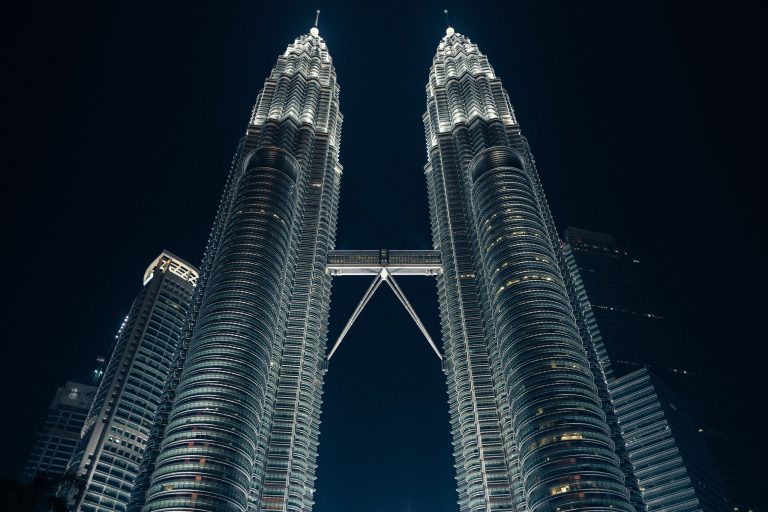
Kuala Lumpur 3-Night, 5-Day Model Plan: The Twin Towers and the Classic Sights
AuthorMIRUTOBE editors
Table of Contents9 items
- Itinerary
- DAY 1 Landing at night, how far can you actually get
- DAY 2 Work down from the towers to the old town, in order of height
- DAY 3 Climb the 272 steps in the morning, see the night view before 20:00
- DAY 4 Shopping, and designing the run back to the airport
- Alternatives
- Why we skipped Malacca
- Where to stay
- What this trip costs
The airport is 28 minutes from KL Sentral. Three nights gives you three usable days, and what breaks them is not the city but the clock: the Twin Towers’ Monday closures, the KL Tower shutting at 20:00, and the last and first trains at 00:05 and 05:00. Clear those four and the rest can be shuffled on the ground.
Itinerary
DAY 1Landing at night, how far can you actually get
Why this order: day one is a single leg from the airport to the hotel. Which transport is available depends on when you land, so fix only where you are staying and leave the rest to be chosen on the ground.
Most flights from Japan reach Kuala Lumpur between late afternoon and night, and the day tends to end in transit. Even so, two decisions made before you land change what that evening looks like.
Before you go: the MDAC is not “from three days before” but “within three days including today”
Entering Malaysia requires online registration of the MDAC, the Malaysia Digital Arrival Card. There is no fee. It is usually described as being available from three days before, but the condition on the immigration registration screen is that travel must fall within three days including the day of submission. You cannot get it out of the way a week ahead; it stays on the list for the last days before departure. It needs your passport and flight number, so doing it on packing day is the practical answer.
Power is the British-style three-pin plug at 240 V. Japanese equipment does not fit as it is, so one adapter is needed. Whether your devices accept 240 V is determined by the marking on the device, so settling the difference between a plug adapter and a transformer first saves carrying a heavy transformer.
Night: KLIA Ekspres is fast, and it is not cheap
Kuala Lumpur International Airport sits about 50 km south of the city. The fastest way in is KLIA Ekspres, 28 minutes from KL Sentral to KLIA Terminal 1 and three more to Terminal 2. It runs every twenty minutes all day, weekends and holidays included. First and last services are 05:00 to 24:00 from KL Sentral, 05:00 to 00:05 from Terminal 1, and 04:55 to 24:00 from Terminal 2. One-way fares are MYR 55 for adults and MYR 25 for ages 6 to 15, with up to three under-sixes free per adult.
Two singles cost MYR 110 and a return MYR 100, so the return saves MYR 10. Buying on the official site or in the app takes 10 per cent off on top, bringing a return down to about MYR 90. A ticket is valid for 90 minutes from entering the station, so you do not have to commit to a particular train.
It is not the answer for everyone, though. Heavy bags, three or more travellers, a late landing: meet any of those and a Grab straight to the hotel is less trouble and often no dearer overall. KLIA Ekspres only takes you to KL Sentral, which leaves one last connection to your room. If you are travelling light and staying near KL Sentral or Bukit Bintang, on the other hand, 28 minutes immune to traffic has no substitute.
Arriving on a low-cost carrier, add three minutes to that. AirAsia and others use Terminal 2, and the train calls at Terminal 1 first. From KL Sentral that is 28 plus 3, so 31. A small difference, except when you are chasing the last train at night, because the last departure from Terminal 2 is 24:00, five minutes earlier than the 00:05 from Terminal 1.
That 00:05 does not mean you can arrive at the airport by five past midnight and catch it. You have to be through immigration, have your bags, and have walked to the station gate. If your flight is timetabled to land after 23:00, leaving the train out of the plan from the start is what keeps the plan intact. Be optimistic about it and you spend the first midnight hunting for transport in an airport.
Later: on a 21:00 arrival, only Bukit Bintang still produces dinner
Where you stay decides what this day is for. Around Bukit Bintang the restaurants and street stalls run into the small hours, so checking in at 21:00 still leaves a dinner and a walk. The high-rise hotels on the KLCC side have the views and are not somewhere you go out walking late. If you do not want the first day to be travel and nothing else, putting at least the first night in Bukit Bintang is worth it.
What you eat tonight is decided by the same thing. The Indian-Muslim mamak shops are open from morning until late, and the standard order is roti canai, thin dough griddled and dipped into curry. They are the fallback when you get hungry at midnight. Satay is grilled on skewers with a sweet, savoury peanut sauce, ordered by the stick at night-market stalls.
DAY 2Work down from the towers to the old town, in order of height
Why this order: the highest point in the morning, the historic district at ground level in the afternoon, the lanes at dusk. Descending in that order puts the peak of the heat indoors and in shade.
Kuala Lumpur stacks its attractions vertically. There are two observation decks, and both show you the same city from a different angle. So a day here is shaped less by where you go than by what height you are at, and at what hour.
Morning: some Mondays you cannot go up at all
Highlights: 452 m tall. You go up to the skybridge linking floors 41 and 42 and the observation deck on floor 86. Tours run Tuesday to Sunday 09:00 to 22:30 with last entry at 21:30. On Mondays only the second, fourth and fifth Monday open, 09:00 to 20:00 with last entry at 19:00; the first and third Mondays are closed. A Monday that is a public holiday or a substitute holiday does open.
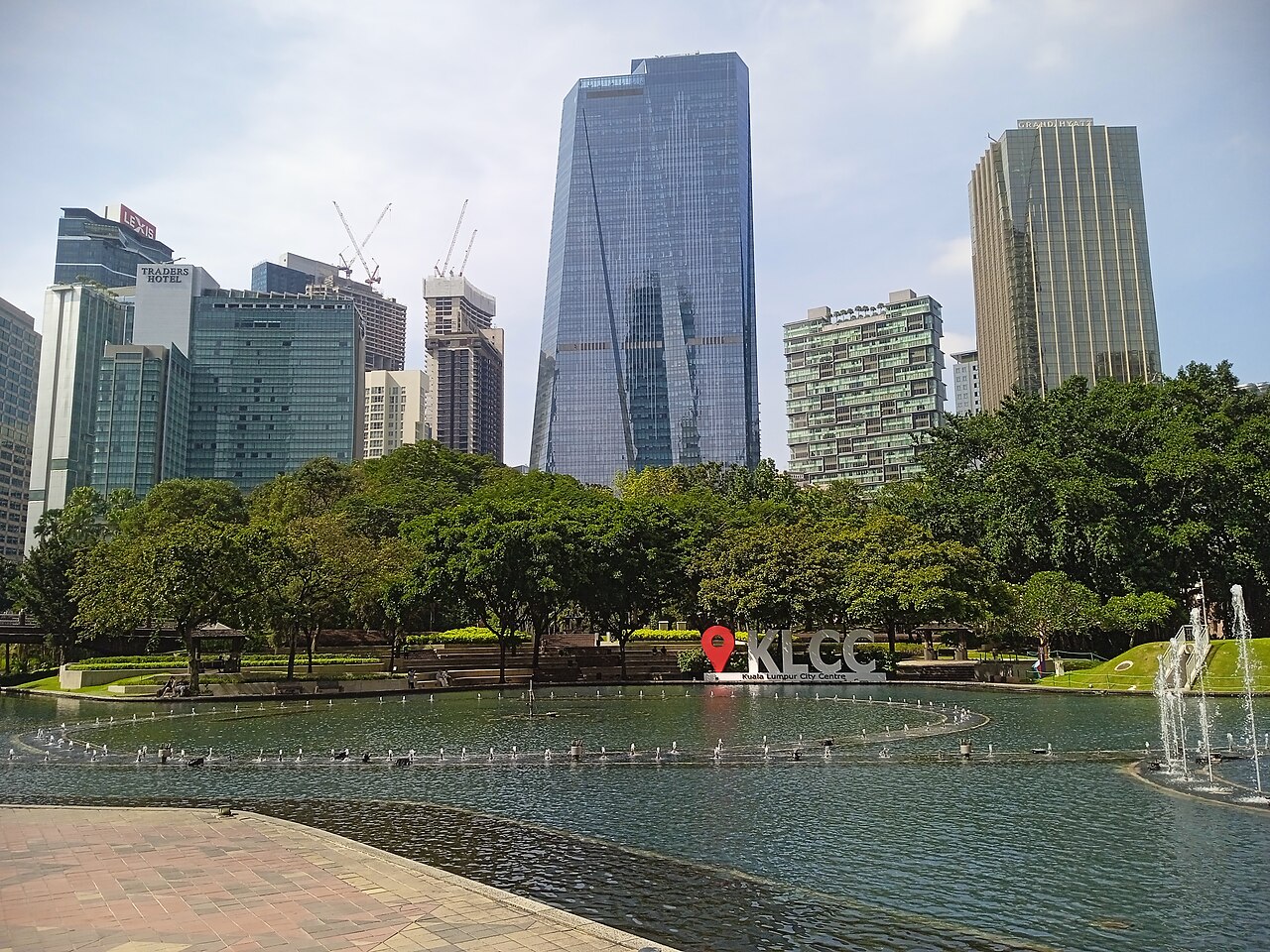
Practical note: looking up at them from KLCC Park costs nothing, and the evening fountain show is visible from there too. If the photograph of the lit towers is all you want, the composition is easier from the ground. The value of the deck is being up the tower, not photographing it.
- Tours
- Tue–Sun 09:00–22:30 (last entry 21:30); 2nd, 4th and 5th Mondays 09:00–20:00 (last entry 19:00)
- Closed
- 1st and 3rd Mondays. In 2026 also 20–23 March and 27 May
- Admission
- Foreign adult (13–60) weekday MYR 127, weekend MYR 137
- Nearest
- KLCC station (LRT Kelana Jaya line), direct access
- Official
- Official site ↗
The day of the week moves the price as well as the opening. The general foreign adult rate is MYR 127 on a weekday and MYR 137 at the weekend, and the Evening Experience after dark goes up again to MYR 157 and MYR 167. The same deck, with a MYR 40 spread depending on the day and the hour.
What stands out is that the foreign rate is more than triple the citizen rate. Dual pricing is unremarkable at attractions in many countries, but against KL’s cost of living this one is conspicuous. Budget on the assumption that a cheap city has cheap observation decks and this is the line where the arithmetic fails.
Which day you fly splits this into three versions, because DAY 2 is the day after departure and so the opening and the price are fixed the moment you choose your departure day.
One caveat: the published tariff says only WEEKDAY and WEEKEND and does not state which days count as the weekend. Kuala Lumpur is a federal territory where Saturday and Sunday are generally the rest days, but Friday counting as weekend cannot be completely ruled out, so if MYR 10 changes your decision, enter the date on the purchase screen and check.
Afternoon: Merdeka Square is somewhere to look at, not somewhere to spend time
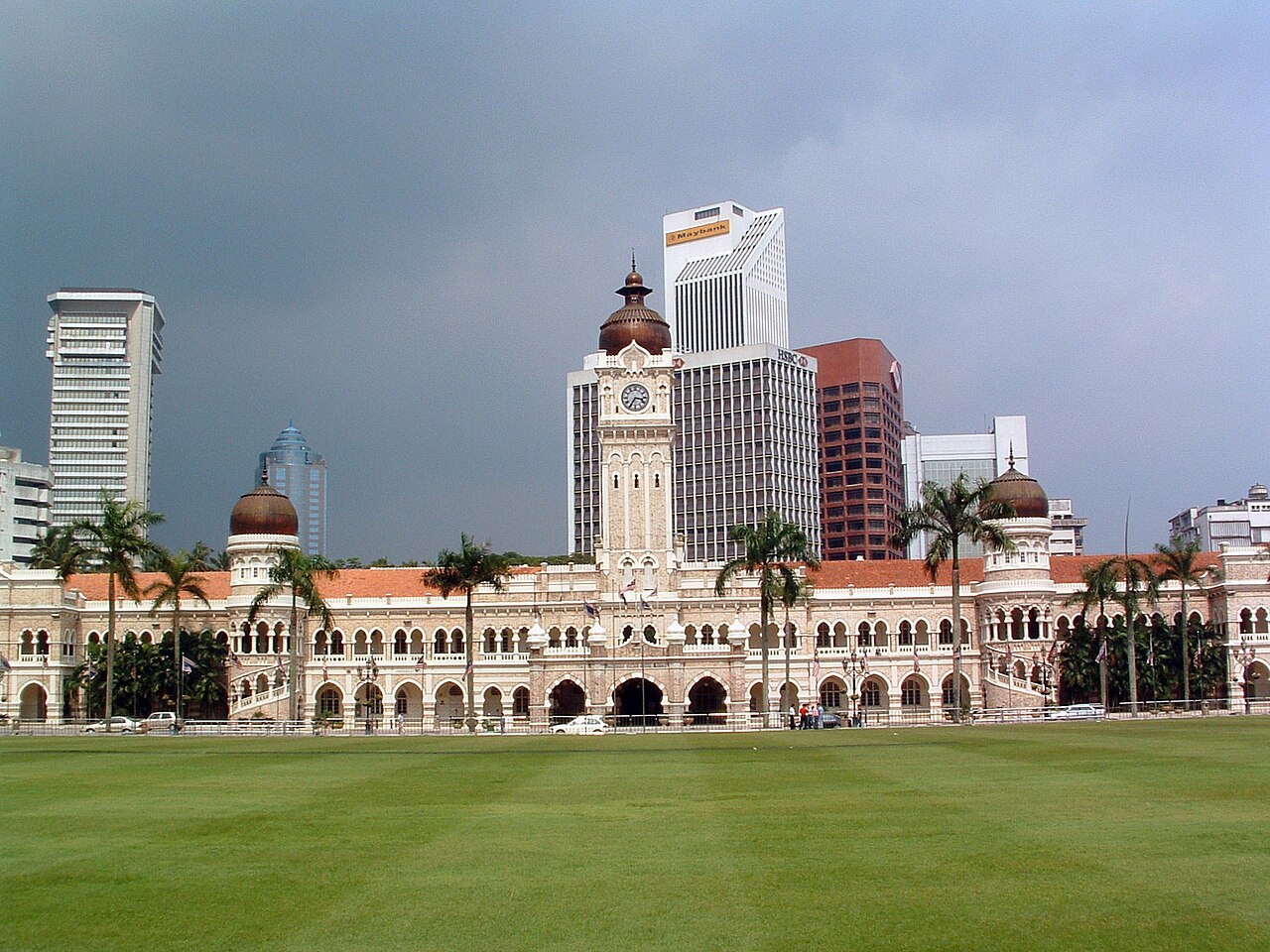
Highlights: the ground where the Union Jack was lowered on 31 August 1957 and independence declared. Facing it is the Moorish Sultan Abdul Samad Building, whose red and white clock tower is the most photographed composition in KL. Colonial-era buildings including the old Federal Secretariat survive as a group here.
Practical note: the square itself is lawn and a flagpole, and the buildings are exteriors only. Photograph it, walk round it, and you are done in thirty minutes. Plan on having time left over and pair it with Masjid Jamek at the confluence of the Klang and Gombak rivers to fill the early afternoon. That confluence is where the city’s name, muddy confluence, comes from.
- Viewing
- MYR 0 (exteriors)
- Nearest
- Masjid Jamek station (LRT)
Going inside the mosque has a dress code. Clothing that covers the skin is required, and robes and scarves are lent at the entrance. Visitors cannot enter during prayer times, so you may have to wait after arriving. Two of the five daily prayers, the early afternoon and the late afternoon, fall in this window.
Dusk: Petaling Street is for walking, Central Market is for buying
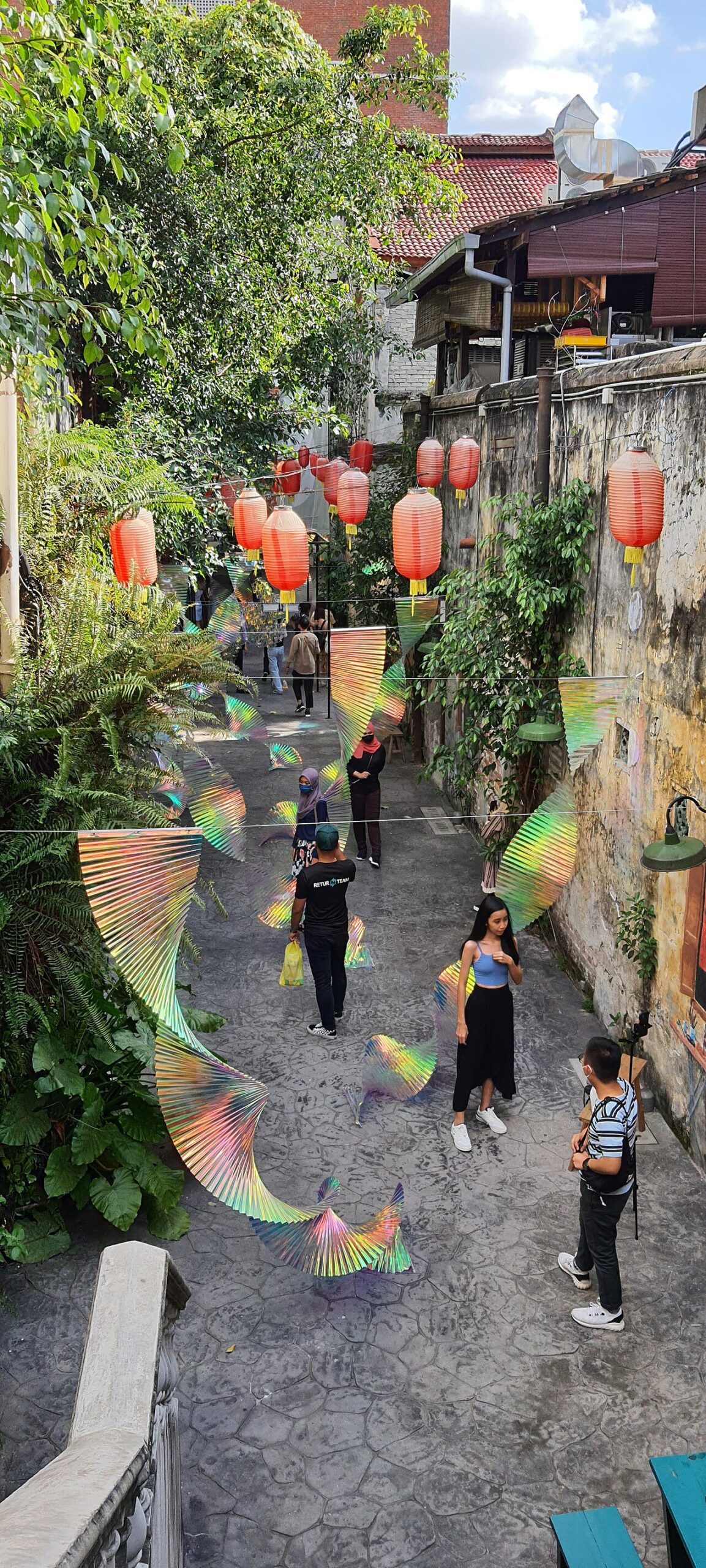
The late afternoon goes to Petaling Street in Chinatown, a covered run of food stalls and souvenir shops. This is where the unit price of souvenirs in KL is at its lowest, below what the same thing costs at the KLCC malls on the last day.
Most shops expect haggling and the first figure is a starting point. Some come down to around half; some do not move at all. But what you enjoy buying here is not necessarily what you can bring home. Petaling Street has shops selling counterfeit branded goods among the rest, and those are confiscated by Japanese customs. A bargain that ends in disposal at an airport is not a bargain, so leave logo-bearing bags, watches and wallets alone.
If you would rather buy things with price tags, the adjoining Central Market suits better: indoors, air-conditioned, with batik and pewter crafts at fixed prices and no negotiating. Separating where you walk from where you buy makes this part of the day much easier to use.
In the evening, back at KLCC, there is a fountain show in the park at the foot of the towers, free to watch. If you went up in the morning, you now look at the same building from underneath.
DAY 3Climb the 272 steps in the morning, see the night view before 20:00
Why this order: the suburbs in the morning, indoors in the afternoon, the tower in the evening. KL Tower closes at 20:00, and counting back from that requires slack in the afternoon.
Morning: the 272 steps go early for the temperature, not the view
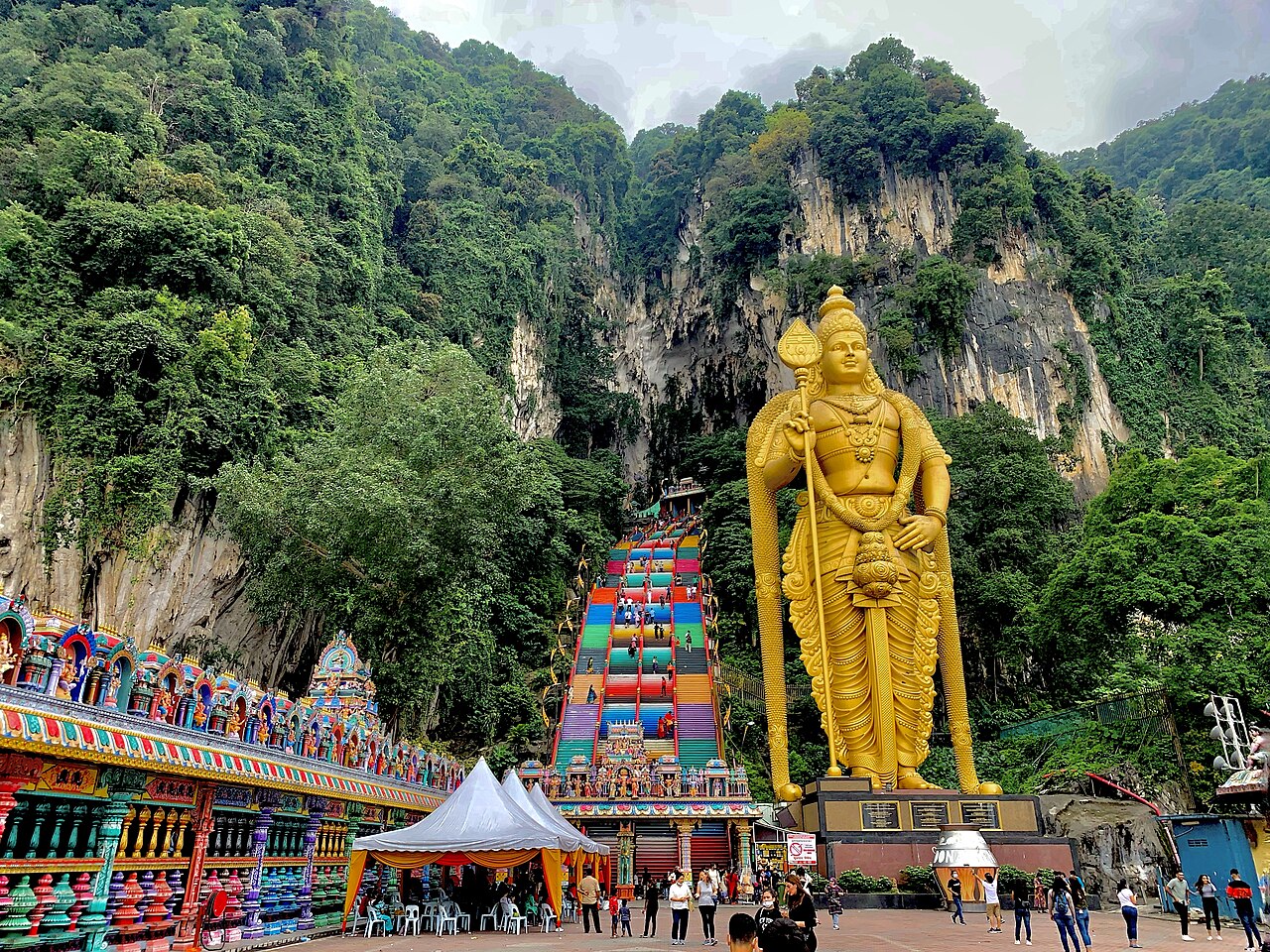
Highlights: about thirty minutes by train from the city. A giant gilded statue of Murugan and 272 brightly painted steps meet you at the bottom. The Hindu temple inside the limestone cave is lit through fissures in the roof.
Practical note: those 272 steps are the hardest physical thing in this itinerary. There is a handrail but no shade, and you climb with equatorial sun full on you. The early morning slot is not about the light; it is about finishing the climb before the temperature peaks. Arrive after midday and you stop more often on the way up, and the delay runs through to the evening.
- Nearest
- KTM Komuter, Batu Caves station (about 30 minutes from the city)
- Dress
- Legs covered to the knee (sarongs lent at the entrance, sometimes for a fee)
There are wild monkeys on the stairs. Monkeys at a tourist site have learned to associate what people carry with food, so a plastic bag in your hand, a water bottle or a loosely held phone all get targeted. Keep your bag closed in front of you and do not take food out before the stairs. They are appealing to photograph, and the closer you get the higher the chance of contact.
The dress code is real. It is a working Hindu temple, so you cannot enter with your knees showing and will be borrowing a sarong at the bottom. Turn up in shorts and the visit starts with that transaction. Going in trousers or a long skirt is faster.
Afternoon: keep somewhere indoors to retreat to
Finish at Batu Caves in the morning and be back in the city in the early afternoon. That is not only about the heat. KL Tower has a closing time, and counting back from it requires slack in the afternoon.
Keeping an air-conditioned option around KLCC, a mall or a museum, somewhere you can absorb an hour, also gives you a way to rearrange when a downpour takes the plan out. Rain here is short and violent, and whether somewhere indoors is within reach decides the second half of the day.
Evening: KL Tower shuts at 20:00, so the dark window is 30 to 60 minutes
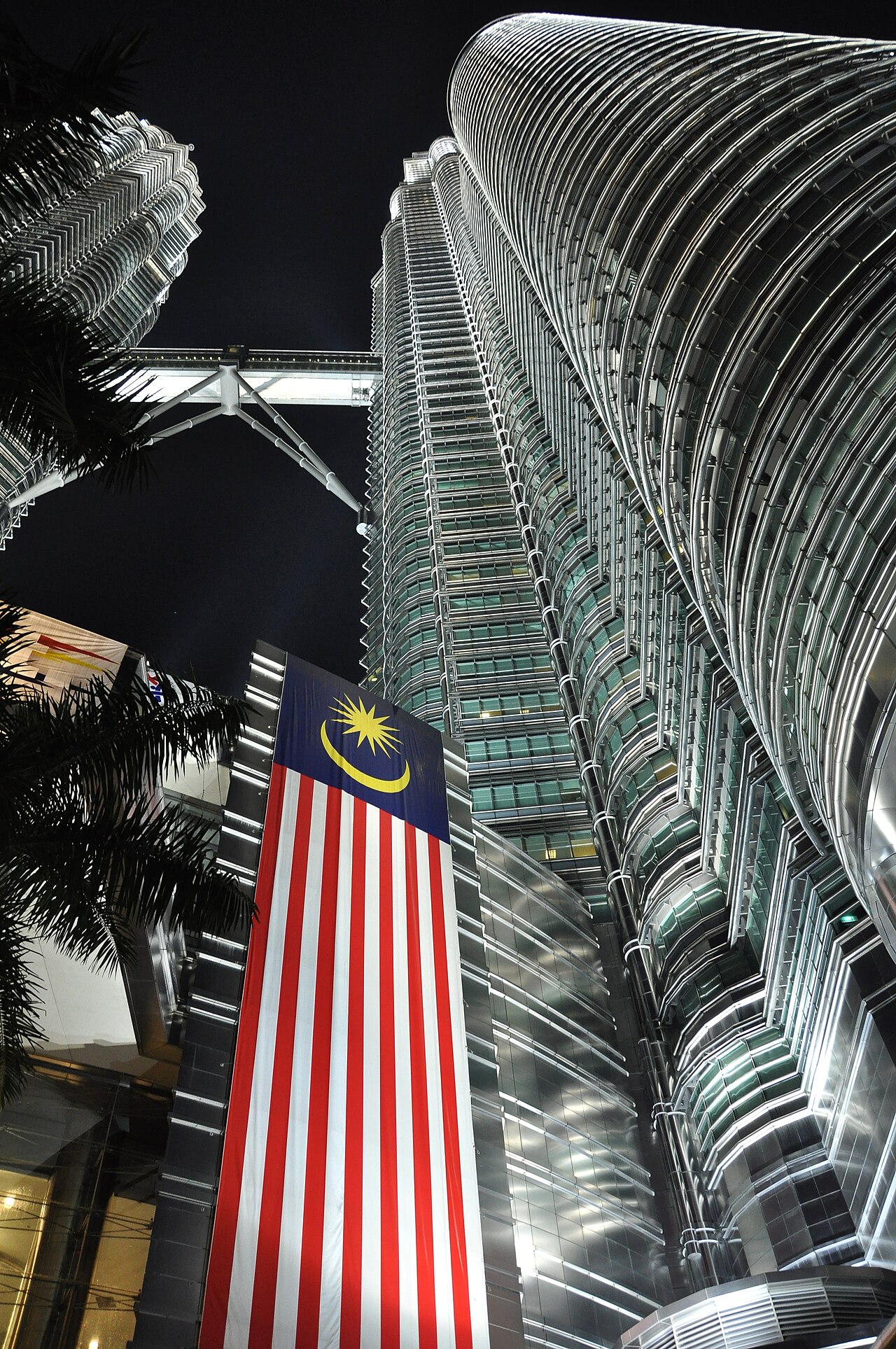
Highlights: 421 m, and built on a hill, so it looks out over the whole of KL including the Twin Towers. Being able to see the Twin Towers themselves while you look at the night view is what this side offers, and the glass-floored Sky Box has nothing under your feet.
Practical note: it opens 10:00 to 20:00 daily. It is usually written up as a night-view spot, but it does not stay open late. Setting off after the light has gone does not get you there in time, so being through the ticket desk by 19:00 is the realistic line.
- Hours
- 10:00–20:00 (daily)
- Height
- 421 m
- Official
- Official site ↗
Here the sunset time is what matters. Kuala Lumpur is close to the equator and its sunset barely moves across the year. Calculated for latitude 3.139, longitude 101.687 and UTC+8 on the 15th of each month, it runs as follows.
The time you can be up there after dark is about an hour at best, in November, and about thirty minutes at worst, in February. Go up while it is light and wait at the top as the lights come on across the city. That order suits this place better.
If a later night view matters more, swap the roles. The Petronas deck is open until 22:30 from Tuesday to Sunday, two and a half hours longer than KL Tower. Reversing this plan so the Twin Towers take the evening and KL Tower the late afternoon fits both in without strain.
DAY 4Shopping, and designing the run back to the airport
Why this order: count back from the flight first. Whether you can check the bags in early is what decides how the last afternoon gets used.
Morning: Bukit Bintang and KLCC shop differently
The big retail concentrations are Bukit Bintang and KLCC. Bukit Bintang is a run of street-facing shops and stalls, which suits browsing on foot. The KLCC side is built around malls connected to the towers, unaffected by weather and easier to move through with luggage.
Dragging a suitcase around on the last day is easier at KLCC, but there is almost nothing there where you can negotiate. If lowering the unit price of souvenirs is the point, buying them in Chinatown on the DAY 2 evening is the reliable move.
Afternoon: some flights let you check in at KL Sentral
KLIA Ekspres publishes an in-town flight check-in at KL Sentral station. It is limited to KLIA Ekspres and KLIA Transit passengers, and completing boarding formalities and dropping bags in the city leaves the last afternoon unencumbered. Which airlines participate and when the desk closes differ by flight, so check yours on the official site if you intend to use it. Knowing in advance that it is available changes what the hours after checkout are for.
The easy thing to miss on the way home is the first train. The first departure from KL Sentral is 05:00, reaching KLIA Terminal 1 in 28 minutes, so you are at the airport around 05:30. For a flight before about 07:00, the train does not get you there in time for check-in. Book one of those and you have to decide in advance either to arrange a Grab the night before or to move the last night to a hotel by the airport. Three nights and five days is five days precisely because it includes this last morning.
Alternatives
Rainy-day swap
The weak day in rain is DAY 3. The 272 steps at Batu Caves have no roof and wet stone is slippery, and the KL Tower deck shows you nothing on a day with low cloud. On a wet day, move the morning indoors around KLCC and push Batu Caves to the next morning.
DAY 2, by contrast, does not disappear in rain. The Petronas deck is indoors, Petaling Street is covered and Central Market is indoors. The only outdoor element is Merdeka Square, which takes thirty minutes. Putting the worst forecast on DAY 2 does the least damage.
During Ramadan, daytime opening can change. The arrangement of the stalls also shifts between day and night, so meal times are one thing to confirm on the ground before setting off.
If the flight is delayed by an hour or more
If a delay puts your arrival past 23:00, KLIA Ekspres drops out of the options. The last departures are 00:05 from Terminal 1 and 24:00 from Terminal 2, and after immigration and the baggage belt you do not make it. That makes it a Grab straight to the hotel. The itinerary itself resumes unchanged the next morning, so all that breaks is the first evening.
The bigger issue is the day of the week. If DAY 2 lands on a first or third Monday, the Petronas deck is closed and the morning empties. Move the DAY 2 morning to Merdeka Square and the historic district and take the tower as a night view after Batu Caves on DAY 3 instead. The Petronas deck is open until 22:30, so it slots into the evening in place of KL Tower.
A delay on the way home barely matters. DAY 4 holds shopping, so there is nothing to cut.
When you’re tired
If something goes, make it one of the two decks. The Twin Towers and KL Tower are very similar experiences, the same city from a height at a different angle. If photographing the Twin Towers themselves is the point, the KL Tower side earns its place; otherwise pick one, and put the time and the admission into food or shopping. Going up both is not a requirement of this city.
Next is Batu Caves: an hour on the train both ways and an hour and a half on the stairs. Replace DAY 3 with a day in the city and your energy survives to KL Tower in the evening. It is the one point in this plan that leaves KL, though, so cutting it means three days entirely inside the city.
With an extra night available, insert it between DAY 2 and DAY 3. DAY 1 and DAY 4 are pinned to flight times, so stretching them adds awkward fragments; in the middle you gain a whole day.
Why we skipped Malacca
World Heritage Malacca is left out of this plan. It is about two hours each way from KL, so a day trip loses four hours to travel. Three nights gives you three usable days, and forcing it in turns either DAY 3 or DAY 4 entirely into transit and thins everything else.
Genting Highlands is out for the same reason: getting up to the mountain resort and back consumes a day. And there is no beach in KL. If Malaysian sea is the point, that needs a separate itinerary with a domestic flight to Penang or Langkawi. The Penang five-night plan splits the trip into World Heritage streets in the first half and a beach in the second, which is the material for deciding whether to add a domestic hop to KL.
What is left out leaves room to add things in the city. Museums around KLCC, crafts at Central Market, stalls in Bukit Bintang. All are within twenty minutes’ travel and fit into the slack in the DAY 3 afternoon.
Where to stay
Two things are asked of a hotel here: dinner within walking distance in the evening, and one change or fewer to reach KL Sentral. The night arrival on day one and the rail run to the airport on the last day are both decided by those two.
Bukit Bintang has restaurants and stalls working late, so a 21:00 check-in still produces dinner. The monorail reaches KL Sentral and the DAY 2 morning run to KLCC is short. It is the position that fits this plan.
KLCC puts the towers within walking distance and starts the DAY 2 morning at the hotel door. It is mostly high-rise hotels with views and not somewhere you go out walking at night. KL Sentral is the rail hub, giving the shortest airport runs and the easiest bag drop on the last day, but the area around the station goes quiet in the evening. Keeping all three nights in one place, Bukit Bintang with its wider evening options, is the version least likely to go wrong.
Prices move on identical dates, which is why none appear in the table above. To have Batu Caves or a trip outside the city arranged with transfers, Klook lists Kuala Lumpur tours and tickets, which is quicker than assembling it yourself.
What this trip costs
Assumptions: two adults, three nights, airport transfers by rail. Air fares are outside the total because they swing too far by route and season, and rooms and meals move on identical dates. The monorail and LRT are paid per journey and the number of journeys depends on how you move, so they are not in the table either. What is listed is only what has a published price.
Every figure above is the published rate as of 2026-08-30. The yen conversion uses the reference rate of 11 September 2026.
KL Tower’s admission is absent from the table because the pricing page on the official site could not be reached and the amount could not be confirmed. The hours and the height are documented officially, so you can decide whether to go, but check the figure on the purchase screen before you budget for it. Admission at Batu Caves is likewise not officially posted.
More than half of that MYR 454 is the observation deck: MYR 254 for two, about JPY 9,600. Looking up from KLCC Park costs nothing, so whether you cut that line changes how the on-the-ground spending reads. The airport rail does not fall much if you swap it for a Grab.
Food is where the range is widest in this city. The spread from stalls to restaurants is large, and moving one of three daily meals to a stall changes how the total reads.
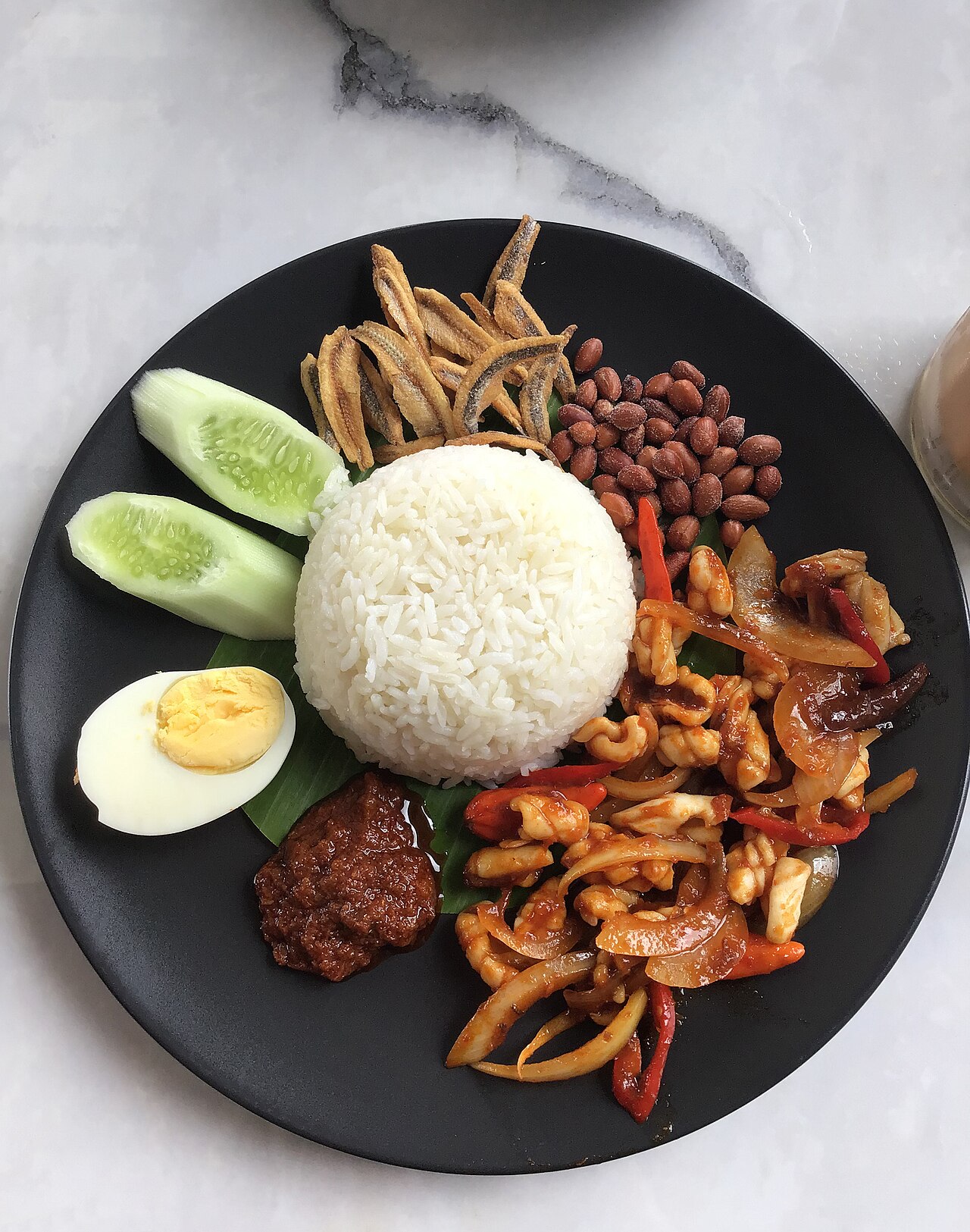
Nasi lemak is the one not to miss, rice cooked in coconut milk with fried anchovies and sambal, the chilli paste, and it is the national dish. It is mostly sold as breakfast, and the takeaway version wrapped in a banana leaf is the stall standard. Bak kut teh is pork simmered in a medicinal broth, with Klang near KL regarded as its home. Because it is pork, Muslim establishments do not serve it, so in a multi-ethnic city which block you are standing in changes what you can eat. Among noodles, the spicy-broth laksa and the fried mee goreng are the two main camps.
Not all of it will suit every palate. Sambal’s heat varies a great deal from shop to shop, and the herbal note in bak kut teh divides people. Getting the first meal wrong makes you cautious about every meal after it, so starting somewhere that can adjust the heat is the safer opening.
For data, a local SIM, an eSIM or a rented router all work. Because this itinerary runs Grab and a map continuously, being connected on landing is safer, and spending the first evening queueing at an airport counter does not pay given the last-train timing. The break-even by party size is worked out in the eSIM against pocket Wi-Fi comparison.
The city itself is not a difficult place. Rail and Grab cover the movement, English works almost everywhere, and the food has range. If this plan comes apart, the cause is the clock rather than the city: the Twin Towers’ Mondays, KL Tower’s 20:00, and the 00:05 and 05:00 on KLIA Ekspres. Those four push everything else around.
Two things to do at the point of booking flights. See whether the departure can fall between Monday and Thursday, and rule out a Sunday departure first, because a first or third Monday empties the DAY 2 morning. Then check whether the arrival runs past 23:00; if it does, switch the first day’s transfer to a Grab and put the hotel in Bukit Bintang. Walking a city built around temples is a different rhythm, so lining this up against the Bangkok four-night plan and the Singapore three-night plan before deciding is not wasted time.
Sources: official sites of the Petronas Twin Towers (petronastwintowers.com.my); KLIA Ekspres (kliaekspres.com); KL Tower (kltower.com.my); and the Immigration Department of Malaysia (imi.gov.my) / Checked on 2026-08-30. Sunset times calculated with the NOAA formula
Other sales ending soon




 4 days leftuntil Oct 24Air Busan Takamatsu-Busan Coupon: Up to 9,000 Yen Off Until October 24
 5 days leftuntil Oct 25JAL Hong Kong Campaign: Tokyo–Hong Kong Round Trip from 75,800 Yen (until 25 Oct)
 11 days leftuntil Oct 31Jin Air Kobe–Seoul: 5,000 yen off a round trip with code KTOUKB1, until 31 October
 11 days leftuntil Oct 31Jin Air to Busan: 4,000 yen off a round trip with code KTOPUS, first 300 only