Bali 5-Night, 7-Day Model Plan: Ubud’s Rice Terraces and a Beach Resort
AuthorMIRUTOBE editors
Table of Contents10 items
- Itinerary
- DAY 1 Before you book the flight, look up that year’s Nyepi
- DAY 2 Terraces and forest around Ubud. The monkey rules run to eleven items
- DAY 3 The World Heritage terraces are on the Tabanan side, on the road down to the sea temple
- DAY 4 The Uluwatu kecak starts at 18:00 exactly
- DAY 5 A day for the sea. The provincial circular lists 12 obligations and 8 prohibitions
- DAY 6 Count back from a flight that leaves after midnight
- Alternatives
- Where to stay
- What this trip costs
A Japanese passport gets no visa waiver here, and an e-VOA is IDR 500,000 a head. The Bali tourist levy is another IDR 150,000 each, and those two alone are over half the fixed cost. Add the rice terraces, the temples and the kecak and it comes to IDR 2,280,000.
Itinerary
DAY 1Before you book the flight, look up that year’s Nyepi
Why this order: day one is a single leg from the airport to Ubud. What gets decided here is not the itinerary but the dates, because one day a year the entire island stops.
Before you go: for 24 hours on Nyepi, the airport and the mobile network both shut
Bali has one day a year on which the island’s functions stop altogether: Nyepi, the Balinese Hindu new year in the Saka calendar. In 2026 it fell on 19 March, and Ngurah Rai International Airport ceased operating for 24 hours from 06:00 on 19 March to 06:00 on 20 March, under NOTAM A0096 issued by AirNav Indonesia. The 440 scheduled flights in that window, 231 domestic and 209 international, did not fly, and 19 aircraft sat parked at the airport.
The last services before the shutdown were a domestic departure at 23:10 on 18 March and an international one at 01:30 on 19 March. Afterwards the first were a domestic flight at 07:00 and an international one at 08:15 on 20 March. The only exceptions allowed are medical evacuation and special flights approved by the relevant authorities. The often-repeated line that emergency landings are exempt does not appear in the official wording.
It is not only aircraft. The network goes down too. Circular SE No.2/2026 from the Minister of Communications and Digital Affairs, dated 12 March 2026, required mobile data, IPTV and television and radio distribution to stop for the same 24 hours. Over 72 critical sites including airports, ports, police headquarters and hospitals keep service quality. Operators were instructed to warn subscribers by SMS on 12, 16, 17 and 18 March.
How the day is spent is set by the Catur Brata Penyepian, four restraints. Amati Geni is no fire or light, Amati Karya no work of any kind, Amati Lelungan no going out or travelling, and Amati Lelanguan no staging or enjoying entertainment. The provincial joint statement prohibits both residents and visitors from going out, and bans firecrackers, loudspeakers, noise and excessive lighting. What is permitted is staying inside your accommodation, with order overseen by the pecalang, the customary security officers.
In practice, you cannot leave the hotel grounds. No chartered car, no Grab, no going down to the beach, no shops open. If any day of a five-night trip falls here, the plan effectively has four nights of usable time.
The date follows the Saka calendar and so moves each year in the Gregorian one. The 19 March 2026 date was fixed by a three-ministry joint decision signed on 19 September 2025, with 18 March a national collective holiday. For 2027 the government’s joint decision has not been published. Dates on calendar websites are not the official determination, so look at the government notice once before you buy flights.
All of that is constraint, but the night before is the most spectacular evening on the island. Officially it is Pengerupukan: before sunset on the eve of Nyepi, each village parades its ogoh-ogoh through the streets to the percussion of a baleganjur, and they are burned at the cemetery at the end. Three or four days before Nyepi comes Melasti, the purification of sacred objects at sea or lake; on the eve there is Tawur Kesanga at Besakih and at town crossroads; and the following day Ngembak Geni, which begins with forgiveness and a shared meal. Of the whole sequence, the one a visitor can get near is the ogoh-ogoh on the eve.
There are only two ways to handle the dates. Avoid it, by keeping Nyepi out of the trip entirely. Or see it, by putting the eve in the itinerary, counting the following day from the start as a day spent at the hotel, and booking the flight home for the day after that. The one arrangement that does not work is watching the eve and flying out the next morning, because the next morning the airport is not running.
Before you go: no visa waiver for a Japanese passport. Three things to arrange
Indonesia’s visa exemption for visits covers 18 countries and territories, and Japan is not among them. Japan’s Ministry of Foreign Affairs states that its application to Japanese nationals is suspended. Tourism therefore needs a visa. The one to use is the visa on arrival, in two forms: the e-VOA obtained online beforehand and the VOA obtained at an airport counter. Both cost IDR 500,000.
It allows 30 days from the date of arrival. The visa’s own validity of 90 days means you must enter within 90 days, not that you may stay for 90. One extension is possible, for a further 30 days, at the same IDR 500,000.
There is a standard accident here. The extension route splits in two. A VOA taken at an airport counter is extended by applying in person at the immigration office where you are staying; an e-VOA taken in advance is extended online. Try to extend an airport VOA online and it becomes a new e-VOA application, leaving you unextended and overstaying. Japan’s foreign ministry names this specific error. The overstay penalty is IDR 1,000,000 per day, and beyond 60 days it becomes grounds for deportation.
The e-VOA can be applied for from 14 days before travel, with 48 hours before departure recommended. Payment is by Mastercard, Visa or JCB credit card only, with 3-D Secure and overseas transactions enabled. Pay within 120 minutes of the confirmation screen or it lapses, and there are no refunds for refusal, non-use or an error in your own entry. One application covers up to five people. The passport needs six months of validity from the arrival date, and you must show an onward or return ticket.
Second is the Bali tourist levy, formally the Pungutan Wisatawan Asing, IDR 150,000 per person. The underlying regulation was replaced in 2025 and now rests on Bali Provincial Regulation No. 2 of 2025 and Governor’s Regulation No. 25 of 2025, with Governor’s Decision 699/03-L/HK/2025 setting the technical guidance. The amount is unchanged, but any old guide saying nothing has changed is citing a superseded basis. It applies to arrivals on domestic flights too, and is paid once before you leave Indonesia. Payment is cashless only: credit card, bank transfer, virtual account, UnionPay or QRIS. Being asked for cash on the ground is a reason to suspect a scam.
Third is All Indonesia. This is not an additional procedure but a single window combining the electronic customs declaration and the health quarantine declaration, which also absorbed the arrival card. It became mandatory at three airports including Ngurah Rai on 1 September 2025 and extended to every international airport and seaport from 1 October 2025. Registration opens three days before arrival counting the arrival day, costs nothing, and has no field for card details. The resulting QR code is shown at immigration, customs and quarantine. Not knowing this is how people go looking for a separate e-CD and land on an expensive agent site.
Night: neither the journey time from the airport nor the fare is published
Ngurah Rai International is about 13 km south of central Denpasar. That is all the official site gives on location; there is no distance, journey time or fare table for Kuta, Seminyak, Ubud or Nusa Dua. On airport taxis it says only that they run on a meter or on fixed fares set by each operator, so you cannot budget from a zone tariff.
Ride-hailing is officially usable. The airport’s transport page lists Gojek and Grab as online taxis, bookable in the app or at dedicated counters inside the terminal. Buggies run free between the domestic and international terminals 24 hours a day. Note that the airport’s official site moved from bali-airport.com to ngurahrai.injourneyairports.id; the old domain redirects, but changing the bookmark is quicker.
Driving yourself is effectively not an option. An international driving permit issued in Japan is not valid in Indonesia: Japan is party to the Geneva Convention and Indonesia to the Vienna Convention, a translation does not help, and a Japanese licence cannot be converted. Moving around the island means a chartered car or a ride-hailing app.
For currency, Bank Indonesia’s reference rate puts JPY 100 at IDR 11,422, making IDR 10,000 about JPY 87.55. Estimates built on IDR 10,000 = JPY 95 are common and value the rupiah about eight per cent higher than it is now; using them overstates what you will spend. A provincial circular requires money to be changed at authorised dealers displaying a Bank Indonesia licence number and the QR logo.
Voltage and plug type are not stated by Japan’s foreign ministry, the consulate-general in Denpasar or JETRO. Commercial travel sites agree on type C at 220 to 230 V, but with no primary source confirming it, what your equipment accepts has to be read off the equipment. How to tell an adapter’s job from a transformer’s is set out in the difference between a plug adapter and a transformer.
DAY 2Terraces and forest around Ubud. The monkey rules run to eleven items
Why this order: the Monkey Forest takes its last entry at 17:00. Put the terraces in the morning light, the forest in the afternoon, and leave the evening for dance.
Morning: Tegallalang is not part of the World Heritage property
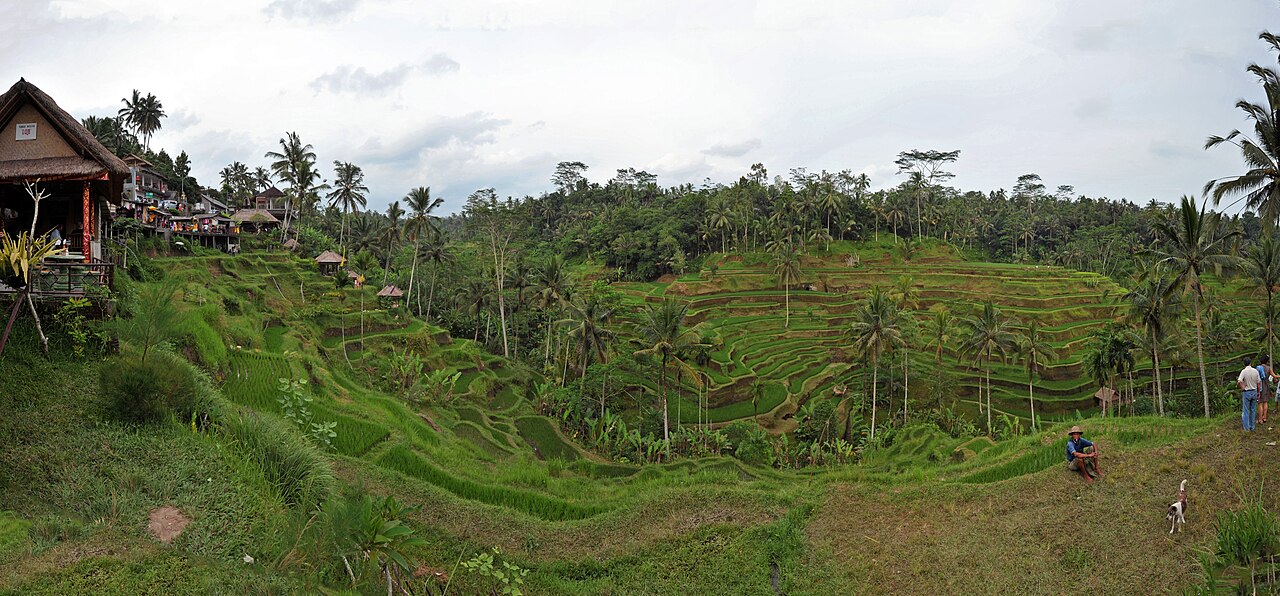
Twenty minutes north of Ubud by car. The stepped terraces are the landscape Bali is known by. One thing most guides get wrong: Tegallalang is not one of the components of the UNESCO World Heritage property.
What is inscribed is the Cultural Landscape of Bali Province: the Subak System as a Manifestation of the Tri Hita Karana Philosophy, listed in 2012, covering 19,519.9 hectares with a 1,454.8-hectare buffer zone. There are five components: Pura Ulun Danu Batur, Lake Batur, the subak landscape of the Pakerisan watershed, the subak landscape of Catur Angga Batukaru, and the royal water temple Taman Ayun. The valley at Tegallalang, in Gianyar regency, is in none of them.
What complicates it is that Indonesia’s own tourism ministry page says the site has grown popular since being inscribed on the World Heritage list. That conflicts with UNESCO’s component list, and both are official. The terraces themselves are sustained by subak irrigation, said to have been brought by the eighth-century sage Rsi Markandeya, so the value of the landscape is not in question. But if your purpose is to see the World Heritage terraces, the destination is on the Tabanan side rather than here.
No official tariff from the managing body could be found for admission, parking or the Bali swings at Tegallalang. What ranks in a search is commercial tour resellers, not the management. That is why this valley is absent from the cost table.
Afternoon: do not make eye contact in the Monkey Forest
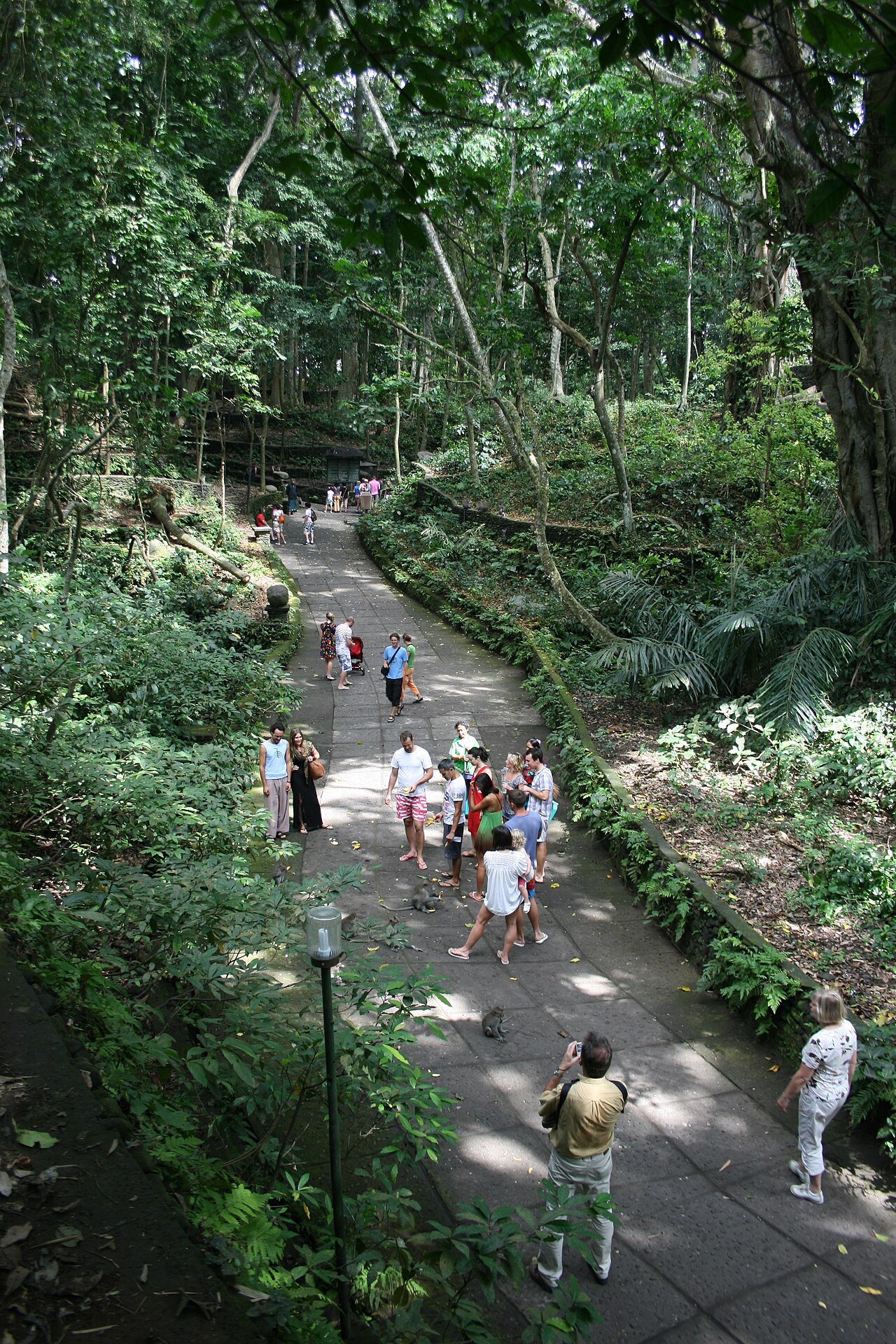
Highlights: 12.5 hectares of forest inside Ubud, run by the village of Padangtegal. The residents are long-tailed macaques, about 1,054 of them by the sanctuary’s count, in seven groups named Cemetery, Central, Michelin, East, Temple, South and New Forest, each of roughly 140 to 171 animals. Three temples stand inside: the main Pura Dalem Agung Padangtegal, the holy spring Pura Beji, and the cremation temple Pura Prajapati, all open only for worship. The banyan at the centre is at least a hundred years old.
Practical note: the official visitor rules run to eleven items. Do not touch, do not pick up, do not feed except under direct staff supervision, do not look them in the eye (it reads as a threat), do not run if one jumps on you but walk slowly, bring no food or drink, do not take out toys, jewellery, beads or similar small objects, do not enter the sanctuaries, bring no plastic. “Do not show food or valuables” is not enough on its own; the two most often missed are the eye contact and the running. If you are bitten, there is a first-aid room on site. Staff feed the monkeys nine times a day, mainly on sweet potato, and do not give peanuts for health reasons.
- Admission
- Adult IDR 130,000; child IDR 100,000 (same for foreign and domestic visitors)
- Hours
- Daily 9:00–18:00 (last entry 17:00)
- Size
- 12.5 hectares; about 1,054 monkeys in 7 groups
- Dance
- Open stage: Rebudaka Saturdays 11:00 and 16:00; frog dance Sundays 11:00 and 16:00
- Official
- Sacred Monkey Forest Sanctuary ↗
People worry about contact with the monkeys, so here is one figure the sanctuary publishes. Across fourteen years of study by a researcher at the University of Notre Dame, not a single case of rabies was found in Bali’s macaques. That is not a basis for calling it safe, but first-line treatment for a bite is available at the on-site clinic.
For photographs with the monkeys there is a selfie voucher at IDR 50,000. It is a supervised slot, consistent with the rule about no contact outside staff supervision. It also leaves you with closer pictures than edging nearer on your own does.
Evening: the kecak is a dance created in the 1930s
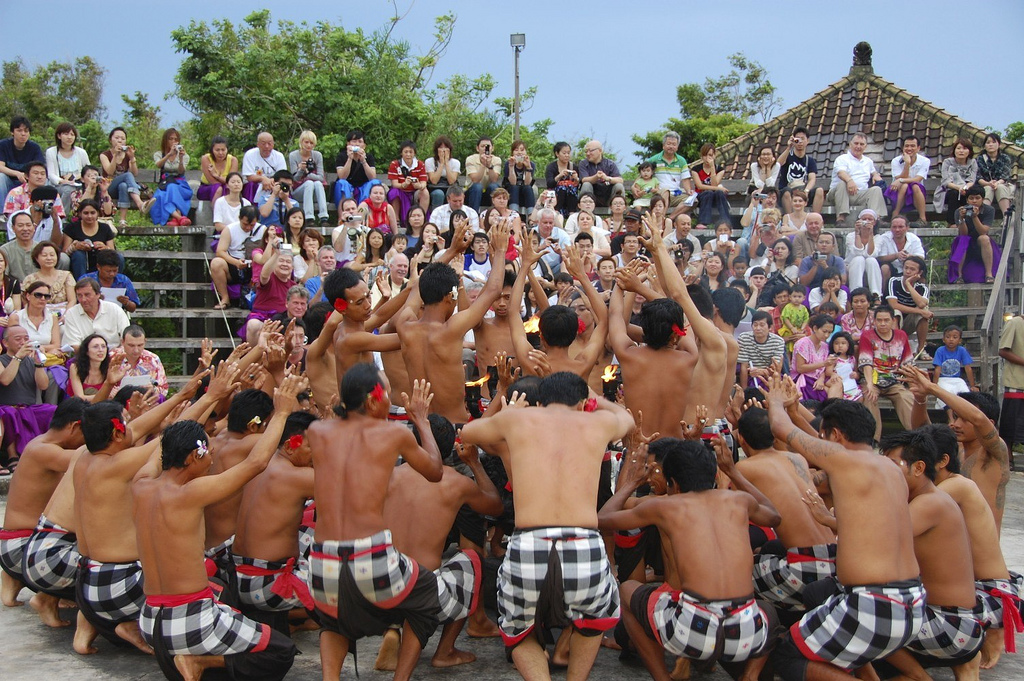
The kecak is often taken for an ancient ritual dance; the tourism ministry’s account dates it to the 1930s. The Balinese dancer Wayan Limbak and the German painter Walter Spies adapted it from the sanghyang trance ritual. The story is the Ramayana, centred on Sita’s abduction and the Hanuman episodes. No instruments are used: dozens to hundreds of men sit in a circle layering the chant of “cak, cak, cak”. The circle is read as a symbol of harmony, balance and coexistence.
The venues the ministry names are Uluwatu, Ubud, GWK, Melasti beach and Tanah Lot. It is often written as though somewhere in Ubud has one every night, but the official schedules by venue could not be confirmed. This plan puts the Uluwatu performance, with its sunset, on DAY 4, so the Ubud evening is either a palace performance or a rest at the hotel.
Ubud Palace itself has no official site, and neither its admission, its opening hours nor the times and prices of the evening performances could be traced to a primary source. The tourism ministry mentions an approximate IDR 100,000 admission and nothing more. That is why it is not in the cost table, and why the amount gets confirmed from the notice board on site.
DAY 3The World Heritage terraces are on the Tabanan side, on the road down to the sea temple
Why this order: Ubud to Jatiluwih to Tanah Lot and on south to Seminyak, in one line. Move hotels on this day so that you never carry luggage up to the terraces.
Highlights: terraces inside the Catur Angga Batukaru component of the World Heritage property, and Jatiluwih states plainly that it is part of the inscribed cultural heritage. The village covers 22.3 square kilometres with seven subak, each led by a pekaseh who directs the water. The terrain is 70 per cent hill, 20 per cent broken ground and 10 per cent gentle slope. Terraces here are recorded in a tenth-century inscription, among the oldest on the island.
Practical note: star-rated and urban hotel development is not permitted, and tourism facilities must leave 70 per cent of their land as paddy or farm. The landscape survives because of the rules. Flying a drone needs prior permission and IDR 300,000 extra. Cycling starts at IDR 470,000 and trekking at IDR 450,000, both bookable up to two days ahead. The evening laser art runs nightly from IDR 50,000.
- Admission
- Foreign adult IDR 75,000; child IDR 50,000 (domestic IDR 25,000 / 15,000)
- Size
- Village area 22.3 km²; seven subak
- Drones
- Prior permission; IDR 300,000 extra
- Activities
- Cycling from IDR 470,000; trekking from IDR 450,000 (book up to 2 days ahead)
- Official
- Daya Tarik Wisata Jatiluwih ↗
The subak system is the substance of the inscription. UNESCO records about 1,200 water associations on the island, with 50 to 400 farming households jointly managing the distribution from a single source. It dates from the ninth century, and the network of water temples has sustained terrace ecology by watershed since the eleventh. Looked at as scenery the terraces are only a shape in the ground; the agreement about how to divide water is what the landscape actually is.
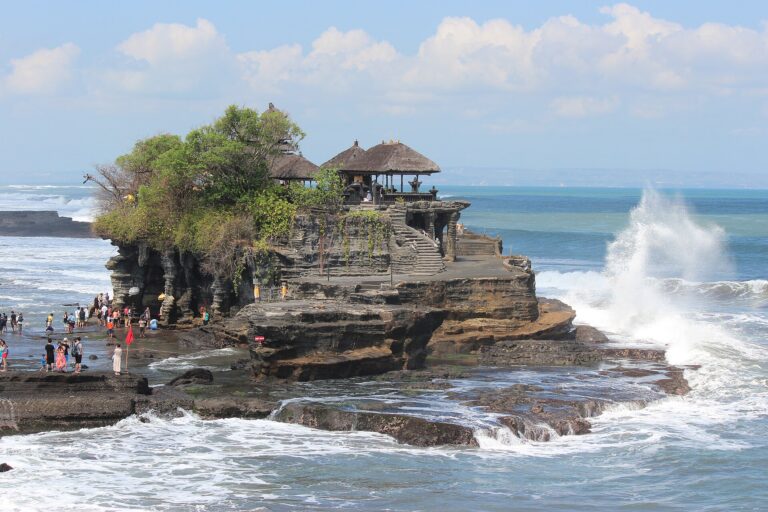
Highlights: a temple on a rock about 300 m offshore, founded by the sixteenth-century priest Dang Hyang Nirartha. Six temples lie within the grounds: Pakendungan, Jero Kandang, Enjung Galuh, Batu Bolong, Batu Mejan and Penataran Madya. Batu Bolong sits on a rock reaching into the sea with a hole through its middle, the shape of which gave it the name. The car park covers 2.77 hectares and there are display areas for small businesses and a rest lounge.
Practical note: opening and closing times are not posted on the official site. If you are going for the sunset, count backwards from it and arrive early. The claim that you can walk out to the rock at low tide is not stated officially either; the tourism ministry’s wording is only that you cross dry ground and climb the hill to reach the temple. Photography, drones and other commercial use require notice to the management office in advance.
- Admission
- Foreign adult IDR 75,000; child IDR 40,000 (domestic IDR 30,000 / 20,000)
- Parking
- Car IDR 5,000; motorcycle IDR 3,000; six-wheeler IDR 10,000
- Location
- Beraban village, Kediri, Tabanan regency; about 300 m offshore
- Hours
- No times found on the official site
- Official
- Daya Tarik Wisata Tanah Lot ↗
Jatiluwih to Tanah Lot stays inside Tabanan regency and runs straight south. Terraces in the morning and the temple in the late afternoon keeps the day pointing one way. Go back to Ubud and come south again the next day instead and you drive the same road twice. Moving the hotel from Ubud to Seminyak on this day is what removes that duplication.
DAY 4The Uluwatu kecak starts at 18:00 exactly
Why this order: the kecak starts at 18:00 with doors at 16:00, which is precisely the window the Tanah Lot sunset occupies. The two cannot share a day. Leave the morning to the sea and head for the southern tip in the afternoon.
The easiest mistake in this itinerary is putting Uluwatu and Tanah Lot on the same day. The Uluwatu kecak runs 18:00 to 19:00 with doors at 16:00. The point of Tanah Lot is the silhouette at sunset, which falls in the same hours. Both are in the south, but they are far enough apart by car that the choice is to drop one or to split them across days. Tanah Lot on the previous day and Uluwatu on this one is why.
Morning: give half a day to the sea and a spa in Seminyak
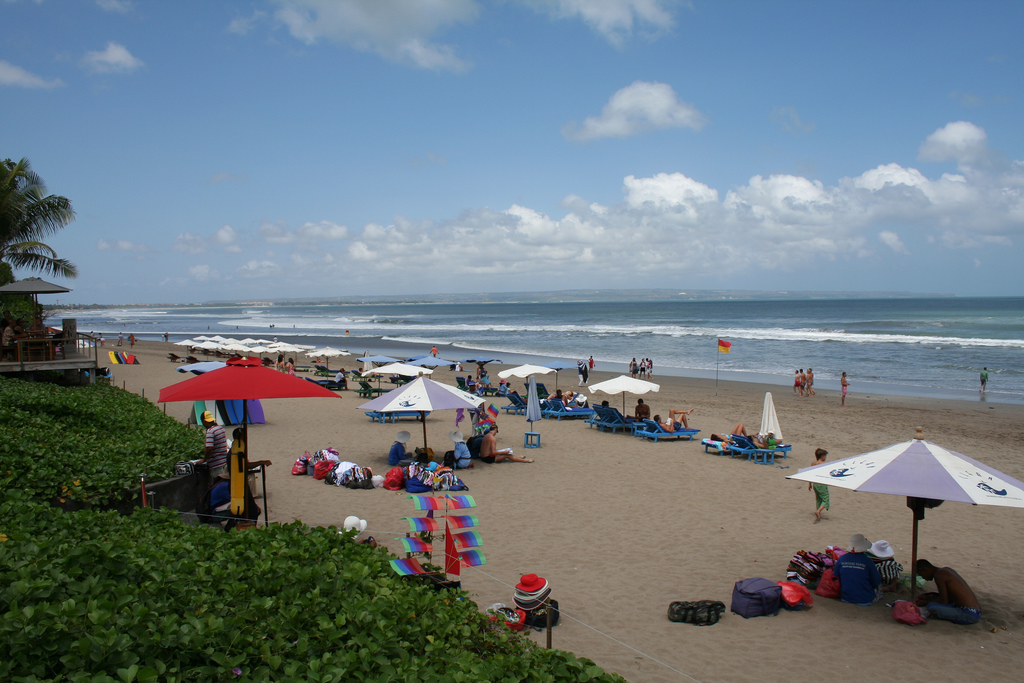
The previous day involved walking terraces and a temple, so leaving this morning still is what makes the second half of the trip work. Seminyak concentrates cafes, shops and beach clubs densely enough to fill half a day without leaving the area. If a massage is going in, it goes here, and since the afternoon heads for Uluwatu, it needs to finish before midday.
Afternoon: Uluwatu Temple stands 70 m up a cliff
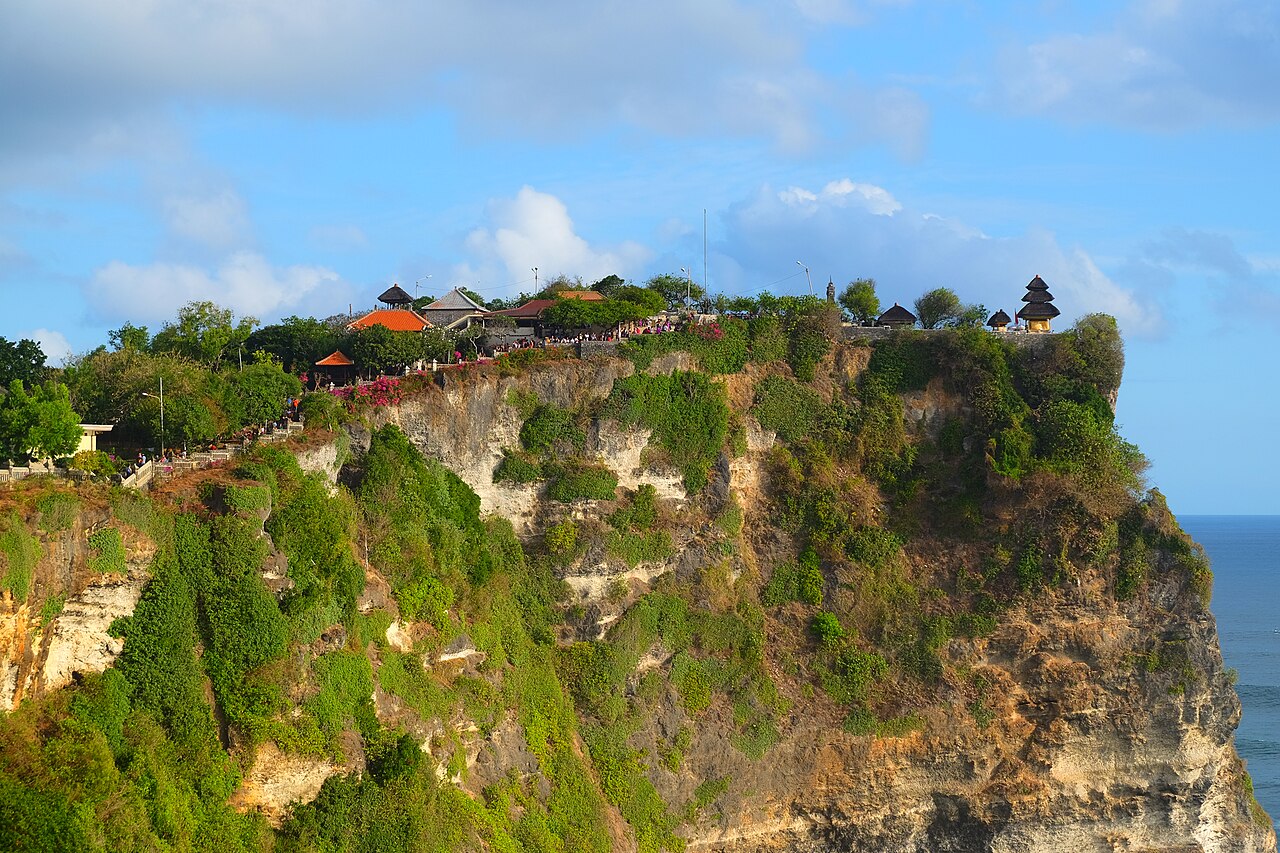
Highlights: set on a limestone cliff 70 m high, one of Bali’s six great temples and the guardian of the south-west. The chronogram carved on the split gate reads 808 Isaka, which is 886 CE. The eleventh-century sage Mpu Kuturan is credited with establishing it as a sea temple, and the sixteenth-century priest Dang Hyang Nirartha is said to have attained release on this cliff. The deity is Shiva Rudra. The anniversary festival, the piodalan, comes round every 210 days in the Balinese pawukon calendar.
Practical note: a sarong and sash are required, and both are lent free at the entrance. The official warnings about the monkeys are specific: do not feed them, do not touch them, hold cameras and phones firmly, protect glasses, hats and bags, better still do not wear a hat, and wear no jewellery. It is also stated that women who are menstruating may not enter the temple area, that drones are not allowed, that no food or drink may be brought in, and that you must not sit or climb on the boundary walls. Admission is inconsistent even within the official site: the detail page says IDR 60,000 for a foreign adult, the FAQ on the front page says IDR 50,000. The cost table uses the higher figure.
- Admission
- Foreign adult IDR 60,000; child IDR 40,000 (IDR 50,000 / 30,000 also appears officially)
- Hours
- Daily 7:00–19:00
- Cliff
- 70 m
- Dress
- Sarong and sash required (lent free at the entrance)
- Official
- Uluwatu Temple ↗
Evening: 1,200 seats, and payment is cash only as a rule
Highlights: an amphitheatre built on the cliff edge, performed against the sun going down into the Indian Ocean. It seats 1,200. Performances run daily 18:00 to 19:00, with doors at 16:00. Tickets are sold at the official booth by the temple entrance: IDR 150,000 for adults and IDR 75,000 for children aged 2 to 9. Temple admission and parking are not included.
Practical note: payment is cash only as a rule. Arriving intending to pay by card means not getting in. The official advice is to be there before 17:00, and because the seating is stone steps, comfortable shoes help. Bring sunglasses and water; flash photography, moving around during the performance and shouting are prohibited, and large bags cannot be brought in. The venue is non-smoking and drones are not allowed.
- Performance
- Daily 18:00–19:00 (doors 16:00)
- Tickets
- Adult IDR 150,000; children 2–9 IDR 75,000
- Payment
- Official booth at the temple entrance; cash only as a rule
- Capacity
- 1,200 seats (stone steps)
- Official
- Uluwatu Kecak Dance ↗
DAY 5A day for the sea. The provincial circular lists 12 obligations and 8 prohibitions
Why this order: build in one day with nothing scheduled. The temples and terraces are done by now, so the plan survives if this day falls apart.
Sunset at a beach club, surf at Kuta, or shopping. Any of them works. But Bali Governor’s Circular SE No.4/2023 places twelve obligations and eight prohibitions on foreign visitors, and a loose day by the sea is exactly when you brush against them, so the relevant ones are worth having.
Among the obligations: behave and dress respectfully at sacred sites, tourist sites and in public; be accompanied by a licensed and permitted guide at tourist sites; change money only at authorised dealers displaying a Bank Indonesia licence number and the QR logo; pay using QRIS and transact in rupiah; wear a helmet and respect passenger limits on a motorcycle; and stay in licensed accommodation.
Among the prohibitions, the ones that bite are entering the two inner zones of a sanctuary, climbing sacred trees, climbing on sacred structures or photographing them while inappropriately dressed, dumping waste into lakes, springs, rivers or the sea, and using single-use plastic. Carrier bags, polystyrene and plastic straws are named. The circular states that breaches are subject to sanction or legal process.
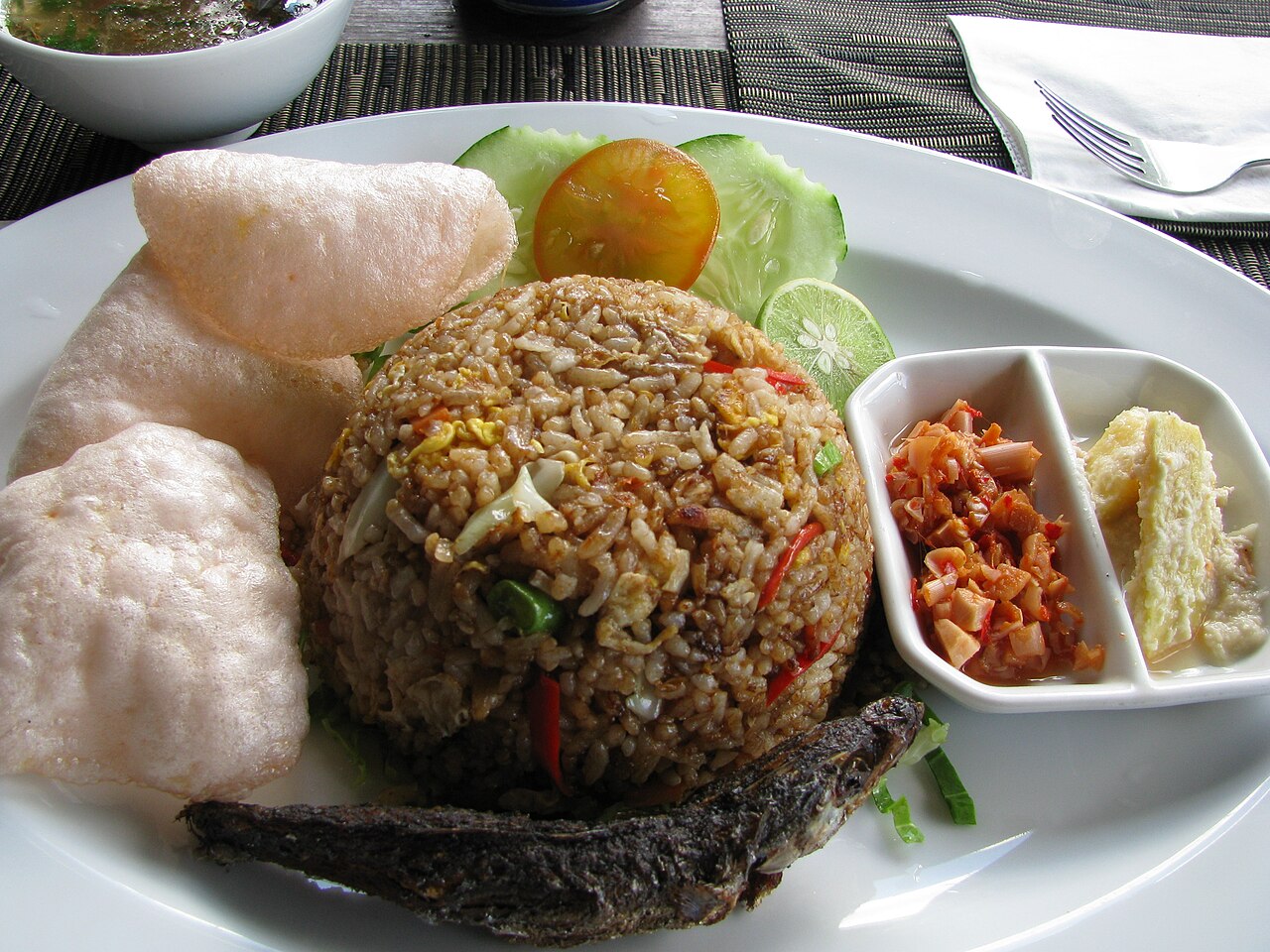
The food runs on spice and coconut. Nasi goreng is the Indonesian fried rice, mie goreng the sweet-savoury fried noodles, nasi campur a plate of rice with several dishes around it. Babi guling is spit-roast pork, originally a celebration dish. Satay is grilled on skewers and eaten with peanut sauce. The same dish is priced differently in Ubud and Seminyak, so estimating food costs works better if you separate them by where you are staying.
Cash has thresholds too. Bringing in or taking out currency worth IDR 100 million or more must be declared to customs, and taking it out additionally requires Bank Indonesia approval. The penalty for failing to declare, or under-declaring, is 10 per cent of the amount carried, capped at IDR 300 million. Duty-free allowances are one litre of alcohol and 200 cigarettes per adult, with goods up to USD 500 FOB; above that, 10 per cent duty plus VAT applies.
DAY 6Count back from a flight that leaves after midnight
Why this order: the journey time to the airport is not published, so leave more slack than feels necessary, and add no excursion on the last day.
Garuda Indonesia is the only airline flying Japan to Bali non-stop; Japan Airlines and ANA connect. On the January to March 2026 schedule, GA880 to Narita leaves Denpasar at 00:50 and lands at 08:50. So the last evening means leaving the hotel late and spending the small hours at the airport. Garuda’s official site cannot be opened directly because of its authentication, and these times come from a distributed timetable, so confirm the flight number and times when you book.
With a departure after midnight, the hours between checkout and the flight have to go somewhere. Either add a late checkout or spend the last half-day in Seminyak’s cafes and spas. Buggies run free between the airport terminals 24 hours a day, so once you are there the internal moves are predictable.
Alternatives
Rainy-day swap
DAY 3 is the weakest in rain. Both the Jatiluwih terraces and the Tanah Lot sunset depend on the sky. The terraces can be walked wet; the sunset cannot happen at all. Put the other way, rain that day costs you only the evening light, and the admissions are not wasted.
The DAY 4 kecak is an open-air theatre on a clifftop. Nothing official states what happens in rain, so on a bad day it has to be checked at the booth. The seating is stone steps, which get slippery underfoot and to sit on.
DAY 2 holds its shape. The Monkey Forest is under trees, with the exhibition room and the clinic under roofs. Terrace photographs want morning light, so putting the worst forecast on DAY 2 does the least damage.
If the flight is delayed by an hour or more
A late arrival changes nothing, because this plan puts nothing on DAY 1 and the same itinerary starts the next morning. All that breaks is the check-in time at the Ubud hotel.
Where it bites is the DAY 4 afternoon. The kecak begins at 18:00 exactly with doors at 16:00, and traffic delays leave you only the seats at the back of the steps. No journey time from Seminyak to Uluwatu is published, so build in an hour of margin.
A delay on the way home matters little. DAY 6 holds packing and a transfer, so there is nothing to cut.
When you’re tired
Jatiluwih goes first. That frees IDR 150,000 for two and around an hour and a half each way from Ubud. If Tegallalang is terrace enough for you, DAY 3 becomes Tanah Lot alone and you keep another half-day in Ubud. Unless being inside the World Heritage property matters to you, the difference is only what is behind you in the photograph.
Next is the kecak, IDR 300,000 for two. The Uluwatu temple itself admits you for IDR 60,000, so seeing the cliff and the sunset and going home costs the pair of you IDR 120,000. With no particular interest in the dance, cutting it and putting the money into dinner is a sound decision.
With an extra night available, insert it between DAY 2 and DAY 3. Three nights in Ubud means the terraces, the forest and the palace need not be crammed into a day, and it doubles as a spare for anything rained off. DAY 1 and DAY 6 are pinned to flight times, so stretching them adds awkward fragments.
Where to stay
This plan splits the stay between hills and coast: two nights in Ubud, three in Seminyak. Keep it in one place and one of those days turns into a round trip of about an hour and a half each way.
Ubud puts the terraces, the forest and the dance within walking distance or a short drive. To photograph the terraces in morning light you need to be staying here, or the departure becomes absurdly early. There are vehicle restrictions in the centre and ride-hailing pick-up points can be limited, so check how a hotel is reached from the main road, not just where it is.
Seminyak is dense with sea, cafes and spas, and it is a short start for the DAY 4 run to Uluwatu. If you intend to be out in the evenings, it fits. If you want quiet, it does not.
Kuta and Nusa Dua are the ones near the airport. With a departure after midnight on DAY 6, that predictability is an advantage, but everything in this plan except Uluwatu sits north and west, so putting all five nights in the south adds travel.
Prices move on identical dates, which is why none appear in the table above. Book flights, then the rooms, then the cars. The Uluwatu kecak is bought in cash on the day, so it can be left until last. To have the driving and the admissions arranged together, Klook lists Bali tours and temple tickets with a chartered car and entry bundled. On an island with this many sections that have no published tariff, that difference is the price of fixing the figure in advance.
What this trip costs
Assumptions: two adults, five nights, arranged individually rather than on a tour. Air fares are outside the total because they swing too far by route and season, and rooms and meals move on identical dates. Chartered cars, ride-hailing and airport taxis have no official tariff, so they cannot go in the table. What is listed is only what the government and the sites publish.
Every figure above is the published rate as of 2026-09-14. The yen conversion uses Bank Indonesia’s reference rate published the same day, JPY 100 = IDR 11,422.
Of the IDR 2,280,000, IDR 1,300,000 is the cost of getting into the country. The e-VOA and the levy alone come to about JPY 11,400 for two. Admission to all five sights plus the kecak adds up to IDR 980,000, about JPY 8,600. The sense that Bali is cheap holds for food and rooms and does nothing at all for the fixed cost of entry. The old estimate of “visa, levy and souvenirs from JPY 5,000 a head” works out at about JPY 5,700 for the first two items alone, which leaves no room for souvenirs.
The exchange rate needs rechecking as well. At IDR 10,000 = JPY 95, IDR 2,280,000 reads as about JPY 21,660; at 87.55 it is about JPY 19,960. Identical spending in rupiah comes out about JPY 1,700 lower, so the table’s figures land below the older estimates. Across five nights of rooms and meals, that gap grows considerably.
Immigration has proposed raising the e-VOA to IDR 750,000 and the airport VOA to IDR 1,000,000. No commencement date has been published, so the table above uses the current IDR 500,000, but reading the figure off the application page before you travel is the safe move. If it takes effect, the fixed cost for two rises by IDR 1.5 million.
Outside the table is data. This is an island run on a ride-hailing app and a map, and on Nyepi the mobile network itself is switched off for 24 hours. The break-even by party size is worked out in the eSIM against pocket Wi-Fi comparison.
Where this plan does not work is for anyone who wants every price and journey time fixed before departure. Airport taxis, chartered cars, the Tegallalang terraces and Ubud Palace all lack published tariffs here, and amounts get settled by a notice board or a negotiation. Carrying enough slack in the budget to absorb that is the realistic approach. Conversely, build only from what has a published unit price and this itinerary’s fixed cost lands at JPY 20,000 for two. For the same region with everything given to the sea, the Cebu four-night plan; for a World Heritage town and a beach kept separate, the Da Nang and Hoi An four-night plan; and for the same five nights leaning on street walking, the Penang five-night plan.
Sources: official sites of the Indonesian Directorate General of Immigration (imigrasi.go.id, evisa.imigrasi.go.id, allindonesia.imigrasi.go.id); Indonesian Customs (beacukai.go.id); Japan’s Ministry of Foreign Affairs overseas safety pages; the Government of Bali Province (lovebali.baliprov.go.id, bmc.baliprov.go.id, ceraken.baliprov.go.id); Ngurah Rai International Airport (ngurahrai.injourneyairports.id); the UNESCO World Heritage Centre; the Sacred Monkey Forest Sanctuary; Jatiluwih; Tanah Lot; Uluwatu Temple; the Indonesian Ministry of Tourism (indonesia.travel); and Bank Indonesia / Checked on 2026-09-14 / Featured image: Grayswoodsurrey, CC BY-SA 4.0 (Wikimedia Commons)
Other sales ending soon




 4 days leftuntil Oct 24Air Busan Takamatsu-Busan Coupon: Up to 9,000 Yen Off Until October 24
 5 days leftuntil Oct 25JAL Hong Kong Campaign: Tokyo–Hong Kong Round Trip from 75,800 Yen (until 25 Oct)
 11 days leftuntil Oct 31Jin Air Kobe–Seoul: 5,000 yen off a round trip with code KTOUKB1, until 31 October
 11 days leftuntil Oct 31Jin Air to Busan: 4,000 yen off a round trip with code KTOPUS, first 300 only