Bangkok 4-Night, 6-Day Model Plan: Three Great Temples, Ayutthaya and a Floating Market
AuthorMIRUTOBE editors
Table of Contents9 items
- Itinerary
- DAY 1 On a night arrival, change money and sort out a data connection
- DAY 2 Take the three temples in order of how early the ticket desk shuts
- DAY 3 Ayutthaya is an hour away on a train that started running in August 2026
- DAY 4 A floating market at dawn, a riverside warehouse district at night
- DAY 5 Shopping, a massage, and counting back to the airport
- Alternatives
- Where to stay
- What this trip costs
The Grand Palace is THB 500, Wat Pho THB 300, Wat Arun THB 100. The three great temples connect on foot and by cross-river ferry, and an air-conditioned express that started running in August 2026 reaches Ayutthaya for THB 50 one way. Four nights, no tour.
Itinerary
DAY 1On a night arrival, change money and sort out a data connection
Why this order: day one is a single leg from the airport to the hotel. The three temples open at 08:30 tomorrow, so nothing goes into this evening and you get to bed early.
Before you go: the TDAC opens three days out, and fake sites exist
Every non-Thai national entering Thailand submits a TDAC, the Thailand Digital Arrival Card, whether they come by air, land or sea. The system started on 1 May 2025 and accepts submissions from three days before arrival, counting the arrival day. There is no fee. A new one is required for each entry; you cannot reuse the last trip’s.
The thing to watch is the imitation sites. Travellers have reported being charged a fee on a screen that was not the official one, and being asked to enter card details. The only place it is submitted is the Immigration Bureau’s own domain, and the only defence is not entering through an advertisement at the top of the search results.
The length of stay also changed on 15 September 2026. From that date, visa exemption for tourism on an ordinary Japanese passport allows a maximum of 30 days per entry. Until then it was 60. The basis is the Thai Royal Gazette of 31 August 2026, announced by the Royal Thai Embassy in Tokyo. Four nights is unaffected, but it matters if you intend to extend the trip and add a circuit. Applying at an immigration office after arrival for an extension of up to 30 days remains possible, at the officer’s discretion.
At immigration you may be asked for proof of accommodation and proof of an onward flight within 30 days of arrival. Showing THB 20,000 in funds and being interviewed are also within the officer’s discretion. And there are cases of entry or exit being refused because the passport carried something other than entry stamps and visas, such as a souvenir stamp from a tourist site or a loyalty sticker. Check on the spot that your entry stamp is actually there. Trying to leave without one is treated as illegal entry.
Power is 220 V at 50 Hz. The sockets take types A, B, C, F and O, so a Japanese plug physically fits. The official guidance, however, names travellers arriving from 110-volt countries and tells them to consider a transformer. Fitting and working are different things, so check on the device itself whether it accepts 220 V. How to tell the two apart is set out in the difference between a plug adapter and a transformer.
Night: 30 minutes into the city by rail, 45 by taxi
The Airport Rail Link at Suvarnabhumi boards on basement level 1 of the main terminal and runs from 05:30 to midnight, reaching Phaya Thai in under 30 minutes. The operator’s own site has been unreachable, so the fare is not confirmed here and you will read it off the machine. On the arrivals level there is a 24-hour metered taxi rank, and the ride into the city takes about 45 minutes depending on traffic. Landing after midnight makes it a taxi and nothing else.
Do not change all your money at the airport. The counters are open around the clock, but the official guidance itself says the rates there are worse than in the city. Change enough at the airport for the first day’s travel and do the rest in town. That is the order the official advice recommends. Notes come in THB 20, 50, 100, 500 and 1,000, and street stalls often cannot break the large ones.
There are rules on bringing cash in as well. Up to THB 50,000 needs no declaration; foreign currency above the equivalent of USD 20,000 does. Going the other way, qualifying purchases can have the 7 per cent VAT refunded at a designated counter at the airport.
DAY 2Take the three temples in order of how early the ticket desk shuts
Why this order: the Grand Palace, whose ticket desk closes at 15:30, goes first thing. Wat Pho, open until 19:30, takes the middle of the day, and Wat Arun, which shuts at 18:00, the late afternoon. Sort them by the hour you can no longer get in, not by the hour they close.
The three sit together in the old city. The Grand Palace to Wat Pho is a walk, and Wat Pho to Wat Arun is a crossing of the river. Almost nothing today involves a vehicle.
Morning: the palace opens at 08:30 and stops selling tickets at 15:30
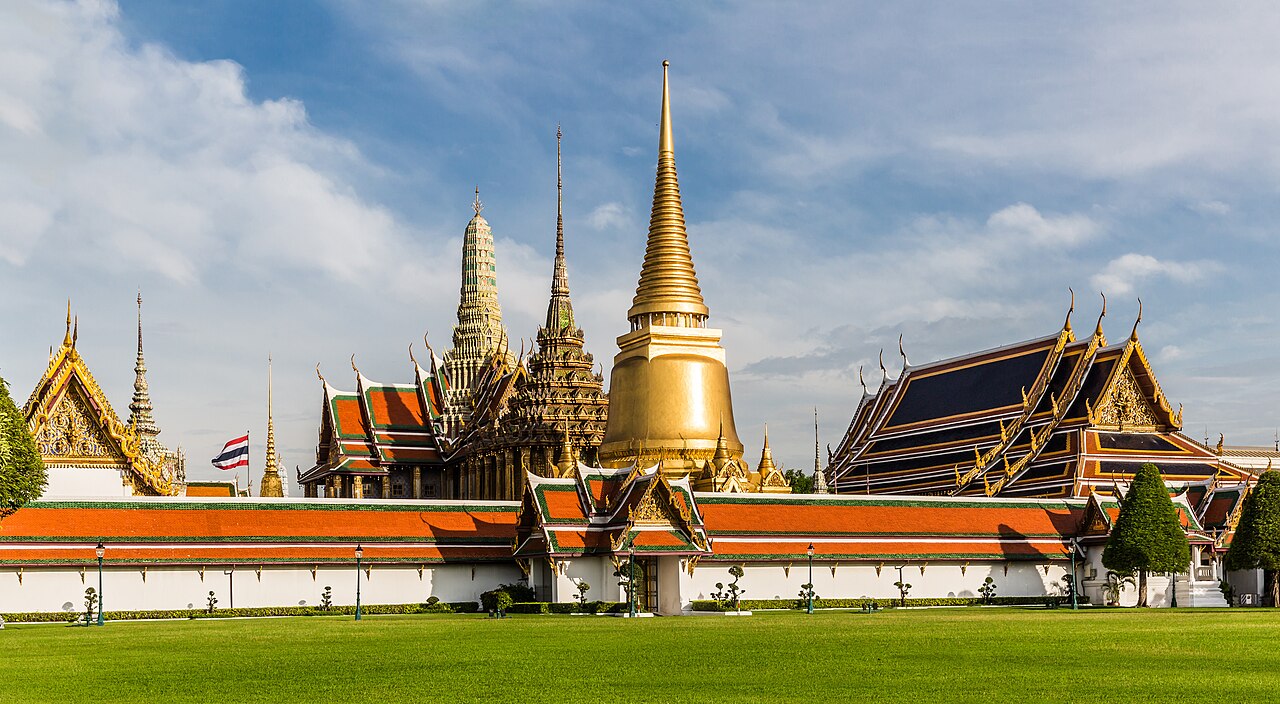
Highlights: the most formally important enclosure in Thailand, housing the Emerald Buddha, the palladium of the kingdom. The THB 500 foreign admission covers Wat Phra Kaew and the Queen Sirikit Museum of Textiles. Thai nationals enter free on production of an ID, and children under 120 cm are free. The audio guide is THB 200 in eight languages including Japanese, and hiring it requires a passport or a credit card.
Practical note: the entrance moved on 10 January 2024 from Wiset Chai Si Gate to Maninopparat Gate. Following older directions to the original gate means walking back around the wall. Online tickets can be bought up to a month ahead, but there are no refunds and no date changes whatsoever. If weather might make you move the day, the counter on the day is more forgiving.
- Hours
- Daily 08:30–16:30 (tickets 08:30–15:30)
- Admission
- Foreign visitors THB 500 (includes Wat Phra Kaew and the Queen Sirikit Museum of Textiles)
- Audio guide
- THB 200, eight languages
- Access
- On foot from exit 1, MRT Sanam Chai (the reliable option for opening time); by water, the blue-flag tourist boat
- Official
- Official site ↗
The route the palace publishes is to leave BTS Saphan Taksin by exit 2, walk to Sathorn pier and take an orange-flag boat up to Tha Chang (N9). But the orange flag only runs on weekday mornings and evenings, and the northbound services from Sathorn are 06:15 to 07:40 and 15:40 to 18:05. It is not running at the hour you would need to arrive for the 08:30 opening. By boat the option is the blue-flag tourist service leaving Sathorn at 09:00; the certain option is walking from exit 1 of MRT Sanam Chai. Oriental pier (N1) is closed for refurbishment.
The dress code here is the strictest of the three. What the palace names and refuses is sleeveless tops, vests, cropped tops, see-through fabric, shorts, ripped trousers, tight trousers, cycling shorts, miniskirts, culottes and loungewear. That is a wider net than shoulders and knees covered, so heavily stretchy leggings are best avoided too. Flying a drone is also on the prohibited list.
Afternoon: the reclining Buddha is 46 m, with 108 marks on the soles
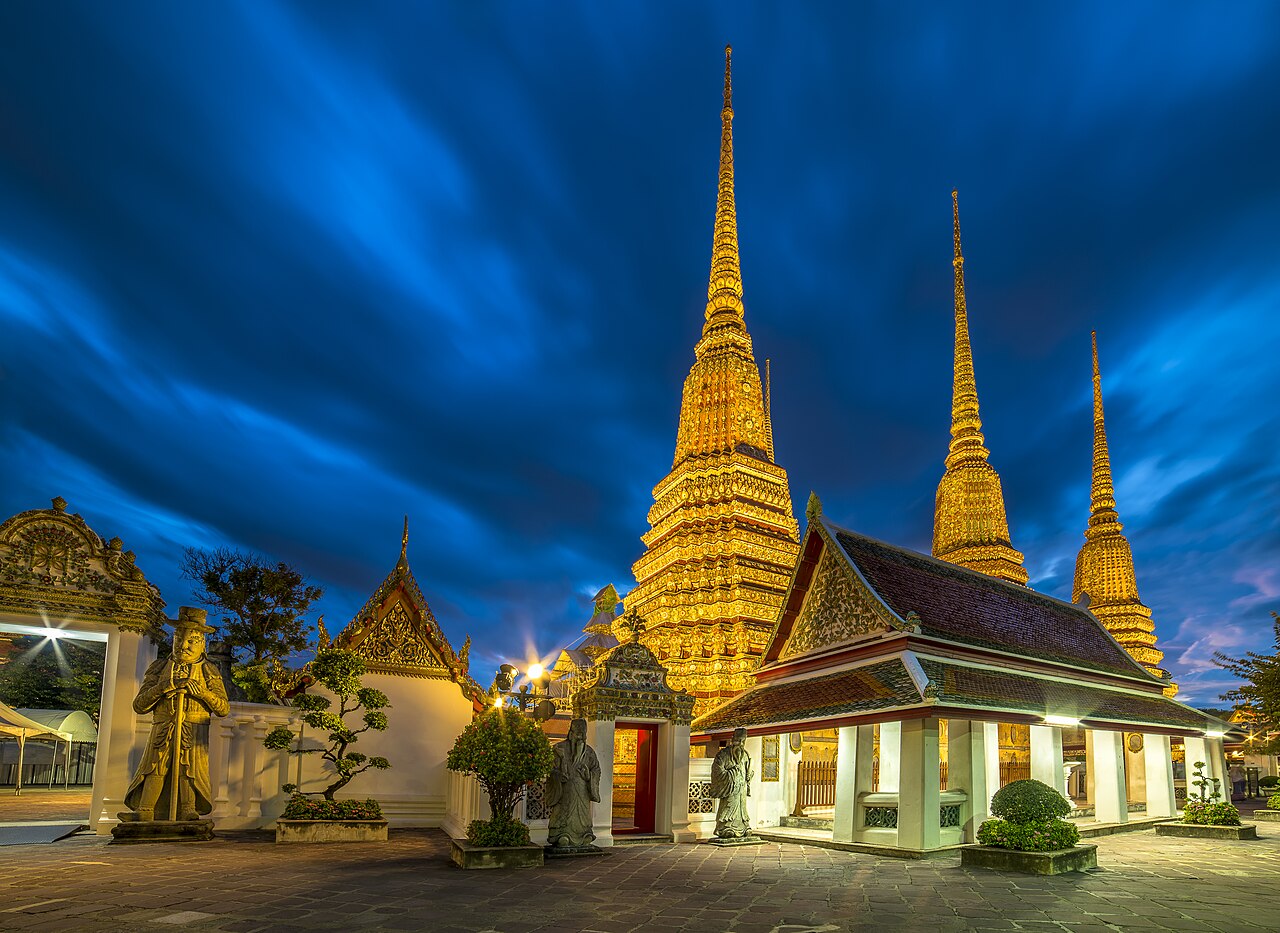
Highlights: the gilded reclining Buddha is 46 m long and 15 m high. Inside the hall you cannot take it in at once, so you walk it from head to feet. The soles carry 108 auspicious marks inlaid in mother-of-pearl, and that is the one part you can stand and look at square on. The grounds are within walking distance of the Grand Palace.
Practical note: the temple publishes its rules of conduct. Remove your shoes inside the halls; do not climb on the Buddha images, though photographs beside them are fine; women do not touch monks or novices; women do not step onto the monks’ seating platform. The last two are what people get corrected for without knowing.
- Hours
- Daily 08:00–19:30
- Admission
- Foreign visitors THB 300 (raised from THB 200 on 1 January 2024)
- Parking
- Chetuphon Road, THB 20 an hour
- Official
- Official site ↗
Inside the grounds is the school of traditional Thai medicine and massage, where you can have a treatment. It opened in 1955 and is regarded as the origin of formal Thai massage teaching. It keeps the same hours as the temple, 08:00 to 19:30.
For today, the 30-minute foot treatment is the right size. After the stone paving of the palace and Wat Pho, it is what gets your legs as far as Wat Arun in the late afternoon. Book the 120-minute slot and the sun is already low before you cross the river.
Late afternoon: the prang at Wat Arun is over 80 m
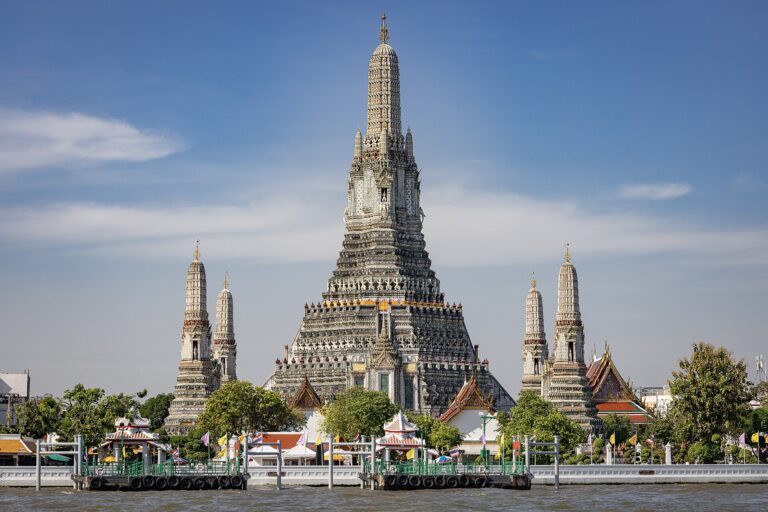
Highlights: the central prang across the river stands over 80 m. It gave Mishima the title of a novel, and the Emerald Buddha was once enshrined here. The image now in Wat Phra Kaew was moved from this temple. Admission is THB 100 for foreign visitors and free for Thai nationals.
Practical note: the temple warns about people who tell you it is closed today and offer to take you somewhere else. It opens daily from 08:00 to 18:00, so within those hours you can walk to the gate and check for yourself. The dress code bars shorts, sleeveless tops, bare shoulders and sandals, which is only slightly looser than the palace.
- Hours
- Daily 08:00–18:00
- Admission
- Foreign visitors THB 100; free for Thai nationals
- Access
- Cross-river ferry from Tha Tien on the Wat Pho side
- Official
- Thai government tourism information ↗
The cross-river fare is not published. You pay at Tha Tien pier, so keeping small change boards you faster. Even after the 18:00 closing, the prang is floodlit and visible from the riverside on the Wat Pho bank. Going inside for sunset or watching from across the water is a decision you can leave to how much is left in your legs.
The general temple etiquette is collected in the government guidance: cover shoulders and knees, take off your shoes inside halls, bow your head when passing in front of a Buddha image, do not point your feet at one, and follow each temple’s own notices on photography. Doing all three in one day means choosing in the morning an outfit that will still pass at six in the evening.
DAY 3Ayutthaya is an hour away on a train that started running in August 2026
Why this order: the ruins have no roof, so concentrate them in the morning. The first train differs by nearly four hours between weekdays and weekends, which means the shape of this day is decided the moment you pick your departure date.
Ayutthaya is about 75 km from Bangkok by the Asian Highway. A day tour is one way to go, but from 1 August 2026 the rail option changed. The State Railway’s air-conditioned SRT BANGKOK CONNEX service moved its Bangkok end from Don Mueang to Krung Thep Aphiwat Central station and began running at weekends.
That THB 50 fare is a three-month promotion running from 1 August to 31 October 2026. What it becomes afterwards has not been set, so a trip from November onwards means checking the fare again. Connections are the Red Line at Rangsit and Don Mueang and the MRT Blue Line at Central. With a hotel on the MRT, one change gets you to the ruins.
What breaks this plan hardest is putting this day on a weekend. The first train becomes 09:05, which lands you at the ruins after ten, starting to walk when the sun is already hard. If you can move the departure date, build it so DAY 3 falls on a weekday.
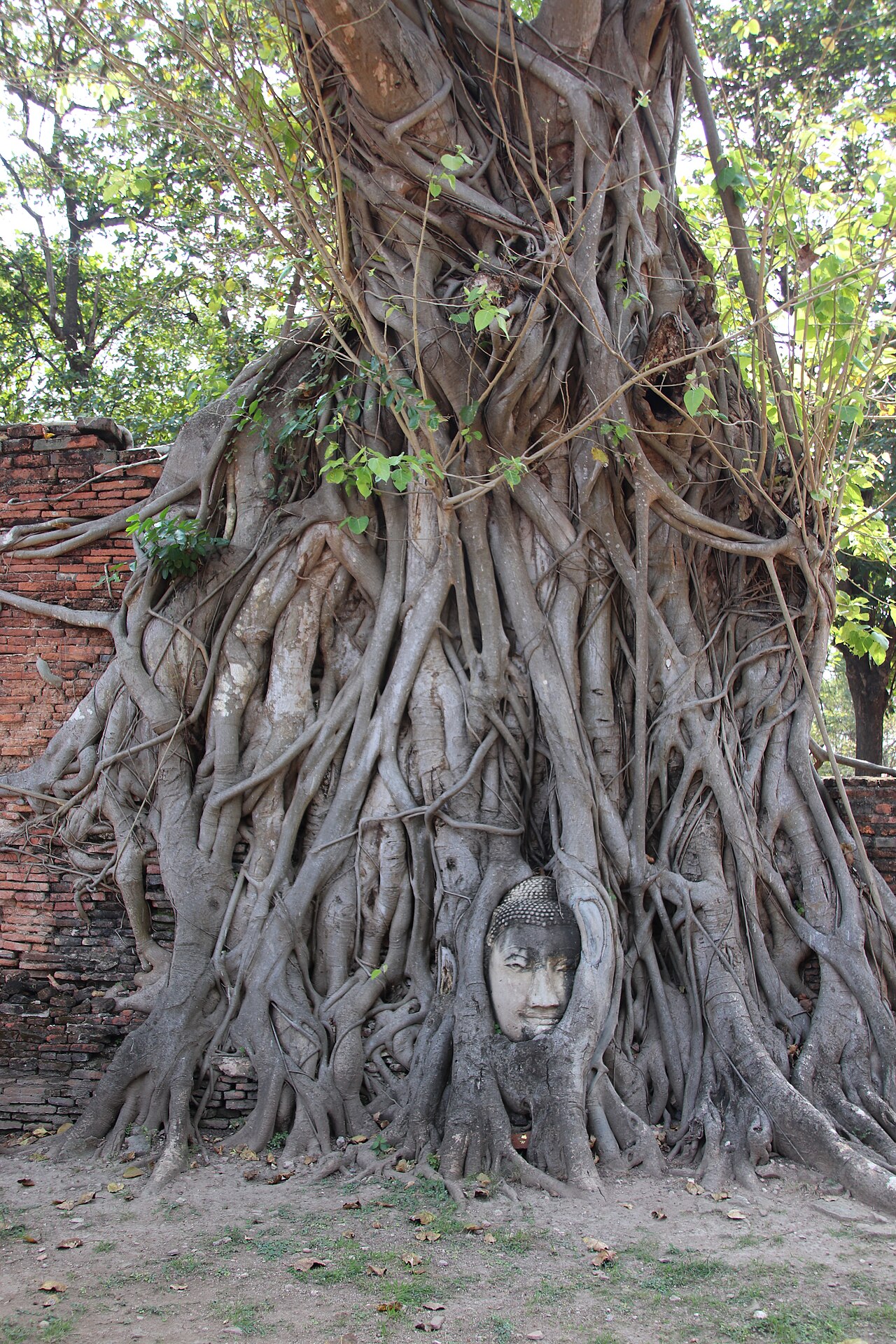
Highlights: inscribed in 1991 as the Historic City of Ayutthaya under criterion (iii), covering 1,810 rai, or 289 hectares. It was the royal capital for 417 years under 34 kings, and a port where Chinese, Japanese, Indian, Persian, Arab, Portuguese, Spanish, Dutch, English and French merchants called. Six sites charge admission: Wat Phra Si Sanphet with the old palace, Wat Phra Ram, Wat Mahathat, Wat Ratchaburana, Wat Chaiwatthanaram and Wat Maheyong.
Practical note: the official price is published two ways. The Fine Arts Department’s QR-code information page says THB 50 per site for foreign visitors and THB 220 for a six-site ticket, while another Fine Arts Department page says THB 40 for other nationalities. Both are official, so you settle the question at the window. Three sites or more and the combined ticket is the cheaper arithmetic.
- Hours
- Daily 08:00–18:00
- Admission
- Foreign visitors THB 50 per site; six-site ticket THB 220 (Thai nationals THB 10 / 40)
- Distance
- About 75 km from Bangkok by the Asian Highway
- On site
- Free information centre, staff guides, bicycle hire, a tram inside the walls
- Official
- Fine Arts Department ↗
Two ways to cover it: the tram inside the walls, which strings the main ruins together, or a hired bicycle under your own power. The land is flat, so a bicycle costs little effort, but there is no shade. Ride into the afternoon and your water consumption stops being predictable. Bicycle in the morning and tram in the afternoon is the combination that survives this climate best.
If an elephant ride is on the list, the provincial authority names the places: the Elephant Centre, Wang Chang Lae Phaniat, next to Khun Phaen House and opposite the city pillar shrine, and Ayothaya Elephant Village inside the Ayothaya floating market. The fee is only published as varying by distance and package, so the amount gets settled on site. Elephant camps in Thailand fall under a national compulsory standard, Good Practices for Elephant Camps, administered by the National Bureau of Agricultural Commodity and Food Standards with the Department of Livestock Development. Before deciding whether to ride, whether the camp operates under that standard is the most solid thing to look at.
To have the transport and the admissions handled in one booking, Klook lists Ayutthaya day trips from Bangkok with transfers and entry bundled. Doing the day yourself costs the two of you THB 200 in fares, so the difference is what you pay to avoid handling timetables and combined tickets.
DAY 4A floating market at dawn, a riverside warehouse district at night
Why this order: keep an 80 km round trip out of the daytime traffic. Leave the hottest part of the day free at the hotel and go out again only in the evening.
Dawn: a rowing boat is THB 1,000 per boat per hour
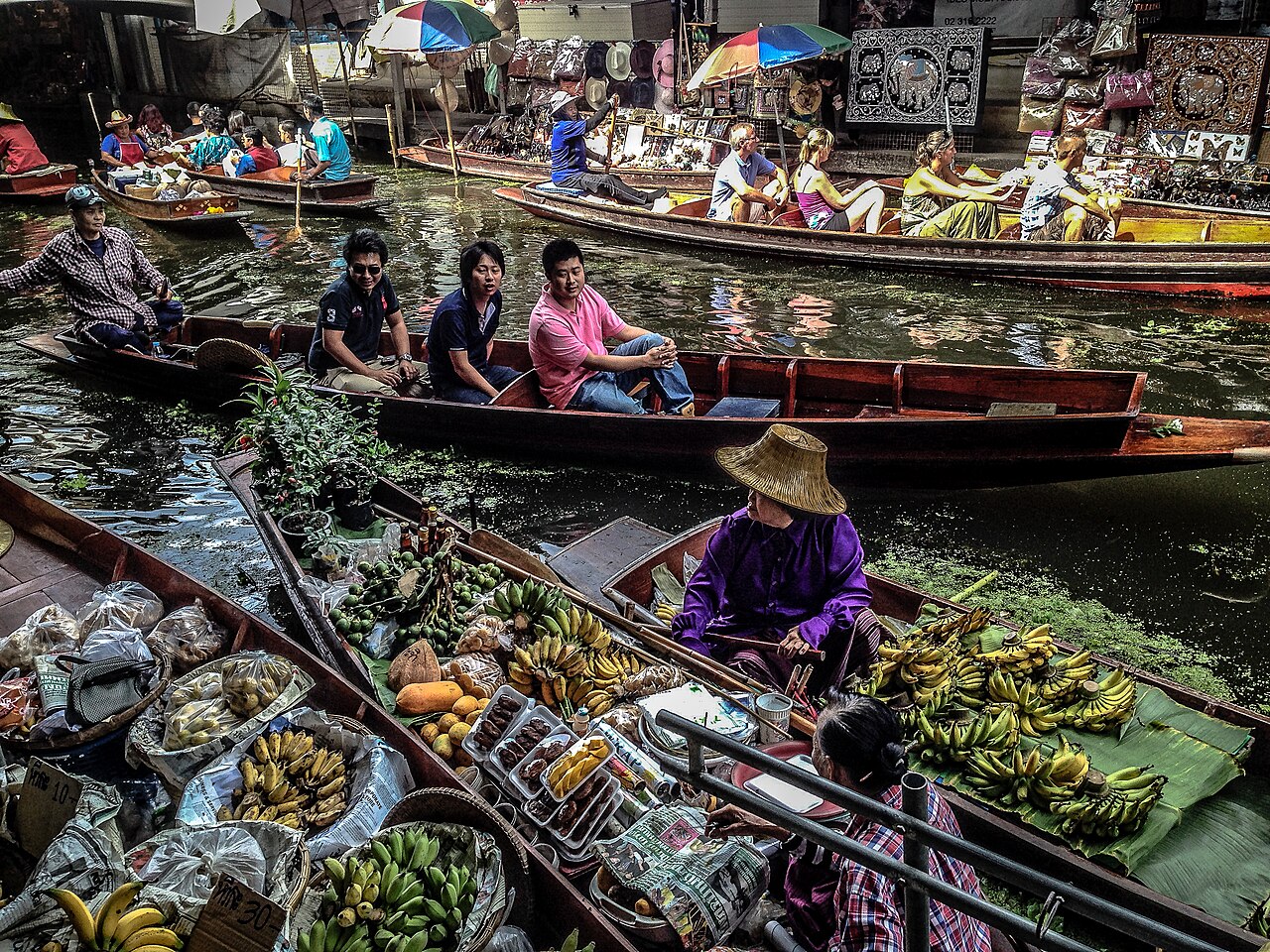
Highlights: an old water market in Ratchaburi province, about 80 km from Bangkok, where fruit and noodle dishes are sold from small boats working a narrow canal. You can watch from the bank without getting in a boat, but the density of the market is not visible until you are inside the canal.
Practical note: boat fares are fixed by provincial notice, issued on 3 May 2024. A rowing boat is THB 500 for Thai nationals and THB 1,000 for foreign visitors, per boat per hour, up to five people. A motorboat is THB 2,000 for foreign visitors, plus THB 1,000 for each additional hour. Two people hiring one boat means the total does not change up to five. If someone quotes you a figure, this notice is what you check it against.
- Distance
- About 80 km from Bangkok
- Rowing boat
- Foreign visitors THB 1,000 per boat per hour (up to 5 people)
- Motorboat
- Foreign visitors THB 2,000 per boat per hour (THB 1,000 per extra hour)
- Complaints
- Department of Internal Trade 1569; Damrongdhama Centre 1567; Tourist Police 1155
The early departure in this plan is not because the market is officially busiest in the morning. The official material gives no time of day at all; leaving early is about keeping an 80 km round trip out of the daytime traffic. Get back before noon and the afternoon can be spent at the hotel.
Journey time is not published either. Only the distance is known, so it reads better if you fix the return time first and tell the driver. The one-hour unit on the boat exists because that is the increment in the provincial notice.
Evening: Asiatique reuses the warehouses as they stand
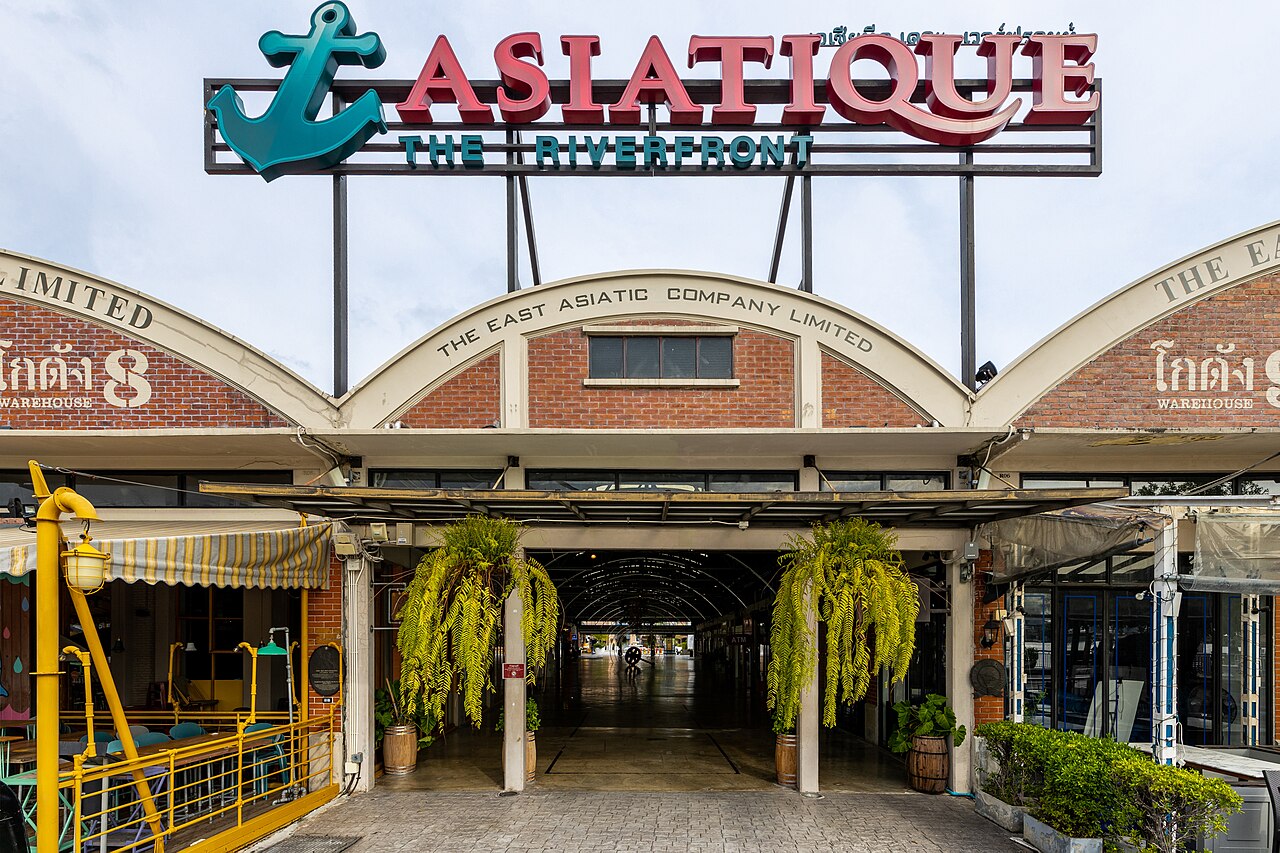
Highlights: a warehouse district on the Chao Phraya reworked into a complex. The 60-metre Asiatique Sky wheel is the landmark, and Warehouses 1 and 2 hold restaurants from across Bangkok and street food from across Thailand. There is also Sirimahannop, a restaurant inside an actual tall ship, the Calypso Cabaret show, and Mystery Mansion, a dark ride 12 m at its highest point.
Practical note: opening hours are not posted on the official site. Arriving to find it shut is a real possibility, so if this evening has to work, check at your hotel before you set out. It is on the river, so taking a boat from Sathorn pier avoids the traffic.
- Location
- On the Chao Phraya, downriver from Sathorn pier
- Wheel
- Asiatique Sky, 60 m high
- Official
- Official site ↗
Going to Asiatique by water means the blue-flag tourist boat. It runs every thirty minutes, THB 40 one way and THB 150 for a day ticket, working between Phra Arthit pier and Sathorn, calling at Wat Arun and extending to Asiatique in the evening. If you can combine DAY 2 and DAY 4 into one day, a single day ticket covers both the temples and the warehouses.
Using the river is the most effective answer to traffic in this city. Weekday fares on the Chao Phraya Express Boat are a flat THB 18 on the orange line from Nonthaburi to Ratchasingkhon, a flat THB 23 on the yellow line from Nonthaburi to Sathorn, and a flat THB 32 on the red line over the same stretch, normally THB 50. The green-yellow line from Pak Kret to Sathorn is THB 35. The orange flag is the service you take for the Grand Palace, and Tha Chang (N9) is the nearest pier.
DAY 5Shopping, a massage, and counting back to the airport
Why this order: count back from an overnight flight and keep only the morning free. If you intend to claim the VAT refund, allow for the queue at the airport in advance.
Morning: you can get through the day without carrying cash
Bangkok’s public transport accepts contactless credit and debit cards, bank-app QR payments and day passes. The BTS has three products: the Single Journey Card, the One-Day Pass and the Rabbit Card. Ticket machines are a mix of coin-only units and ones that take notes and QR.
Bank apps from eight countries and territories, Japan’s JP Bank Pay among them, work directly with Thai QR payment. That widens the range of places you can pay without changing money, and takes some of the anxiety out of spending down cash on the last day.
Fares vary by line. The BTS runs from THB 15 to THB 62, with THB 62 the ceiling. The MRT Blue Line runs THB 17 to THB 44, capped at THB 44. Both step up with distance and then stop moving.
One scheme here does not reach foreign visitors. Thailand caps fares at THB 20 for journeys made on a registered transit card, but eligibility is limited to Thai nationals holding a 13-digit national ID. Travellers pay the ordinary fares in the table. The BTS does have a one-day pass, but its price appears nowhere on the official site, and the MRT’s product list has no day pass at all, only single-journey tokens and EMV cards.
For a second massage, the Wat Pho school from DAY 2 is the price benchmark. What separates it from a shop in the city is premises and location, not a published tariff. Booking a 120-minute slot on the last day makes everything after it heavier.
Afternoon: the VAT refund happens at a designated airport counter
Qualifying purchases can have the 7 per cent VAT refunded on departure. The process happens at a designated counter at the airport, which takes time around check-in. If you intend to use it, set your departure from the city 30 to 60 minutes earlier than you otherwise would.
The emergency numbers are worth noting down: police 191, fire 199, ambulance 1669, Tourist Police 1155 with English, German and French, the Tourism Authority of Thailand 1672, and the government call centre 1111. All operate around the clock.
Alternatives
Rainy-day swap
What rain hurts here is DAY 3. The ruins at Ayutthaya have no roof, and rain removes the bicycle from the options entirely. The tram inside the walls is covered, so a wet day means dropping the bicycle and doing it all by tram. Even then the ground is earth, and walking it wet is slower than you expect.
DAY 2 survives rain. All three temples involve long stretches inside halls, and the only outdoor section is the walk from the palace to Wat Pho. Putting the day with the worst forecast on DAY 2 does the least damage.
October in Bangkok runs 24 to 32 degrees with lower humidity than high summer. Showers come through and the air conditioning indoors is fierce. A thin jacket and a folding umbrella absorb the gap between the inside of a hall and the street.
If the flight is delayed by an hour or more
Landing after midnight on the first day means the Airport Rail Link is not running. That makes it a metered taxi and nothing else, and the itinerary from the next morning is unchanged. The only thing that breaks is the first evening, and this plan has nothing in it.
Where it bites is the day of the week for DAY 3. The first train is 05:15 on a weekday and 09:05 at a weekend. Put DAY 3 on a weekend and you reach the ruins nearly four hours later. When that happens, swap DAY 3 and DAY 4, sending the floating market to the weekend and Ayutthaya to a weekday. The floating market is reached by car and is not tied to a timetable.
A delay on the way home barely registers. DAY 5 holds shopping and a massage, so there is nothing to cut, though the VAT refund needs its own time reserved.
When you’re tired
The first thing to drop is the floating market on DAY 4. A 160 km round trip for two hours of looking. The ratio of travel to substance is the worst in the plan. Cutting it frees THB 1,000 for two in admissions and the boat, and gives you that whole day inside Bangkok.
Next is the combined ticket at Ayutthaya. If you narrow it to Wat Mahathat and Wat Phra Si Sanphet rather than all six, paying THB 50 per site is cheaper. Three sites is the break-even point.
With an extra night available, insert it between DAY 3 and DAY 4. DAY 1 and DAY 5 are pinned to flight times, so extending them adds awkward fragments. In the middle, the day after Ayutthaya becomes a rest day and the early start for the floating market gets easier.
Where to stay
What this plan wants from a hotel is proximity to either the river or a rail line. DAY 2 is a boat, DAY 3 a train, DAY 4 a car. The mode changes every day, so leaning hard on any one of them puts the other days further away.
Sathorn and the riverside put a pier in walking distance, which covers both the DAY 2 run to the palace and the DAY 4 trip to Asiatique by boat. BTS Saphan Taksin is close, which also shortens the line from the airport. It is the position that fits this plan best.
Sukhumvit is the commercial district where the BTS and MRT cross, with the widest choice of food and shopping. It is away from the river, though, so DAY 2 gains a change of train. Staying in the old city, Rattanakosin, puts the three temples within walking distance at the cost of distance from both dinner and the railway. All three work, but with the Ayutthaya trip on DAY 3, a position with MRT Blue Line access to Central station has the advantage.
Prices move on identical dates, which is why none appear in the table above. Book flights, then the room, then the admissions. The exception is the Grand Palace’s online ticket, which allows neither refunds nor date changes, so leave it until last or buy at the counter on the day.
What this trip costs
Assumptions: two adults, four nights, moving under your own arrangements rather than on a tour. Air fares are outside the total because they swing too far by route and season, and rooms and meals move on identical dates. City BTS and MRT fares vary by section, THB 15 to 62 and THB 17 to 44, so they are not in the table either. What is listed is only what has a fixed price per unit of payment.
Every figure above is the published rate as of 2026-09-14. The yen conversion uses the Bank of Thailand’s telegraphic rate for 11 September 2026.
Nearly half of that THB 3,440 is the Grand Palace and Wat Pho: THB 1,600 for two, about JPY 7,500. Wat Arun at THB 100 is an order of magnitude below the other two, so cutting costs means touching the palace rather than the temple across the river. Cut the palace, though, and the subject of the trip changes.
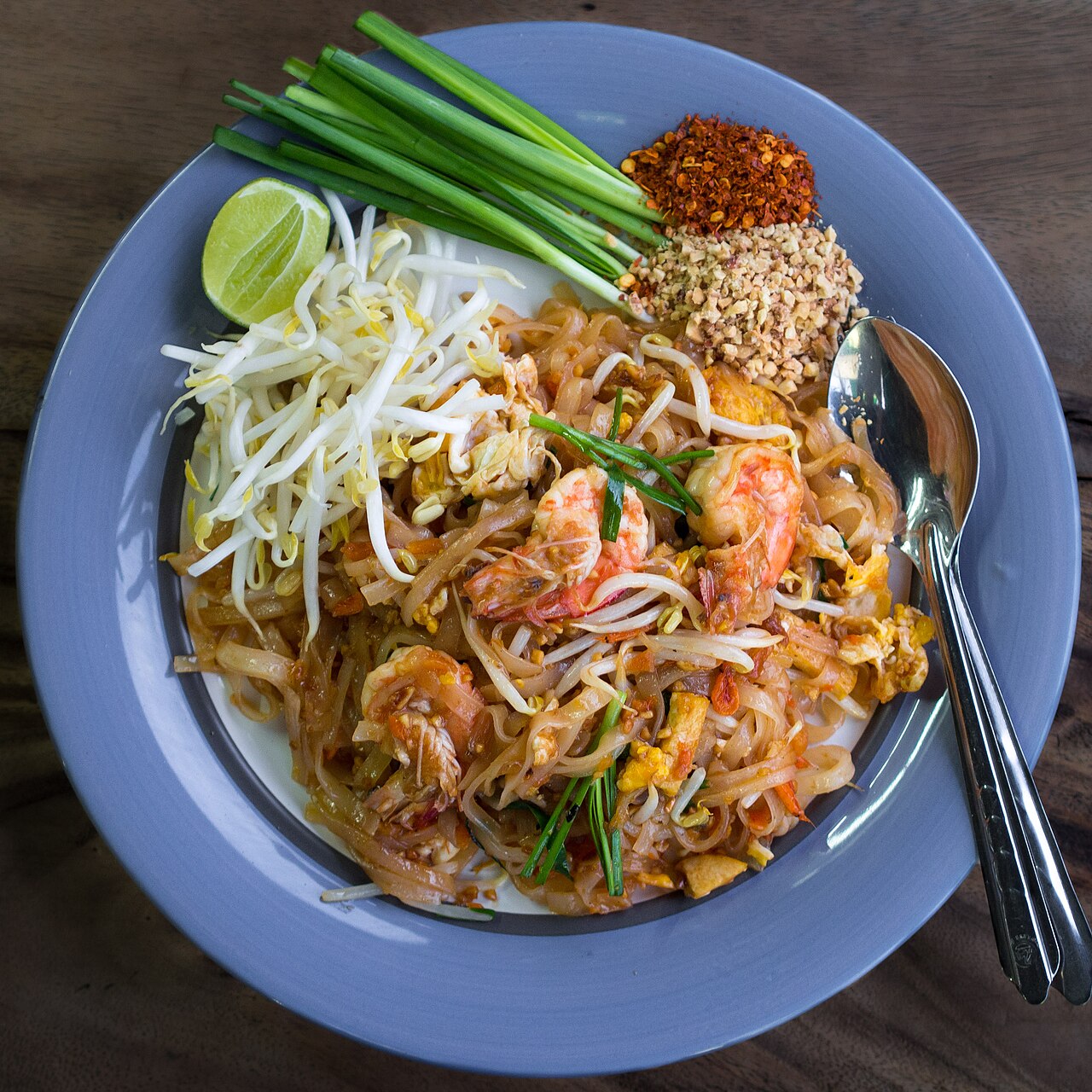
Food is where the range is widest in this city. Pad thai, gaprao rice and khao man gai from a stall, against tom yum goong in an air-conditioned dining room, are different orders of magnitude for the same meal. Sweet things like mango sticky rice are better on the stall side, so switching one of three daily meals to a stall changes how the total reads.
Also outside the table is data. This is an itinerary run on a ride-hailing app and a map, so being connected from the moment you land is the safer arrangement. The break-even by party size is worked out in the eSIM against pocket Wi-Fi comparison.
On safety, the methods Japanese travellers actually encountered in 2025 have been published. Pickpocketing is the most common, followed by a stranger asking to see your money and removing cash or a card during the exchange. Fraud after accepting an invitation from someone unknown, taxi and tuk-tuk drivers included, and inflated bills at karaoke venues also occur. The approach Wat Arun warns about, being told the temple is closed, is the same shape of opening.
Where this plan does not work is a set of dates that can only put DAY 3 on a weekend. The first train becomes 09:05 and you walk roofless ruins through the middle of the day. Secure one weekday, on the other hand, and you can reach Ayutthaya and back and cover the combined ticket for THB 640 between two, without a tour. For another Southeast Asian trip built on ruins, the Siem Reap three-night plan is the comparison; for one that splits street walking and the sea, the Penang five-night plan is. Line them up by how many days you have.
Sources: official sites of the Grand Palace (royalgrandpalace.th); Wat Pho (watpho.com); Thai government tourism information (am2026thailand.go.th); the Fine Arts Department (finearts.go.th); the State Railway of Thailand and the Government Public Relations Department; Ratchaburi provincial announcements; the Chao Phraya Express Boat; the Thai Immigration Bureau (TDAC); the Royal Thai Embassy in Tokyo; Japan’s Ministry of Foreign Affairs overseas safety information; and the Bank of Thailand / Checked on 2026-09-14 / Featured image: Mastertongapollo, CC BY-SA 4.0 (Wikimedia Commons)
Other sales ending soon




 4 days leftuntil Oct 24Air Busan Takamatsu-Busan Coupon: Up to 9,000 Yen Off Until October 24
 5 days leftuntil Oct 25JAL Hong Kong Campaign: Tokyo–Hong Kong Round Trip from 75,800 Yen (until 25 Oct)
 11 days leftuntil Oct 31Jin Air Kobe–Seoul: 5,000 yen off a round trip with code KTOUKB1, until 31 October
 11 days leftuntil Oct 31Jin Air to Busan: 4,000 yen off a round trip with code KTOPUS, first 300 only