This article contains advertising (affiliate links). We may earn a commission when you buy or sign up through a link in this article.
Estimated Local Budget for 2 Adults (Excluding Shinkansen & Airfare)
56,860 JPY (28,430 JPY per person)
Full itemization and verification date are listed in the cost table at the end of this guide
A complete 2-day, 1-night winter itinerary for two adults exploring Nyuto Onsenkyo and the samurai district of Kakunodate in Akita Prefecture without a rental car. To eliminate the risk of getting stranded by late-afternoon blizzards or rural bus suspensions, this route reverses the standard tourist sequence: you ascend directly from JR Tazawako Station to the mountain hot springs of Nyuto Onsen around midday on Day 1, and spend Day 2 exploring Lake Tazawa and walking the flat, snow-covered streets of Kakunodate within easy walking distance of the Shinkansen station.
Depart Tokyo Station on the Akita Shinkansen Komachi (JR East E6 series, all-reserved seating) to JR Tazawako Station (approx. 2 hours 55 minutes). Enjoy hot Inaniwa udon or mountain vegetable soba lunch near the station
Ride the Ugo Kotsu route bus (Nyuto Line) to Alpa Komakusa bus stop (approx. 35 minutes, 600 JPY one way). Transfer to the inn shuttle van for Tsurunoyu Onsen and soak in the milky-white open-air snow baths (Shirayu and Kuroyu) before sunset
Savor a traditional mountain dinner featuring yamanoimo (mountain yam) hot pot and charcoal-grilled iwana (char) around the hearth in the thatched Honjin building, followed by a quiet night bath illuminated by snow lanterns
DAY 2
Use the guests-only Yumeguri-cho pass (2,500 JPY) to visit one neighboring inn such as riverside Taenoyu or forest-surrounded Ganiba Onsen. Take the late-morning bus down to Lake Tazawa Lakeside and visit Kansagu (Ukiki Shrine)
Board the JR Tazawako Line from Tazawako Station to Kakunodate Station (approx. 20 minutes, 330 JPY one way). Store luggage at the station, dine on Hinai-jidori oyakodon, and tour the samurai residences (Ishiguro House, Aoyagi House, Kabazaiku Museum) on foot
Warm up with coffee and red-bean sweets at a converted storehouse cafe, walk 15 to 20 minutes back to JR Kakunodate Station, and board an evening Akita Shinkansen Komachi back to Tokyo Station
DAY 1From JR Tazawako Station to Nyuto Onsenkyo: Ascending by Midday Bus for Daylight Snow Baths
Routing Intent: Ascend to the 700-meter-high mountain hot springs of Nyuto Onsenkyo during the brightest midday hours before evening road icing or snowstorms can disrupt mountain bus operations, securing unhurried daylight bathing in the open-air rotenburo.
Morning: Arriving at JR Tazawako Station Aboard the Akita Shinkansen Komachi
When planning a car-free winter journey into the deep snow country of northern Tohoku, the single most critical decision is the exact hour you ascend into the mountains. Boarding the Akita Shinkansen Komachi (operated with JR East E6 series 7-car trainsets) at Tokyo Station brings you north to Sendai Station in roughly 1 hour 30 minutes and to Morioka Station in about 2 hours 15 minutes. Beyond Morioka Station, the train leaves the high-speed viaduct and enters the JR Tazawako Line section, climbing across the steep Sengantoge mountain pass along the Ou Mountains to reach JR Tazawako Station in Semboku City, Akita Prefecture, in approximately 2 hours 55 minutes from Tokyo Station (travel time to Tazawako Station is about 1 hour 15 minutes from Sendai Station, 40 minutes from Morioka Station, and 55 minutes from Akita Station).
Many conventional travel brochures suggest spending your first morning and early afternoon sightseeing in the castle town of Kakunodate, then doubling back to Tazawako Station in the late afternoon to catch a bus up to Nyuto Onsenkyo. During the heavy snow months from December through March, following that conventional sequence is a serious mistake. If you finish walking around Kakunodate and attempt to board a 15:00 or 16:00 Ugo Kotsu route bus on the Nyuto Line, twilight is already settling over the mountains, temperatures are plunging well below freezing, and blowing snow or snowplow operations frequently cause route delays. In my winter itinerary design across northern Japan, I always prioritize one strict rule: clear the mountain bus segment during midday on Day 1, because steep mountain bus routes are far more vulnerable to sudden evening weather closures than main rail lines.
Transport Option from Tazawako Station
Travel Time
Cost for 2 Adults (One Way)
Best Suited For & Practical Characteristics
Ugo Kotsu Route Bus “Nyuto Line” (Exit at Alpa Komakusa + Inn Shuttle)
Approx. 35 min + 10 min shuttle
1,200 JPY (600 JPY × 2 adults)
Standard recommended route for pairs staying at or visiting Tsurunoyu Onsen
Ugo Kotsu Route Bus “Nyuto Line” (Ride to Nyuto Onsen Terminal)
Approx. 50 min
1,600 JPY (800 JPY × 2 adults)
Travelers heading directly to Taenoyu, Ganiba Onsen, Ookama Onsen, or Kyukamura
Station Taxi (Direct from JR Tazawako Station to Nyuto Onsenkyo)
Approx. 30 min
Approx. 6,500 to 9,000 JPY (per cab)
Backup transfer during bus suspensions or for travelers carrying oversized luggage
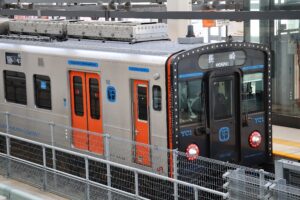
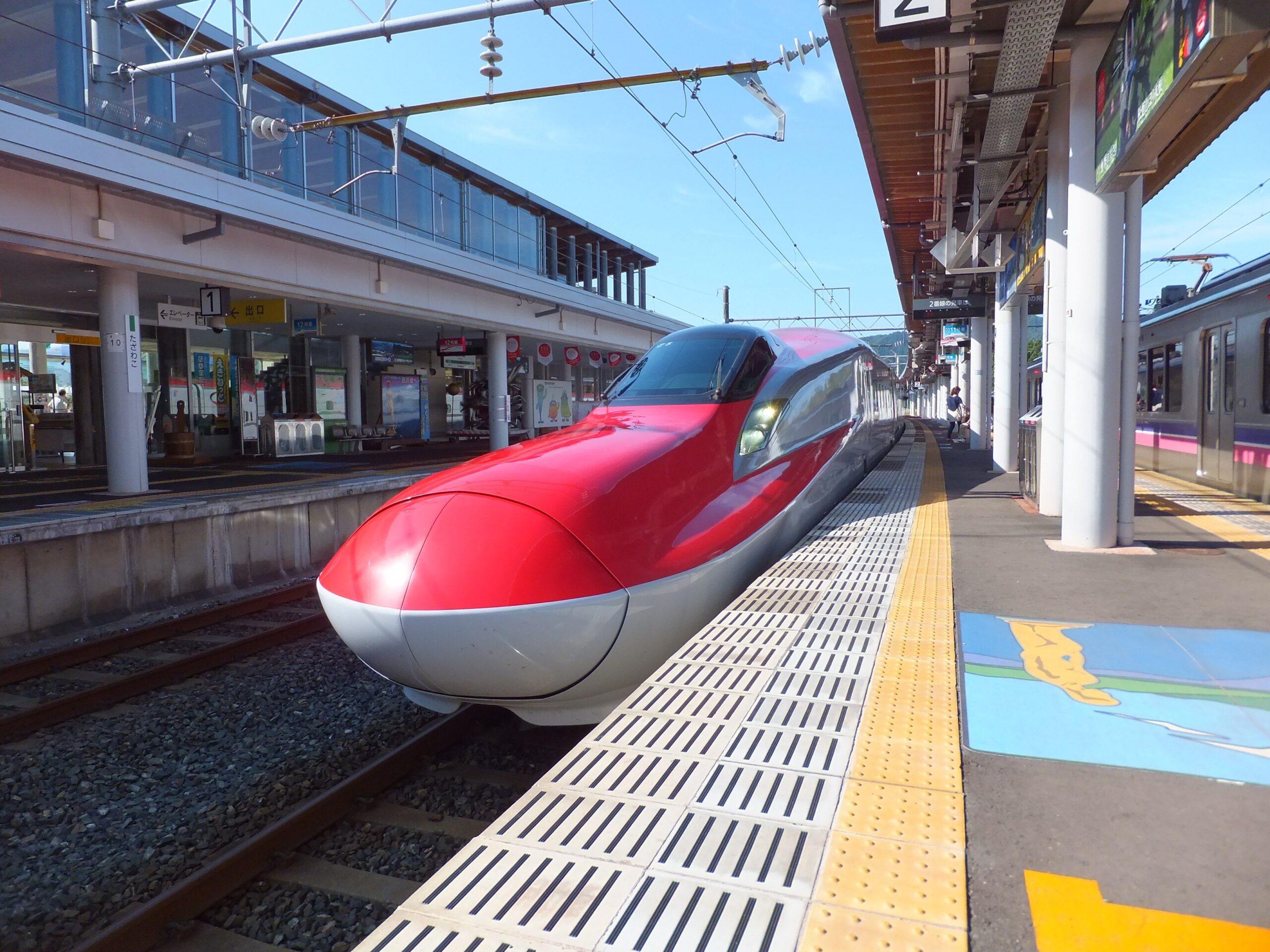
JR East E6 series Akita Shinkansen Komachi at Tazawako Station (Source: Wikimedia Commons / Kikucha, CC BY-SA 3.0)
JR Tazawako Station & Semboku City Tourist Information Center “Folake”
Suggested Time: Approx. 40 to 60 minutes (including lunch and bus connection)
A modern glass-walled station building housing a full-service tourist desk where you can verify live mountain bus operations and snow-clearing conditions before ascending.
If you are staying at Tsurunoyu Onsen or requesting its pickup shuttle, always call the inn front desk as soon as you arrive at Tazawako Station to confirm which departure time of the Ugo Kotsu bus you are boarding so the shuttle van will meet you at Alpa Komakusa bus stop.
Address
68 Otokozaka, Obonai, Tazawako, Semboku City, Akita Prefecture
Counter Hours
08:30 to 17:15 (Tourist Information Center “Folake”)
Bus Fares
600 JPY per adult to Alpa Komakusa / 800 JPY per adult to Nyuto Onsen
By departing Tokyo Station on an 08:00 or 09:00 hour Akita Shinkansen Komachi, you will step onto the platform at JR Tazawako Station between 11:30 and 12:50. Because every car on the Komachi is reserved seating, you never have to worry about standing in crowded aisles even during peak winter holiday periods. However, keep in mind a crucial operational detail: the track between Morioka Station and Akita Station is a single-track mini-Shinkansen line where high-speed trains share upgraded standard-gauge rails through heavily forested mountain valleys. In winter, precautionary slowdowns for wildlife on the tracks (such as Japanese serow) or high winds and heavy snow accumulation frequently cause minor delays of 10 to 20 minutes. Rather than gambling on a tight 8-minute or 10-minute bus connection at Tazawako Station, plan from the start to take the next hourly Ugo Kotsu “Nyuto Line” bus while enjoying a hot lunch of Inaniwa udon or mountain vegetable soba at a restaurant right in front of the station (budgeting around 3,600 JPY for two adults). For a deeper look at how single-track winter rail schedules behave in northern Japan, see the operational timetable buffer analysis in our JR Hokkaido Doko-Iku Weekday Pass day-trip itinerary guide.
Right beside the ticket gates inside JR Tazawako Station sits the Semboku City Tourist Information Center “Folake” (open daily from 08:30 to 17:15). The staff post real-time updates on day-bath cleaning closures across the seven inns of Nyuto Onsenkyo as well as weather advisories for the mountain road. If you have 30 minutes before your bus departs, browse the second-floor local heritage gallery in the station building and pick up bottled drinks or snacks at the station kiosk. Once your bus climbs into the beech forests of Nyuto Onsenkyo, there is not a single convenience store anywhere in the valley, meaning the small souvenir counters inside each ryokan are your only source of supplies until the next morning.
Afternoon: Transferring at Alpa Komakusa for the Milky-White Snow Baths of Tsurunoyu Onsen
Departing from the bus rotary outside JR Tazawako Station, the Ugo Kotsu route bus on the Nyuto Line first passes the eastern shore of Lake Tazawa at the Tazawako Kohan stop (approx. 12 minutes from the station, fare 350 JPY). From there, the bus climbs steadily past Mizusawa Onsenkyo (500 JPY) and the Tazawako Ski Resort stop (530 JPY), reaching the “Alpa Komakusa” bus stop in roughly 35 minutes (600 JPY per adult, or 1,200 JPY for two adults). Staying on the bus all the way to the upper stops at Kyukamura-mae and Nyuto Onsen takes about 50 minutes from the station (800 JPY per adult, or 1,600 JPY for two adults).
Here lies the single most common trap for first-time winter visitors heading to Tsurunoyu Onsen. The Ugo Kotsu route bus has a stop named “Tsurunoyu Onsen Iriguchi” (Tsurunoyu Onsen Entrance, 700 JPY from Tazawako Station or 180 JPY from Alpa Komakusa), which sounds as if it drops you right outside the inn. In reality, Tsurunoyu Onsen sits at the end of a narrow, snow-packed forest road (the Tsurunoyu Rindo) roughly 3 kilometers uphill from that bus stop. Even in summer, walking that forest road takes 40 to 50 minutes uphill; in sub-zero winter blizzards while pulling wheeled luggage, walking from Tsurunoyu Onsen Iriguchi is out of the question. Always telephone the inn before boarding the bus at Tazawako Station, step off one stop earlier at “Alpa Komakusa,” and board the dedicated Tsurunoyu courtesy shuttle van waiting in the parking lot (the shuttle operates strictly between Tsurunoyu Onsen, Yamanoyado, and the Alpa Komakusa bus stop).
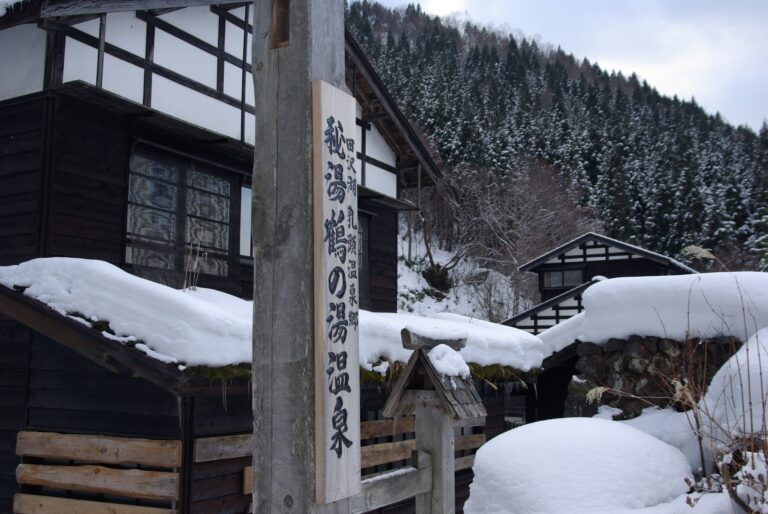
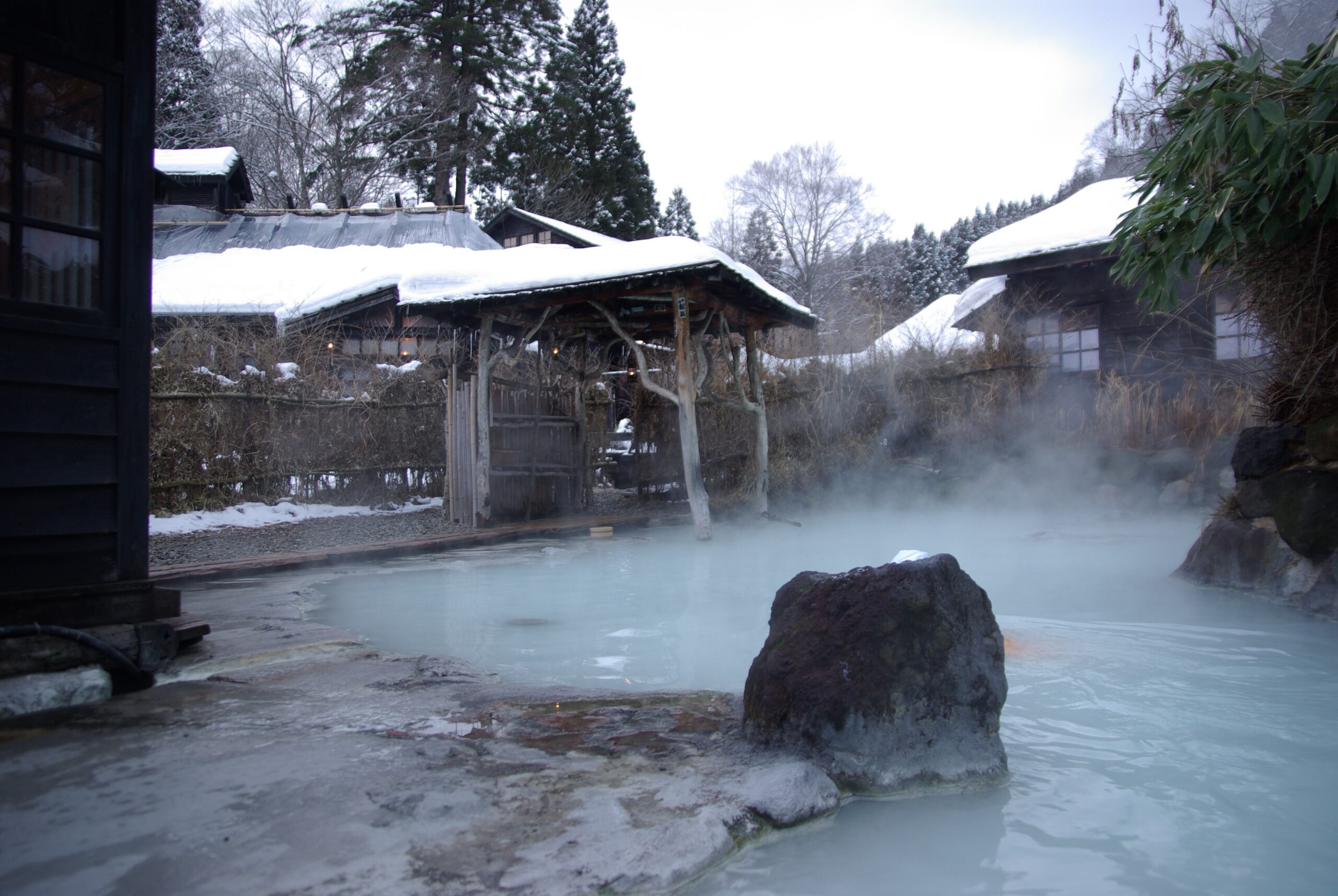
Milky-white geothermal waters and snow-draped wooden roofs at Tsurunoyu Onsen (Source: Wikimedia Commons / Fumiaki Yoshimatsu, CC BY-SA 2.0)
Nyuto Onsenkyo: Tsurunoyu Onsen
Suggested Time: Overnight stay (approx. 60 to 90 minutes for day-trip bathers)
The oldest hot spring inn in Nyuto Onsenkyo, with historical records of feudal lord therapy visits dating back to 1638 (Kan’ei 15).
Four distinct natural spring sources (Shirayu, Kuroyu, Nakanoyu, and Takinoyu) bubble up within a 50-meter radius. Note that the open-air baths close to day-trip visitors every Monday (or the following weekday if Monday is a national holiday) for full-drainage cleaning.
Address
50 Sendatsuzawa National Forest, Tazawako Tazawa, Semboku City, Akita Prefecture
Day-Bath Hours
10:00 to 15:00 (Closed to day-trip bathers on Mondays for open-air bath cleaning)
Standard Rates
Day bath: 700 to 1,000 JPY per adult (300 to 500 JPY per child, towel sale 200 JPY) / Overnight with 2 meals: 11,700 to 24,350 JPY per person (plus 1,320 JPY winter heating fee per room)
After a 10-minute ride along the snow-walled forest lane in the courtesy van, the trees part along the Sendatsu River to reveal the iconic thatched-roof “Honjin” longhouse of Tsurunoyu Onsen. Sitting at the foot of Mount Nyuto (elevation 1,478 meters), Tsurunoyu traces its documented history to 1638 (Kan’ei 15), when Satake Yoshitaka, the second feudal lord of the Akita Domain, visited for hot-spring therapy, followed in 1661 (Kanbun 1) by Lord Iwaki Genba of the Kameda Domain. Records of ordinary travelers staying at the inn begin in the Genroku era (1688 to 1704), and local lore attributes the name “Tsurunoyu” (Crane’s Hot Spring) to a local hunter named Kansuke who spotted a wounded crane healing its leg in the steaming waters. The long thatched Honjin building originally quartered the samurai guards who accompanied the feudal lord; every few decades, master thatchers known as “kayade” from the Jindai Umezawa district re-thatch the roof by hand using miscanthus grass harvested in the Obonai Shimotakano area and seasoned over an entire winter.
Once you check in around 14:30 or 15:00, head straight across the wooden footbridge in front of the main office to the bathhouses while daylight still illuminates the valley. Remarkably, four chemically distinct springs well up naturally within a 50-meter radius on the grounds. The signature “Shirayu” (White Bath) is a sulfur, sodium, calcium chloride, and bicarbonate spring (hydrogen sulfide type), famous for its opaque milky-blue tint and nicknamed both the “Beauty Bath” and the “Chills-Cooling Bath.” Right next to it, “Kuroyu” (Black Bath) is a sodium chloride and bicarbonate spring prized as a deep-warming bath (“Nugudamari-no-yu”), while “Nakanoyu” (a baking-soda and salt hydrogen sulfide spring known for soothing the eyes) and “Takinoyu” (hot sulfur waterfall massage spouts) complete the quartet. Even though the wooden tubs sit steps apart, the crisp sulfur aroma of Shirayu feels completely different on the skin from the velvety warmth of Kuroyu. Furthermore, because day-trip bathing ends strictly at 15:00 across Tsurunoyu, all non-staying visitors clear out right at 15:00, leaving the vast open-air rotenburo and snow-covered boulders exclusively to overnight guests during the magical late-afternoon hour. Travelers planning to book JR East rail passes or regional sightseeing tickets in advance can also check Klook’s Japan rail pass and Tohoku transport listings to bundle Shinkansen travel before departure.
Evening: Mountain Yam Hot Pot Around the Hearth and Snow-Lantern Solitude
By 16:30 in midwinter, deep indigo darkness settles over the valley of Nyuto Onsenkyo. When the oil-style lamps hanging beneath the eaves of the Honjin and the small snow lanterns carved along the footpath are lit, the dark timber walls and two-meter-high snowbanks glow with a quiet warmth that feels centuries removed from modern city life. Dinner is served either directly around the sunken irori hearth inside the historic Honjin rooms or in the atmospheric Honjin dining hall. The centerpiece of a winter stay at Tsurunoyu is “Yamanoimo-nabe,” a rich miso-based hot pot filled with hand-grated, extraordinarily dense mountain yam dumplings simmered alongside pork, wild mountain vegetables (sansai), and local mushrooms. Eating a bowl of this steaming mountain yam stew alongside whole river char (iwana) slow-roasted on bamboo skewers stuck into the hearth ashes warms your core so thoroughly that you barely feel the frost when stepping back outside.
After letting dinner settle and heading back out around 21:00 for a late-night soak in the open-air baths or the women-only rotenburo, pay close attention to winter footing and temperature acclimation. The wooden bridge and outdoor walkways connecting guest buildings (Building 1, Building 2, Building 3, Shin-Honjin, and Higashi-Honjin) freeze solid at night and become treacherous if walked in damp indoor slippers. Always slip into the tall insulated rubber snow boots provided at the building entrance and watch the lit path carefully. Because the rustic wooden changing rooms are also unheated or lightly heated, never step straight from the cold floorboards into the freezing outdoor air; instead, pour plenty of hot spring water over your shoulders and legs inside the indoor Kuroyu or Shirayu bath first so your body is thoroughly warmed before wading out into the snow-rimmed rotenburo.
DAY 2Morning Bath-Hopping, Lake Tazawa’s Unfrozen Shore, and Kakunodate’s Samurai Streets
Routing Intent: Finish mountain bath-hopping and descend by bus to the valley floor before noon, spending the afternoon in the flat castle town of Kakunodate where you can walk directly to the Shinkansen station regardless of evening snowfall.
Morning: Visiting One Neighboring Inn with the Yumeguri-cho Pass and Descending to Lake Tazawa
On the morning of Day 2, after a sunrise soak and breakfast at your inn, take advantage of the “Yumeguri-cho” (Bath-Hopping Passbook, 2,500 JPY per adult and 1,000 JPY per child, or 5,000 JPY for two adults; cash payment only), sold exclusively at the front desks of the seven member inns of the Nyuto Onsenkyo Cooperative (Tsurunoyu, Taenoyu, Ganiba, Ookama, Magoroku, Kuroyu, and Kyukamura Nyuto Onsenkyo). Here it is essential to understand a key seasonal rule: the cheaper “Yumeguri Map” (1,000 JPY, covering bus rides only for non-staying day visitors) is sold only from April through November and is suspended throughout the winter. By contrast, overnight guests at any of the seven inns can purchase the full 2,500 JPY Yumeguri-cho even in midwinter, granting admission to one bath at each of the seven inns plus access to the cooperative’s “Yumeguri-go” shuttle bus (advance reservation required, operating on a winter timetable). Even better, the Yumeguri-cho remains valid for one full year from the date of purchase, meaning you never need to rush through all seven baths in a single winter morning.
For a relaxed 2-day winter trip, I strongly recommend picking just one additional inn to visit during the morning window before catching your bus down the mountain. The two best winter choices are “Taenoyu” (located right beside the Sendatsu River rapids; day-bath hours 10:30 to 15:00 with last entry at 14:00, closed Tuesdays, regular admission 1,000 JPY) or “Ganiba Onsen” (tucked at the far end of the paved road with a cedar-framed open-air bath in a primeval beech forest; day-bath hours 09:00 to 16:00, closed Wednesdays, regular admission 800 JPY). Attempting to squeeze three or four baths into a single snowy morning leaves you exhausted from repeatedly dressing in heavy winter layers and waiting for buses, and risks missing the midday bus back to Tazawako Station. At Taenoyu, you can compare two completely different spring types—the amber, iron-rich “Kin-no-yu” (Gold Bath, a calcium-magnesium sulfate spring) and the crystal-clear “Gin-no-yu” (Silver Bath, a simple thermal spring)—while gazing directly at snow-draped boulders in the rushing stream (note that Ookama Onsen, famous for its relocated wooden schoolhouse and 700 JPY acidic bath closed Thursdays, experiences periodic operational suspensions, so always verify its status at your front desk before setting out).
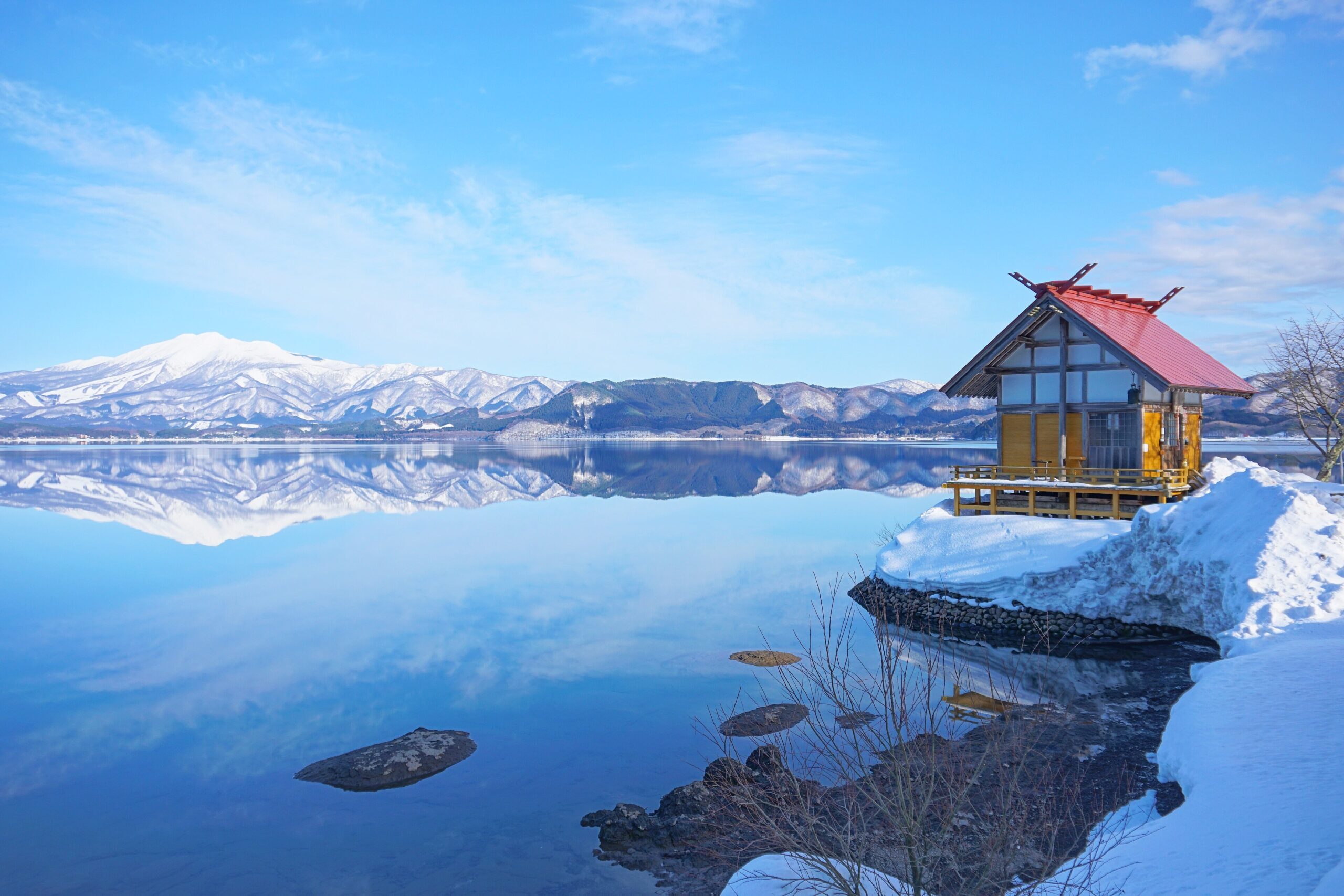
Kansagu (Ukiki Shrine) on the winter shore of Lake Tazawa (Source: Wikimedia Commons / Kikucha, CC BY-SA 4.0)
Lake Tazawa Eastern Shore, Kansagu (Ukiki Shrine) & Shirahama
Suggested Time: Approx. 30 to 45 minutes
A nearly circular caldera lake measuring about 20 kilometers in circumference with a maximum depth of 423.4 meters—the deepest in Japan—whose cobalt-blue waters never freeze even in midwinter.
On your Ugo Kotsu bus ride back from Nyuto Onsenkyo toward JR Tazawako Station, step off at the “Tazawako Kohan” stop (650 JPY from Nyuto Onsen or 500 JPY from Alpa Komakusa; 350 JPY onward to Tazawako Station) to walk the snowy shoreline and shrine before catching the next bus to the station.
Address
Haruyama, Tazawako Tazawa, Semboku City, Akita Prefecture (Tazawako Kohan)
Visiting Hours
Lakeside promenade open 24 hours (Tazawako Rest House hours vary by season)
Bus Fare
350 JPY per adult from Tazawako Kohan to JR Tazawako Station (700 JPY for 2 adults, approx. 12 minutes)
When descending from Nyuto Onsenkyo on an 11:00 or 12:00 hour Ugo Kotsu route bus, if the sky is reasonably clear, stepping off at the “Tazawako Kohan” (Lake Tazawa Lakeside) bus stop makes for a memorable 30-to-45-minute interlude. Because Lake Tazawa plunges to a depth of 423.4 meters—making it the deepest lake in Japan—upwelling thermal currents from the deep lakebed prevent the surface from freezing over even in the dead of an Akita winter. The visual contrast between pure white snowdrifts along the Shirahama beach, the deep sapphire water, and the unpainted wooden shrine building of Kansagu (Ukiki Shrine) jutting out over the water is breathtaking on a calm winter day. Keep in mind that the famous golden “Tatsuko Statue” stands on the opposite western shore at Katajiri (710 JPY from Tazawako Station or 490 JPY from Tazawako Kohan), where winter round-the-lake bus departures (1,160 JPY) are infrequent. For a car-free 2-day itinerary, staying at the eastern Tazawako Kohan stop where every Nyuto Line bus passes gives you the lakeside scenery without risking a long wait in the cold, before hopping a 12-minute bus ride (350 JPY per adult) back to JR Tazawako Station.
Afternoon: Riding the JR Tazawako Line to Kakunodate and Walking the Snow-Covered Samurai District
Back at JR Tazawako Station, board either a local train on the JR Tazawako Line (701 series, approx. 17 to 20 minutes, fare 330 JPY per adult or 660 JPY for two adults) or the Akita Shinkansen Komachi (approx. 13 minutes, one stop) westward to JR Kakunodate Station. Because local trains on the Tazawako Line have multi-hour gaps during midday, if no local train aligns with your bus arrival, simply purchase a short-segment Shinkansen ticket or board the Ugo Kotsu route bus bound for the Kakunodate Bus Office (550 JPY per adult) to keep your afternoon schedule moving smoothly.
Immediately upon arriving at JR Kakunodate Station, store all suitcases and heavy bags either in the station coin lockers (400 JPY for small, 500 JPY for medium, 700 JPY for large) or at the adjacent “Semboku City Tourist Information Center Kakunodate Ekimae-Kura” right next to the station building (open 09:00 to 17:30, luggage storage 500 JPY per bag, or 1,000 JPY for two bags). Even though Kakunodate’s main streets are plowed, dragging small suitcase wheels through packed snow or slush quickly jams the casters and exhausts your arms. At the Ekimae-Kura center you can also inquire about complimentary loaner snow boots (subject to availability), check walking maps, and set off into the historic town completely hands-free.
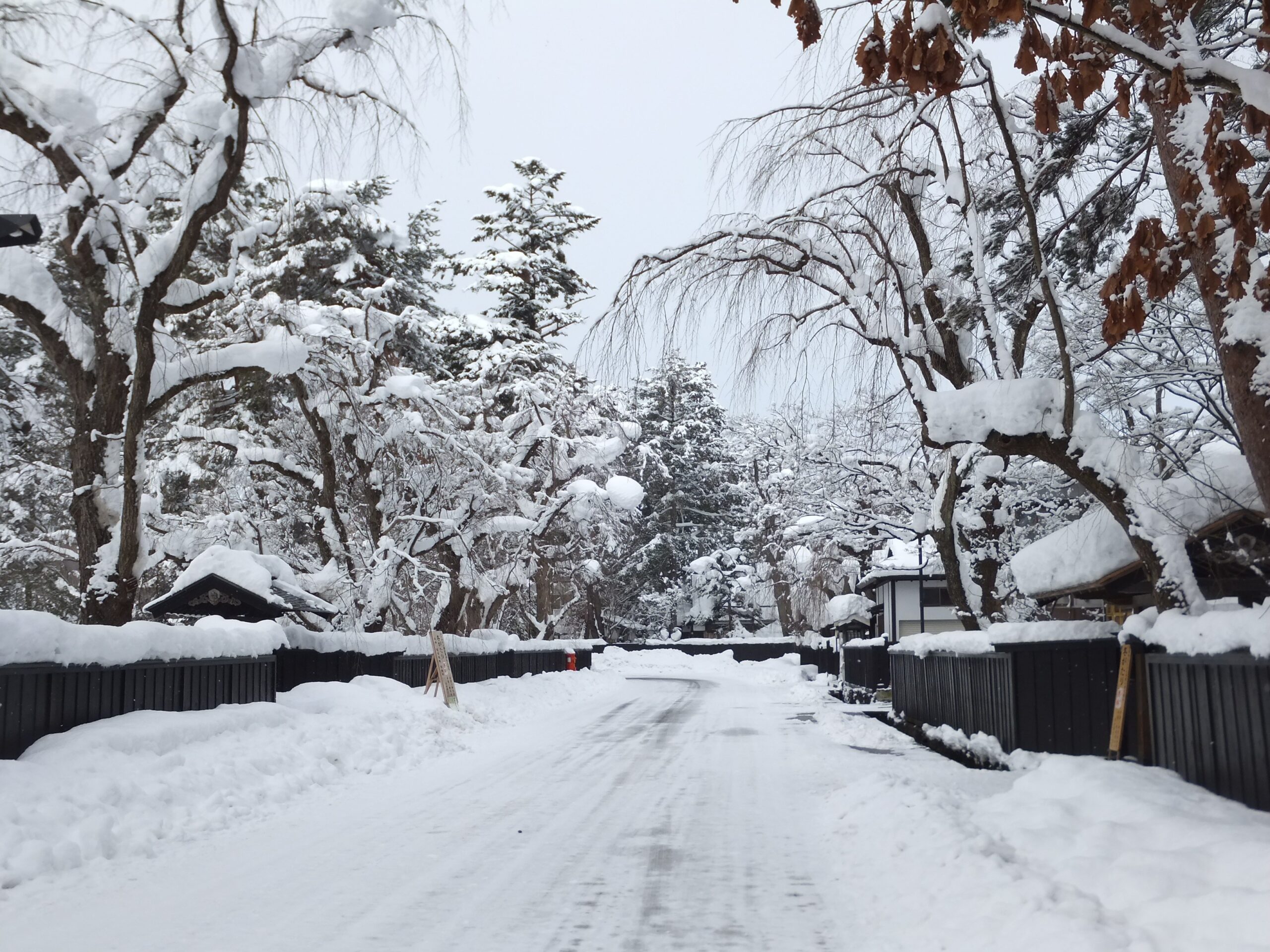
Snow-covered Bukeyashiki Street and black wooden fences in winter Kakunodate (Source: Wikimedia Commons / Kikucha, CC BY-SA 3.0)
Kakunodate Bukeyashiki Street (Ishiguro House, Aoyagi House & Kabazaiku Denshokan)
Suggested Time: Approx. 2.5 to 3 hours (including lunch and interior samurai house tours)
A nationally designated Important Preservation District for Groups of Traditional Buildings retaining its original 1620 (Genna 6) street grid and black-boarded samurai compounds.
Do not simply walk the snowy street outside: step inside both the “Ishiguro House” (400 JPY, the oldest surviving samurai residence in Kakunodate) and the 3,000-tsubo “Aoyagi House” (500 JPY) to hear live explanations and explore heated exhibition storehouses.
Address
Omotemachi Shimocho & Higashishorakucho, Kakunodate-machi, Semboku City, Akita Prefecture (15 to 20 minutes on foot from JR Kakunodate Station)
Opening Hours
Ishiguro House: 09:00 to 17:00 (open year-round) / Aoyagi House: 09:00 to 16:00 (Nov to Mar winter hours; until 17:00 Apr to Oct) / Kabazaiku Denshokan: 09:00 to 16:30 (Dec to Mar winter hours)
Admission
Ishiguro House: 400 JPY per adult (800 JPY for 2) / Aoyagi House: 500 JPY per adult (1,000 JPY for 2) / Kabazaiku Denshokan: 300 JPY per adult (600 JPY for 2)
The walk from JR Kakunodate Station to the southern entrance of Bukeyashiki Street (the Samurai District) covers roughly 1.2 kilometers along flat city sidewalks, taking 15 to 20 minutes on foot. Before entering the preservation district, stop for lunch at one of the specialty restaurants near Omotemachi to enjoy a set meal pairing “Hinai-jidori Oyakodon” (charcoal-seared Akita heritage chicken and rich egg over rice) with warm “Inaniwa Udon” noodles (approx. 2,000 JPY per person, or 4,000 JPY for two adults). The smoky aroma of grilled Hinai chicken and the silky texture of hand-stretched udon broth provide the ideal midday fuel before a two-hour winter walk.
Stepping onto Bukeyashiki Street (spanning Omotemachi and Higashishorakucho) feels like walking into an ink-wash painting. Originally laid out in 1620 (Genna 6) by Lord Ashina Yoshikatsu and later governed by the Satake Kita branch of the Akita clan, this wide avenue is packed shoulder-to-shoulder with tour buses during the spring weeping-cherry blossom season and autumn foliage peak. On a winter weekday afternoon, however, the wide thoroughfare falls hushed and empty, framed only by towering firs, snow-draped cherry branches, and long stretches of jet-black wooden fencing (kuroitabei). Before I realized it, I had spent over an hour walking through the silence, hearing nothing but the crisp crunch of fresh snow underfoot and the soft thud of snow slipping from the eaves.
Along the avenue, be sure to tour the interiors of three key landmarks rather than staying outdoors the entire time. Start at the “Ishiguro House” (open daily year-round from 09:00 to 17:00; admission 400 JPY per adult or 800 JPY for two adults, 200 JPY for children), the oldest extant samurai residence in Kakunodate, where direct descendants of the Ishiguro family still reside today. Visitors are invited up onto the tatami rooms of the main house, where a guide explains the strict status hierarchy between the formal front entrance (seigenkan) and side entrance (shikidaigenkan), as well as the intricate wood-carved transoms (ranma). Because historic wooden floors are icy cold in winter, wearing two pairs of thick socks or carrying insulated room socks in your coat pocket makes a huge difference in comfort. Next door, the expansive “Kakunodate Historical Village Aoyagi House” (winter hours 09:00 to 16:00 from November through March; admission 500 JPY per adult or 1,000 JPY for two adults) spans roughly 3,000 tsubo (nearly 10,000 square meters) behind its historic Yakuimon gate. Inside its six museum storehouses you can examine authentic samurai armor in the Armory, anatomical illustrations by Edo-period scholar Odano Naotake, and antique clocks and gramophones in the Haikara-kan building—offering warm indoor shelter if a snow squall passes through. Finally, visit the “Semboku City Kakunodate Kabazaiku Denshokan” (winter hours 09:00 to 16:30 from December through March, closed December 28 to January 4; admission 300 JPY per adult or 600 JPY for two adults) to watch master artisans crafting polished wild-cherry-bark tea caddies.
Evening: Warming Up at a Storehouse Cafe and Walking Back to JR Kakunodate Station
When the samurai residences begin closing around 15:30 to 16:00, stroll south into the former merchant quarter (Tomachi) on your way back toward the station and duck into a cafe housed in a renovated earthen-walled kura storehouse. Ordering hot drip coffee served alongside sweet red-bean zenzai soup or traditional “Morokoshi” (toasted adzuki-flour confections pressed into wooden molds) lets you warm your hands and pick up lightweight souvenirs before heading to the train (budgeting around 2,400 JPY for two adults).
Here the structural advantage of our Day 2 sequence shines brightest: even if heavy snow begins falling at 16:00 or 17:00, you are already on flat city streets just a 15-to-20-minute walk from JR Kakunodate Station along cleared sidewalks. Because you do not depend on any mountain bus connection on your departure evening, the nightmare scenario of a delayed bus causing you to miss your reserved Shinkansen back to Tokyo is completely eliminated. Retrieve your bags from the station lockers or Ekimae-Kura counter, board a 17:00 or 18:00 hour Akita Shinkansen Komachi directly from Kakunodate Station (approx. 3 hours 5 minutes to 3 hours 15 minutes straight to Tokyo Station), and you will be back in Tokyo between 20:00 and 21:30. You can compare how we structure car-free public-transit connections in our Nagasaki 2-day car-free model itinerary using streetcars and airport buses.
Alternative Plans for Weather & Delays
Rainy or Blizzard Day Adjustments
In inland Akita during winter, the toughest weather condition is either freezing sleet or a fierce ground blizzard (bofusetsu), which makes open-air walking along Lake Tazawa and Kakunodate’s streets bitingly cold on Day 2. When strong winds or sleet hit, skip the midday stopover at the Tazawako Kohan lakeside bus stop on Day 2 and ride the Ugo Kotsu bus straight from Nyuto Onsenkyo to JR Tazawako Station. Transfer immediately to Kakunodate and concentrate your afternoon inside heated exhibition buildings: spend your time touring the multiple indoor storehouse galleries and upstairs tearoom inside the 3,000-tsubo “Aoyagi House” (500 JPY), the craft workshops inside the “Kabazaiku Denshokan” (300 JPY), and the municipal literary museum near the station. Alternatively, because the scenic “Akita Nairiku Jukan Railway” (connecting Kakunodate and Takanosu) departs from right next to JR Kakunodate Station, you can shorten your outdoor walking to one hour and take a warm, short out-and-back local train ride toward Matsuba or Aniai to watch the deep snowfields from a heated train car.
If Your Train Is Delayed by Over an Hour
If winter gales or snow-removal work delay your outbound Akita Shinkansen Komachi by an hour or more on Day 1—pushing your arrival at JR Tazawako Station to the 14:00 or 15:00 hour—skip the sit-down noodle lunch in front of the station, grab an ekiben bento or snacks at the kiosk, and board the very next Ugo Kotsu “Nyuto Line” bus immediately. If you are staying at Tsurunoyu Onsen, call the inn front desk from the Shinkansen as soon as the new arrival time is announced so the staff can shift your courtesy shuttle pickup at Alpa Komakusa bus stop to match the later bus. In the rare event that extreme snowfall suspends the Ugo Kotsu bus line itself, head straight to the taxi stand outside JR Tazawako Station (approx. 30 minutes to Nyuto Onsenkyo, 6,500 to 9,000 JPY per small cab) and consider sharing a cab with fellow ryokan guests waiting at the bus stop.
Low-Energy Compromise Plan
Walking in snow boots across packed snow uses far more calf and lower-back energy than walking on dry pavement. If you wake up on Day 2 feeling fatigued and want to minimize cold-weather transfers, skip both the morning Yumeguri-cho bath-hopping to a second inn and the intermediate stop at Lake Tazawa. Instead, linger in your own ryokan’s open-air bath and warm tatami room right up until the 10:00 check-out time, ride the 10:00 hour bus directly to JR Tazawako Station, and limit your Kakunodate interior visit to either the “Ishiguro House” or the “Aoyagi House” alone while spending the rest of the afternoon relaxing at a storehouse cafe.
Why We Excluded Classic Kuroyu Onsen and Day-1 Kakunodate Sightseeing
Whenever travelers research Nyuto Onsenkyo in guidebooks or on social media, “Kuroyu Onsen” (day-bath admission 800 JPY, overnight stays from 19,400 JPY per person) is invariably featured alongside Tsurunoyu as one of the two most atmospheric thatched-roof hot springs in the valley. While Kuroyu’s steaming source vents and rustic wooden bathhouses at the deepest end of the valley are extraordinary in green season, we explicitly excluded Kuroyu Onsen from this winter itinerary. The reason is a hard operational fact that surprises many visitors: Kuroyu Onsen operates only from mid-April through early or mid-November, and closes completely for winter hibernation from mid-November through mid-April due to multi-meter snowdrifts. In winter, the access road leading down to Kuroyu is buried under deep snow and impassable. For winter bath-hopping in Nyuto Onsenkyo, you must choose exclusively among the year-round inns: Tsurunoyu, Taenoyu, Ganiba Onsen, Magoroku Onsen, and Kyukamura Nyuto Onsenkyo.
Similarly, we rejected the popular guidebook sequence of “visiting Kakunodate on Day 1 and riding a late-afternoon bus to Nyuto Onsenkyo” because of winter daylight hours and mountain transport vulnerability. In Semboku City from December through February, sunset occurs between 16:15 and 16:50, and mountain temperatures drop sharply after 15:00. If you linger in Kakunodate on Day 1 and board a 16:00 hour bus up to Nyuto Onsenkyo, you arrive in pitch darkness—missing the daytime view of snow-draped forests from the milky-white rotenburo—and leave yourself zero backup options if an evening snowstorm halts the mountain bus. Ascending to the mountain inn at midday on Day 1 and descending to flat, walkable Kakunodate on Day 2 is the only resilient way to structure this trip without a car.
How to Choose Your Base Area
On a 2-day, 1-night trip to Kakunodate and Nyuto Onsenkyo, choosing which of the three local areas to sleep in shapes both your total budget and how early you need to book. Because individual ryokan rooms sell out rapidly during snow season, compare the three base areas below before locking in your reservation. Travelers comparing hotel breakfast policies at station-front properties can also consult our comparison of complimentary breakfast conditions across Japanese hotel chains.
Nyuto Onsenkyo Area (Sendatsuzawa & Mount Nyuto Foothills — Top Recommendation)
Why choose this area: The heart of the hot spring valley where over 10 distinct spring sources emerge. Staying overnight here is the only way to experience the silent snow-covered open-air baths between 15:00 and 10:00 after day-trippers leave, and the only way to purchase the guests-only Yumeguri-cho pass (2,500 JPY). Because small historic inns often fill up six months in advance, check availability across multiple booking platforms as soon as your travel dates are set.
Estimated Budget: Approx. 24,000 to 48,000 JPY for 2 adults (1 night with 2 meals, ranging from self-catering wing rooms to Honjin and riverside Japanese rooms)
Tazawako Kogen & Mizusawa Onsenkyo Area (Best Alternative When Nyuto Is Full)
Why choose this area: Located directly along the same Ugo Kotsu “Nyuto Line” bus route (20 to 35 minutes from JR Tazawako Station, fare 500 to 600 JPY) and just 10 to 15 minutes by bus below Nyuto Onsenkyo. Even when all seven inns in Nyuto Onsenkyo are sold out, staying in Mizusawa or Tazawako Kogen lets you ride the morning bus up to Tsurunoyu or Taenoyu right at 10:00/10:30 for day-trip bathing while enjoying larger resort hotels with much better last-minute room availability.
Estimated Budget: Approx. 20,000 to 34,000 JPY for 2 adults (1 night with 2 meals)
Kakunodate Station & Samurai District Area (Best for Transit Convenience & Town Dining)
Why choose this area: Ideal for pairs who prefer evening izakaya dining, local Akita sake bars, and an early-morning walk along the unplowed snow of Bukeyashiki Street before day tourists arrive. Staying right by JR Kakunodate Station keeps your Shinkansen transfers within a 3-minute walk.
Estimated Budget: Approx. 14,000 to 28,000 JPY for 2 adults (station-front hotels to renovated storehouse inns)
Estimated Trip Costs & Breakdown
Assumptions: 2 adults traveling for 1 night and 2 days (arriving at JR Tazawako Station and departing from JR Kakunodate Station). Overnight accommodation is calculated for a 1-night, 2-meal stay in the Nyuto Onsenkyo area including the winter room heating charge (1,320 JPY) and bathing tax. Long-distance Akita Shinkansen fares from your origin city (for reference, a regular reserved seat from Tokyo Station to Tazawako or Kakunodate costs approx. 16,120 to 16,320 JPY one way, or approx. 11,280 to 14,500 JPY with Ekinet Tokudane 10/30 advance discounts) are excluded from the local total because they vary by departure city and rail pass usage; all ground expenses incurred locally are itemized below by payment unit.
Payment Unit
Payee / Operator
Cost for 2 Adults
Breakdown & Notes
Overnight Ryokan Stay (1 night, 2 meals, 1 room)
Nyuto Onsenkyo Area Inn
34,000 JPY
17,000 JPY × 2 adults (standard estimate including 1,320 JPY winter heating fee per room & bathing tax)
Route Buses (Tazawako Station – Alpa Komakusa & Lakeside)
Total Local Ground Expenses (Excluding Shinkansen)
Total for 2 Adults
56,860 JPY
28,430 JPY per person
All fares and admission fees in the table above are calculated based on official published rates verified as of November 1, 2026.
Because this itinerary is engineered specifically to eliminate winter rental-car driving on icy mountain roads and minimize bus-to-train connection risks, it is not suited for travelers who want to conquer all seven hot springs of Nyuto Onsenkyo in a single day, nor for those hoping to hike Dakigaeri Gorge (whose riverside trail is closed throughout winter) or drive out to the Oga Peninsula. For a pair seeking to experience Akita’s two quintessential winter landscapes—steaming milky-white snow baths and black-fenced samurai streets—safely in 2 days and 1 night by train and bus, this sequence offers the most reliable balance of scenery and transit safety.