This article contains advertising (affiliate links). We may earn a commission when you buy or sign up through a link in this article.
Post-Tokudane Shinkansen DiscountsUp to 50% OffFour Remaining Routes: Special 28, JRE POINT Awards, Shareholder Coupons, and Base e-Tickets
Year-round Ekinet Tokudane 1 and Tokudane 14 discounts on JR East and JR Hokkaido Shinkansen trains ended with departures on September 30, 2026. From October 2026 onward, four practical options remain for reducing Shinkansen fares: weekday-only Tokudane Special 28 fares at 50% off, distance-based JRE POINT Award Tickets (including three annual 35% off campaigns), 40% off JR East Shareholder or JRE BANK discount coupons, and standard Shinkansen e-Tickets that take 200 JPY off paper ticket fares all year round.
Discontinued Ekinet Discounts and the 4 Remaining Alternatives from October 2026
Shinkansen e-Ticket (Tokudane 14) sales ended on September 16, 2026, and Tokudane 1 sales ended on September 29, 2026 (both valid through September 30, 2026 departures)
Round-trip discounts (601 km or more) and Shinkansen e-Ticket round-trip fares ended with purchases on March 13, 2026
For weekday travel during promotional windows booked at least 28 days ahead, Shinkansen e-Ticket (Tokudane Special 28) cuts Ordinary Car reserved seat fares by 50%
For weekend or last-minute travel, JRE POINT Award Tickets can be booked up to 4 minutes before departure (no later than 23:24)
City-zone fare rules (such as Tokyo Ward Area or Sendai City Area) do not apply to any Shinkansen e-Ticket, so connecting local JR lines require separate IC fares
Under the product overhaul announced by JR East and JR Hokkaido on August 7, 2026, year-round Shinkansen e-Ticket (Tokudane 14) and Shinkansen e-Ticket (Tokudane 1) fares across the Tohoku/Hokkaido, Akita, Yamagata, Joetsu, and Hokuriku Shinkansen lines were discontinued after September 30, 2026 departures. On conventional limited express lines, year-round Ticketless Limited Express (Tokuwari) discounts on the Azusa, Kaiji, Hitachi, Tokiwa, Narita Express, Odoriko, Kusatsu/Shima, and Kamakura—along with the standard 100 JPY adult / 50 JPY child ticketless discount—also ended on September 30, 2026.
In addition, the March 14, 2026 fare revision ended the 10% round-trip base fare discount for trips of 601 km or moreeach way and discontinued Shinkansen e-Ticket round-trip fares after March 13, 2026. Travelers can no longer rely on opening Ekinet two weeks before departure to book a year-round 10% to 30% discount seat with a credit card alone. The table below summarizes the four remaining discount mechanisms and their eligibility rules.
Shinkansen e-Ticket (Tokudane Special 28)Weekdays only in set windows (Oct 14–27, 2026; Dec 7–17, 2026)50 % off Ordinary Car reserved seatsUntil 23:50, 28 days before travel. Limited trains, sections, and seats; no stopovers
Shinkansen e-Ticket (JRE POINT Award – Standard)Year-round on JR East Shinkansen sectionsDistance tiers in 500 pt increments (Tokyo–Nagano 7,000 pt, Sendai 9,500 pt)Until 4 min before departure (by 23:24). Excludes JR West section west of Joetsumyoko
Shinkansen e-Ticket (JRE POINT Award – 35% Off Campaign)3 campaigns per year (next: Jan 18–31, 2027 departures)35 % off standard points (Tokyo–Nagano 4,500 pt, Sendai 6,000 pt)Bookings open Dec 18, 2026. Limited seats; GranClass with meal/drink service excluded
Shinkansen e-Ticket (Shareholder / JRE BANK Coupon)Year-round on JR East one-way sections40 % off one-way fare per couponRequires coupon number and password entry. Hokuriku Shinkansen valid only to Joetsumyoko
Shinkansen e-Ticket (Standard Base Product)Year-round on all trains (including weekends and peak dates)200 JPY off combined paper ticket fareUntil 4 min before departure (by 23:24). City-zone rules (Tokyo Ward Area, etc.) do not apply
As the table shows, Ekinet has eliminated its year-round 10% to 30% middle tier. Discounts are now split between deep 50% weekday fares for travelers who lock in plans 28 days ahead and 35% to 40% effective reductions for travelers using JRE POINTs or shareholder/bank coupons. For cash-only bookings made one to two weeks before a weekend trip, no standalone deep discount remains on Ekinet.
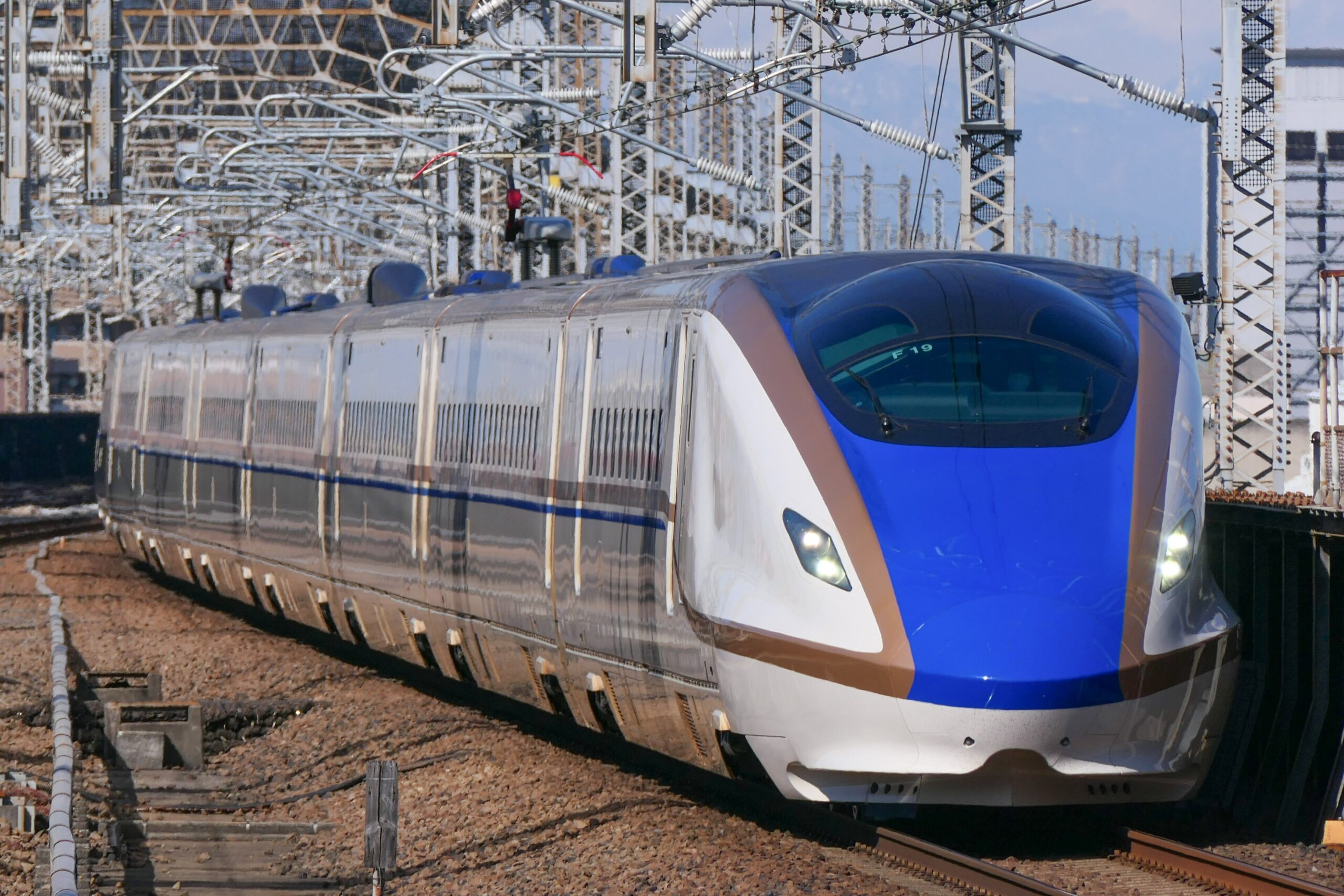
E7 Series trainset used on Hokuriku Shinkansen Kagayaki/Hakutaka and Joetsu Shinkansen Toki/Tanigawa services. Tokudane Special 28 covers Tokyo–Kanazawa through-fares, whereas JRE POINT Awards and JR East shareholder coupons stop at Joetsumyoko. Photo: MaedaAkihiko / CC BY-SA 4.0 (Wikimedia Commons)
Exact Fare Comparison from Tokyo: Standard e-Ticket vs. Tokudane Special 28 vs. JRE POINT Awards
To see how much each option saves in practice, we compare exact one-way fares from Tokyo across major corridors. The baseline is the post-March 14, 2026 regular-season Shinkansen e-Ticket fare for one adult in an Ordinary Car reserved seat. First, here are the 12 primary routes offered under weekday-only Shinkansen e-Ticket (Tokudane Special 28).
Tsubasa: Tokyo ⇔ Yamagata11,470 JPY5,720 JPY5,750 JPY
Yamabiko: Tokyo ⇔ Sendai11,110 JPY5,550 JPY5,560 JPY (RT 11,120 JPY)
Toki: Tokyo ⇔ Niigata10,780 JPY5,390 JPY5,390 JPY (RT 10,780 JPY)
Nasuno: Tokyo ⇔ Koriyama8,250 JPY4,120 JPY4,130 JPY
Asama: Tokyo ⇔ Nagano8,250 JPY4,120 JPY4,130 JPY (RT 8,260 JPY)
Tanigawa: Tokyo ⇔ Echigo-Yuzawa6,700 JPY3,350 JPY3,350 JPY
Booking Tokudane Special 28 both ways between Tokyo and Shin-Hakodate-Hokuto drops the round-trip cost from 48,000 JPY to 23,980 JPY, saving 24,020 JPY. On the Tokyo–Akita route, a round trip drops from 36,520 JPY to 18,240 JPY (saving 18,280 JPY). If you align a 2-day winter Kakunodate and Nyuto Onsen itinerary with the December weekday window (December 7–17, 2026), that 18,280 JPY rail saving nearly covers a night at a hot-spring ryokan. Note, however, that on Tokyo–Sendai and Tokyo–Morioka, Tokudane Special 28 from Tokyo is set on Yamabiko trains (5,550 JPY to Sendai; 7,360 JPY to Morioka) rather than Hayabusa services. Hayabusa Special 28 fares from Tokyo/Ueno/Omiya apply only to stations from Iwate-Numakunai north to Shin-Aomori and Shin-Hakodate-Hokuto.
When you cannot commit 28 days in advance or prefer the faster Hayabusa on Tokyo–Sendai, Shinkansen e-Ticket (JRE POINT Award) becomes the primary tool. Since March 14, 2026, award rates follow distance tiers in 500-point increments, and JR East runs three 35% off campaigns in fiscal 2026 (June, September, and January 2027). The table below compares regular-season cash fares with 35% off campaign award rates across six corridors.
Section (One-Way)Standard e-Ticket (Ordinary)35% Off Ordinary Car Award35% Off Green Car / GranClass
Tokyo ⇔ Kumagaya3,640 JPY1,900 pt2,600 pt / 4,500 pt
Tokyo ⇔ Karuizawa5,930 JPY2,900 pt4,200 pt / 6,100 pt
Tokyo ⇔ Shinjo13,130 JPY7,000 pt10,000 pt / 12,000 pt
Tokyo ⇔ Shin-Aomori (Hayabusa)17,910 JPY9,000 pt13,000 pt / 15,000 pt
Before March 14, 2026, both Tokyo–Nagano and Tokyo–Sendai required 7,940 points. Under the revised distance tiers, Tokyo–Nagano dropped to 7,000 points while Tokyo–Sendai rose to 9,500 points. Redeeming 9,500 points for a regular 11,430 JPY Tokyo–Sendai Hayabusa seat yields about 1.20 JPY per point, whereas the 6,000-point campaign rate (next window: January 18–31, 2027 departures, booking from December 18, 2026) yields roughly 1.90 JPY per point. Unlike Tokudane Special 28, JRE POINT Awards cover weekends, include Hayabusa trains on Tokyo–Sendai, and remain bookable up to 4 minutes before departure.
For weekend long-distance trips outside point campaign windows, JR East Shareholder Discount Coupons or JRE BANK Discount Coupons take 40% off a one-way Shinkansen e-Ticket. On Tokyo–Shin-Aomori (17,910 JPY regular), a 40% coupon brings the one-way fare to around 10,740 JPY (saving 7,170 JPY); on Tokyo–Akita (18,260 JPY regular), it drops to around 10,950 JPY (saving 7,310 JPY), beating the old 30% Tokudane 14 rate. If your trip includes hotel nights, check our total cost comparison of rail-and-hotel package tours versus independent booking, or compare non-rail options in our overnight highway bus versus early-morning LCC cost breakdown.
3 Common Ticketing & Fare Gate Pitfalls on Ekinet
City-Zone Rules (Tokyo Ward Area, Sendai City Area) Do Not Apply to Shinkansen e-Tickets
Paper tickets for trips of 201 km or more include free local JR travel within designated city zones such as the Tokyo Ward Area or Sendai City Area. Shinkansen e-Tickets—whether Standard, Tokudane Special 28, JRE POINT Award, or Shareholder Coupon—apply strictly between Shinkansen stations. Riding the Chuo Line from Shinjuku to Tokyo Station to board the Tohoku Shinkansen triggers a separate IC fare for Shinjuku–Tokyo.
If you choose a Standard Shinkansen e-Ticket solely for its 200 JPY discount but transfer to local JR lines at both ends of your journey, the extra IC fares exceed 200 JPY and make the e-Ticket more expensive than a paper ticket. Travelers reaching Tokyo, Ueno, or Omiya on foot or by subway keep the full 200 JPY saving, but travelers connecting from suburban JR stations should add both local segments before booking.
Hokuriku Shinkansen West of Joetsumyoko (Toyama, Kanazawa, Tsuruga) Is Excluded from JRE POINT & JR East Coupons
The Hokuriku Shinkansen is operated by JR East between Tokyo and Joetsumyoko and by JR West between Joetsumyoko and Tsuruga. Shinkansen e-Ticket (Tokudane Special 28) spans both operators, allowing you to book Tokyo–Kanazawa for 7,200 JPY one way (regular 14,400 JPY).
By contrast, Shinkansen e-Ticket (JRE POINT Award) and JR East Shareholder / JRE BANK Coupons are valid only within JR East territory. They cannot be used through to Toyama, Kanazawa, Fukui, or Tsuruga; coverage ends at Joetsumyoko Station. For Hokuriku trips outside Tokudane Special 28 windows, rail-and-hotel packages are the main discount alternative.
Conventional Ticketless Limited Express Excludes Base Fare and Lost Its 100 JPY Discount on October 1
While a Shinkansen e-Ticket bundles both the base fare and the limited express surcharge, a Conventional Line Ticketless Limited Express ticket covers only the limited express surcharge. You must pay the base fare separately with an IC card or paper base ticket.
Furthermore, the year-round 100 JPY adult / 50 JPY child ticketless discount and Tokuwari on Azusa, Kaiji, Hitachi, Tokiwa, and Odoriko services ended on September 30, 2026, returning to standard seasonal reserved-seat surcharges from October 1, 2026. Meanwhile, from November 1, 2026 departures, Ticketless Limited Express expands to the Inaho (Niigata–Akita, with 25% off Tokuwari at 780–1,880 JPY regular) and Shirayuki (960–2,040 JPY regular), while Tsugaru / Super Tsugaru Tokuwari discounts were reduced from 35% to 25% on October 1, 2026 (1,480 JPY to 1,710 JPY on Akita–Shin-Aomori/Aomori; 1,220 JPY to 1,410 JPY on Akita–Odate/Hirosaki; 960 JPY to 1,110 JPY on Odate–Shin-Aomori/Aomori).
Step-by-Step Booking, IC Card Linking, Change, and Refund Procedures
StepCutoffs & Fee Rules
STEP 1Advance Application (1 Month + 7 Days Out)Ekinet Advance Application opens at 14 :00 one week before the 1-month sale date and closes at 9 :54 one month before departure. Because Tokudane Special 28 seats are limited, submitting an advance request is recommended, though seats are allocated sequentially at 10:00 and may sell out.
STEP 2General Sales & Booking DeadlinesGeneral sales open at 10 :00 one month before departure. Tokudane Special 28 closes at 23 :50 exactly 28 days before departure—leaving only a 4-day booking window. Standard e-Tickets and JRE POINT Awards remain open until 4 minutes before departure (by 23:24; JRE POINT system offline 00:50–05:00).
STEP 3Link Suica / IC Card & Tap Through GatesAfter booking, link each passenger’s Suica or compatible IC card number in your Ekinet account before boarding. Do not print a paper ticket; tap the linked IC card directly at the Shinkansen automated fare gate.
STEP 4Changes & Refunds (320 JPY per Seat)Tokudane Special 28 can be changed only while its booking window is still open (up to 23:50, 28 days prior); no changes are permitted from 27 days prior onward. Refunds before gate entry and prior to scheduled departure cost 320 JPY per seat on Ekinet.
The strictest cutoff is the 23:50 deadline 28 days before travel in Steps 2 and 4. Because Tokudane Special 28 goes on sale one month out at 10:00 and closes 28 days out at 23:50, you have only a four-day window to book or modify your train. Once you are within 27 days of departure, train times cannot be changed, and missing your booked train voids both the base fare and limited express portions—you cannot board a later non-reserved car. When your schedule may shift, booking a Standard e-Ticket or JRE POINT Award avoids full ticket forfeiture. When pairing rail bookings with hotels, check our hotel booking sites recurring coupon calendar to align cancellation windows with your rail cutoff.
If I miss a Tokudane Special 28 train, can I ride a later non-reserved car?
No. Tokudane Special 28 is valid strictly on the booked train and seat. If you miss the train, both the base fare and limited express portions become invalid, and you cannot board a later non-reserved car or standing space. You must purchase a new full-fare base ticket and limited express ticket.
Are JR East Shareholder Coupons and Otona no Kyujitsu Club discounts still available on Ekinet?
Yes. Only the year-round Tokudane 1, Tokudane 14, and conventional line Tokuwari discounts ended in September 2026. Shinkansen e-Ticket discounts for JR East Shareholder Coupons, JRE BANK Coupons, and Otona no Kyujitsu Club (Middle and Zipangu) continue year-round from October 2026 onward.
Which is cheaper: Touch de Go! Shinkansen or a Standard Shinkansen e-Ticket?
On trains with non-reserved cars, Touch de Go! Shinkansen (charged at the standard non-reserved fare) is cheaper than a reserved seat. However, all-reserved trains such as Hayabusa, Komachi, Tsubasa, and Kagayaki do not offer standard non-reserved seating. For a guaranteed reserved seat, the Standard Shinkansen e-Ticket (200 JPY off paper reserved fares) is the baseline choice.
Sources: Official JR East / Ekinet documents listed above / Verified 2026-11-05 / Body photo: MaedaAkihiko, CC BY-SA 4.0 (Wikimedia Commons) / Featured image: MaedaAkihiko, CC BY-SA 4.0 (Wikimedia Commons)